
Quick Answer: How To Jump Start A Mower?
Most gasoline riding mowers and lawn tractors use a 12-volt starter battery and can be jump-started when that battery is weak but the rest of the machine is sound. Use a 12-volt jump pack or another 12-volt donor. Connect positive to positive, put the last negative clamp on bare grounded metal away from the battery, start the mower, then disconnect…

Pros
- Large-size design named in product title
- Sharpening and balancing functions listed
- Listed as a new upgraded version

Pros
- Adjustable 15-to-45-degree range in title
- Sharpening and balancing functions listed

Pros
- Sharpener and balancer functions in title
- 15-to-45-degree adjustable setting listed
- Built for lawn mower blade maintenance
Pros
- Includes replacement gaskets and a 98079-55846 spark plug
- Matches Honda HRR216 and HRS216 lawn mower models
- Designed around the 16100-Z8B-901 carburetor specification
Cons
- Restricted to select Honda GCV160 mower applications
- Installation requires basic mechanical tools and skills
Can You Jump-Start a Lawn Mower?
A typical gasoline riding lawn mower or lawn tractor starts with a small 12-volt battery. That battery is not identical to a car battery, but it serves the same job: it feeds the starter motor long enough for the engine to fire. If the battery is discharged and the starter, engine, and safety circuits can still work, another 12-volt source can supply temporary cranking current.
This procedure is for gas riding equipment with a user-accessible 12-volt starter battery. It is not a universal fix for every mower-shaped machine. For broader ecosystem context, read through our operational guide on jbl partybox club 120 vs sony srs xv500.
Walk-behind mowers are often pull-start. Some electric-start walk-behinds use a much smaller battery or a different electrical layout. Do not treat them as if they take a vehicle-style jump from a car or truck. Corded and battery-electric mowers do not have a gasoline starter battery to jump this way. If you are not sure whether your machine has a 12-volt starting battery with marked terminals, check the operator’s manual or stop and have the machine identified before you attach cables. For broader ecosystem context, read through our operational guide on jbl partybox club 120 vs sony srs xv500.
Battery location and terminal style vary. Some batteries sit under the seat or a hood with clear positive and negative posts. Others are covered, recessed, or hard to reach. A factory jump post, if the machine has one, is safer than forcing a clamp onto a hidden terminal. If you cannot get a secure bite on a marked terminal without guessing polarity, do not improvise. For troubleshooting and reliability insights, consult our in-depth z890 vs x870e motherboard report.
A jump start only supplies cranking current for a short time. It does not repair stale fuel, a clogged fuel path, no spark, a failed starter solenoid, a broken charging system, or a safety interlock that is holding the starter out of the circuit. It also cannot make a cracked, leaking, frozen, or badly swollen battery safe to use.
Make Sure a Weak Battery Is Actually the Problem
Jumping a mower that will not start for another reason wastes time and adds electrical risk. Sort the symptoms before any clamp goes on. For troubleshooting and reliability insights, consult our in-depth z890 vs x870e motherboard report.
These signs often point to a discharged 12-volt battery or poor connections at the battery terminals:
- Dash lights, an hour meter, or indicator lamps are dim or dead when you turn the key.
- You hear a single click from the starter solenoid and the engine does not turn.
- The starter turns very slowly or not at all.
- Lights change when you wiggle a cable or terminal, which can mean a loose or corroded connection rather than a totally dead cell.
These signs usually mean jumping will not help: Readers comparing setup options can review our technical analysis on marshall stanmore iii vs harman kardon onyx studio 8.
- The engine cranks strongly but never fires. That pattern is more often fuel, spark, or air than a weak battery.
- The key is completely silent—no click and no lights—after you have confirmed the battery cables are tight. That can be an open safety interlock, a failed switch, or another open circuit.
- You smell a strong fuel odor, hear backfire, or see obvious mechanical damage. Stop and investigate those problems instead of adding a donor battery.
Do a short safety and setup check first. Park on level ground and set the parking brake. Confirm the PTO and blades are off. Put the transmission in the start position marked on the machine, which is often park or neutral. Sit in the seat if the mower uses a seat switch. Turn the fuel valve on if the machine has one, and confirm there is fuel in the tank. Keep the key under your control. Look at the battery terminals for obvious looseness, heavy corrosion, or a broken cable before you bring a donor near the machine.
Seat, brake, neutral, and blade or PTO interlocks can prevent cranking even when the battery is healthy. That is intentional. Do not bypass, jumper, or remove a safety interlock to force a start. If the machine is out of the start position or the operator-presence circuit is open, correct that condition instead of treating it as a dead battery. For complementary field maintenance guidelines, examine our breakdown of dyson v8 cyclone vs bissell featherweight stick.
What You Need and Safety Checks First
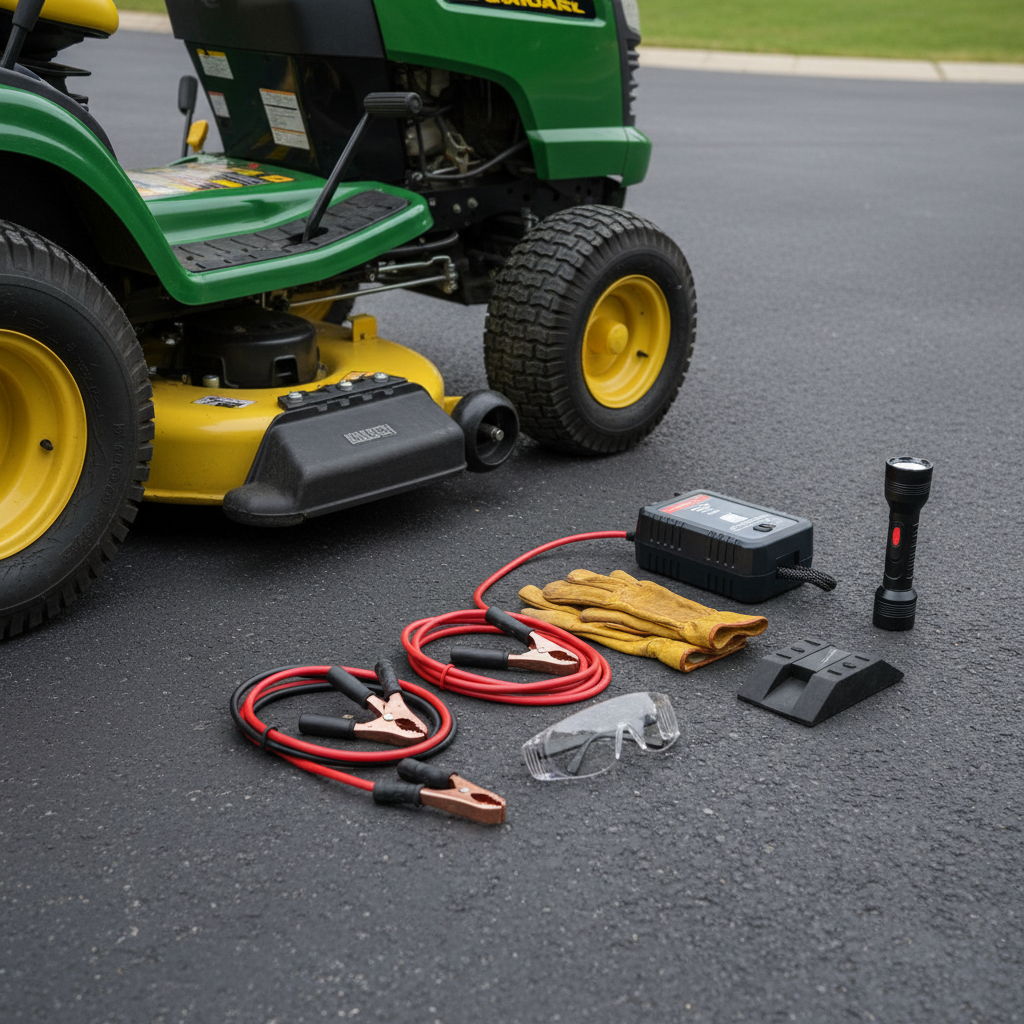
You do not need a shop full of tools. You do need the right voltage, a secure connection, and a work area that will not turn a spark into a fire or a roll-away.
Enough equipment for most jobs: To evaluate matched hardware tolerances, consult our detailed overview of bissell crosswave hydrosteam vs shark stainforce.
- Heavy-duty 12-volt automotive-style jumper cables, or a 12-volt jump starter pack intended for lead-acid starting batteries.
- Eye protection and gloves. Battery acid can burn skin and eyes. Metal jewelry can short a terminal.
- A flashlight if the battery sits in a dark compartment.
- Wheel chocks if the parking brake is weak or the ground is uneven.
A portable jump starter pack is often the simplest donor. You do not have to align two machines, idle a vehicle nearby, or route long cables past belts and blades. A second 12-volt mower or a 12-volt vehicle can work if you can park the machines close enough without touching, keep both in park or neutral with brakes set, and keep cables clear of hot, moving, or sharp parts. The donor must be another 12-volt system. Do not use a 24-volt source or a pack whose voltage you cannot confirm.
If you use a jump pack, follow that pack’s polarity marks and power-on sequence. Do not use a pack that is damaged, swollen, or not meant for 12-volt lead-acid starting batteries. Packs built for other chemistries or voltages are not interchangeable just because the clamps look similar.
Prepare the site and the mower before any connection:
- Work outdoors or in a very well-ventilated space. Engine exhaust is carbon monoxide. A charging or gassing battery can give off hydrogen gas, which can ignite if a spark occurs at the vents.
- Do not smoke, and keep open flame and grinding sparks away from the battery.
- Use level ground, set the parking brake, keep the PTO and blades off, and chock the wheels if needed.
- Keep children, pets, and bystanders away from the deck and the cable path.
- Do not lay metal tools across the battery terminals.
Stop instead of connecting if the battery is cracked, leaking, frozen, missing a cap on a flooded cell, or strongly swollen. Stop if you smell a sharp acid odor and see wet residue on the case. Stop if the cables or jump pack are damaged, or if you cannot tell positive from negative with certainty. Reverse polarity can damage electrical parts. A spark at the battery can ignite hydrogen. Battery acid needs to stay off skin and clothing; rinse any contact with plenty of water and seek medical care for eye exposure or a significant burn.
How to Connect the Cables and Start the Mower
Identify the positive terminal and the negative terminal before you pick up a clamp. The positive post is usually marked “+” and may have a red cover or red cable. The negative post is usually marked “−” and may have a black cable. Corrosion, paint, or a plastic cover can hide those marks. Wipe or brush only enough to read the mark, and do not let a metal tool bridge both posts. If the machine has a clean factory jump post, use that marked point instead of forcing a clamp onto a recessed terminal. If the posts are side-terminal, covered, or so awkward that the clamp will not bite cleanly, stop rather than risk a loose connection that arcs or slips onto the frame.
Use the widely taught vehicle-style order. Never let live clamps touch each other or painted bodywork.
- Connect the red clamp to the positive terminal on the dead mower.
- Connect the other red clamp to the positive terminal on the donor or jump pack.
- Connect the black clamp to the negative terminal on the donor. On many jump packs this step is built into the pack’s leads; still match the pack’s marked negative output.
- Connect the last black clamp to a clean, unpainted ground point on the mower frame—bare grounded metal away from the battery, fuel lines, carburetor, and moving parts. Do not put this last clamp on the dead battery if you can avoid it. A spark at the battery is the hazard you are trying to keep away from hydrogen gas.
Do not lean over the battery while you attach the last clamp. After the last connection is solid, keep cables away from belts, the deck, the steering, and hot exhaust.
Using a portable jump starter pack
Confirm the pack is rated for a 12-volt lead-acid starting battery and that its clamps or leads are clearly marked. Connect the pack to the mower using the same polarity order: positive first on the mower, then the pack’s positive, then the pack’s negative path, with the final ground on the mower frame if the pack instructions call for a separate ground. Power the pack on only after the connections are secure, unless the pack’s own sequence says otherwise. Leave the PTO off and the parking brake set. Turn the mower key to start in short attempts rather than holding the starter for a long grind. If the battery is deeply discharged, a brief rest with the pack already connected may help; there is no universal wait time that guarantees a start. If the pack warns, overheats, or the mower does not crank after a few attempts, stop and switch to charging or diagnosis.
Using a vehicle or another mower
Park the donor close enough for the cables to reach without stretching, but do not let the machines touch. Set both parking brakes. Keep both PTOs and blades off. Start the donor only after the cables are connected in the order above, and let it idle. Do not race either engine. Then try the dead mower in short cranks with the operator in the seat if required and the controls in the start position. If the mower begins to run, do not engage the blades while the cables are still attached.
When the mower idles on its own, disconnect in reverse order. Remove the last-on ground clamp first, then the donor negative, then the donor positive, then the mower positive. Keep the free clamps from touching anything metal until they are fully off and stowed. Shut the donor down after the cables are clear if you used a vehicle or a second mower.
After the Engine Starts
Leave the blades and PTO disengaged until the cables are off and you have a reason to cut. Remove the cables only after the engine holds a stable idle. A working charging system can put some charge back into the battery while the engine runs, but a jump session will not fully recharge a deeply discharged battery. Do not assume a set runtime will restore the battery.
After you disconnect, let the mower run in a ventilated area while you watch for a dying idle, warning lights, or a smell of hot wiring. Then shut it down and try a restart from its own 12-volt battery. If it restarts and the terminals are clean and tight, plan a proper charge with a charger or maintainer suited to the battery type listed in the machine’s manual. If it dies as soon as the donor comes off, or it will not restart later the same day, the problem is not solved. A weak battery, a loose ground, a slipping or missing belt on some charging setups, or a charging-system fault can all mimic a one-time dead battery.
Check the terminals again after the job. A successful jump can hide a cable that is only making contact while the clamp is pulling on it. Tighten hardware that is meant to be serviceable, and clean off corrosion so the next start does not depend on another donor.
When to Stop and Charge or Replace the Battery Instead
Jumping is a temporary way to get cranking current. It is the wrong next step when the battery itself is unsafe or when the machine only lives while a donor is attached.
Do not jump a battery that is leaking, cracked, frozen, missing a vent cap on a flooded cell, or badly deformed. Those conditions raise the chance of acid spray, internal shorting, or a hydrogen ignition. Move people away, avoid sparks, and treat replacement and proper disposal as the path forward rather than another set of cables. Follow the battery label and local rules for handling a damaged unit.
A charger or a replacement is the better step when:
- The mower needs a jump every time you use it.
- The battery will not accept or hold a charge after a slow charge.
- The engine runs only while the jump pack or donor stays connected.
- The case is old enough, sulfated-looking, or heat-damaged that you already distrust it, even if you do not know its exact age.
An immediate re-death after a successful start usually means the battery cannot hold charge, the charging system is not replenishing it, or a connection is opening under vibration. More jumps will not repair those faults. A storage maintainer or a slow charge can help a sound battery that sat unused, but it will not revive a battery that has a dead cell or a machine that is not charging. Have the charging system and cables inspected if a new or freshly charged battery still goes flat after normal use. Do not treat jumping as routine maintenance.
If It Still Will Not Start After a Jump
If the cables are on, polarity is correct, and the engine still will not crank or fire, stop looping on the same clamps. Recheck the operator-presence and start conditions. Many riding mowers and lawn tractors will not crank unless the operator is in the seat, the parking brake or clutch and neutral path is in the start position, and the PTO is off. A seat switch, brake switch, or blade interlock that is out of adjustment or failed open will look exactly like a dead battery if you only listen for silence at the key.
If the starter now cranks with good speed but the engine does not start, shift attention away from the jump. Empty or stale fuel, a closed fuel valve, a clogged air or fuel path, a fouled or disconnected spark plug lead, or a flooded engine can all prevent firing after a perfectly good jump. Corroded battery terminals and a loose ground can also drop voltage again as soon as you try to crank, even with a donor attached. A failed starter or starter solenoid may click, stay silent, or spin without turning the engine; those are inspection jobs, not cable jobs.
Stay general and conservative. Do not jumper across safety switches. Do not keep grinding the starter until it smells hot. If you have confirmed fuel is present, the interlocks are satisfied, the terminals are clean, and a known-good 12-volt donor still produces no crank—or a strong crank with no fire after basic fuel and spark checks—it is time to stop DIY guessing. A technician can test the starter, solenoid, and wiring without defeating the circuits that keep the blades and machine from moving unexpectedly.
How to Avoid Another Dead Mower Battery
Most dead mower batteries are not a mystery. They sit for weeks, lose charge, and then get asked to crank a cold engine. Keep the terminals clean and tight so the charging system and the starter see the battery they think they are connected to. Run the machine periodically during the season so the charging system can work. Store it with a charged battery, and consider a maintainer during a long idle period if the battery type and the maintainer are compatible. Follow the charger or maintainer label; the goal is to hold a sound battery, not to boil it.
Parasitic drains, corroded cables, a weak charging system, and a battery that was already near the end of its useful life can flatten even a machine you used last weekend. If you need a jump more than once, treat that as a diagnosis reminder rather than a new normal. A polarity-safe jump can get you off the lawn today. Clean connections, a battery that holds charge, and a charging system that actually replenishes it are what keep you from doing this again the next time you turn the key.
For more detailed testing breakdowns and top recommendations, check our in-depth guide to residential zero-turn lawn mower guide.
For more hands-on benchmarks and buying recommendations, consult our guides on heavy-duty chainsaw buyer guide, as well as high-CFM commercial leaf blower guide, as well as automated robotic lawn mower guide.
Mechanical safety standards, operational tolerances, and protective gear guidelines align with benchmark specifications established by the American National Standards Institute (ANSI).