

Quick Answer: How To Remove Tire From Lawn Mower?
To remove a lawn mower tire, secure the mower on a level surface, locate the fasteners (bolts, nuts, or clips) holding the wheel, use the appropriate tools to remove them, and separate the wheel assembly from the axle. The specific process varies between push mowers and riding mowers, and between bolt-on and clip-on wheel systems. This guide walks you through…

Pros
- Broad compatibility covering rim sizes from 4 to 16.5 inches
- Integrated manual bead breaker separates beads without shop air
- Reinforced rectangular steel base enhances operational stability
- Adjustable locking collar secures wheels during service
Cons
- Heavy 66-pound unit is cumbersome to transport or store
- Full manual operation requires significant physical effort

Pros
- Screw-driven foot unseats beads without needing heavy shop presses
- Works on equipment wheels while still mounted when clearance allows
- Compatible with standard hand wrenches and air ratchets
- Includes a pair of work gloves for added convenience
Cons
- Cannot be used with impact wrenches
- Only breaks beads; demounting spoons are required to remove tires

Pros
- Complete 3-piece set includes a bead breaker and two tire spoons
- Durable carbon steel build withstands tough mechanical stress
- Rounded spoon tips help safeguard rims against scratching
- Versatile fit for motorcycles, lawn mowers, and utility equipment
Cons
- Manual lever design requires significant user strength for stiff beads
Gather Tools and Secure the Mower
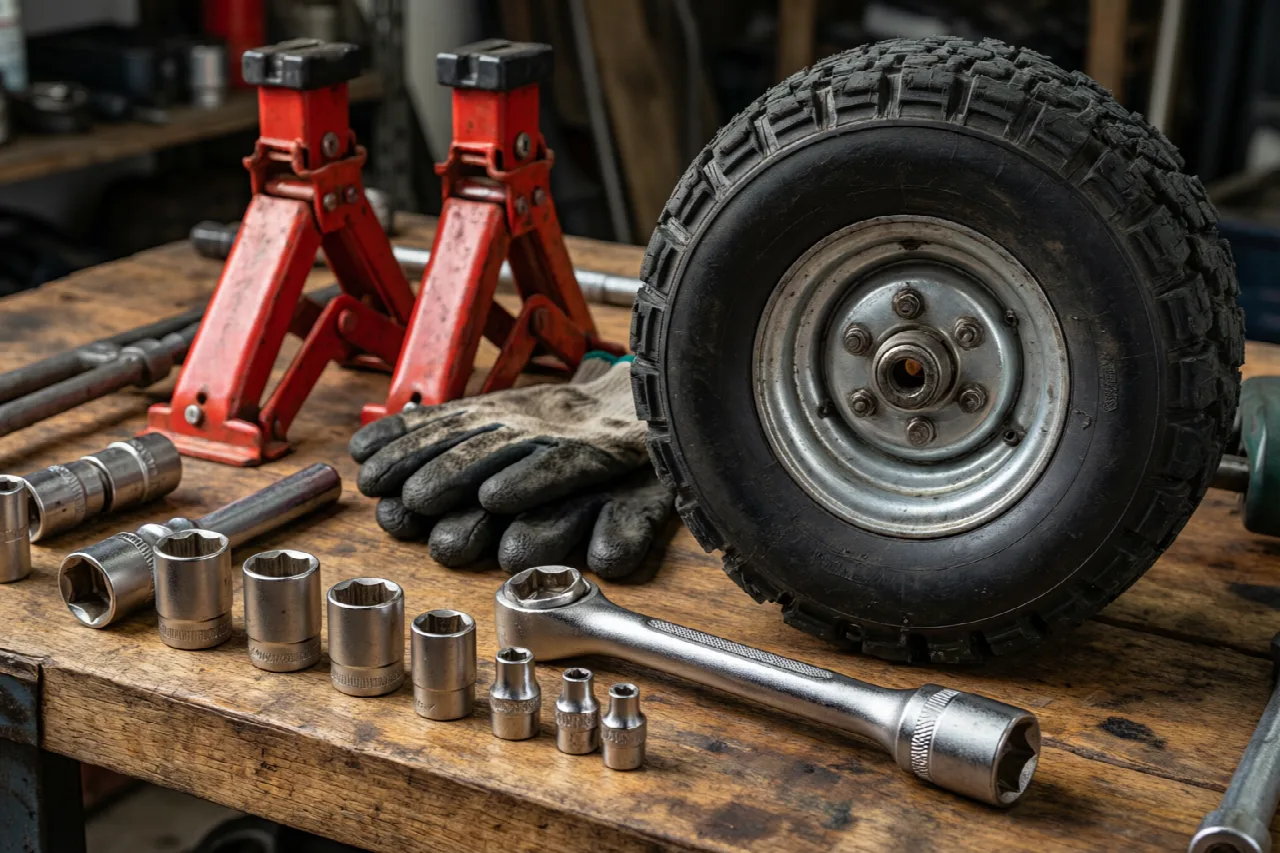
Before you begin any lawn mower tire removal, you need to set up a safe and stable work area. Start by moving the mower to a flat, level surface, such as a concrete driveway or a garage floor. This prevents the mower from rolling or shifting while you work, which is especially important for heavier riding mowers.
You will also want to gather the right tools ahead of time. For most push mowers, a socket wrench or a standard wrench is sufficient to remove the axle bolt or nut. For riding mowers, you may need a larger socket set, a jack or jack stands to lift the machine, and possibly a pry bar or rubber mallet to help free a stuck wheel. A pair of work gloves and safety glasses are recommended to protect your hands and eyes from dirt, grease, and debris.
If you are working on a riding mower, engage the parking brake and turn off the engine before you begin. For a push mower, disconnect the spark plug wire to ensure the engine cannot accidentally start while you are handling the wheel. Taking these precautions reduces the risk of injury and makes the process much smoother.
Identify the Wheel Fastening System
Once the mower is secure, the next step is to determine how the wheel is attached to the axle. Lawn mowers generally use one of two systems: bolt-on wheels or clip-on wheels. Knowing which type you have determines the correct removal technique.
Bolt-on wheels are the most common on modern push mowers and many riding mowers. In this system, a single bolt or nut holds the wheel hub to the axle. You can usually see the bolt head on the outside of the wheel or the nut on the inside. This type of fastener requires a wrench or socket to loosen and remove.
Clip-on wheels use a spring-loaded clip or a retaining ring that snaps over the axle. These are often found on older or budget-friendly push mowers. To remove a clip-on wheel, you typically need to compress the clip with pliers or use a flathead screwdriver to pry it loose. Some models use a cotter pin or a hairpin clip that must be pulled out before the wheel can slide off the axle.
Take a moment to inspect the wheel hub and axle area carefully. Look for any visible fasteners, plastic caps, or dust covers that might be hiding a bolt or clip. Some mowers have a decorative hubcap that snaps off to reveal the fastener underneath. Identifying the system correctly saves time and prevents damage to the wheel or axle.
Remove Fasteners
With the fastening system identified, you can now remove the fasteners that hold the wheel in place. For bolt-on wheels, use the correct size socket or wrench and turn the bolt counterclockwise to loosen it. If the bolt is tight, apply steady pressure rather than jerking the tool, as this can strip the threads. A penetrating oil, such as WD-40, can help loosen rusted or corroded fasteners if you let it sit for a few minutes first.
For clip-on wheels, compress the clip with pliers or insert a flathead screwdriver under the clip and pry it away from the axle. Work slowly and carefully so the clip does not fly off and get lost. Once the clip is released, you can pull the wheel straight off the axle. If the wheel is stuck due to rust or debris, gently tap the tire with a rubber mallet to break it free. For broader ecosystem context, read through our operational guide on marshall stanmore iii vs harman kardon onyx studio 8.
When removing multiple fasteners, such as on a riding mower with a multi-bolt hub, loosen each bolt a little at a time in a crisscross pattern. This prevents uneven pressure that could warp the hub or make removal difficult. Once all fasteners are loose, remove them completely and set them aside in a safe place so you do not lose them.
Separate the Wheel and Tire Assembly
After the fasteners are removed, you can separate the wheel assembly from the axle. Grasp the tire at the top and bottom and pull it straight toward you, away from the axle. If the wheel does not come off easily, rock it gently from side to side while pulling. This helps break any corrosion or debris bond between the hub and the axle. For troubleshooting and reliability insights, consult our in-depth dyson v8 cyclone vs bissell featherweight stick report.
For riding mowers, you may need to lift the mower with a jack to remove the wheel. Place jack stands under the frame for safety before working under the machine. Never rely on a jack alone to support the weight of the mower while you are removing a wheel.
It is important to understand the difference between removing the wheel assembly and removing the tire from the wheel itself. Removing the wheel assembly from the mower is the process described above and is usually all that is needed for most maintenance tasks, such as replacing a flat tire or accessing the axle. Removing the tire from the wheel rim is a more involved process that requires a tire iron or a tire-changing machine, and it is typically done when the tire itself is damaged or needs to be replaced. Readers comparing setup options can review our technical analysis on bissell crosswave hydrosteam vs shark stainforce.
If your goal is simply to replace the entire wheel and tire as a unit, you can stop once the wheel assembly is off the axle. If you need to remove the tire from the rim, you will need to deflate the tire completely, break the bead loose from the rim, and use tire irons to pry the tire over the rim edge. This process requires significant force and care to avoid damaging the rim.
Buyer FAQs: How To Remove A Tire From A Lawn Mower Solved
What tools do I need to remove a lawn mower tire?
The tools you need depend on the fastening system. Most push mowers require a socket wrench or standard wrench for the axle bolt. Riding mowers may need a larger socket set, a jack, and possibly a pry bar or rubber mallet. Pliers and a flathead screwdriver are useful for clip-on wheels.
How do I know if my wheel is bolt-on or clip-on?
Inspect the wheel hub and axle area. If you see a visible bolt head or nut, it is a bolt-on wheel. If you see a spring clip, retaining ring, or cotter pin, it is a clip-on wheel. Some wheels have a hubcap that must be removed to reveal the fastener.
Can I remove a lawn mower tire without a jack?
For push mowers, a jack is usually not needed because the mower is light enough to tip or lift. For riding mowers, a jack is recommended to safely lift the machine and access the wheel. Always use jack stands for support when working under a riding mower.
Why is my wheel stuck on the axle?
Wheels can become stuck due to rust, corrosion, or debris between the hub and the axle. Applying a penetrating oil and letting it sit can help. You can also gently tap the tire with a rubber mallet to break the bond. Avoid using excessive force, as this can damage the axle or wheel.
Do I need to remove the tire from the rim to fix a flat?
Not necessarily. If the tire has a small puncture, you may be able to patch it while it is still on the rim. However, if the tire is severely damaged or the bead is broken, you will need to remove the tire from the rim to replace it. This requires tire irons and more effort.
Removing a lawn mower tire is a straightforward task once you understand the fastening system and have the right tools. By securing the mower properly, identifying the attachment method, and working carefully, you can complete the job safely and get your mower back in working order.
Technical Standards and Compliance
Mechanical safety standards, operational tolerances, and protective gear guidelines align with benchmark specifications established by the American National Standards Institute (ANSI).









