Quick Answer: How to Replace a Mower Pull Cord
To replace a mower pull cord: (1) Unbolt the recoil starter housing from the engine shroud. (2) Remove remnant rope and rotate the pulley 4 to 5 turns clockwise to preload the spring. (3) Thread #4 or #4.5 nylon rope through the eyelet, tie a secure figure-eight knot, and allow slow recoil.
To replace a pull cord on a lawn mower, remove the recoil starter housing (usually on top of the engine), disconnect the old rope from the pulley, and thread a new starter rope through the system while maintaining spring tension. Most push mower pull cord replacements take 30 to 60 minutes and require only a screwdriver, pliers, and a replacement rope kit (typically $10-$25). The exact process varies slightly depending on whether you’re replacing just the rope or the entire starter assembly, and by mower type.

Pros
- Stated 1,600-pound capacity and 22 cubic feet
- Hand-pull or foot-pedal dumping options
- 16x8-inch pneumatic tires listed for grass, mud, and gravel
- Reinforced hitch and side rails per the listing
- Removable rear panel
Cons
- Heavy at about 118 pounds before loading
- Requires a hitch that accepts a 0.47-inch pin

Pros
- Manufacturer-rated 600 lb capacity and 17 cu. ft. storage
- Hand-pull and foot-pedal dumping options
- Three-sided guardrails to help contain loads
- 16-inch pneumatic tires for uneven ground
- Listed 0.47-inch (12mm) pin for hitch connection
Cons
- Listed weight of about 99 lb adds to towing load
- Capacity and build claims are manufacturer-stated, not verified

Pros
- 500-pound capacity and 10 cubic feet listed
- Hand-pull and foot-pedal dumping options
- 16-inch pneumatic tires listed for uneven ground
- 0.47-inch pin listed for various tractors and ATVs
Cons
- Listed weight is 59.92 pounds before loading
- No customer reviews are provided to confirm real-world durability
Understanding Your Mower’s Pull Cord System
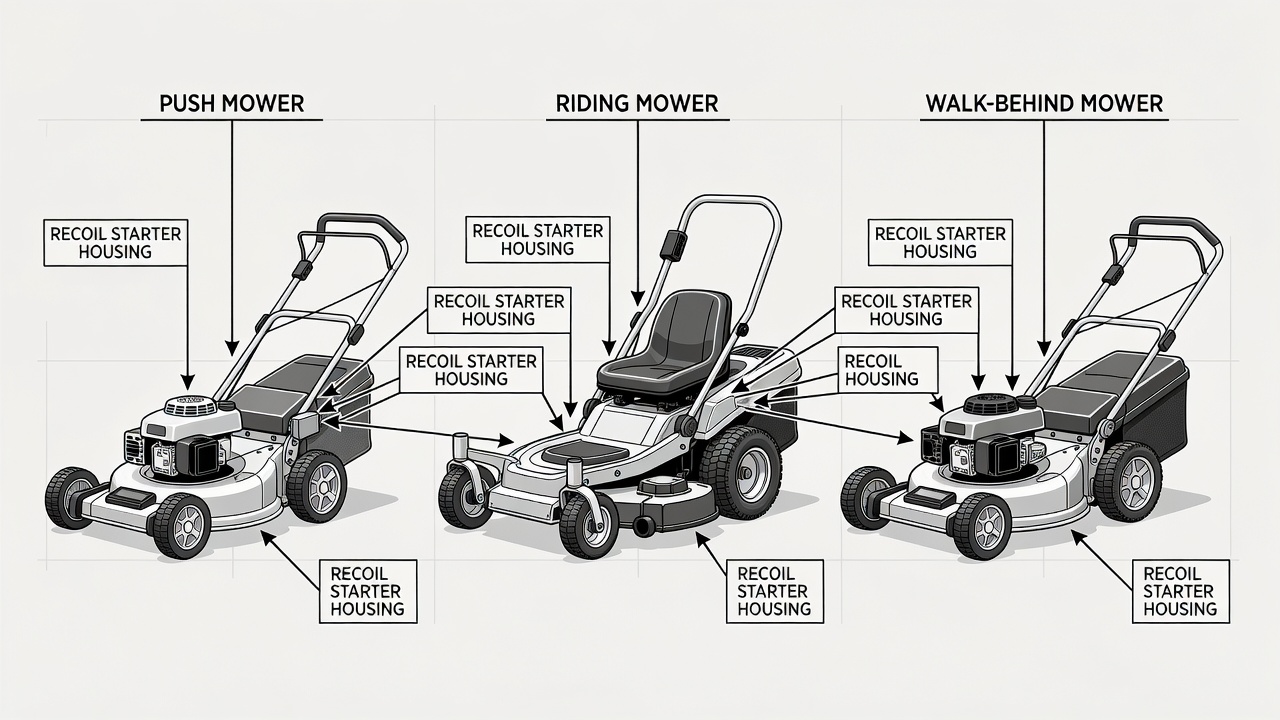
Before starting any repair, you need to understand the basic components of your mower’s recoil starter system. The pull cord is part of a larger mechanism designed to spin the engine’s crankshaft quickly enough to achieve ignition. Knowing your mower type and identifying where the starter is located will save you time and prevent mistakes.
Mower Types and Starter Locations
- Push mowers (gas): The recoil starter housing is typically mounted on top of the engine, usually on the side closest to where you hold the handle. It’s the black or gray plastic box with the pull cord emerging from it.
- Riding mowers: Starter systems vary; some have a pull cord similar to push mowers, while others use an electric starter. Check your owner’s manual if you’re unsure.
- Walk-behind mowers: Similar to push mowers, the starter is usually on the engine block’s upper surface.
If you can’t locate it, check your mower’s owner’s manual or search for the engine model number online (often printed on the engine block itself).
Rope vs. Entire Starter Assembly: What Needs Replacement?
You may only need to replace the rope if:
- The rope is frayed, torn, or broken
- The rope has lost its grip or feels slippery
- The recoil mechanism returns smoothly when pulled
You’ll need to replace the entire recoil starter assembly if:
- The housing is cracked or damaged
- The internal spring is broken or detached
- The pulley is damaged or won’t turn freely
- The pull cord won’t retract after you pull it
Tools and Materials You’ll Need
Gather these items before you begin work:
| Category | Item | Notes |
|---|---|---|
| Tools | Screwdrivers (Phillips and flathead) | Sizes will vary by mower; bring both common sizes |
| Tools | Pliers or locking pliers | Useful for holding spring tension and removing clips |
| Tools | Socket wrench set | Only needed if your starter is bolted on; many are screwed |
| Materials | Replacement starter rope (3.5 to 4.5 mm diameter) | Most push mowers use 4 mm rope; check your manual or bring the old rope to the store |
| Materials | Replacement recoil starter assembly (optional) | Only if the housing or spring is damaged; $30-$80 depending on brand |
| Safety | Work gloves and eye protection | Recoil springs can be under tension and snap suddenly |
Where to buy: Replacement rope kits and recoil starters are available at hardware stores, online retailers like Amazon, or directly from the mower manufacturer’s parts site. Bring your mower’s model number to ensure you get the right fit.
Safety Precautions Before Starting
Working on a mower engine requires care to avoid injury. Follow these steps before you open the starter housing:
- Disconnect the spark plug wires: This prevents accidental engine startup if someone pulls the cord or if the engine is jarred during work.
- Allow the engine to cool: Wait at least 30 minutes after last use; the engine and housing can be hot to the touch.
- Work on a stable, flat surface: Place the mower on a level workbench or concrete floor; do not work with the mower on grass or an unstable surface.
- Wear eye protection and gloves: Recoil springs are under significant tension and can snap or release suddenly if mishandled.
- Read the owner’s manual: Your specific mower may have unique steps or torque specifications you need to follow.
- Take a photo before disassembly: Photograph the starter housing and internal components before you remove anything; this reference will help during reassembly.
How to Replace Just the Rope (Simplest Method)
If only the rope is damaged and the starter mechanism works smoothly, follow these steps to replace the rope alone. This is the most common repair and usually the quickest. Before finalizing equipment decisions, refer to our comprehensive marshall stanmore iii vs harman kardon onyx studio 8 comparison.
Step 1: Remove the Recoil Starter Housing
- Locate the bolts or screws holding the starter housing to the engine block. Most push mowers use 2 to 4 screws.
- Using the appropriate screwdriver or socket, remove all fasteners and set them in a safe place (a small container or magnetic tray prevents loss).
- Gently lift the housing away from the engine. Be careful; the pulley and rope are often still attached inside.
- Place the housing on a clean work surface with the pulley facing upward so you can see how the rope is threaded.
Step 2: Remove the Old Rope
- Locate where the rope is knotted inside the housing. Most designs have the rope tied to a knot holder or loop inside the pulley.
- Carefully cut or untie the knot securing the rope to the pulley. If it’s melted or impossible to untie, you may need to cut the rope with scissors or a utility knife.
- Pull the entire length of old rope out of the housing, noting the direction it wound around the pulley.
- If the rope doesn’t pull freely, the spring may be stuck or the pulley may be misaligned; gently wiggle and work it out without forcing.
Step 3: Thread and Wind the New Rope
- Cut your new starter rope to approximately 12 to 15 feet in length (the exact length depends on your mower; if unsure, match the old rope or consult the manual).
- Melt or seal the cut ends of the new rope with a lighter or match to prevent fraying. Let the plastic cool for a few seconds; do not touch immediately.
- Thread one end of the new rope through the hole in the pulley (the same hole the old rope used). Some pulleys have a dedicated hole; others thread through the pulley rim.
- Tie a secure knot on the inside of the housing to anchor the rope. A simple overhand knot works, but make sure it’s tight; pull hard to test it.
- Slowly pull the rope handle through the housing outlet to wind the rope evenly around the pulley. Keep tension on the rope as you pull to ensure it winds neatly.
- Pull until approximately 6 to 8 inches of rope is outside the housing handle area. This will become your pull handle.
Step 4: Reattach the Housing and Test
- Carefully align the recoil starter housing over the engine mounting points.
- Reinstall all bolts and screws, tightening them snugly but not over-tightening (over-tightening can crack plastic housing).
- Reconnect the spark plug wires.
- Hold the mower firmly and give the new pull cord a firm pull to test. The cord should extend fully and retract smoothly. Do not force it; if resistance is high, the rope may not be wound correctly.
- Pull 3 to 5 times to verify smooth operation before starting the engine.
How to Replace the Entire Recoil Starter Assembly
If the housing is cracked, the spring is broken, or the pulley won’t turn, you’ll need to replace the entire assembly rather than just the rope. This process is slightly more involved but still manageable for a DIY repair.
When Full Replacement Is Necessary
Signs you need a complete replacement include: For broader ecosystem context, read through our operational guide on dyson v8 cyclone vs bissell featherweight stick.
- Visible cracks in the plastic housing
- The pull cord won’t retract or retracts very slowly
- The pulley is visibly damaged or wobbles
- The recoil spring is loose inside or makes a rattling sound
- Previous rope replacement didn’t solve the problem
Step 1: Remove the Old Assembly
- Disconnect spark plug wires and allow the engine to cool completely.
- Remove all bolts or screws holding the starter housing to the engine block.
- Lift the assembly away from the engine. Some assemblies have a cable or return spring attached to the engine; note these connections before removing them.
- If a return spring is attached to the engine frame, unhook it or unscrew its anchor point.
- Set the old assembly aside; do not discard it until you’ve verified the new one works.
Step 2: Install the New Assembly
- Position the new recoil starter assembly over the engine mounting holes, aligning the bolt holes carefully.
- If a return spring was attached to the old assembly, attach it to the same point on the engine frame or housing.
- Insert all bolts or screws and tighten them snugly. Do not over-tighten; hand-tight plus a quarter turn is usually sufficient.
- Reconnect spark plug wires.
- Test the pull cord: it should extend smoothly and retract completely on its own. Perform 3 to 5 test pulls.
Variations by Mower Type and Brand
Briggs & Stratton (Most Common Brand)
Briggs & Stratton engines dominate the push mower market. Their recoil starters typically use a horizontal pulley and a 4 mm rope. The spring is contained inside a cartridge that clips into the housing. If the spring breaks, replace the entire cartridge (approximately $15-$25). Rope replacement follows the steps above with no significant differences.
Honda Mowers
Honda pull cord systems are similar but often have a slight variation: the rope may be held by a small clip rather than a knot. If your Honda mower’s rope is held by a clip, slide the clip out instead of untying a knot. The replacement process is otherwise identical. For troubleshooting and reliability insights, consult our in-depth bissell crosswave hydrosteam vs shark stainforce report.
MTD and Yard Machines
MTD-brand mowers (sold as Yard Machines, Craftsman, and others) use variable rope diameters; check your manual to confirm whether yours uses 3.5 mm or 4.5 mm rope. The housing design is similar to Briggs & Stratton but may require a socket wrench if bolts instead of screws are used.
Riding Mowers
Many riding mowers use electric starters rather than pull cords, but some models retain a backup pull cord. On these, the starter is usually accessed from the side of the engine and may require removal of a side panel or deck. The rope replacement procedure is the same, but you may need to navigate around larger components. Check your owner’s manual for the exact location and any precautions specific to riding mower design.
Commercial or Larger Push Mowers
High-end commercial mowers may use reinforced rope (5 to 6 mm diameter) or a dual-handle system. The principle is identical, but rope thickness and pulley size differ. Always verify rope diameter against your manual or the old rope before purchasing replacement.
Troubleshooting Common Issues
The Pull Cord Won’t Retract Smoothly
Problem: After replacement, the cord is stiff or doesn’t retract fully.
Causes and solutions:
- Rope wound too tightly: The spring may be over-tensioned. Remove the housing again and verify the rope is wound in a loose, even spiral without cross-over or bunching. Pull the cord out slightly and re-check.
- Rope caught on pulley edge: If the rope is frayed or bumpy, it may catch. Trim any rough edges with scissors and seal them with a lighter.
- Broken spring: If the cord still won’t retract after re-winding, the internal spring is likely broken. You’ll need to replace the entire assembly.
The Pull Cord Keeps Fraying or Breaking Prematurely
Problem: The new rope frays quickly or breaks again within a few weeks of use.
Causes and solutions:
- Wrong rope diameter: If the rope is too thin, it will fray under normal use. Verify you’re using the correct size (typically 4 mm for push mowers). Thicker rope may be needed for frequent-use mowers.
- Rope not sealed at cut ends: Ensure both cut ends are melted or sealed with a lighter to prevent unraveling. The seal should be smooth and firm, not bubbly.
- Sharp edges inside housing: Inspect the housing interior for cracks, sharp plastic, or rough spots that could catch or cut the rope. Sand down any rough areas with fine-grit sandpaper.
- Pulley misaligned: If the pulley is slightly off-center, the rope may rub against the housing edge. Remove the housing and verify the pulley spins freely without touching the sides.
The Recoil Spring Breaks During Disassembly
Problem: You hear a snap when removing the housing, or the spring is loose inside.
Causes and solutions:
- Spring under high tension: This is the most common issue. The spring is always under tension, and removing the housing incorrectly can release it violently. If this happens, do not attempt to re-spool the spring yourself; replace the entire assembly ($30-$80).
- Prevention: Before removing the housing, pull the cord all the way out, which reduces spring tension. Carefully note the spring’s position before opening the housing. Some mowers have a spring cartridge that can be removed and replaced separately.
When to Seek Professional Help
While pull cord replacement is generally a beginner-friendly repair, some situations warrant professional service:
- Housing is severely cracked or damaged: Structural damage may affect engine performance or safety. A professional can assess whether the entire engine needs service.
- Engine won’t start after rope replacement: If you’ve replaced the rope and the engine still won’t turn over, there may be an internal engine issue unrelated to the starter. A professional can diagnose compression, spark, or fuel problems.
- Spring breaks during your repair: While replacement is possible, spring cartridges require precise reassembly. If you’re unsure, a professional can handle it correctly.
- Mower is still under warranty: Check whether your mower’s warranty covers parts and labor. Opening the engine housing may void some warranties, so contact the manufacturer first.
Professional repair cost: A professional pull cord replacement typically costs $50-$150 in labor plus parts, depending on your location and the repair shop’s rates. For comparison, a DIY replacement costs $10-$25 in materials and 30 to 60 minutes of your time.
Everything You Need to Know: How To Replace Pull Cord On A Lawn Mower FAQ
How long does a pull cord typically last before needing replacement?
Most quality pull cords last 5 to 10 years with regular use (mowing weekly during season). Lifespan depends on rope quality, frequency of use, and storage conditions. Ropes stored in extreme heat or humidity degrade faster. Replacing a rope every 3 to 5 years as preventive maintenance is reasonable for heavy-use mowers.
Can I use any diameter rope, or does it have to match the original?
Use the same diameter as the original rope; it’s specified in your manual or can be measured from the old rope. Using a thinner rope risks fraying and breakage; using a thicker rope may not fit through the pulley hole or may jam the mechanism. If your original rope was 4 mm, purchase 4 mm replacement.
What should I do if I lose the pull cord handle?
You can tie a new handle to the rope end using a wooden dowel, plastic tube, or a commercial pull cord handle (available for $5-$10 at hardware stores). Drill a small hole through the handle material, thread the rope through, and tie a secure knot. The handle should be comfortable to grip and approximately 3 to 4 inches long.
Is it normal for the pull cord to feel tight or require multiple pulls to start the engine?
A new rope may feel slightly different in tension at first, but it should not require excessive force. If you need many pulls or the cord feels unusually tight, verify the rope is wound correctly and the pulley spins freely. If the problem persists, the issue may be with the engine (low compression, spark plug, or fuel) rather than the rope.