

Quick Answer: How To Start A Push Lawn Mower?
For a typical gasoline walk-behind push mower, start outdoors on firm, level ground. Clear the deck and discharge, check engine oil, and use fresh fuel. Set the primer or choke as the engine is labeled, hold the blade-brake handle, and pull the recoil starter in one smooth, full stroke. Open the choke after the engine runs. If it does not…

Pros
- Large-size design named in product title
- Sharpening and balancing functions listed
- Listed as a new upgraded version

Pros
- Adjustable 15-to-45-degree range in title
- Sharpening and balancing functions listed
Pros
- Includes replacement gaskets and a 98079-55846 spark plug
- Matches Honda HRR216 and HRS216 lawn mower models
- Designed around the 16100-Z8B-901 carburetor specification
Cons
- Restricted to select Honda GCV160 mower applications
- Installation requires basic mechanical tools and skills
Safety first: what to do before you pull the cord
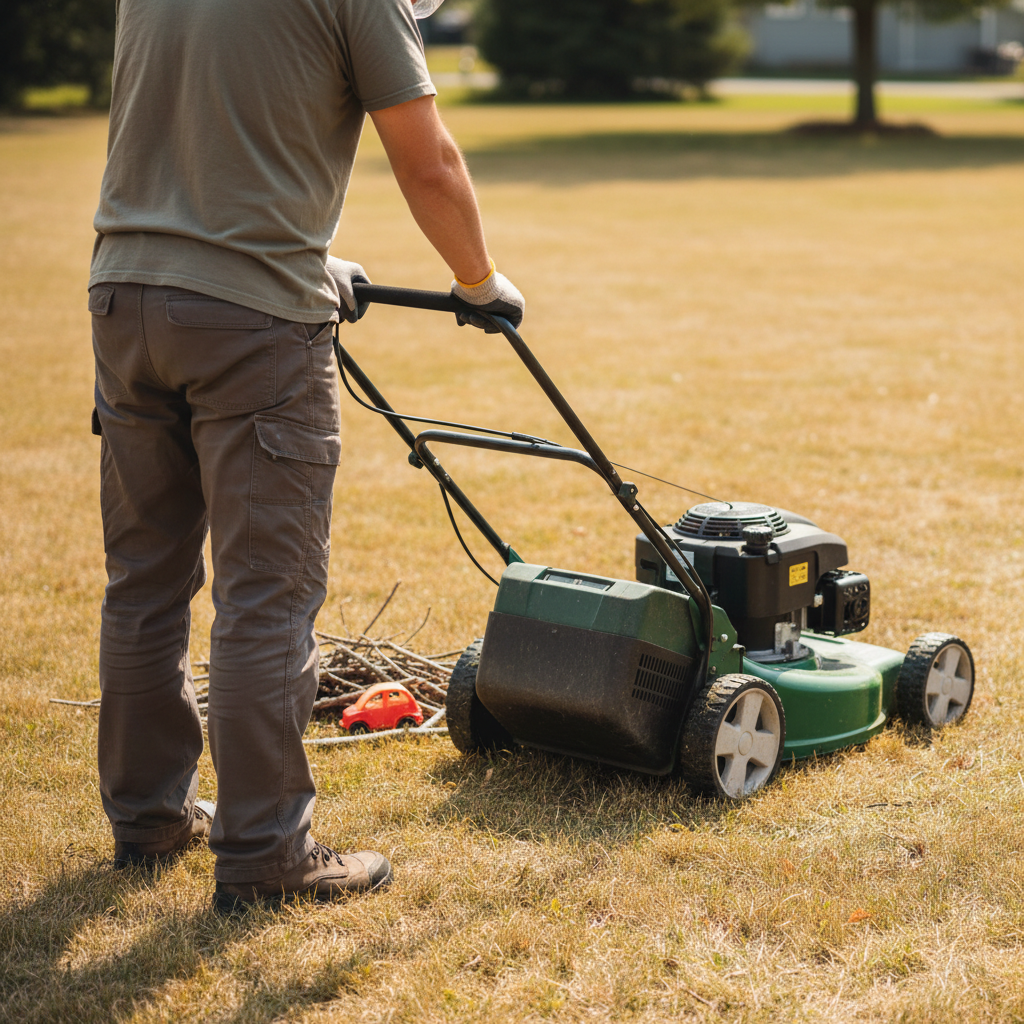
A push lawn mower is a cutting tool first and a small engine second. On a typical walk-behind mower the blade can begin turning as soon as the gasoline engine fires, and the exhaust contains carbon monoxide. Treat the pre-start routine as required every time, even if you only intend to move the machine a short distance or “see if it still runs.”
Where to start and how to stand
Start and run a gasoline mower outdoors. Carbon monoxide is colorless and can collect in a garage, shed, or enclosed porch even when a door is open. Do not start the engine indoors “just for a second.”
Choose firm, level ground so both feet stay planted and the mower cannot roll or tip when the engine kicks. Avoid wet slopes, loose gravel, and unsecured ramps or trailers unless the owner’s manual specifically allows starting there and the unit is fully stable. Stand behind the handle in a balanced stance. Do not stand beside the deck, in front of the machine, or in line with the side-discharge opening.
Clear the deck, discharge, and cutting path
The blade can throw sticks, stones, wire, toys, and packed clumps of grass. Walk the area you plan to mow and pick up debris before the first pull. Look under the deck and into the discharge chute or bagger tunnel for a stuck branch, a forgotten tool, or a grass plug. Keep people and pets away from the starting area and the intended path.
If the mower is set up with a side-discharge deflector, mulch plug, or bag, confirm that part is installed the way the deck is designed to be used. A blocked discharge is a poor way to begin a start attempt and can pack the housing around the blade.
What to wear, and what to take out of your pockets
Wear closed-toe shoes with decent traction, long pants, and eye protection. Hearing protection is wise around a small gasoline engine. Avoid loose cords, drawstrings, and jewelry that can catch on the handle or controls. Empty pockets of keys, knives, and other hard objects that can fall toward the deck. Tie back long hair. Keep both hands free for the operator-presence control and the pull cord.
Visible damage that means you should not pull the starter
Do not start if the recoil housing is cracked, the rope is badly frayed or jammed, a blade appears loose or bent, a wheel or handle is detached, or fuel is dripping from a tank, line, or carburetor. A leaking fuel system is a fire hazard. If the mower was tipped recently, fuel or oil may have reached the air filter or exhaust; pause and follow the owner’s manual before you try again.
Many modern walk-behind mowers will not produce spark unless you hold the operator-presence control—often called a blade-brake handle or bail—against the main handlebar. That interlock is there so the engine and blade stop when you let go. Never tape, tie, wedge, or otherwise bypass that handle, a kill switch, or any other safety device to make starting easier.
Confirm you have a typical gas push mower
The core sequence in this article is for a typical gasoline walk-behind mower: a small engine on a cutting deck that you walk behind, usually started with a recoil starter (pull cord). Layouts vary. The owner’s manual and the labels on the engine and deck override any generic steps.
Gasoline walk-behind versus battery, corded, or riding mowers
A battery mower or corded electric mower has no gasoline, primer bulb, or choke. It usually starts with a key, button, or switch after you hold a safety handle. A riding mower uses a different seating position and, typically, a brake-and-key sequence. Those machines are outside this starting loop.
Some gasoline walk-behind mowers add electric start—a key or button—plus a backup pull cord. Electric start still needs correct engine oil, fresh fuel, a held safety handle, and the same outdoor, clear-deck rules. The onboard battery only cranks the engine; it does not replace fuel or oil.
4-stroke versus 2-stroke
Most modern walk-behind gasoline mowers use a 4-stroke engine. A 4-stroke typically has a separate oil fill and a dipstick or marked oil-fill cap, and it uses unmixed gasoline in the fuel tank. You check crankcase oil before starting.
A 2-stroke engine typically does not use a crankcase dipstick the same way. It usually needs oil mixed into the gasoline at the ratio specified on that engine or in its manual. Putting straight gasoline in a 2-stroke that requires mix, or mixed fuel in a 4-stroke that does not, can prevent starting or damage the engine. If you are unsure, read the fuel and oil language on the engine shroud before you add anything.
Push versus self-propelled
A purely push model has no wheel-drive engagement. A self-propelled walk-behind mower has a separate drive bar, lever, or similar control. That drive control is not the starter and is not a substitute for the blade-brake handle. Do not squeeze a drive bar thinking it will allow spark, and do not engage the wheels until the engine is running and you are ready to walk.
| Machine type | Fuel and oil | Typical start method | What not to assume |
|---|---|---|---|
| Gasoline 4-stroke walk-behind | Unmixed gasoline plus oil in a separate crankcase | Primer and/or choke, then pull cord or electric start | That every unit has both a primer and a choke lever |
| Gasoline 2-stroke walk-behind | Fuel mixed with oil at the engine’s specified ratio | Often primer and/or choke, then pull cord | That it has a 4-stroke-style dipstick |
| Battery or corded electric | No gasoline or crankcase oil fill for starting | Key, button, or switch plus safety handle | That choke, primer, or a recoil sequence applies |
Check oil, fuel, and the air filter
Many seasonal no-starts are fuel, oil, or airflow problems rather than a failed engine. Do these checks with the engine off and the mower sitting level. If you will reach under the deck or handle the spark-plug area, follow the manual’s guidance for disconnecting the spark-plug boot first so the engine cannot start unexpectedly.
Read a typical dipstick on a cold, level 4-stroke
Park on level ground and wait until the engine is cool enough to handle. Remove the dipstick, wipe it, reinsert it the way that engine specifies—some thread into the fill neck, others rest in a tube—then read the high and low marks. Add only the oil named on the engine or in the manual, and only enough to reach the indicated range. Do not overfill.
There is no single oil viscosity that is correct for every mower. The grade printed on the engine or listed in the manual is the one that matters. Running a 4-stroke with a nearly empty crankcase can damage it quickly, so this check belongs before the first pull of the day, especially after storage or after the mower was tipped.
A 2-stroke does not get this same dipstick routine. Confirm that the tank contains the specified mixed fuel instead of topping up a crankcase that is not designed that way.
Fresh fuel for a 4-stroke versus mixed fuel for a 2-stroke
For a typical 4-stroke, the tank takes unmixed gasoline that meets the engine maker’s stated requirements. For a typical 2-stroke, the tank takes the specified gasoline-and-oil mixture. There is no universal octane, ethanol limit, stabilizer dose, or mix ratio that applies to every engine. Use the fuel wording on the engine and in the owner’s manual.
Leftover seasonal gasoline is a common reason a mower will not start. Fuel that has sat for a long time can lose volatility, pick up moisture, and leave varnish in the carburetor. If the machine stored with old fuel in the tank or bowl, draining and replacing it the way the manual describes is often more effective than pulling the cord repeatedly.
Refuel outdoors, with the engine off and cool. Wipe drips and close the cap firmly. If the mower has a fuel shutoff valve, open it before you try to start. A closed valve looks like an empty tank from the engine’s point of view.
What a serviceable air filter should look like
A foam or paper air filter should be intact, seated in its housing, and not packed with dust, grass, or oil. A clogged or oil-soaked air filter can keep the engine from starting or from running after it fires. If the filter is torn, missing, or soaked with fuel or oil, service or replace it as the manual describes before you keep pulling. Do not run the engine with the filter cover left off as a workaround.
Set the primer, choke, and throttle for a cold start
Cold-start controls are not the same on every walk-behind mower. Some gasoline engines have a primer bulb, some have a choke lever, some combine functions on one handle control, and some use an automatic choke. Read the icons on your handle and engine. Do not copy a fixed number of primer presses from memory or from another brand.
What a primer bulb does
A primer bulb is usually a small, soft bubble on or near the carburetor. Pressing it moves fuel toward the carburetor so a dry engine can fire. Press it firmly so it depresses and returns. The correct number of presses is whatever that engine’s label or manual shows—not a universal count.
If you already smell a strong raw-fuel odor around the air intake, or you see wetness in that area, extra priming can create a flooded engine and make starting harder. Stop adding fuel to the carburetor and follow the flooded-start notes later in this article and in your manual.
When to use choke, and when to open it
Choke restricts air so the mixture is richer, which helps a cold engine. Full choke is typically for a cold start. A warm engine that just stalled may need little or no choke. After the engine runs, move the control toward Run or Open so the mixture is not left overly rich. Leaving full choke on after the engine is running can cause rough running, stalling, or fouling.
If the mower has auto-choke, you may only set a throttle or a single Start/Run lever. If there is no primer and no visible choke, use the single control’s start or choke icon. The same caution applies: do not keep enriching a machine that already smells strongly of fuel.
Throttle or Fast/Run
Many walk-behind mowers want the throttle, if there is a separate lever, in a high or Run position to start. Some combine throttle and choke on one lever with rabbit/turtle or choke icons. Set that lever to the start position shown on the control, not to a low idle, unless the manual says otherwise. If the only handle control is the blade-brake bail, the engine-mounted lever or auto-choke is doing the mixture work.
How to pull-start the recoil without damaging it
The recoil starter is a spring-loaded rope inside a housing. Short, angled yanks and a handle that slaps the shroud are common ways to break it. A few smooth, full strokes tell you more than a long series of panicked tugs.
Hold the blade-brake handle, then pull
Stand behind the mower with both feet stable. Pull the operator-presence or blade-brake handle against the main handle and keep it there. On most modern walk-behind mowers this allows spark and releases the blade brake. If you let go, the engine is designed to stop. Hold the bail with one hand and the starter handle with the other, or use the grip the handle design allows without releasing the safety control.
Grip, path, and a smooth full stroke
Hold the starter handle firmly. Take up slack until you feel resistance, then pull in one smooth, full stroke along the path the rope is meant to travel—usually up and slightly back, not sideways across the engine. A tug of only a few inches often will not spin the engine enough to fire and encourages a harder yank on the next try.
Let the rope rewind under your hand so the handle does not snap into the housing. Do not wrap the rope around your hand. If the engine kicks back, keep the handle under control and stop if the kick is violent or the rope binds. Yanking at a sharp angle, pulling only a few inches over and over, or allowing the handle to slap the shroud can damage the recoil.
If the rope sticks, frays, or the engine kicks hard
Stop. Do not force a locked recoil, stand on the deck for leverage, or pull at an extreme angle. A rope that will not move can mean a jammed starter, damage inside the housing, or a cylinder that will not turn after the mower was tipped and fuel or oil entered it. Those are inspection problems, not starting tricks. Replace a badly frayed pull cord before it breaks in your hand.
There is no required pull count and no useful rule such as a fixed number of pulls then a rest. A few controlled full strokes are enough to know whether the engine is trying to fire. Endless pulling floods the carburetor and wears the starter.
After the engine fires
Keep holding the operator-presence handle. As the engine steadies, ease the choke toward Run or Open. If it stumbles, you can return the choke slightly, then open it again as it catches. Listen for a reasonably even note. Look for obvious fuel leaks, heavy smoke that does not clear as the choke opens, or vibration that feels abnormal. If anything looks or sounds wrong, release the bail and stop.
Do not start walking or cutting until the mower is under control and the discharge path is still clear. On a self-propelled model, engage the drive only after the engine is running and you are ready to move. Drive engagement is not part of starting unless your specific manual says otherwise. There is no universal warm-up time in minutes and no single target idle speed that applies to every engine. Use the engine’s behavior and the manual rather than a stopwatch.
If it will not start after a few pulls
Stop after several unsuccessful, controlled attempts. More pulls on full choke, or extra primer shots, often create a flooded engine. Flooding often announces itself with a strong gasoline smell and a wet air-filter area or wetness around the spark plug.
Work through visible checks only:
- You are holding the blade-brake or operator-presence handle the entire time.
- The tank has fresh fuel of the correct type, and any fuel shutoff valve is open.
- The throttle and choke are in the cold-start position shown on the control, and you have not kept priming after smelling raw fuel.
- The spark-plug boot is fully seated on the plug.
- The air filter is not blocked, missing, or soaked.
- Any obvious kill switch is in the run position, and a safety key is inserted if that model uses one.
If you suspect flooding, use the flooded-start steps in the owner’s manual when they are provided. Those steps often involve opening the choke, skipping further priming, and pulling a few times to clear the extra fuel. Do not keep enriching the mixture. Do not use starting fluid as a generic shortcut; it is a fire and engine-damage risk and does not replace finding a fuel, air, or spark problem.
If the engine still will not fire—or you find damaged wiring, a leaking carburetor, a rope that will not rewind, or a blade that is not secure—stop. Persistent no-starts belong in the owner’s manual or with a qualified small-engine technician. Carburetor rebuilds, flywheel work, spark-plug gap setting, and ignition repairs are repair jobs, not starting tips.
When this general sequence does not apply
Use a different procedure when the machine is not a typical gasoline walk-behind mower, when the labels do not match these controls, or when something is damaged.
Battery and corded electric mowers start with their own key, button, or switch. They still need a clear deck, a held safety handle, stable footing, and people kept out of the blade path. They do not use gasoline, choke, or a primer.
If the recoil, levers, or decals look unfamiliar, missing, or broken, do not invent a sequence. Manufacturer steps on hang tags, the owner’s manual, and engine or deck decals take precedence over any general article. Not every push mower has a primer, a choke lever, electric start, or self-propel. If the unit was submerged, badly tipped into a fuel or oil spill, or involved in a fire, do not keep pulling the cord; have it inspected.
A safe start is a short loop: confirm the machine type, check oil and fuel, set the labeled cold-start controls, hold the operator-presence handle, pull the recoil in a smooth full stroke, then open the choke and stay in control. When that loop fails, investigate rather than force it.
Common questions about starting a push mower
How many times should I pull the cord?
There is no universal pull count. After you have set oil, fuel, and the labeled choke or primer, a few smooth, full strokes are enough to tell whether the engine is trying to fire. If it is not, stop and check the safety handle, fuel, air filter, and spark-plug boot instead of flooding the engine or stressing the recoil starter.
The engine starts, then dies. What should I try first?
Keep holding the blade-brake handle—releasing it is supposed to kill the engine. If you are already holding it, ease the choke toward Run or Open; a cold engine left on full choke often runs briefly and stalls. Also check for stale fuel, a clogged or soaked air filter, and a fuel shutoff that is only partly open. If it still dies immediately after those checks, treat it as a no-start diagnosis rather than a starting trick.
Do I prime a warm engine the same way as a cold one?
Usually not. A warm engine that just stalled often needs little or no primer and little or no choke. Follow the warm-start icons on that engine. Extra priming on a hot engine is a common path to a flooded engine.
Can I start a gas mower in a garage if the door is open?
No. Start and run gasoline mowers outdoors. Open doors do not reliably keep carbon monoxide from collecting in a garage or shed. Roll the mower outside, then start it on firm, level ground.
My mower has a start key or button. Do I still pull the cord?
On an electric-start gasoline walk-behind, use the key or button after the same oil, fuel, choke or primer, and safety-handle steps. Use the pull cord only as the backup your manual describes, such as when the start battery is low. A battery mower has no pull-start fuel sequence at all; use its key or button and safety handle only.









