

Quick Answer: How To Start A Riding Lawn Mower With A Screwdriver?
On an electric-start riding mower you own, a screwdriver is sometimes used only as a brief diagnostic jump across the starter solenoid’s large battery and starter terminals. That can crank the engine if the key switch or solenoid coil has failed. It is not a normal starting method, not a repair, and not a way to start equipment you do…

Pros
- Large-size design named in product title
- Sharpening and balancing functions listed
- Listed as a new upgraded version

Pros
- Adjustable 15-to-45-degree range in title
- Sharpening and balancing functions listed
Pros
- Includes replacement gaskets and a 98079-55846 spark plug
- Matches Honda HRR216 and HRS216 lawn mower models
- Designed around the 16100-Z8B-901 carburetor specification
Cons
- Restricted to select Honda GCV160 mower applications
- Installation requires basic mechanical tools and skills
What a Screwdriver Is Actually Bridging
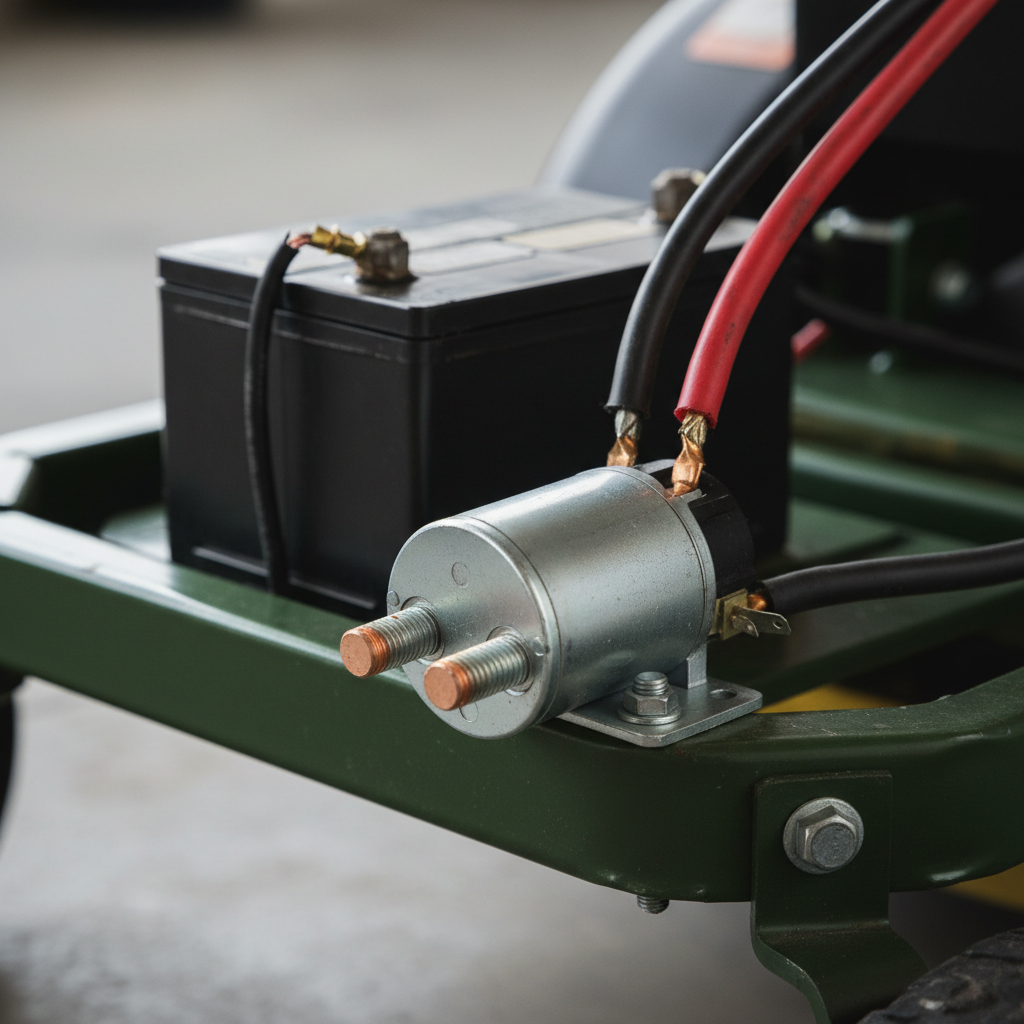
A riding lawn mower with electric start does not use the ignition key as a giant on-off switch for the starter motor. The starter draws a large burst of current from the battery. Routing that current through a small key cylinder would quickly burn the switch. Manufacturers therefore put a starter solenoid in the middle of the circuit. The solenoid is a heavy-duty electromagnetic switch. Two large posts carry battery current toward the starter motor. One or more small terminals receive a much lighter control signal when you turn the key.
When the ignition switch, safety interlocks, and wiring are healthy, turning the key to start sends that control signal to the solenoid coil. The coil pulls an internal contact closed. Battery current then flows through the large posts and cables into the starter motor, and the engine cranks. The key is commanding the solenoid. It is not carrying the starter’s full current.
A metal screwdriver can complete only the high-current path. If you briefly touch the blade across the two large solenoid terminals, you are forcing the same connection the internal contacts would make. The battery, positive cable, solenoid posts, starter cable, and starter motor become a closed loop for as long as the tool is held there. If those parts can still deliver enough current, the starter motor turns. That is why a conductive tool can make an electric-start mower crank even when the key does nothing.
This is different from turning a working ignition key in several important ways. A working key also enables the ignition and fuel-cutoff circuits that let the engine keep running after it fires. It usually does that only after seat, brake, and blade interlocks are satisfied. A screwdriver across the large posts does not restore those control functions. It does not “start the ignition system itself.” It only tests whether the cranking circuit can spin the engine when the solenoid’s high-current path is forced closed.
Terminal layout is not universal. On many riding mowers the solenoid is a small cylinder or rectangular box near the battery, the starter, or the frame rail, with two prominent studs and smaller spade or screw terminals. Some brands reverse the physical arrangement, hide the unit under a panel, or combine functions in a different module. Post labels, if present at all, vary. Treat any description of “the two large posts” as a general pattern, not a wiring diagram for your machine. The owner’s manual or a technician who can see the actual hardware is the authority for that mower.
A screwdriver test also does not replace understanding the rest of the starting path. Corroded cable ends, a weak battery, a failed starter, or an open ground can make the same tool produce nothing but a spark. Jumping the large posts cannot diagnose those faults by itself. It only answers a narrow question: if the solenoid’s main path is closed by force, will the engine crank?
This Is a Temporary Diagnostic, Not a Real Starting Method
A screwdriver is not a designed starting control. It is not a substitute for a working key switch, and it is not an acceptable everyday way to start a riding lawn mower. The only legitimate use on equipment you own or are authorized to service is a short diagnostic check after ordinary no-crank checks have failed. If you do not own the machine and do not have permission to service it, stop. This article is not a method for starting someone else’s mower, a locked rental, or any equipment used as a theft deterrent by removing the key.
If the engine cranks when the large posts are bridged, the mower is not fixed. A successful crank often points toward a problem in the key switch, the solenoid coil, a control wire, a ground, or an interlock that never sends the start signal. It does not identify the failed part with certainty. The same result can appear when the solenoid’s internal contacts are burned even though the starter itself is fine, or when the key switch is worn and the rest of the circuit is healthy. One jump is a clue, not a complete diagnosis.
Do not leave the tool in place. Do not wrap wire around the posts so you can start without a key. Do not add a hidden toggle or permanently jumpered solenoid and call that a repair. Those changes defeat the designed control path, can leave the starter engaged, and can bypass safety interlocks that exist to keep blades and drive from engaging unexpectedly. They also create a continuous risk of sparks at a battery that can vent hydrogen gas.
Who should attempt this kind of test? Only an owner or authorized user who already understands the machine’s basic controls, can set the parking brake, can confirm the blades are disengaged, and is prepared to stop after one brief check and pursue a real repair. Who should stop and get help? Anyone who cannot clearly identify the solenoid, anyone working on a machine with fuel leaks or a damaged battery, anyone who is unsure the mower is in a safe state, and anyone whose goal is simply to run the mower without restoring the ignition switch. A small-engine shop or dealer is the better next step in those cases.
Repeating the bypass as a lifestyle is a bad habit even when it “works.” Each contact can pit the posts, melt insulation, or start the engine at a moment when you are leaning over the battery. It also hides the original fault. A failing key switch or solenoid will not heal because you learned to jump around it.
Safety Checks Before You Touch the Starter Circuit
The starter circuit on a riding mower can spin a heavy engine, throw sparks at a live battery, and—if interlocks are ignored or already failed—allow blades or drive to move. Treat the scene as you would any unexpected-start hazard. Authorized access comes first. If the mower is not yours and you are not authorized to service it, do not open the circuit.
Work outdoors or in a well-ventilated area. Hydrogen gas can collect around a charging or recently charged battery, and a spark can ignite it. Confirm there is no gasoline smell and no visible fuel leak at the tank, lines, carburetor, or filter. A spark that is merely annoying on a dry, leak-free machine is a fire hazard on a machine that is dripping fuel. Look at the battery case for cracks, bulges, or wet residue. Electrolyte is corrosive. Do not proceed on a leaking or physically damaged battery.
Set the parking brake. Disengage the PTO or blade switch and confirm the blades are not spinning. Place the transmission in neutral or park, according to how that machine is designed. Remove the cutting deck from the “ready to mow” mindset even if you believe the interlocks still work. Clear bystanders, children, and pets from the area. Keep feet and hands away from the deck, belts, and rear tires. Follow any warning labels on the machine; those labels override a general article.
Handle the tool as a live electrical conductor, because that is what it becomes the instant it touches both large posts. Prefer a screwdriver with an insulated handle. Remove jewelry. Keep loose clothing and long hair clear of belts and the cooling fan. Use a one-hand approach so a slip is less likely to send current across your chest. Do not lean your face or torso over the battery. There is no guaranteed-safe body position, and no consumer article can certify a particular glove or tool rating for your machine. The point is to reduce the chance of a slip, a spark in your face, or an accidental short to the frame.
Refuse to proceed when any of the following is true: you do not own or are not authorized to service the mower; fuel is leaking; the battery is damaged; guards are missing and moving parts are exposed; the blades or PTO are engaged; the area is enclosed and unventilated; or you cannot identify the solenoid’s large terminals without guessing. Guessing among small control terminals, ignition wires, or dash connectors is how people create new shorts. If the situation is unclear, charge or load-test the battery, inspect the cables, and take the mower to a qualified technician instead of improvising in the wiring.
Expect sudden motion. The engine can fire on the first revolution if it still has spark and fuel. The mower can lurch if it was left in gear and the brake is weak. Blades can engage if a PTO switch or linkage is faulty. Plan where you will stand, how you will remove the tool instantly, and how you will shut the machine down if it starts. Know where the throttle, choke, and key or kill switch are before you touch the solenoid.
Rule Out Common No-Crank Problems First
A screwdriver test is pointless—and needlessly risky—when the battery, cables, or operator interlocks already explain the silence. Check those items first. Many no-crank riding mowers return to normal starting once a weak battery is charged, a loose cable is tightened, or the operator simply sits down and sets the brake.
Begin with the battery and its connections. A riding mower that has sat for weeks often has a battery too low to crank, even when the headlights or dash lamp still glow faintly. Look for a disconnected negative or positive clamp, a clamp that turns on the post, white or green corrosion, and a frayed cable where it meets the terminal. Clean and tighten only what you can reach safely with the machine off and the area clear. If the battery is obviously discharged, charge it with a charger intended for small lead-acid or AGM batteries, following the charger and mower manuals. A screwdriver cannot revive a dead or badly sulfated battery.
Follow the heavy cables visually from the battery to the solenoid and from the solenoid toward the starter. A burned, melted, or oil-soaked cable can drop so much voltage that the starter only clicks or groans. Wiggle tests should be gentle; you are looking for obvious looseness, not ripping connectors apart. If the machine has an inline or blade fuse in the start or accessory circuit, inspect it. Fuse ratings and locations are model-specific, so use the owner’s manual rather than a guessed amperage.
Then treat the safety interlocks as first-class starting controls, because on most electric-start riding mowers they are. Common interlocks include:
- A seat or operator-presence switch that expects weight in the seat before the starter is allowed to crank.
- A parking-brake or clutch-pedal switch that expects the machine to be held from rolling.
- A PTO or blade-engagement switch that expects the cutting deck to be off.
In general terms, many mowers will not crank unless the operator is in the seat, the brake is set, and the blades are disengaged. A failed seat switch is a frequent reason a key does nothing even though the battery is strong. So is a brake switch that no longer closes, or a PTO switch stuck in the “blades on” state. Do not defeat these interlocks to force a start. They exist because a rider leaving the seat, or a deck that is still engaged, can cause serious injury. If an interlock is the fault, repair or replace that switch. Jumping the solenoid to work around a safety circuit is the wrong lesson to take from a no-crank mower.
Symptom patterns can narrow the next check, but they are not universal diagnoses:
- A completely silent start circuit—no click, no solenoid tap, no dash activity—often points to a dead battery, an open main connection, a blown fuse, a failed ignition switch, or an interlock that never completes the control path.
- A single click with no crank often points to a weak battery, poor cable connections, or a solenoid that chatters but cannot pass high current. It can also be a starter that is beginning to fail.
- Dim lights and a slow groan usually mean the battery or connections cannot supply cranking current. A screwdriver across the solenoid will not fix that supply problem.
- The engine already cranks but will not fire is not a solenoid-jump problem. That is an ignition, fuel, or safety-run circuit issue, and bridging the large posts adds no useful information.
If lights are strong, cables are clean and tight, you are in the seat with the brake set and blades off, and the key still produces no click, a failed key switch or solenoid coil becomes more plausible. That is the narrow situation in which a brief, authorized solenoid jump is sometimes used as a diagnostic. If any of the simpler faults are still untested, test those first.
The High-Level Solenoid Jump Concept
On many electric-start riding mowers the starter solenoid sits close to the battery or along the cable run to the starter. It typically looks like a small cylinder or box with two large threaded posts and one or more small control terminals. The large posts are the high-current path. The small terminals are the control path the key switch and interlocks normally drive. You are not looking for the ignition lock, the steering column, or a bundle of dash wires. Those areas are outside the scope of this diagnostic and are how theft-style bypasses are described. Do not go there.
The diagnostic idea is simple and should stay simple. A momentary metal bridge across the two large posts only tests whether the battery, main cables, and starter motor can crank the engine when the solenoid’s high-current path is forced closed. If they can, the engine turns. If they cannot, the problem is not solved by touching smaller wires or prying at the key cylinder.
Keep the contact brief. The instant the engine cranks, remove the tool so the starter is not held engaged after the engine starts. If you see a harsh, continuous spark, hear a rapid machine-gun click, smell melting insulation, or notice fuel or battery vapor, stop immediately and do not repeat the contact. If nothing happens, stop after one brief test. Do not escalate into shorts across small control terminals, ignition-coil leads, or harness connectors unless a service manual written for that exact machine tells a technician to perform a specific test there. Random extra jumps create new faults and can energize circuits that were never meant to be live together.
This section is intentionally not a numbered procedure. Terminal order, boot covers, mounting brackets, and nearby grounded metal differ by brand. A step-by-step recipe that pretends otherwise would be both inaccurate and easy to misuse on a machine the reader does not own. If you cannot see two obvious large posts on a component that is clearly in the battery-to-starter cable path, do not invent a substitute connection. Consult the manual or a qualified shop.
After the brief test, put the tool down and decide what the result means. A crank means the high-current path can work and the control side still needs a proper repair. No crank means you should inspect battery condition, cable continuity, the starter, and whether the engine is free to turn—not keep striking sparks at the solenoid.
When You Should Not Use a Screwdriver at All
A solenoid jump will not solve every no-start story, and in several situations it should not be attempted at all.
It will not revive a dead or badly sulfated battery. It will not replace burned or undersized cables. It will not repair a failed starter motor, a seized engine, or a flywheel that will not turn. It will not fix a mower that already cranks but refuses to run because of fuel, spark, or a run-enable interlock. If the engine turns with the key and then dies when you leave the seat, the starting circuit is not the remaining problem.
Do not attempt the test on equipment you do not own or are not authorized to service. Do not use it to start a machine whose key is missing because it is being used as a theft deterrent. Do not use it on a mower with fuel leaks, a damaged battery, missing guards, or engaged blades. Do not use it in an enclosed space where battery gas or gasoline vapor can collect. Those are hard stops, not inconveniences to work around.
The scope of this article is electric-start riding lawn mowers—the garden tractors and rider mowers whose starters are battery-powered and whose solenoids sit in that cranking path. It does not apply to cars, trucks, motorcycles, or other road vehicles. Automotive ignition and immobilizer systems are different, and blending car hot-wiring into lawn-equipment advice is both inaccurate and unsafe. It also does not apply to recoil or pull-start walk-behind mowers. Those machines have no starter solenoid to jump; a screwdriver is the wrong tool for a rope-start engine.
Some garden tractors share a similar solenoid layout with riding mowers, but the same ownership, safety, and last-resort limits apply. If the machine is a compact utility tractor with a more complex electrical system, or if it has a diesel glow-plug circuit, do not assume a lawn-mower-style jump is appropriate. Use the manual for that tractor or a dealer technician.
Legal rules about operating equipment, ignition bypass, and unauthorized use vary by place. This article cannot declare what is lawful on a particular driveway or job site. The practical rule for a reader is simpler: only diagnose a mower you are allowed to service, restore a proper key switch and solenoid, and do not treat a metal tool as a spare key.
What to Repair After the Test
Convert the result into a real fix. The screwdriver was never the repair.
If the engine cranks when the large posts are bridged, the battery, main cables, and starter are at least capable of turning the engine in that moment. Usual next checks are the ignition or key switch, the solenoid itself—especially the small control circuit and the condition of the large posts—and the control wiring and grounds that should carry the start signal when the key is turned. Confirm that seat, brake, and PTO switches actually change state instead of assuming they are innocent because you sat down and set the brake. A switch can be mechanically moved and still be electrically open.
Also confirm that the charging system can keep the battery healthy after you restore normal starting. A mower that only lives through jumps may have been hiding a weak charging circuit. A battery that is repeatedly drained will make the next no-crank event look like another ignition-switch failure. Charging-system details are model-specific; use the service information for that machine rather than a generic voltage number from an unrelated article.
If the engine still will not crank, look at battery condition and connections again, then at cable continuity from battery to solenoid to starter, then at the starter motor, and finally at whether the engine turns freely. A hydrostatic unit or a deck belt that is binding will not be cured by more sparks at the solenoid. If you cannot turn the engine by the approved manual method in the owner’s manual, or if you hear a locked mechanical noise, stop electrical experiments and investigate the mechanical side.
There is no universal rule that you must always replace both the key switch and the solenoid. Either part can fail alone. Replace what testing and inspection support. If you are not equipped to isolate a control-side open circuit, a small-engine shop can do that without guesswork. Bring notes about what you already observed: silent key, click with no crank, or crank only when the large posts were bridged. Those observations help a technician start in the right place.
Repeating the screwdriver start is a poor long-term habit for reasons that go beyond inconvenience. Each contact risks sparks at the battery, melted post threads, a starter that remains engaged, and an accidental start while your hands are in the engine bay. It also trains you to ignore interlock faults. A seat switch that no longer works is not a minor annoyance if the blades can stay live when you leave the seat. Restore the designed starting path so the key, the solenoid, and the safety switches do their jobs together.
Do not install a hidden toggle, a permanently jumped solenoid, or a disabled safety switch and treat that as an acceptable repair. Those modifications trade a failed part for a machine that can start or keep running in unsafe conditions. The correct end state is a riding mower that starts with its own key, cranks only when the interlocks allow it, and does not require a tool across live battery terminals.
Key Takeaways for a No-Crank Rider
A screwdriver can appear to “start” an electric-start riding lawn mower because it can briefly close the high-current path through the starter solenoid. That path normally closes only when the key switch and safety interlocks energize the solenoid coil. The tool does not repair the ignition switch, does not replace the solenoid, and does not make the machine safe to operate as a regular habit.
Stay inside a narrow, owner-only diagnostic: verify the battery, cables, and interlocks first; keep the parking brake set and the blades off; treat the battery as a spark and acid hazard; and use at most one brief bridge across the two large solenoid posts if you can identify them with certainty. Then stop. If it cranks, inspect or replace the key switch, solenoid, and related control parts. If it does not, inspect the battery, cables, starter, and engine for a problem the jump cannot fix. When the layout is unclear or the machine is not yours to service, a qualified technician is the correct tool—not a screwdriver.









