
Pros
- 24 cores (8 P-cores, 16 E-cores) and 32 threads for intense multitasking
- Advertised maximum clock speed reaching up to 6.0 GHz
- Broad compatibility with both DDR4 and DDR5 memory platforms
- Features integrated Intel UHD Graphics 770
Cons
- Requires a potential BIOS update for Intel 600-series motherboards

Pros
- 14-core hybrid architecture with 6 P-cores and 8 E-cores
- Unlocked clock speeds up to a rated 5.2 GHz
- Equipped with 26MB cache for responsive processing
- Supports modern PCIe 5.0 and 4.0 standards
- Compatible with Intel 800 series motherboards
Cons
- Requires a dedicated discrete graphics card
- Does not include a cooling solution

Pros
- High 5.4 GHz max boost is well suited to gaming workloads.
- Unlocked multiplier gives experienced users tuning headroom.
- AM5 and DDR5 support align with current-generation desktop platforms.
- 6-core, 12-thread layout is practical for gaming and general use.
Cons
- Cooler is not included, so buyers must plan for separate cooling.
- Requires an AM5 motherboard and DDR5 memory, which limits drop-in upgrades for older systems.
- 6 cores may be less ideal for heavy content creation or workstation tasks than higher-core CPUs.
Overview: The AMD Ryzen 5 9600X is a 6-core, 12-thread unlocked desktop processor built on the Zen 5 architecture. It is aimed at users who want a fast, modern CPU for an AM5-based gaming PC or a responsive everyday desktop build.
Performance and features: With a 5.4 GHz max boost, 38 MB cache, and DDR5-5600 support, this processor is positioned for strong gaming responsiveness and smooth multitasking. Select AM5 motherboards can also provide PCIe 5.0 support, which adds future-ready flexibility for compatible components.
Drawbacks and considerations: The main limitation is that a cooler is not included, so total build cost can rise once cooling is added. It also depends on the AM5 platform and DDR5 memory, which makes it less convenient for older AMD or Intel system upgrades.
Verdict: This CPU makes the most sense for gamers and PC builders who want a fast, unlocked Ryzen chip for a current-generation AM5 system. If you want a straightforward upgrade path and value high boost clocks over bundled extras, the Ryzen 5 9600X is a strong fit.
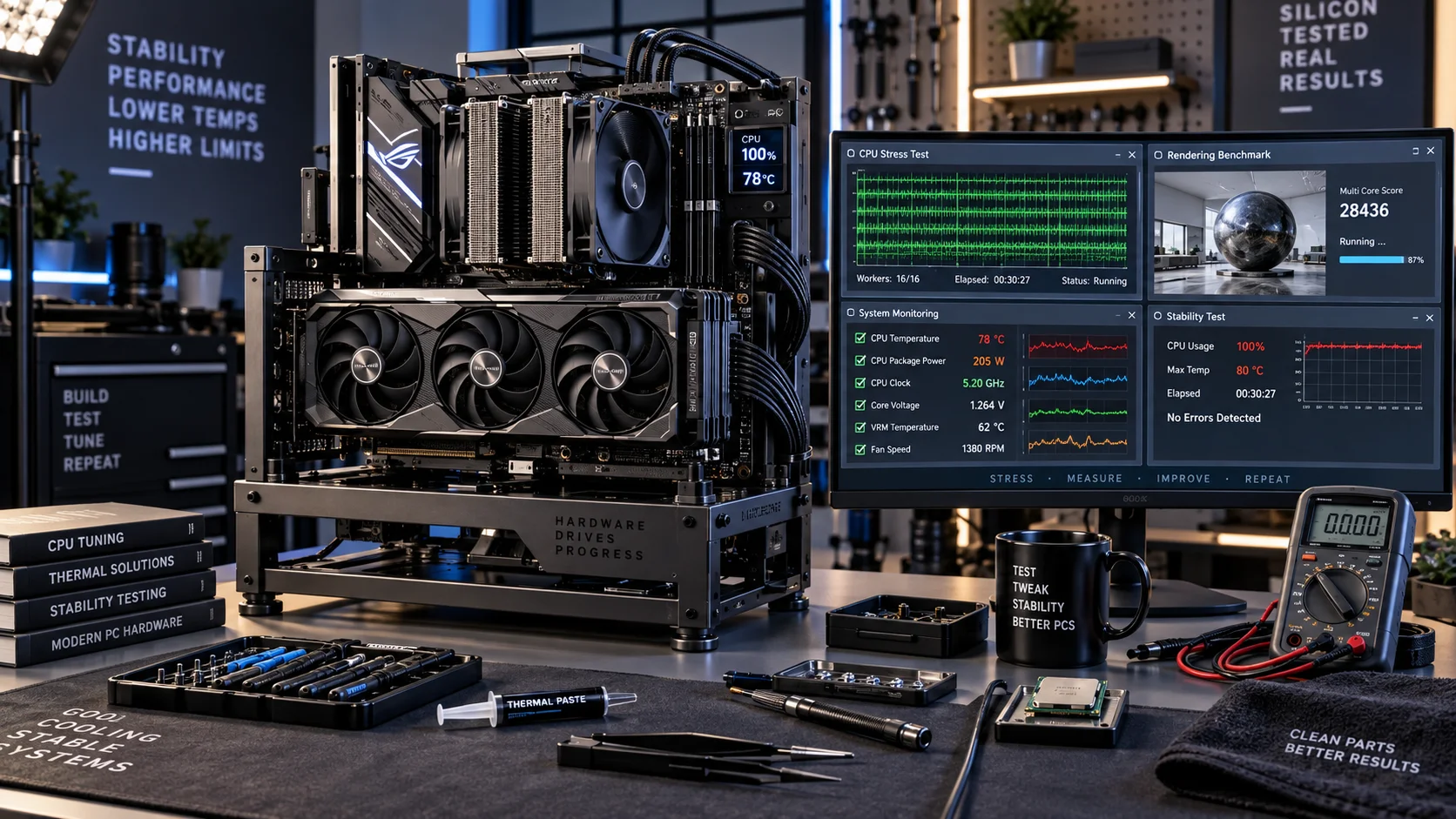
Why CPU Stress Testing Matters Before You Trust Your Build
A CPU that boots Windows and launches games is not a CPU that has passed stability validation. Electromigration, marginal VRM output voltages, inadequate cooling contact, and aggressive XMP/EXPO memory profiles can all produce a system that appears functional for days before producing a corrupted game save, a silent arithmetic error in a rendering job, or a hard crash under sustained load. Stress testing exposes these failure modes in a controlled environment, before they manifest in production workloads.
This applies equally to stock-clocked builds, factory-overclocked CPUs, and manually tuned systems. Intel’s 13th and 14th Generation processors shipped with eTVB and power limit configurations that caused long-term degradation under sustained unrestricted power draw, a real-world example of why even an out-of-box system benefits from systematic thermal and stability validation. AMD’s Ryzen 7000 series with Precision Boost Overdrive similarly demands verification that the motherboard’s power delivery and cooling solution meet AMD’s specification before the CPU is trusted for professional work.
Monitoring CPU temperature limits during a stress test is not optional, it is the primary safety gate. Without knowing your thermal ceiling in real time, you risk accelerated silicon aging or outright thermal shutdown without understanding why.
Stress Test Tool Comparison: Prime95 vs. Cinebench 2026 vs. OCCT
| Attribute | Prime95 30.x | Cinebench 2026 | OCCT 12.x |
|---|---|---|---|
| Primary Algorithm | Lucas-Lehmer / FFT | Cinebench rendering engine (AVX2/AVX-512) | LINPACK / custom matrix ops |
| AVX-512 Support | Yes (optional toggle) | Yes (automatic on supported CPUs) | Yes (LINPACK mode) |
| CPU Power Draw | Extreme (Small FFTs: 150 to 250%+ TDP) | High (realistic: 90 to 120% TDP) | Extreme (LINPACK: 140 to 230% TDP) |
| Error Detection | Built-in checksum validation | None (score consistency only) | Built-in hardware error detection |
| Realistic Workload Sim | Low (synthetic only) | High (3D render pipeline) | Medium (engineering compute) |
| Best For | VRM/thermal ceiling detection | Overclock performance validation | Voltage instability, silent errors |
| Test Duration (Recommended) | 30 to 60 min (stock), 2 to 4 hr (OC) | 10 to 20 loop iterations | 30 to 60 min CPU:LINPACK |
| Free / Paid | Free (donationware) | Free | Free (basic) / Paid (Pro) |
| Platform | Windows, Linux | Windows, macOS | Windows |
Pre-Test System Preparation
Skipping preparation invalidates test results. A system that crashes during Prime95 due to a loose CPU cooler mounting pressure rather than silicon instability produces a false failure. Address these items before launching any test. To compare alternative configurations, check our hands-on review of what power supply wattage for gaming pc.
- Verify cooler mounting torque: Reseat the CPU cooler if installed within the last 48 hours. Thermal interface material requires brief operation under load to fully wet the IHS surface. Check that all mounting screws are uniformly finger-tight to within manufacturer spec.
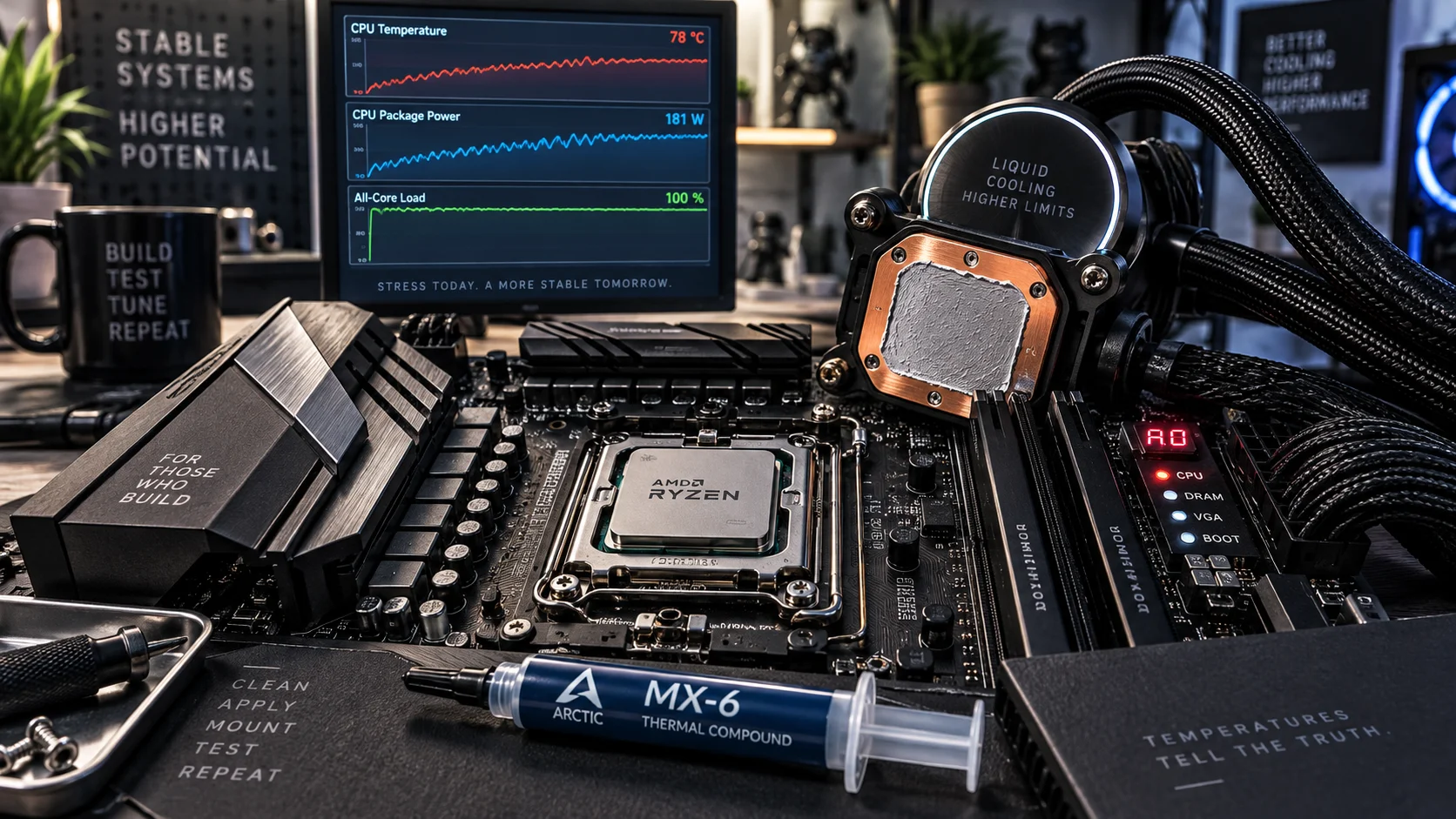
- Confirm thermal paste application: Excess or insufficient paste produces 5 to 15°C variance in measured temperatures. Review thermal paste application best practices before proceeding if you have any doubt about your current application.
- Disable system sleep and screen savers: Windows power plan must be set to High Performance or Balanced with sleep disabled. A sleep interrupt during Prime95 produces a false error log entry.
- Close background applications: Antivirus real-time scanning, browser tabs with video, and game launchers all compete for memory bandwidth. Close them to isolate CPU behavior.
- Load monitoring software: HWiNFO64 (free) is the field standard. Configure it to log CPU Package Power (watts), CPU Core temperatures (per-core maximum), CPU VCore voltage, and CPU Clock Speed per core. Enable logging to CSV for post-test analysis.
- Note your baseline: Run Cinebench 2026 once before any extended stress test to record your expected multi-core score. This baseline is the reference for detecting throttle-induced score regression during loop testing.
Prime95: Stress Testing CPU Power Delivery and Thermal Headroom
Prime95 operates by running Lucas-Lehmer primality tests across multiple FFT sizes. The FFT size determines the memory footprint of each worker thread and, critically, the AVX instruction mix applied to the CPU. Each FFT configuration stresses different subsystems.
Recommended Prime95 Test Configurations
- Small FFTs (4K-32K): Maximizes CPU core and execution unit utilization. Produces the highest power draw and the highest temperatures of any Prime95 mode. The definitive thermal ceiling test. Use this to determine whether your cooling solution can sustain long-duration load. Duration: 30 minutes minimum for a stock CPU, 2 hours minimum for an overclock.
- Large FFTs (4M-32M): Stresses the CPU alongside memory subsystem. Useful for detecting instability related to memory controller configuration, particularly relevant when XMP or EXPO is enabled. See how RAM speed and timings interact with CPU memory controller stability.
- Blend: Cycles between FFT sizes. Broadly validates both compute and memory. Appropriate for a general first-pass test on a stock system.
In Prime95’s Options u2192 CPU menu, disable AVX and AVX-512 for a first pass on Intel 12th Gen and later, and AMD Ryzen 7000 series. AVX-512 in Prime95 can push package power 30, 50% beyond what any shipping workload will produce and may trigger thermal throttling on otherwise-stable overclock configurations. Validate stability without AVX-512 first, then re-run with AVX enabled as a secondary ceiling test. Users looking for related component recommendations can explore our how to fix intel arrow lake z890 bios voltage breakdown.
A passing result is zero hardware errors reported in the Prime95 worker windows for the full test duration, with CPU temperatures remaining below the manufacturer’s specified TJMax, typically 100°C for Intel Core, 95°C for AMD Ryzen 7000. Reference Intel’s CPU Cooler Master Guide for platform-specific thermal guidance.
Cinebench 2026: Real-World Performance Validation and Throttle Detection
Cinebench 2026, released by Maxon, uses the Cinema 4D rendering engine to benchmark CPU throughput. Unlike Prime95, it does not verify arithmetic correctness, it measures throughput via render score. Its value in stability testing is not error detection but performance consistency across iterations.
Running Cinebench 2026 as a Stability Loop
- Open Cinebench 2026 and navigate to File u2192 Advanced Benchmark. Set the minimum test duration to 10 minutes and enable multi-core test.
- Run a minimum of 10 consecutive iterations. Record the nPts score for each run.
- A thermally stable, electrically stable CPU produces scores within u00b12% across all iterations. Variance beyond 5% between the first and subsequent runs indicates thermal throttling, the boost clock is being suppressed because the cooling solution cannot sustain the thermal load.
- A BSOD, application crash, or rendered output corruption during any iteration is a hard stability failure requiring investigation before the system is trusted for production work.
Cinebench 2026 added support for AVX-512 dispatch on Intel Alder Lake and later, and on AMD Zen 4. On these platforms, the benchmark exercises the full modern instruction set, making it a meaningful proxy for professional rendering, simulation, and ML inference workloads. This is why it functions as a better final validation tool than Prime95 for content-creation rigs , it tests what those systems will actually run. Before finalizing equipment decisions, refer to our comprehensive how to safely connect 12v 2×6 gpu power cable comparison.
OCCT: Silent Error Detection and Voltage Stress
OCCT (OverClock Checking Tool) by OCBASE targets a failure mode that both Prime95 and Cinebench miss: silent arithmetic errors that do not produce a crash. An overclocked CPU running with marginal core voltage can produce incorrect computational results that are mathematically wrong but do not trigger an operating system exception. OCCT detects these through its built-in error-checking layer.
OCCT CPU:LINPACK Test Procedure
- Launch OCCT and select CPU:LINPACK from the test menu. LINPACK solves large systems of linear equations and is the same benchmark class used by the TOP500 supercomputer rankings.
- Set instruction set to AVX2 for the first pass. Enable AVX-512 only if your CPU supports it natively (Intel Sapphire Rapids, AMD Zen 4).
- Set duration to 30 minutes. OCCT will display a real-time error count, temperature graph, and power draw graph simultaneously.
- Any non-zero error count is a failure. Investigate CPU core voltage (Vcore), LLC (Load Line Calibration) setting, and cooling performance before adjusting the overclock.
- Run OCCT CPU:Memory test separately for 20 minutes if XMP/EXPO is enabled, this isolates memory controller errors from core compute errors.
OCCT’s graphical output is particularly useful for identifying power delivery droop: the Vcore under full load should not drop more than 50 to 100mV below the idle set voltage depending on LLC level. A droop of 200mV or more under LINPACK load indicates either an insufficiently aggressive LLC setting or VRM phase current limiting, both correctable in UEFI firmware. If you recently updated GPU drivers and observe system instability only under combined CPU+GPU load, rule out driver conflict via GPU driver clean install before attributing the failure to CPU instability.
Interpreting Results and Diagnosing Failures
Thermal Throttling
Identified by: Cinebench score drops 10%+ between iteration one and later runs; HWiNFO64 shows CPU frequency falling below boost specification while package temperature sits at TJMax. Root cause: inadequate cooler, poor contact pressure, degraded thermal paste, or inadequate airflow. Resolve the cooling issue before any voltage or frequency adjustment.
Hard Crash (BSOD / Reboot)
Identified by: System restarts or produces a STOP error during Prime95 or OCCT. Common STOP codes include WHEA_UNCORRECTABLE_ERROR and CLOCK_WATCHDOG_TIMEOUT. Root cause: insufficient Vcore, excessive CPU frequency, or defective silicon. On overclocked systems, raise Vcore by 25mV increments and retest. On stock systems, check for BIOS AGESA updates, AMD and Intel both release microcode revisions that correct boost behavior and power limit defaults.
Silent Errors (OCCT Error Count > 0)
Identified by: OCCT error counter increments without any crash. Root cause: marginal Vcore under AVX load, aggressive LLC causing voltage overshoot-undershoot oscillation, or faulty memory interacting with memory controller. Increase LLC by one step or raise Vcore by 25mV. If errors persist at stock settings with XMP disabled, the CPU or memory controller may have silicon defects, process an RMA if under warranty.
VRM Overtemperature
Identified by: HWiNFO64 shows VRM or MOSFET temperatures exceeding 100 to 110°C; system may throttle CPU frequency or shut down independently of CPU temperatures. Root cause: motherboard VRM insufficient for sustained high-power CPU, or inadequate airflow across VRM heatsink. Add a case fan directed at VRM area or reduce CPU power limits in UEFI. This is especially common on mid-range B-series boards paired with high-TDP CPUs.
The Complete Stress Test Sequence
Execute these steps in order for a full stability certification of any new or modified system:
- Step 1, Baseline score: Single Cinebench 2026 multi-core run. Record score and peak temperature.
- Step 2, Thermal ceiling: Prime95 Small FFTs, AVX disabled, 30 minutes. Monitor temperatures and VRM. Abort if TJMax is sustained for more than 60 seconds.
- Step 3, Performance consistency: Cinebench 2026 loop, 10 iterations. Verify score variance under u00b12%. Check that CPU temperature limits are respected throughout.
- Step 4, Error validation: OCCT CPU:LINPACK, AVX2, 30 minutes. Zero errors required to pass.
- Step 5, AVX-512 ceiling (if applicable): Prime95 Small FFTs with AVX-512 enabled, 20 minutes. For overclockers only, this final test validates headroom under worst-case instruction mix.
- Step 6, Memory controller validation: OCCT CPU:Memory, 20 minutes, especially if XMP/EXPO is active.
A system that completes all six steps without errors, crashes, or sustained thermal throttling is stable. Document your HWiNFO64 CSV logs and Cinebench scores. If you later add hardware, such as a new GPU or NVMe drive on a PCIe 5.0 compatibility-dependent platform, repeat Steps 2 and 4 to confirm that the new platform power budget has not introduced instability under combined load.
Conclusion
CPU stress testing is not a single-tool task. Prime95 locates your thermal and power delivery ceiling. Cinebench 2026 validates real-world performance consistency under sustained load. OCCT detects the silent computational errors that neither crashes nor temperature readings will reveal. Run them in sequence, log everything with HWiNFO64, and interpret results against manufacturer thermal and voltage specifications. A CPU that clears all three tools is a CPU you can trust for production workloads, competitive gaming, and long-duration rendering, without reservation.
Background on Stress Workloads
Stress workloads push a processor hard for long periods, which can expose heat and power problems that normal use hides. A broad reference on how electrical equipment is evaluated for safe operation is American National Standards Institute (ANSI).