

Direct Answer: What Lawn Mower Tune-Up Involves
Tuning up a lawn mower means performing preventive maintenance on the engine and cutting system to restore peak performance and reliability. For gas-powered mowers, a complete tune-up includes changing the oil, replacing or cleaning the spark plug, sharpening the blade, servicing the air filter, maintaining the fuel system, and cleaning the deck. Electric mowers require fewer steps, focusing mainly on blade maintenance and deck cleaning. Most manufacturers recommend a full tune-up at the start of each season or after every 50 hours of use.

Pros
- Powerful 80V brushless motor delivers 32HP gas-equivalent performance with quiet fume-free operation and no engine maintenance.
- Complete kit includes four 6.0Ah batteries and 600W charger for substantial runtime up to 1.5 acres.
- SmartCut technology and 42-inch heavy-duty steel deck ensure consistent cuts without bogging in tough conditions.
- Versatile towing up to 350 lbs and optional cargo hauling plus comfort features like high-back seat and LED lights.
- Strong 4-year limited warranty and full compatibility with the Greenworks 80V tool ecosystem.
Cons
- Rear utility cargo bed for 200 lb hauling is sold separately and not included in the kit.
- Runtime of up to 1.5 acres varies with conditions and may require recharging or battery swaps on larger properties.
- As a fully cordless model continuous operation depends on battery levels unlike gas engines with unlimited runtime.
The Greenworks 80V 42" CrossoverT Cordless Riding Lawn Tractor is a ready-to-mow zero-emission tractor designed for homeowners managing medium to large lawns. It features a reinforced 42-inch stamped steel deck of 12-gauge construction along with premium comfort elements such as a high-back padded seat with foldable armrests. The overall build emphasizes durability and user convenience right out of the box with the included battery and charger set.
Performance centers on the 80V TruBrushless motor that provides 32HP gas-equivalent power with instant torque and quiet fume-free operation. SmartCut technology senses grass conditions and automatically adjusts power to maintain a consistent cut even in tall thick or wet areas. The four 6.0Ah batteries support runtime for up to 1.5 acres depending on conditions while dual LED headlights and a 7-position deck height range from 1.5" to 4.5" add practicality. Front and rear attachments further allow towing up to 350 lbs for added yard utility.
Key considerations include that the rear utility storage bin capable of hauling 200 lbs is sold separately so full cargo functionality requires an extra purchase. Runtime remains condition-dependent and may fall short for properties significantly larger than 1.5 acres without using the 600W charger or swapping batteries. The cordless design prioritizes ease and low maintenance but trades off the continuous runtime of traditional gas models.
This tractor delivers strong value for eco-conscious owners of residential properties who want gas-like power without the emissions noise or upkeep. It suits those who already use or plan to expand into the Greenworks 80V family of tools and who appreciate the 4-year limited warranty. Users with exceptionally large or commercial-scale lawns should evaluate battery logistics carefully before purchase.

Pros
- Delivers strong 21 horsepower equivalent power comparable to gas riding mowers.
- Provides up to 1.5 acres of runtime on a full charge with the six included batteries.
- Features low-maintenance dual brushless motors without belts for greater durability.
- Offers versatile 12-position cutting height adjustment from 1.5 to 4.5 inches.
- Includes digital controls for blade settings, drive speeds, and cruise control.
Cons
- Limited to 1.5 acres of cutting per charge without purchasing additional batteries for bigger lawns.
- Requires recharging time for the six 56V batteries after each use session.
- Relies solely on battery power with no hybrid or gas backup option for extended operation.
The EGO Power+ TR4204 is a cordless electric riding lawn mower built as a modern tractor alternative for residential use. It features a robust 42-inch stamped steel deck and arrives ready to go with six 56V 6.0Ah batteries plus a charger, creating an immediate impression of convenience and solid construction free from gas engine complexity.
Performance shines through its equivalent 21 horsepower output and top speed of 6 MPH, allowing efficient coverage of up to 1.5 acres on a single charge. Dual brushless cutting motors operate without belts for added durability and less upkeep, while the digital display lets users select three blade settings, three drive speeds, and cruise control. The 12 adjustable heights ranging from 1.5 to 4.5 inches combined with anti-scalp wheels deliver precise results across varied terrain.
Drawbacks center on battery dependency, as larger properties beyond 1.5 acres require extra batteries and recharging intervals can interrupt workflow. The fully electric design eliminates fuel storage needs but demands access to power sources between sessions.
This mower suits homeowners with medium to large yards who value quiet, emission-free operation and reduced maintenance. Those seeking expandable battery capacity for bigger areas will find the EGO Power+ TR4204 a strong long-term investment in cordless lawn care.

Pros
- High-efficiency brushless motors maximize power output and durability over traditional motors
- Up to 2 acres runtime with three included 10.0 Ah batteries supports substantial mowing sessions
- Zero-emission operation with gas-equivalent 20 HP power for quieter environmentally friendly use
- Six-port auto-switchover battery system provides flexible extended runtime options
- Durable 42-inch steel deck plus included mulch and towing kits add immediate functionality
Cons
- Runtime is limited to approximately 70 minutes or 2 acres which may require recharging for larger properties
- Fully battery-dependent design means performance relies on charge levels and spare battery availability
- 42-inch deck size may require more passes on expansive lawns compared to wider commercial models
The PRORUN PZT60V42 is a fully electric 60V zero-turn riding lawn mower built for residential and light commercial use. Its primary design centers on a robust 42-inch 14-gauge stamped steel twin blade deck powered by direct-drive brushless motors, giving an immediate impression of solid construction and modern battery-focused engineering. The mower arrives complete with three 10.0 Ah batteries, a charger, mulch kit, and towing kit for ready-to-work versatility.
In performance terms, four high-efficiency brushless motors deliver power equivalent to a 20 HP gas engine while producing zero emissions. The system supports up to 2.0 acres or 70 minutes of runtime, and six battery ports with auto switchover intelligently manage all PRORUN 60V battery sizes for continuous operation. A washout port on the steel deck further simplifies post-mow maintenance during real-world sessions.
Potential drawbacks include the finite 70-minute runtime window which can limit coverage on larger properties without spare batteries or recharge breaks. As a fully electric model, it also depends entirely on battery charge levels rather than continuous fuel refills, and the 42-inch deck width may demand extra passes compared with wider traditional options.
Overall the PRORUN PZT60V42 offers strong value for homeowners and small-property managers who want gas-like cutting power without emissions or noise. Those with medium-sized lawns seeking quiet efficient zero-turn performance and included accessories will benefit most from this electric mower.

Pros
- Strong 24HP FR730 engine power for demanding cutting conditions
- Wide 54-inch FAB deck reduces total mowing time
- Zero turn design delivers excellent maneuverability
- Fabricated deck supports durable everyday operation
Cons
- Sparse details beyond engine and deck leave other features unspecified
- Gas-powered FR730 engine needs regular fuel and maintenance
- Large 54-inch deck size may feel oversized on compact properties
The Husqvarna Z254F is a zero turn mower from the established Husqvarna brand in the riding lawn mowers category. It centers on a solid build that pairs a 24HP 726cc FR730 engine with a 54-inch FAB deck for straightforward residential grass care.
Performance stems directly from the listed specifications. The FR730 engine delivers the horsepower needed for steady operation across typical lawns while the wide FAB deck completes passes efficiently. Zero turn handling improves control in real yard layouts based on the model design.
Considerations arise from the limited data available. Secondary elements such as comfort features fuel capacity or extras receive no mention and the gas engine format involves routine upkeep. The large deck suits open areas better than confined spaces.
The Husqvarna Z254F provides the most value for owners of medium or large properties who want reliable engine power and a broad cutting width. Users with smaller lots or those seeking extensive accessory options should weigh the core specs carefully before purchase.
Why Regular Lawn Mower Tune-Ups Matter
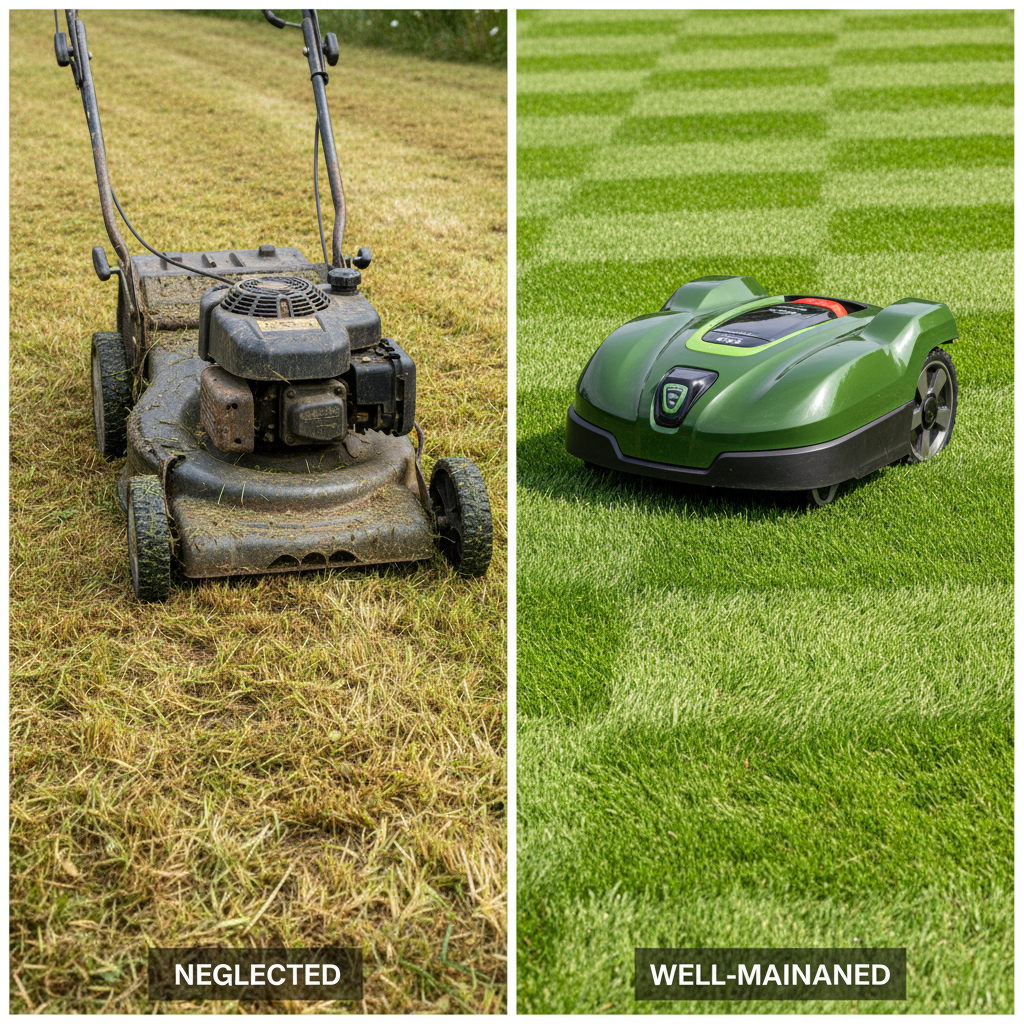
A neglected lawn mower loses cutting efficiency, becomes harder to start, and may fail mid-season. Regular tune-ups prevent these problems by keeping the engine running cleanly, the blade sharp, and all systems in working order. Tune-ups also extend the mower’s lifespan by reducing strain on components, lower fuel consumption, and improve safety by catching worn or damaged parts before they fail. Starting a tune-up routine in spring—before heavy use—ensures your mower performs reliably throughout the season.
What You’ll Need Before Starting
Gather these tools and materials before beginning:
- Tools: Socket wrench set, spark plug socket, screwdrivers (Phillips and flathead), ratchet wrench, oil drain pan, oil filter wrench, wire brush, grinding stone or file, safety glasses, work gloves, and jack or ramps (for riding mowers).
- Replacement Parts: New spark plug, new or replacement air filter, new oil filter (if your mower has one), fresh engine oil, fuel filter, and possibly a carburetor cleaning kit.
- Consumables: Clean rags, compressed air canister, and appropriate engine oil type for your mower (typically SAE 30 or 10W-30 for small engines).
Consult your mower’s manual to confirm oil type, spark plug specifications, and filter sizes. Having everything on hand prevents mid-job delays.
Step 1: Change the Oil
Oil keeps the engine lubricated and removes contaminants. Over time, oil degrades and loses effectiveness, requiring replacement.
- Warm the engine by running it for 2–3 minutes, then shut it off and allow it to cool for 5 minutes. Warm oil flows more easily.
- Locate the oil drain plug (usually on the bottom or side of the engine) and position your drain pan underneath.
- Remove the drain plug with a wrench and let old oil drain completely, typically 5–10 minutes.
- Wipe the drain plug clean and reinstall it, tightening it snugly but not excessively.
- If your mower has an oil filter, unscrew it using an oil filter wrench, apply a thin coat of new oil to the rubber gasket of the new filter, and screw it on hand-tight.
- Remove the oil filler cap, place a funnel in the opening, and add the recommended amount of fresh oil (check your manual for the exact quantity).
- Replace the filler cap, start the engine, run it for 30 seconds, then shut it off and wait 2 minutes.
- Check the oil level using the dipstick or sight glass and top up if needed.
Change oil at the start of the season and every 50 hours of use afterward. If you store your mower over winter, change the oil before storage to remove acidic residues.
Step 2: Replace or Clean the Spark Plug
The spark plug ignites the fuel-air mixture in the engine. A fouled or worn plug makes starting difficult and causes rough running.
- Disconnect the spark plug wire by twisting it gently and pulling it off the plug (do not pull on the wire itself).
- Use a spark plug socket and ratchet wrench to unscrew the plug from the cylinder head.
- Inspect the plug: if it’s heavily fouled, corroded, or the electrode is eroded, replace it. If it’s only lightly soiled, you can clean it with a wire brush.
- If replacing, check your mower manual for the correct plug type and gap specification (typically 0.025–0.030 inches). Most new plugs arrive pre-gapped but verify before installation.
- Thread the new or cleaned plug into the engine by hand first to avoid cross-threading, then tighten it with the spark plug socket to a snug fit (not overtightened).
- Reconnect the spark plug wire, pressing it firmly onto the plug until you hear a click.
Replace the spark plug annually or every 100 hours of use. Replacing it is inexpensive and improves starting and fuel efficiency.
Step 3: Sharpen the Blade
A dull blade tears grass instead of cutting cleanly, leaving a brown, stressed appearance. Sharpening restores clean cuts and the health of your lawn.
- Turn off the engine and disconnect the spark plug wire to prevent accidental starting.
- Tip the mower on its side (carburetor facing up to avoid oil leakage) or use a jack to raise it safely.
- Mark the top side of the blade with paint or tape so you remember its orientation.
- Inspect the blade for cracks or bends; if damaged, replace it instead of sharpening.
- Secure the blade with a block of wood or specialized blade holder to prevent it from spinning.
- Using a metal file or grinding stone, sharpen both edges of the blade at a 30–45-degree angle (the angle used by the manufacturer, listed in your manual). File in one direction only, from the top side of the blade down and away from you.
- Keep the blade balanced: count file strokes and apply the same number to each edge. An unbalanced blade causes severe vibration and engine damage.
- Check balance by hanging the blade horizontally on a nail through its center hole; it should remain level without tilting.
- Reinstall the blade with the marked top side facing up and tighten its bolt securely.
- Lower the mower and reconnect the spark plug wire.
Sharpen blades every 20–25 hours of mowing, or whenever you notice rough cuts. Never use a dull blade; it stresses the engine and damages grass.
Step 4: Service the Air Filter
The air filter prevents dust and debris from entering the engine. A clogged filter restricts airflow, reducing power and efficiency.
- Locate the air filter housing, typically a cylindrical or box-shaped cover on top of or beside the engine.
- Remove the housing by unbolting or unclipping it.
- If the filter is foam or cloth, tap it gently against a hard surface to dislodge dust, then wash it with warm soapy water, rinse thoroughly, and let it dry completely before reinstalling.
- If the filter is paper, replace it with a new one (they cannot be reliably cleaned).
- For heavily soiled foam or cloth filters, replacement is better than cleaning.
- Reinstall the filter and secure the housing with bolts or clips.
Check the air filter every 25 hours of use and clean or replace as needed. A clean filter improves starting and fuel efficiency.
Step 5: Maintain the Fuel System
Stale fuel and carburetor buildup cause hard starting and rough running, especially after storage. Fuel system maintenance ensures consistent engine performance.
- If your mower sits for more than 30 days, drain the fuel tank completely. Turn the fuel valve (if present) to the off position, then disconnect the fuel line at the carburetor and let fuel drain into a container.
- Locate the fuel filter (inline between the tank and carburetor) and replace it if it shows dirt or discoloration.
- To clean the carburetor, disconnect the fuel line and spray carburetor cleaner into the fuel inlet while gently turning the engine over (do not start it). This flushes out varnish and debris.
- For stubborn buildup, remove the carburetor bowl (held by a single bolt), soak it in carburetor cleaner for 15 minutes, and reinstall it.
- If the mower was stored over winter with fuel still in the tank, drain and refill with fresh fuel before starting.
Perform fuel system maintenance at the end of each season before storage and again before spring use. Fresh fuel and a clean carburetor prevent starting problems.
Step 6: Clean the Mower Deck
Grass clippings accumulate underneath the deck, promoting rust and reducing cutting efficiency. Regular cleaning extends deck life and prevents corrosion.
- Disconnect the spark plug wire and tip or jack the mower safely to access the deck underside.
- Use a plastic scraper or wooden stick to remove caked-on grass and debris. Never use your hand or a metal tool, as you may touch a sharp blade edge.
- For stubborn buildup, spray water from a hose while scraping.
- Wipe the deck with a dry cloth and inspect for rust spots or damage.
- If rust is present, lightly sand the area and apply a rust-preventative spray or paint.
- Lower the mower and reconnect the spark plug wire.
Clean the deck after every 3–4 mowing sessions, especially in wet conditions. A clean deck prevents premature deterioration.
Tune-Up Differences by Mower Type
Push Mowers (Gas-Powered): Follow all six steps above. Push mowers are the simplest to maintain and these steps apply directly.
Riding Mowers: All six steps apply, but riding mowers may have additional maintenance: check the belt tension and condition, inspect the deck spindles for wear, and ensure the blade engagement cable works smoothly. Riding mowers also have larger oil capacity and may use different oil types, so consult your manual.
Zero-Turn Mowers: Follow all six steps plus check the hydrostatic transmission fluid and belt tension. Zero-turns are complex machines; refer to the manufacturer’s manual for transmission-specific maintenance.
Electric Mowers (Cordless and Corded): Electric mowers have no engine, so skip oil changes, spark plug replacement, air filter service, and fuel system maintenance. Focus on blade sharpening, deck cleaning, and battery care (for cordless models). Charge batteries fully before storage and keep contacts clean.
Pre-Season and Off-Season Lawn Mower Care
Spring Preparation: Before the mowing season begins, perform a full tune-up: change oil, replace the spark plug, sharpen the blade, service the air filter, and clean the deck. Check fuel for staleness and replace if necessary. Test-run the mower to confirm it starts smoothly and runs without stalling.
Winter Storage: In fall, drain old fuel from the tank and carburetor, or add fuel stabilizer to the tank if you prefer to leave fuel in. Change the oil to remove acidic residues. Clean the deck, sharpen the blade, and store the mower in a dry location away from extreme temperatures. Cover it to protect against dust and moisture. Remove the spark plug and store it separately to prevent accidental starting.
Frequently Asked Questions About How Do You Tune Up A Lawn Mower
How often should you tune up a lawn mower?
Perform a basic tune-up (oil change, spark plug check, filter service) at the start of each mowing season and after every 50 hours of use. Mid-season, inspect and sharpen the blade every 20–25 hours of mowing and clean the deck every 3–4 sessions. At the end of the season, perform another full tune-up before storage.
Can you tune up a lawn mower yourself or does it require a professional?
Most homeowners can perform a basic tune-up themselves with hand tools and a mower manual. Oil changes, spark plug replacement, air filter service, and deck cleaning require only simple tools. Blade sharpening and carburetor cleaning are slightly more involved but still DIY-friendly if you follow instructions carefully. For complex repairs, transmission issues on riding mowers, or if you lack tools, professional service is recommended.
What type of oil should you use for a lawn mower?
Most small gas-powered mowers use SAE 30 or 10W-30 engine oil. Check your mower’s manual for the exact specification, as some models have different requirements. Do not use automotive 5W-30 or heavier grades unless your manual specifies them. Electric mowers require no oil.
How do you know if a lawn mower blade needs sharpening?
If the mower leaves a ragged, brown edge on cut grass instead of a clean green line, the blade is dull. Also, if the mower vibrates excessively or requires more effort to push, sharpening may help. Check the blade visually for flat or rounded edges; sharp blades have a clean, thin edge.









