Intel P-Cores vs E-Cores: How Thread Director Affects Gaming Stutter (2026)
Hybrid CPU architecture arrived on the consumer desktop with Intel’s 12th-generation Alder Lake in late 2021, and by 2026 the design spans four successive microarchitectures, Alder Lake, Raptor Lake, Meteor Lake, and Arrow Lake, each refining the interplay between Performance cores (P-Cores) and Efficient cores (E-Cores). The premise is sound: offload background threads to power-frugal E-Cores, free the wide, high-IPC P-Cores for foreground workloads. In practice, the hardware mechanism that orchestrates this division, Intel Thread Director, introduces a class of gaming stutter that is reproducible, measurable, and, crucially, correctable. This guide dissects the architecture, identifies the failure modes, and provides validated remediation steps grounded in platform-level testing.
Understanding the Hybrid Core Architecture
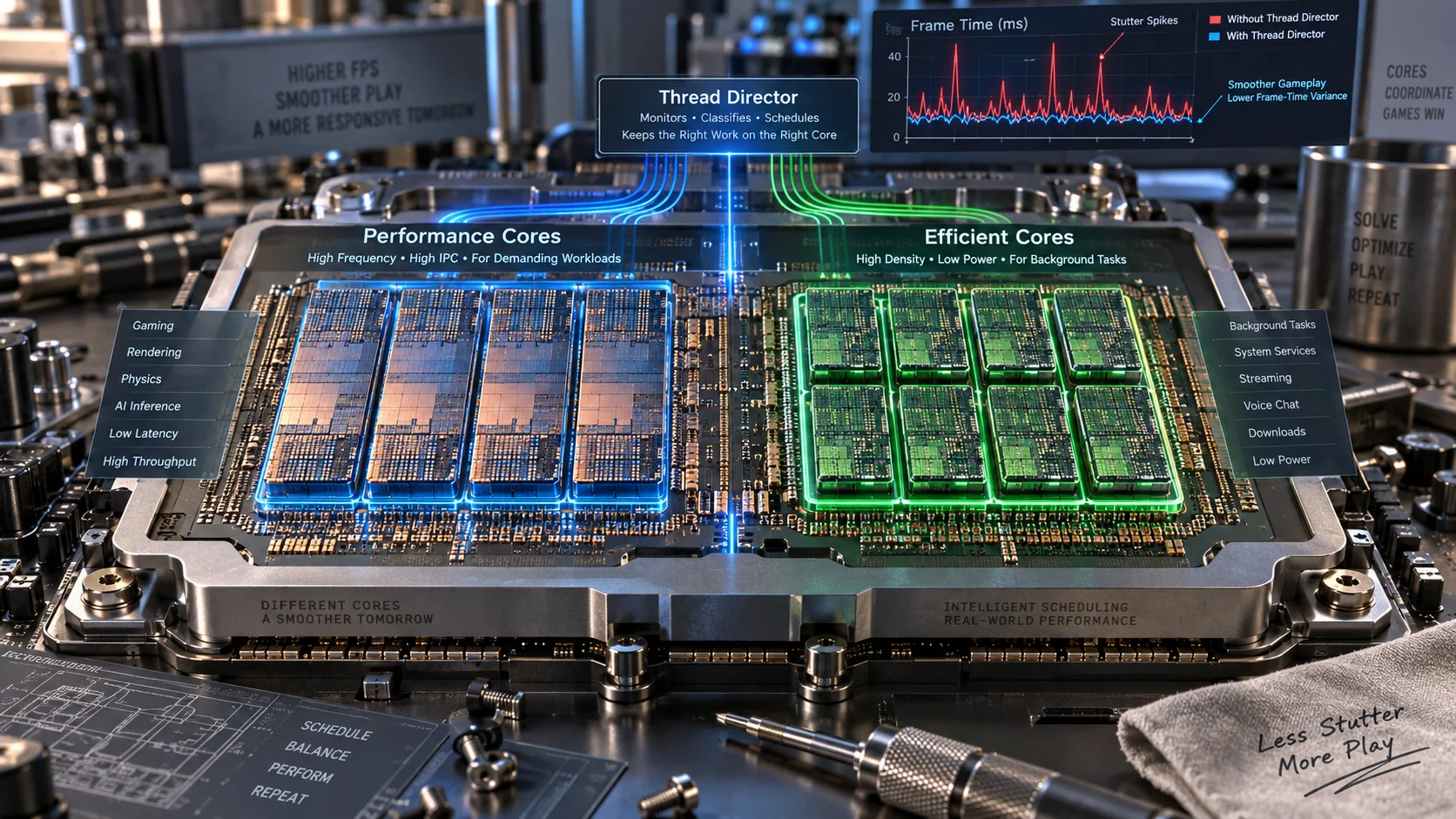
A modern Intel hybrid processor contains two physically distinct core clusters sharing a single die or chiplet package. P-Cores implement the Golden Cove, Raptor Cove, or Lion Cove microarchitecture depending on generation; they are out-of-order, wide-execution engines with large L2 caches (1.25 to 2 MB per core on Raptor Lake, up to 3 MB on Lion Cove) and full Hyper-Threading. E-Cores implement the Gracemont or Crestmont microarchitecture: narrower in-order clusters grouped in quads sharing a 4 MB L3 slice, no Hyper-Threading, lower voltage headroom, and significantly reduced single-thread peak throughput.
The critical hardware layer between these two populations is Intel Thread Director (ITD), introduced with Alder Lake. ITD is a microarchitectural feedback mechanism embedded in the CPU itself. It classifies each hardware thread every millisecond into one of four instruction-mix classes , integer-heavy, floating-point-heavy, memory-bound, or mixed , and exposes that classification as a hint table to the operating system scheduler via a new hardware feedback interface (HFI) ACPI table. The OS scheduler, Windows 11’s heterogeneous scheduling layer in particular, reads these hints and makes placement decisions. The partnership between ITD hardware hints and OS scheduler logic is where gaming stutter is born. When planning workspace deployment, consider the engineering criteria outlined in our what power supply wattage for gaming pc guide.
How Thread Director Classifies Threads
ITD samples the instruction retirement mix of each logical thread using internal performance monitoring counters inaccessible to user-space software. It scores each thread on two axes: performance capability (how well this thread would run on a P-Core relative to an E-Core) and efficiency preference (how much power savings is achievable on an E-Core). These scores are normalized to a 0 to 255 scale and written into per-logical-processor entries in the HFI table. The Windows 11 scheduler reads the HFI table periodically and biases its load balancer toward placing high-performance-score threads on P-Cores.
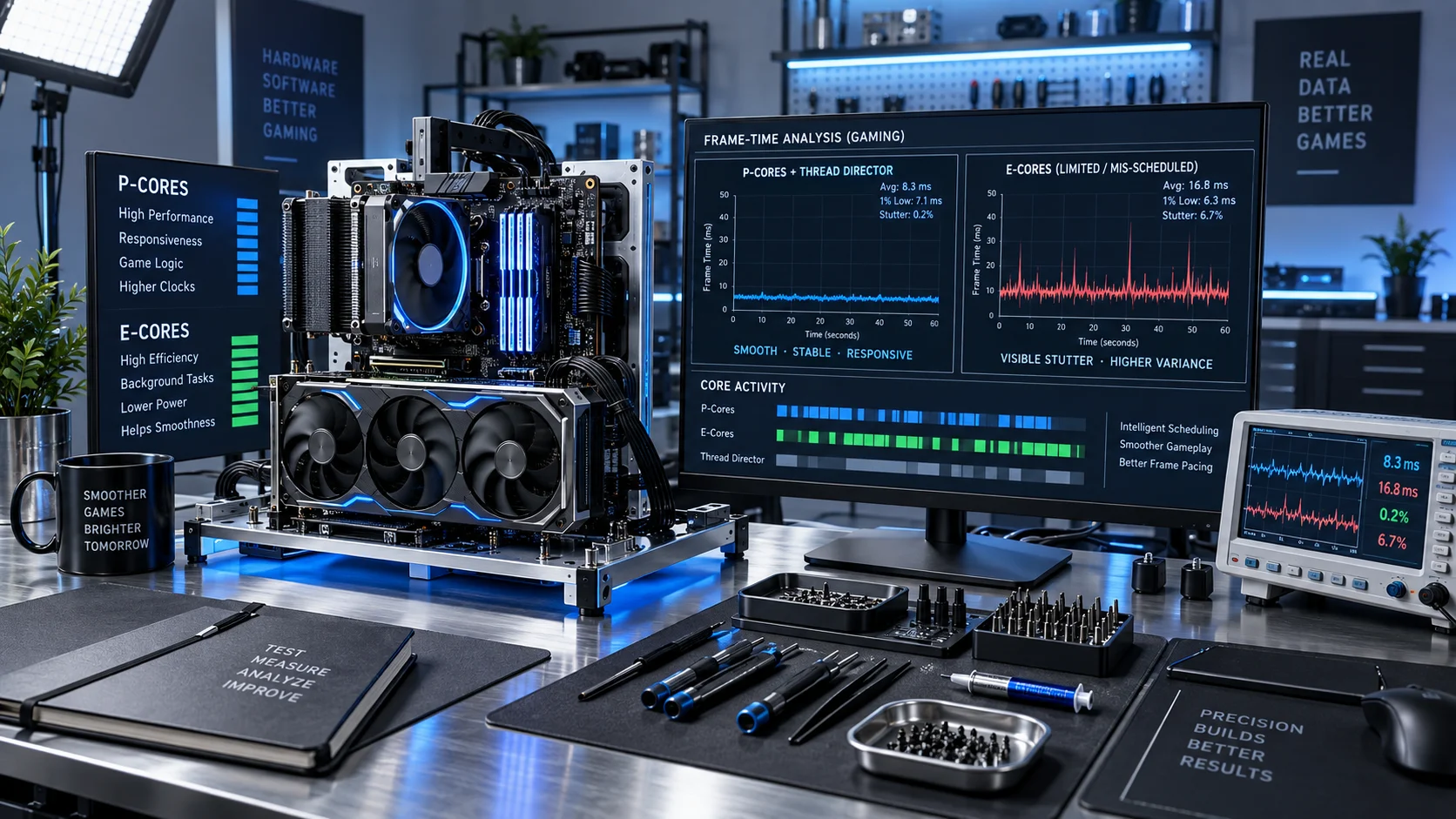
The failure mode for gaming is classification latency and volatility. A game’s render thread, physics thread, or audio thread can appear mixed or even memory-bound during a brief sampling window , particularly during asset streaming, shader compilation, or scene transitions , causing ITD to temporarily downgrade its performance score. The scheduler may then migrate that thread to an E-Core for one or more scheduling quanta (typically 15, 20 ms on Windows). The result is a visible frame-time spike: a 1% low or 0.1% low event that tools like FrameView or CapFrameX report as a stutter rather than a sustained framerate drop. For additional operational safety benchmarks, see our published testing notes on how to fix intel arrow lake z890 bios voltage.
Diagnostic Comparison: P-Core vs E-Core Gaming Impact
| Parameter | P-Core (e.g., Raptor Cove) | E-Core (e.g., Gracemont/Crestmont) | Gaming Impact |
|---|---|---|---|
| Single-thread IPC | High (wide OoO, deep RS) | ~40 to 60% of P-Core at same clock | Critical, render thread on E-Core loses 15 to 30 fps |
| Clock frequency ceiling | 5.0 to 6.2 GHz (boosted) | 3.9 to 4.4 GHz (boosted) | Lower peak throughput on E-Core compounds IPC gap |
| L2 cache per core | 1.25 to 3 MB | 2 MB shared per quad cluster | Cache thrash under multi-threaded game load elevates L3 latency |
| Hyper-Threading | Yes (2 logical per physical) | No | Affects DX12/Vulkan driver thread concurrency models |
| Thread Director class latency | ~1 ms re-score interval | Same hardware interval | Classification lag during asset streaming triggers migration |
| OS scheduler bias (Win11 22H2+) | Preferred for High-priority threads | Preferred for Normal/Idle threads | Process priority elevation keeps game on P-Cores |
| Power consumption at load | 8 to 15 W per core TDP contribution | 2 to 4 W per core TDP contribution | Thermal headroom affects P-Core sustained boost, see CPU temperature limits |
| Inter-core migration cost | Low (P-to-P same ring/mesh) | High (P-to-E crosses fabric domain) | Each cross-cluster migration adds ~0.5 to 2 u00b5s cache reload latency |
| Arrow Lake (Core Ultra 200) change | Lion Cove: no HT, higher IPC | Skymont: ~4u00d7 throughput vs Gracemont | E-Core migration penalty reduced but P-Core IPC still dominant |
Measured Stutter Scenarios and Root Causes
Scenario 1: Render Thread Migration During Scene Load
Open-world titles with runtime asset streaming, Cyberpunk 2077, Microsoft Flight Simulator 2024, Starfield, stress the CPU with burst-IO, decompression, and shader compilation simultaneously. During these bursts, the game’s main render thread temporarily issues a high ratio of memory-bound micro-operations. ITD reads this as a lower performance-class score and suggests migration. If the Windows 11 scheduler acts on that hint before the burst subsides, the render thread executes two to four scheduling quanta on an E-Core. Frame times spike from a baseline of 8 to 10 ms to 22 to 35 ms, perceivable as a hard stutter even at 120 Hz target refresh.
Scenario 2: DirectStorage Decompression Interference
DirectStorage 1.2+ offloads GPU decompression to hardware, but fallback paths and metadata threads still run on CPU. On platforms without correctly calibrated ITD telemetry, these short-lived decompression helper threads compete for E-Core slots with background Windows processes, occasionally displacing game threads already resident there. The cascading effect: background threads bump onto P-Cores, evicting game threads mid-quantum. RAM latency sensitivity compounds this, tighter CAS timings directly reduce the severity, as documented in our guide on RAM speed and timings.
Scenario 3: E-Core Cluster Thermal Saturation
Under prolonged all-core loads, integrated NPU workloads on Meteor Lake, simultaneous streaming and gaming, the E-Core cluster temperature rises independently of the P-Core ring. Intel’s power management firmware (PMC) throttles E-Core clocks to maintain package power limits, but the ITD hint table does not update instantaneously to reflect degraded E-Core performance. The scheduler continues routing threads to thermally constrained E-Cores for up to 50 to 100 ms before the HFI table refreshes with updated efficiency scores. Proper thermal paste application on the IHS maintains uniform die temperature and delays this saturation point.
Operating System Scheduler Evolution and Its Effect on Gaming
Windows 10 had no awareness of heterogeneous core topologies. Threads were load-balanced across all logical processors using a single homogeneous scheduling domain. On Alder Lake hardware running Windows 10, E-Cores were frequently assigned render threads because the scheduler treated them as equivalent execution units. Microsoft addressed this with Windows 11’s heterogeneous scheduling support, mandatory for Intel hybrid platforms, but the implementation has evolved through multiple cumulative updates.
The KB5017321 and subsequent updates through 2022 to 2023 refined the HFI-to-scheduler signal pipeline. By Windows 11 23H2, the scheduler incorporates ITD class hints more aggressively for elevated-priority processes. By Windows 11 24H2 (the 2025 release), further changes to the thread priority boost mechanism reduce voluntary migration of foreground game threads during CPU-intensive background bursts. The practical advice: always run the current Windows 11 cumulative update on any Intel hybrid platform used for gaming. Running a 12th- or 13th-gen Intel chip on Windows 11 21H2 leaves substantial stutter on the table.
Linux users on kernel 5.18+ benefit from the ITMT (Intel Turbo Max Technology) scheduler domain logic that integrates ITD scores into the CFS scheduler’s load balancer weights. Gaming on Proton/Wine sees measurably less cross-cluster migration than early hybrid Linux builds, though Windows remains the primary gaming platform where ITD behavior is most studied.
Arrow Lake and the ITD Recalibration in 2025 to 2026
Intel’s Core Ultra 200S series (Arrow Lake, released Q4 2024) introduced a disaggregated chiplet design: the Compute Tile (P-Cores on Intel 20A/TSMC N3B), the SoC Tile (E-Cores, NPU, IO), and the GPU Tile are separate silicon dies connected via EMIB and Foveros packaging. This physical separation changes ITD’s operating context. Cross-cluster thread migration now crosses a die boundary with measurably higher latency than on monolithic Raptor Lake.
Intel responded by recalibrating Thread Director’s migration aggressiveness in Arrow Lake’s PMC firmware. The updated ITD implementation raises the threshold performance-score delta required to trigger a cross-cluster migration recommendation, effectively making the scheduler more conservative about moving high-class threads off P-Cores. Initial testing in late 2024 showed Arrow Lake’s gaming stutter profile was improved over Raptor Lake at equivalent settings, but the gains were partially offset by Arrow Lake’s removal of Hyper-Threading on P-Cores, a controversial decision that reduced thread concurrency for DX12 titles relying on fine-grained command list parallelism.
Intel’s official documentation on Thread Director architecture is published in the Intel Thread Director developer reference, covering the HFI table structure, class definitions, and scheduler integration points relevant to platform developers and OS vendors.
PCIe Topology and Its Interaction with Core Scheduling
A less-discussed stutter vector involves GPU interrupt servicing. PCIe interrupt completion routines execute on the logical processor that owns the interrupt affinity mask, often processor 0 or processor 1, which on most Intel hybrid platforms maps to P-Core 0’s logical threads. If the OS scheduler migrates the game’s render thread off P-Core 0 during an E-Core migration event, GPU frame-completion interrupts and render thread resumption occur on different cores, adding a synchronization penalty. This is why manually setting GPU interrupt affinity to P-Core logical processors via msconfig or third-party tools like Process Lasso produces measurable 1% low improvements on 12th/13th-gen platforms. PCIe 5.0 bandwidth is not the limiting factor here, latency of interrupt delivery is, but understanding PCIe 5.0 compatibility matters for confirming the slot runs at full x16 electrical width without bifurcation surprises.
Validated Remediation Steps for Gamers in 2026
Step 1: BIOS and Firmware Configuration
- Load Recommended Defaults or Optimized Defaults in BIOS, many OEM aggressive XMP profiles set E-Core voltage offsets that destabilize the cluster under burst load.
- Disable E-Cores entirely only as a last resort; on 13th-gen 24-core SKUs, removing 16 E-Cores surrenders background task capacity and raises P-Core temperatures due to lost thermal mass distribution.
- Set PL1 = PL2 at rated TDP rather than allowing unlimited power delivery, which causes thermal-induced ITD hint table lag on inadequate coolers.
- Update to the latest BIOS to receive the most recent PMC firmware carrying ITD calibration patches specific to your die stepping.
Step 2: Windows Scheduler Configuration
- Apply all pending Windows 11 cumulative updates; the scheduler HFI integration patches are not optional for hybrid platforms.
- Set game executable priority to High in Task Manager or via Process Lasso’s persistent profile. High-priority processes receive preferential P-Core affinity under the Windows 11 heterogeneous scheduler.
- Use the Balanced or High Performance power plan, not Ultimate Performance, which disables core parking but also disables ITD-guided frequency scaling, producing less informed placement decisions.
- After any driver update, perform a GPU driver clean install, stale driver state occasionally misconfigures interrupt affinity masks that persist across reboots.
Step 3: In-Game and API-Level Controls
- Enable Resizable BAR (Smart Access Memory equivalent) in BIOS and GPU driver settings, it reduces CPU involvement in VRAM address translation, lowering E-Core interrupt load that competes with game threads.
- For DX12/Vulkan titles, prefer async compute where the option exists; async compute moves GPU work off CPU submission threads, reducing the thread count that ITD must classify and the probability of a misfired migration.
- Disable in-game overlays (Discord, Xbox Game Bar) or reduce their process priority, these spawn additional Normal-priority threads that consume E-Core slots and trigger unnecessary load balancer activity.
Conclusion: ITD Is a Tool, Not a Guarantee
Intel Thread Director represents a genuine advance in heterogeneous compute management: real-time hardware classification of workload characteristics, exposed to the OS with millisecond granularity, is architecturally superior to the static affinity masks that preceded it. The gaming stutter problem is not a design flaw in Thread Director itself, it is an emergent mismatch between ITD’s power-optimization objectives and the latency requirements of a real-time interactive workload. Game threads are not steady-state; they burst, block on GPU sync primitives, and change instruction mix within the span of a single frame. ITD’s 1 ms classification window is too coarse to track these transitions without occasional misclassification.
The trajectory through Alder Lake, Raptor Lake, Meteor Lake, and Arrow Lake shows Intel progressively tightening ITD’s migration thresholds and improving OS scheduler integration. Each generation reduces, but does not eliminate, the risk of stutter from cross-cluster thread migration. For the 2026 gaming platform builder, the practical advice is concrete: run Windows 11 at current patch level, keep BIOS firmware updated, elevate game process priority, and monitor frame-time data with CapFrameX or PresentMon rather than relying on average FPS, which masks the stutter events that ITD misclassification produces. Average framerates remain misleading; 1% lows and frame-time variance are the metrics that expose whether Thread Director is working for your game or against it.

Pros
- Very strong core hardware combination with a flagship-class CPU, high-end GPU, and large memory capacity.
- Prebuilt system is stress-tested before shipping and includes lifetime technical and diagnostic support.
- 3-year limited hardware warranty adds extra buyer protection for a premium desktop purchase.
- No bloatware is listed, which can mean a cleaner Windows installation experience.
- Wireless connectivity includes internal Wi-Fi 6E for modern home networking support.
Cons
- The Intel Core i9-14900KF has no integrated graphics, so the system depends on the discrete GPU for video output.
- The non-RGB design may not suit buyers who want a more flashy gaming aesthetic.
- Only one HDMI and one DisplayPort are guaranteed, and additional port availability may vary.
Overview & Design: The Empowered PC Mantis V2 Non-RGB is a premium prebuilt gaming tower built around an Intel Core i9-14900KF, RTX 5080 16GB graphics, 64GB DDR5 memory, and a 2TB Gen4 NVMe SSD. The case uses a brushed aluminum front panel with a tempered glass side panel, giving it a clean look rather than an RGB-heavy style.
Performance & Key Features: This configuration is aimed at users who want fast gaming, strong multitasking, and capable content creation performance. The 24-core CPU and high-memory GPU should handle demanding titles, streaming, and productivity tasks well, while the SSD supports quick boot times and fast loading. Windows 11 Pro, Wi-Fi 6E, and the included keyboard and mouse make it practical as a ready-to-use desktop.
Drawbacks & Considerations: Because the processor is a KF model, there is no integrated graphics, so the system requires the discrete GPU to function for display output. The non-RGB design may be a downside for buyers who prefer more visual flair. Also, the listed video outputs are limited to guaranteed HDMI and DisplayPort connections, with additional ports depending on the build.
Verdict: The Mantis V2 is best suited to gamers, streamers, and creators who want high-end prebuilt performance without assembling a PC themselves. It stands out for its powerful specs, warranty coverage, and included support, but it is most appealing to buyers who value performance and simplicity over flashy aesthetics.

Pros
- Very large 128GB DDR5 memory capacity for demanding multitasking.
- Massive 11TB storage is useful for games, media libraries, and project files.
- Broad connectivity with Wi-Fi 6E, Bluetooth 5.3, and multiple video and USB ports.
Cons
- RTX 4060 Ti 8GB is capable, but it is not the strongest GPU option for a system with this premium CPU and memory.
- Most of the 11TB storage is on a hard drive, so bulk capacity is high but speed is lower than SSD storage.
- The listing does not include a monitor, keyboard, or mouse, so this is a tower-only purchase.
Overview: The ASUS ROG Strix G700TF is a desktop gaming tower built around an Intel Core Ultra 9 285K, 128GB of DDR5 memory, and Windows 11 Pro. The spec sheet suggests a machine focused on high capacity, strong responsiveness, and premium desktop performance.
Performance: The processor and large memory pool should handle modern games, multitasking, and creative workloads with ease. Its storage setup is also practical, with a 1TB SSD for faster system access and a 10TB HDD for large file storage, while the RTX 4060 Ti 8GB supports current gaming and graphics workloads.
Drawbacks: The main limitation is balance. The RTX 4060 Ti is solid, but it is not the most powerful graphics option in this class, so users chasing the highest 4K gaming settings may want more GPU power. The HDD adds capacity, but it will be slower than SSD storage for frequently accessed files.
Verdict: This tower is a strong fit for buyers who prioritize massive RAM, huge storage, and a fast Intel CPU for multitasking and productivity. It offers a lot of system resources, but gamers focused mainly on top-end graphics performance may prefer a model with a stronger GPU.

Pros
- Strong hardware balance with dual CPUs and 128GB RAM for demanding server tasks.
- Enterprise SSD storage and RAID controller support faster access and better storage resilience.
- Remote management through iDRAC9 Express simplifies administration.
- Included Windows Server 2016 Standard reduces setup time for compatible environments.
Cons
- Renewed condition means cosmetic wear and prior-use history can vary.
- Windows Server 2016 is an older server operating system compared with newer releases.
- The listing does not provide full details on warranty coverage, expansion options, or included accessories.
Overview: The Dell PowerEdge T640 is a renewed tower server designed for small businesses, branch locations, and home offices that need more than a basic desktop system. Its tower format and enterprise hardware make it a practical choice for dedicated server deployments.
Performance and features: With dual Intel Silver 4110 processors, 128GB of DDR4 registered memory, and 1.6TB of Enterprise SAS SSD storage, this system is built to handle multitasking, shared applications, and data-heavy workloads with greater responsiveness. The PERC H730P RAID controller and iDRAC9 Express add storage control and remote management capability.
Drawbacks and considerations: Because this is a renewed unit, buyers should expect some variation in cosmetic condition and prior usage. The included Windows Server 2016 Standard installation is functional, but it is not the newest Microsoft server platform, and the listing does not specify warranty, dimensions, or accessory details.
Verdict: This T640 makes the most sense for buyers who want a ready-to-run Windows tower server with strong CPU, memory, and enterprise storage specs. It is best suited to organizations or advanced home users who value remote management, RAID support, and dependable server-class components.
Pros
- Large 128GB RAM configuration is strong for this class of server.
- High-capacity 16TB SAS drive setup is well suited to shared storage and backups.
- Dual-CPU design gives it more multitasking potential than single-processor tower servers.
- Tower chassis is practical for small office or branch office deployment.
- Windows Server 2019 Standard comes preloaded, simplifying initial use.
Cons
- It is a renewed unit, so cosmetic wear or variation in condition may be present.
- The 7.2K HDDs prioritize capacity over speed, so storage performance will not match SSD-based systems.
- The Intel Silver 4110 platform is older than current-generation server hardware.
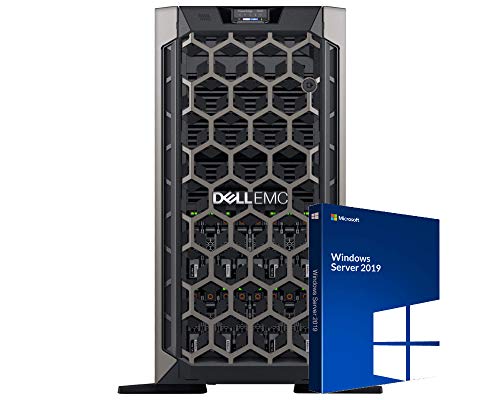
Overview: The Dell PowerEdge T440 is a renewed tower server built for small businesses, branch locations, and home offices. Its tower chassis is practical for environments that do not use a rack, and the overall setup is aimed at dependable everyday server use.
Performance: With dual Intel Silver 4110 8-core processors, 128GB of DDR4 registered memory, and 16TB of 12Gb/s SAS storage, this system is designed to handle shared files, backups, light virtualization, and other multi-user workloads. The included PERC H330 RAID controller adds storage management flexibility.
Drawbacks: This configuration uses 7.2K hard drives, so it favors capacity over speed. Since it is a renewed server, buyers should also expect possible cosmetic wear and should confirm the exact included accessories and condition before purchase.
Verdict: The T440 makes the most sense for buyers who need a prebuilt, high-capacity Windows Server solution and value expandability more than cutting-edge performance. It is a practical choice for IT setups that need reliable local infrastructure.
Extra Reading on Core Designs
Efficiency cores and performance cores handle background tasks and demanding threads differently, and games do not always use them the same way. If you want general context on how processor design terms are documented, American National Standards Institute (ANSI) is a reasonable place to begin.