

Quick Answer: Choosing the Best Lawn Mower Oil Type
The oil your lawn mower takes depends on the engine type. Most 4-stroke mower engines use SAE 30 or SAE 10W-30 detergent oil with an API classification of SF, SG, SH, SJ, or higher. 2-stroke engines require a separate 2-stroke oil that is mixed with fuel. To get the exact specification, identify whether your mower is a push, self-propelled, riding,…

Pros
- SAE 30 viscosity for four-stroke mower engines
- Stated as exceeding API SJ specifications
- Sized for 2 to 5.5 horsepower mowers
- Designed for most air-cooled four-stroke engines
Cons
- Not described for engines outside 2 to 5.5 horsepower
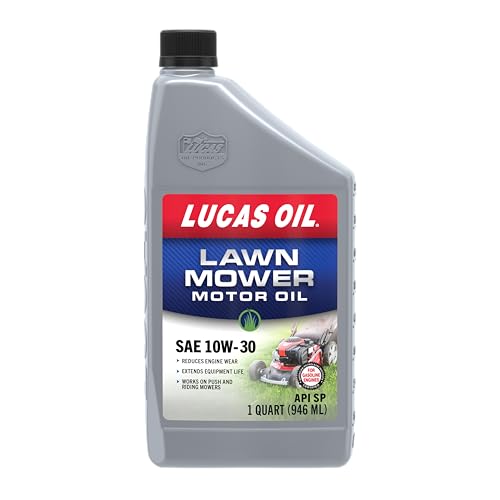
Pros
- SAE 10W-30 grade listed for lawn mower engines
- Listed for push and riding mowers
- Manufacturer claims wear and rust protection
- One-quart bottle size
Cons
- Benefits are manufacturer claims, not verified results
- No customer reviews are provided
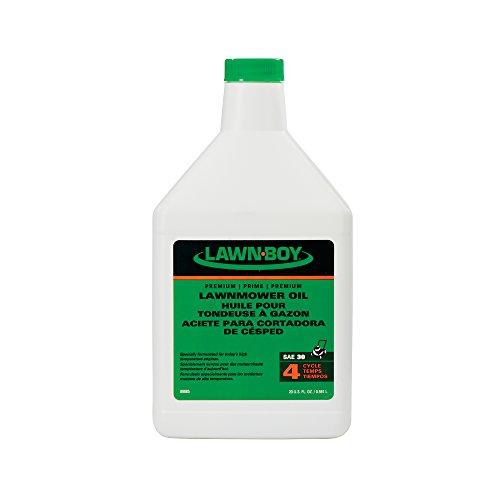
Pros
- Formulated for high-temperature four-stroke engines
- Listed to cool, clean and seal internal moving parts
- No additional additives needed, per the listing
- Comes in a 20-ounce bottle
Cons
- Viscosity grade and API rating not listed in the data
- Small bottle size, per the listing
Identify Your Mower and Engine Type First
Before you can choose the right oil, you need to know what kind of engine your lawn mower has. The most important distinction is between a 2-stroke engine and a 4-stroke engine, because they require fundamentally different oil handling.
A 4-stroke engine has a separate oil reservoir that you fill and check with a dipstick. The oil lubricates the engine but is not burned with the fuel. Most modern lawn mowers, including push mowers, self-propelled models, riding mowers, and zero-turn mowers, use 4-stroke engines.
A 2-stroke engine, on the other hand, does not have a separate oil reservoir. Instead, the oil is mixed directly with the gasoline, and the mixture is burned in the combustion chamber. 2-stroke engines are less common in modern lawn mowers but are still found on some older models and certain types of equipment like string trimmers and chainsaws.
To tell which type you have, look for an oil fill cap or dipstick. If you see one, it is a 4-stroke engine. If there is no oil fill cap and the fuel cap is the only access point, it is likely a 2-stroke engine.
The type of mower, push, self-propelled, riding, or zero-turn, does not by itself determine the oil type. What matters is the engine. A push mower and a riding mower can both use 4-stroke engines, and they may even use the same viscosity of oil. However, riding and zero-turn mowers often have larger engines that may have different oil capacity and occasionally different viscosity recommendations.
Standard Oil Types for 4-Stroke Mower Engines

For the vast majority of 4-stroke lawn mower engines, the recommended oil is a high-quality detergent oil with a viscosity of SAE 30 or SAE 10W-30, and an API service classification of SF, SG, SH, SJ, or higher.
SAE 30 is a single-grade oil that is commonly recommended for use in warmer temperatures, typically above 40°F (4°C). It is thick enough to provide a strong protective film at operating temperature. SAE 10W-30 is a multi-grade oil that flows more easily in cold weather, making it a good all-season choice. Many manufacturers accept either SAE 30 or SAE 10W-30, and some specify 10W-30 as the preferred option for a wider temperature range.
The API service classification indicates the oil’s performance level. The letters progress alphabetically, with newer letters generally representing better additive packages and protection. For lawn mower engines, a classification of SF, SG, SH, SJ, or higher is typically sufficient. Using an oil with a higher classification, such as SL or SM, is usually fine as long as it meets the viscosity requirement.
Detergent oil is recommended because it contains additives that help keep the engine clean by suspending dirt and combustion byproducts so they can be removed during an oil change. Non-detergent oil is not recommended for modern mower engines because it does not provide the same level of cleaning and protection.
2-Stroke Engines and Oil-Fuel Mixing
If your lawn mower has a 2-stroke engine, you will need a dedicated 2-stroke oil that is designed to be mixed with gasoline. This oil is sometimes called 2-cycle oil and is available in bottles that are pre-measured for specific fuel volumes. For broader ecosystem context, read through our operational guide on marshall stanmore iii vs harman kardon onyx studio 8.
The correct oil-to-fuel ratio is critical for the engine’s health. Common ratios include 50:1, 40:1, and 32:1, meaning 50, 40, or 32 parts of gasoline to 1 part of oil. The exact ratio for your mower will be stated in the owner’s manual and is often printed on the fuel cap or near the fuel tank. Using the wrong ratio, especially too little oil, can cause severe engine damage from lack of lubrication.
You must never use 4-stroke engine oil in a 2-stroke engine. 4-stroke oil is not designed to be burned with fuel and will cause heavy smoke, carbon buildup, and potentially catastrophic engine failure. Always use a 2-stroke oil that meets the specifications recommended by the engine manufacturer, and mix it thoroughly with the gasoline in a separate container before adding it to the fuel tank. For troubleshooting and reliability insights, consult our in-depth dyson v8 cyclone vs bissell featherweight stick report.
Finding the Exact Spec in Your Owner’s Manual
The most reliable way to determine the exact oil your lawn mower needs is to consult the owner’s manual. The manual will list the recommended viscosity grade, the API classification, and the oil capacity for your specific engine model.
If you have lost the manual or bought the mower used, you can often find a digital copy online. Search for the mower’s brand and model number, which is usually located on a decal on the mower’s deck or frame. You can also look up the engine model number, which is typically stamped on the engine block or printed on a label. The engine manufacturer’s website will often have the oil specification available. Readers comparing setup options can review our technical analysis on bissell crosswave hydrosteam vs shark stainforce.
If you cannot find the manual, a safe fallback for a 4-stroke mower is to use SAE 30 or SAE 10W-30 detergent oil with an API classification of SJ or higher, as this covers the majority of mower engines. However, this is not a substitute for the manufacturer’s recommendation, and you should make every effort to confirm the exact spec before adding oil.
Engine Oil vs. Other Fluids
It is important to understand that the engine oil is not the same as the other fluids used in your lawn mower, particularly on riding and zero-turn models. These machines often have a transmission and may have a hydraulic system, each requiring its own specific fluid.
The engine oil lubricates the internal components of the engine. The transmission fluid is used in the hydrostatic or gear transmission to transfer power from the engine to the wheels. These fluids have different properties and are not interchangeable. Using engine oil in the transmission can cause damage and poor performance.
Some riding and zero-turn mowers also use hydraulic fluid for power steering or for the deck lift mechanism. Again, this is a distinct fluid with its own specification. The owner’s manual will clearly identify each fluid type and its recommended specification. Always use the fluid specified for each system and never mix different types.
Technical Standards and Compliance
Mechanical safety standards, operational tolerances, and protective gear guidelines align with benchmark specifications established by the American National Standards Institute (ANSI).









