

Quick Answer: Choosing the Best Riding Lawn Mower Oil Type
Choosing the right oil for your riding lawn mower is essential for engine protection and performance. The correct choice depends primarily on the temperature range in which you operate the mower. Most riding mower engines are four-stroke, air-cooled gasoline engines. They do not use the same oil as your car’s engine, though some automotive oils meet the necessary specifications.

Pros
- Large-size design named in product title
- Sharpening and balancing functions listed
- Listed as a new upgraded version

Pros
- Adjustable 15-to-45-degree range in title
- Sharpening and balancing functions listed
Pros
- Includes replacement gaskets and a 98079-55846 spark plug
- Matches Honda HRR216 and HRS216 lawn mower models
- Designed around the 16100-Z8B-901 carburetor specification
Cons
- Restricted to select Honda GCV160 mower applications
- Installation requires basic mechanical tools and skills
Here is a general guide to the most common viscosity grades and their typical operating temperature ranges:
- SAE 30: This is a single-grade oil ideal for consistently warm weather. It is often recommended for summer use when temperatures are generally above 40°F (4°C).
- 10W-30: This multi-grade oil provides good cold-start performance while offering protection at higher operating temperatures. It is a versatile choice for variable temperatures throughout spring and fall.
- 5W-30: This multi-grade oil flows more easily at very low temperatures, making it suitable for cold climates or early morning starts in cooler weather.
These are broad guidelines. The definitive source for the correct oil type for your specific engine is always the owner’s manual.
Viscosity Grades Explained
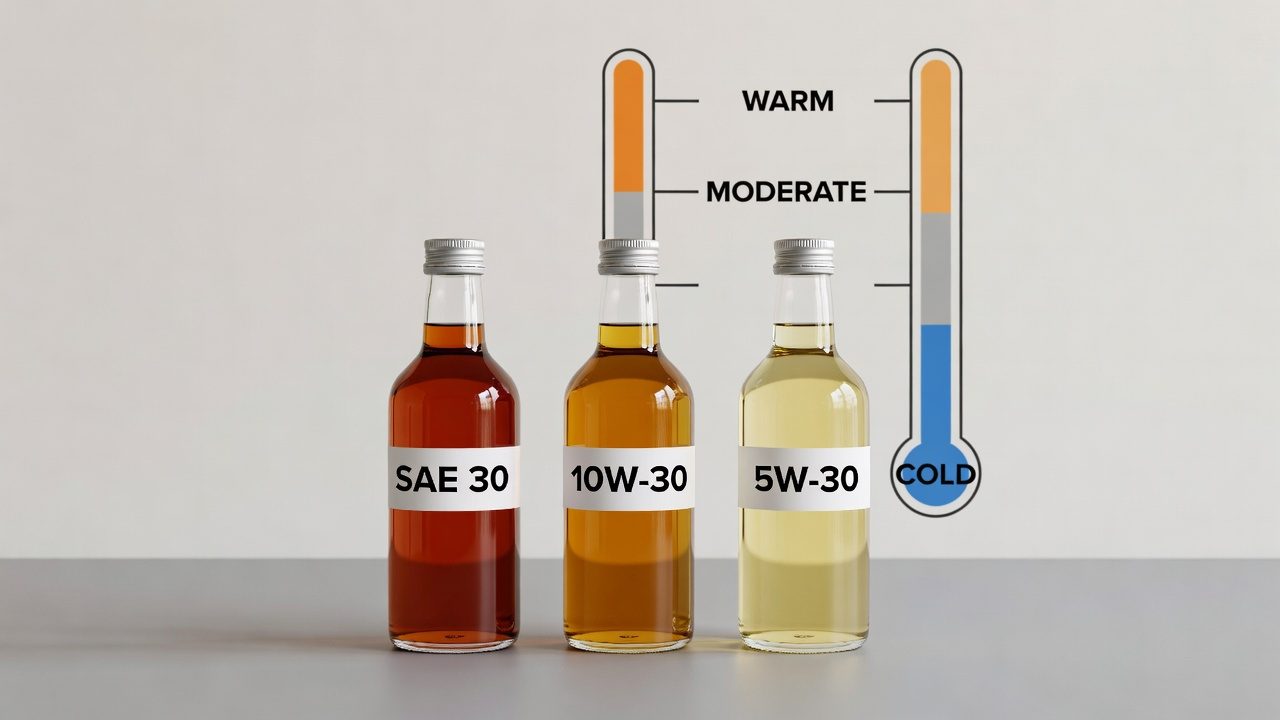
The numbers on the oil bottle, such as SAE 30 or 10W-30, refer to the oil’s viscosity, or its resistance to flow. Understanding these numbers helps you make an informed choice.
What does SAE 30 mean? SAE stands for the Society of Automotive Engineers, which sets the viscosity standards. A single-grade oil like SAE 30 has a viscosity that is measured at a single, high operating temperature. It thickens more in cold weather than multi-grade oils.
What is the difference between 10W-30 and 5W-30? The “W” stands for winter. The number before the “W” indicates the oil’s flow characteristics at cold temperatures. A lower number (5W vs. 10W) means the oil is thinner and flows more easily when the engine is cold, which reduces wear during startup. The second number (30) indicates the oil’s viscosity at the engine’s normal operating temperature. Both 10W-30 and 5W-30 have the same high-temperature viscosity, but the 5W-30 will perform better in cold conditions.
Why do multi-grade oils have two numbers? Multi-grade oils contain additives called viscosity index improvers. These additives allow the oil to behave like a thinner oil when cold and a thicker oil when hot, providing protection across a wider range of temperatures.
Synthetic vs. Conventional Oil
Another important decision is whether to use conventional (mineral) oil, synthetic oil, or a synthetic blend.
Can I use synthetic oil in my riding mower? Yes, in most cases. Major engine manufacturers like Briggs & Stratton, Kohler, and Kawasaki generally approve synthetic oils that meet the required API service classification and viscosity grade. Synthetic oil is engineered for superior performance.
Is synthetic oil better for air-cooled engines? Air-cooled engines, which are common in riding mowers, can run hotter than liquid-cooled car engines. Synthetic oil typically provides better thermal stability, meaning it resists breaking down at high temperatures. It also contains fewer impurities and can reduce the formation of deposits and sludge. For additional operational safety benchmarks, see our published testing notes on marshall stanmore iii vs harman kardon onyx studio 8.
Do I need to stick with conventional oil for an older engine? Not necessarily. If the engine is in good condition without excessive wear or leaks, synthetic oil can be used. However, if an older engine has developed significant wear, the superior sealing properties of conventional oil might be preferable in some cases. Always consult the manual.
What about synthetic blends? Synthetic blends offer a middle ground, providing some of the benefits of synthetic oil at a lower cost than a full synthetic. They are a suitable option for many riding mower engines.
API Service Classification: What to Look For
The American Petroleum Institute (API) sets performance standards for motor oils. The API “S” category is for gasoline engines. You will see ratings like API SJ, SL, SM, SN, or SP on the oil bottle. To compare alternative configurations, check our hands-on review of dyson v8 cyclone vs bissell featherweight stick.
What API rating do riding mower engines require? The common baseline for most small four-stroke engines is API SJ or higher. This means an oil rated SN or SP meets or exceeds the requirements of an engine calling for SJ.
Can I use oil rated for diesel engines (e.g., CJ-4)? It is generally not recommended. Diesel oils have different additive packages and may not be formulated for the specific needs of small gasoline engines. Stick to oils with an API “S” service classification. Users looking for related component recommendations can explore our bissell crosswave hydrosteam vs shark stainforce breakdown.
Does a higher API letter (SN, SP) replace an older one (SJ)? Yes, the API “S” categories are backward compatible. An oil meeting a newer specification (like API SP) is designed to be an improvement over older ones and will meet the requirements of engines designed for earlier specifications.
How to Check and Change the Oil
Proper maintenance includes regular oil checks and changes. Here is the general procedure:
How do I check the oil level correctly? Ensure the engine is off and has had a few minutes for oil to drain back into the crankcase. Park the mower on a level surface. Locate the dipstick, which is often attached to the oil fill cap. Remove it, wipe it clean, reinsert it fully, and remove it again to read the level. The oil should be between the “Add” and “Full” marks.
How often should I change the oil? A typical guideline is to change the oil every 50 to 100 hours of operation, or at least once per mowing season. However, the owner’s manual for your specific engine will provide the manufacturer’s recommended interval.
What is the correct way to drain and refill? Warm the engine slightly to help the oil flow out. Place a drain pan under the oil drain plug or drain valve. Remove the plug or open the valve and let the oil drain completely. Replace the plug securely, then refill with the correct type and amount of oil. Check the level with the dipstick and add more if needed, being careful not to overfill.
How much oil does a typical riding mower hold? Oil capacity varies by engine size, but a common range is 1.5 to 2 quarts. The exact capacity for your engine is specified in the owner’s manual.
Brand-Specific Considerations
While the general guidelines above apply to most engines, major manufacturers may have unique specifications or recommendations.
Does Briggs & Stratton require a specific oil? Briggs & Stratton publishes oil charts that recommend specific viscosity grades based on the expected temperature range during operation. Their manuals will state whether synthetic oil is approved for a given engine model.
Are Kohler engines different? Kohler also provides detailed oil specifications in their owner’s manuals. Some Kohler engines may have specific recommendations regarding oil change intervals or approved oil types for different operating conditions.
What about Kawasaki V-twin engines? Kawasaki engines have their own maintenance schedules and oil requirements. The engine model number is key to finding the correct specifications.
Where do I find the exact spec for my engine model? The most reliable source is the owner’s manual that came with your mower or engine. If you have lost the manual, you can often find a digital copy on the engine manufacturer’s website. You will need the engine model number, which is typically found on a sticker or plate on the engine itself, not the mower deck.
Common Mistakes and Risks
Avoiding common errors can prevent costly engine damage and ensure safety.
What happens if I use the wrong viscosity? Using an oil that is too thick for cold weather can cause hard starting and inadequate lubrication during startup, leading to increased wear. Using an oil that is too thin for high temperatures can result in low oil pressure and poor lubrication at operating temperature.
Can overfilling oil hurt the engine? Yes. Overfilling the crankcase can cause the crankshaft to whip the oil into a foam. This aerated oil cannot lubricate effectively and can lead to overheating, seal leaks, and in severe cases, hydro-lock, where oil enters the combustion chamber and prevents the engine from turning over.
Is it safe to check oil on a hot engine? It is not recommended. Hot oil can cause burns. Additionally, the oil level reading is less accurate because the oil has not had time to fully drain back into the sump.
Do new mowers need special break-in oil? Some manufacturers recommend an initial oil change after a short break-in period, such as 5 to 10 hours of operation, to remove any metal particles from the engine’s break-in process. Check your manual for specific break-in instructions.
When to Consult the Owner’s Manual
The owner’s manual is the final authority for your specific equipment. It contains information tailored to your engine’s design and warranty requirements.
Where in the manual is the oil specification? Look in the “Specifications” or “Maintenance” sections. There will typically be a table or paragraph that lists the recommended oil type, viscosity grade, and API service classification.
What if I lost the manual? You can often download a PDF version from the manufacturer’s website. Search for the engine model number, not the mower brand or model number.
Can I use the engine model number to look it up online? Yes. The engine model number is the most precise way to find the correct specifications. Once you have it, visit the website of the engine manufacturer (e.g., Briggs & Stratton, Kohler, Kawasaki) and look for their support or manuals section.
Using the right oil is a simple but critical part of maintaining your riding lawn mower. By understanding viscosity grades, oil types, and API ratings, and by always deferring to your owner’s manual, you can ensure your engine runs reliably for years to come.
Related Maintenance and Operating Guides
To keep your equipment running at peak operating efficiency, explore our related technical walkthroughs and maintenance tutorials:
- Consult our detailed breakdown on heavy-duty chainsaw buyer guide.
Technical Standards and Compliance
Mechanical safety standards, operational tolerances, and protective gear guidelines align with benchmark specifications established by the American National Standards Institute (ANSI).









