Quick Answer: RX 9070 vs RX 9070 XT — Which Should You Buy in 2026?
Buy the RX 9070 XT if you want the highest gaming performance, play at high-refresh 1440p or 4K, or can find it for only about $50–$80 more than the RX 9070. It is typically 10–13% faster in rasterized gaming and 9–19% faster in ray tracing. Choose the RX 9070 if you value lower power use, a smaller PSU requirement, or a lower purchase price—particularly when it is at least $80–$100 cheaper. Standard operational and maintenance protocols can be consulted via AMD official chipset architecture and support resources.
Winner by Category
| Category | Winner | Margin / Evidence |
|---|---|---|
| 1080p | RX 9070 XT | Approximately 9–11% faster on average, although CPU limits can narrow the gap; individual games have shown roughly 6–15%. |
| 1440p | RX 9070 XT | Approximately 11–13% faster on average; a 52-game comparison measured a 12% advantage. |
| 4K | RX 9070 XT | Approximately 11–14% faster on average; a 52-game comparison measured a 12% advantage. |
| Ray tracing | RX 9070 XT | Generally 9–19% faster, with the larger gains appearing in demanding workloads. It has 64 ray accelerators versus 56. |
| Upscaling | Tie | Both support FSR 4, HYPR-RX and AMD Fluid Motion Frames. Neither supports Nvidia DLSS. |
| VRAM | Tie | Both include 16GB of GDDR6 memory on a 256-bit bus with 640GB/s of bandwidth. |
| Power | RX 9070 | 220W TBP versus 304W for the RX 9070 XT, giving the RX 9070 the efficiency and system-power advantage. |
| Value | RX 9070, conditionally | It is the better value when the price gap is close to the original $50 MSRP difference. The XT can win when its premium is no more than approximately 10–15%. |
Pros
- Large 16GB VRAM buffer is well suited to demanding games and visual settings.
- Advanced WINDFORCE cooling design offers multiple thermal management features.
- Dual BIOS provides useful flexibility between performance and lower-noise operation.
- Reinforced build quality adds confidence for long-term desktop installation.
Cons
- The 2.7-slot design may be too bulky for smaller cases or tightly spaced builds.
- Full AMD platform benefits are best realized with compatible Ryzen 9000 and AM5 hardware.
- RGB customization depends on GIGABYTE CONTROL CENTER, which adds software overhead.
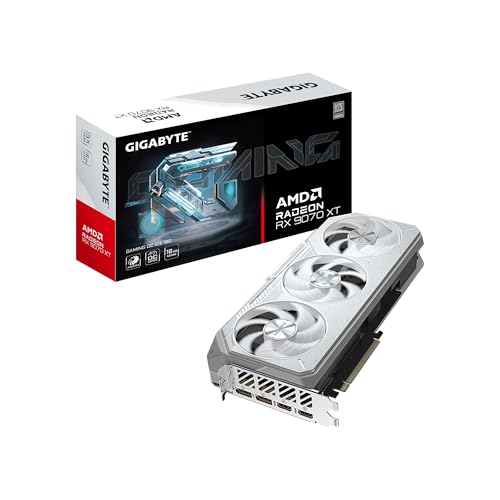
Overview: The GIGABYTE Radeon RX 9070 XT Gaming OC ICE 16G is a premium graphics card built around AMD Radeon RX 9070 XT graphics and 16GB of GDDR6 memory. Its reinforced metal backplate, 2.7-slot design, and ICE styling give it a sturdy, high-end look and feel right out of the box.
Performance: This card is positioned for demanding gaming setups, with PCIe 5.0 support, DisplayPort 2.1, and AMD Smart Access Memory compatibility for modern AM5 systems. GIGABYTE's WINDFORCE cooling combines server-grade thermal conductive gel, Hawk fans, copper heat pipes, a copper plate, and 3D active fans to support sustained gaming loads.
Considerations: The larger cooler may be a challenge in compact cases, and users will get the most from its AMD-specific features when paired with compatible Ryzen 9000 and AM5 hardware. RGB lighting and mode switching are useful, but they also add a layer of software and system management.
Verdict: This is a strong option for gamers who want a well-cooled, feature-rich Radeon card with modern display support and 16GB of memory. It is best suited to builders who have enough case space and plan to use it in a modern AMD-based gaming PC.

Pros
- 16GB of GDDR6 memory is well suited for modern game assets and multitasking.
- Includes WINDFORCE Cooling System for thermal management under load.
- PCIe 5.0 interface supports newer desktop platforms.
- RGB lighting provides a customizable aesthetic for themed builds.
Cons
- No detailed dimensions or case-clearance information is provided in the listing.
- The product page does not include full specification details beyond the main features.
- Customer feedback is limited in the provided data, so real-world owner insight is scarce.
Overview: The GIGABYTE Radeon RX 9070 XT Gaming OC 16G is a desktop graphics card built around AMD Radeon RX 9070 XT graphics. It combines 16GB GDDR6 memory with GIGABYTE's Gaming OC line styling, making it a practical choice for users assembling a modern gaming PC.
Performance and Features: This model highlights WINDFORCE cooling, a Hawk Fan design, and server-grade thermal conductive gel, all of which suggest a focus on heat control during extended gaming or GPU-heavy use. PCIe 5.0 support and RGB lighting add platform compatibility and visual appeal for users who want both function and style.
Drawbacks and Considerations: The listing does not provide detailed dimensions, power requirements, or bundled accessories, so compatibility planning may require additional research. There is also limited customer feedback in the provided data, which makes long-term user experience harder to judge from this page alone.
Verdict: This graphics card is best suited to buyers who want a Radeon RX 9070 XT-based option with 16GB memory and a cooling-focused design. It is a strong fit for gaming-focused desktop builds, especially when visual customization and thermal management are important.

Pros
- Clear clock specifications are provided, including up to 2880 MHz boost in OC mode.
- Cooling-focused hardware includes Axial-tech fans, dual ball bearings, and a phase-change thermal pad.
- Dual BIOS adds practical flexibility for different usage or tuning needs.
- The 2.5-slot form factor should fit more builds than larger triple-slot alternatives.
Cons
- The source data does not list key details such as memory configuration, dimensions, or power connector requirements.
- The highest advertised clocks require OC mode through GPU Tweak III, so users need software tuning to access them.
- Even with a 2.5-slot design, the card may still be too large for very compact cases.
Overview: The ASUS Prime Radeon RX 9070 GRE EVO OC Edition is a modern PCIe 5.0 graphics card built with ASUS cooling hardware and a 2.5-slot design. It is positioned for builders who want a balance of performance, thermal management, and broader case compatibility.
Performance: The card lists up to 2880 MHz boost clock in OC mode through GPU Tweak III, with a default boost of up to 2860 MHz. Axial-tech fans, dual ball fan bearings, GPU Guard, and a phase-change GPU thermal pad are all aimed at keeping temperatures controlled during demanding use.
Considerations: The listing does not provide full details such as dimensions, memory configuration, or power connector information, so buyers should verify those before purchase. The top clock speeds also depend on OC mode, which means users will need ASUS software to access the advertised tuning levels.
Verdict: This model makes the most sense for PC builders who want a Radeon card with strong cooling features and a more manageable footprint than larger high-end cards. It is a practical option if you value thermal engineering and BIOS flexibility in a mainstream gaming build.
Specifications Side-by-Side
The two cards use the same RDNA 4 generation and Navi 48 GPU design, but the XT enables more compute resources and substantially higher clocks. Memory capacity and bandwidth are identical, so the main hardware differences are shader capacity, clock speed, ray accelerators, AI accelerators and board power.
| Specification | Radeon RX 9070 | Radeon RX 9070 XT |
|---|---|---|
| Architecture | AMD RDNA 4 | AMD RDNA 4 |
| GPU | Navi 48 | Navi 48 |
| Manufacturing process | TSMC N4P | TSMC N4P |
| CUDA cores | Not applicable | Not applicable |
| Stream processors | 3,584 | 4,096 |
| Compute units | 56 | 64 |
| VRAM | 16GB GDDR6 | 16GB GDDR6 |
| Memory bus | 256-bit | 256-bit |
| Memory bandwidth | 640GB/s | 640GB/s |
| Game clock | 2,070MHz | 2,400MHz |
| Boost clock | Up to 2,520MHz | Up to 2,970MHz |
| Ray accelerators | 56 | 64 |
| AI accelerators | 112 | 128 |
| Total board power | 220W | 304W |
| Launch MSRP | $549 | $599 |
| Typical U.S. street price in 2026 | Approximately $650–$660 | Approximately $700–$740 for common retail models |
Gaming Performance
1080p
The RX 9070 XT is normally the faster 1080p card, with an average advantage of approximately 9–11%. The gap is less consistent at this resolution because a fast processor can become the limiting factor before either GPU is fully loaded. Individual game results have ranged from roughly 6% to 15%, while a broader aggregate database reported a smaller 2.5% average difference. That variation means the RX 9070 can already be a sensible high-performance 1080p choice, especially when its lower price matters. For additional operational safety benchmarks, see our published testing notes on how to clean gpu dust.
1440p
1440p is the clearest target for both cards, and the RX 9070 XT has a more dependable advantage as the workload shifts toward the GPU. Testing generally places the XT approximately 11–13% ahead, with a 52-game comparison measuring a 12% lead. In Cyberpunk 2077 at 1440p with rasterized rendering, launch testing commonly found the RX 9070 XT about 12% faster, although exact frame rates depend on the preset and test system. The RX 9070 remains well suited to 1440p, while the XT offers more headroom for high-refresh displays and demanding settings. For additional operational safety benchmarks, see our published testing notes on how to clean gpu dust.
4K
At 4K, the RX 9070 XT extends its lead to approximately 11–14% in typical rasterized comparisons. The same 52-game comparison recorded a 12% advantage, while the broader aggregate database measured a 9% difference. Neither card gains additional VRAM or memory bandwidth over the other, so the XT’s benefit comes primarily from its extra stream processors, compute units and higher clocks. The XT is therefore the stronger option for 4K, but the RX 9070 can still make sense when the price difference is large.
Ray Tracing & Upscaling
The RX 9070 XT is also ahead in ray tracing, generally by 9–19%. In Cyberpunk 2077 at 1080p with RT Ultra, the RX 9070 produced 61 FPS and the RX 9070 XT reached 71 FPS, a roughly 16% advantage. In Black Myth: Wukong at 1440p with upscaled ray tracing, the RX 9070 delivered about 47 FPS and the XT was approximately 6 FPS faster. Both cards support FSR 4, which can substantially raise performance in supported games, but availability depends on game integration and driver support. To compare alternative configurations, check our hands-on review of vertical gpu mount airflow.
Features & Ecosystem
Both GPUs provide the same core AMD feature set. FSR 4 is an ML-based upscaler for the RX 9070 series, and both cards also support HYPR-RX and AMD Fluid Motion Frames. This makes the feature decision straightforward within this pair: the XT does not unlock a different upscaling technology. Its advantage is that it starts with more native rendering performance, giving it more room to work with when higher image-quality settings, ray tracing or frame generation are enabled.
Neither Radeon is a DLSS product. Nvidia DLSS and DLSS 4 are not available on these cards, and Nvidia generally retains an advantage in the heaviest ray-tracing and path-tracing workloads. FSR 4 can be effective in supported games, but its coverage and ecosystem are narrower than Nvidia’s DLSS ecosystem. Buyers who prioritize broad support for Nvidia-specific rendering features should compare these cards with Nvidia alternatives rather than treating the two Radeon models as DLSS competitors. Users looking for related component recommendations can explore our weak psu cause gpu stutter breakdown.
For recording and streaming, both cards include hardware AV1, H.264 and H.265/HEVC encoding and decoding. The RX 9070 XT has 128 RDNA 4 AI accelerators versus 112 on the RX 9070, along with its higher GPU throughput. That makes the XT the stronger choice between the two for video encoding and GPU-accelerated creator workloads. However, neither card supports Nvidia CUDA natively. ROCm and HIP can provide a path for supported AI and compute applications, but compatibility and optimization are generally less universal than CUDA.
AMD Adrenalin drivers provide Windows support, HYPR-RX and FSR 4 integration. By 2026, AMD’s official driver pages list current Adrenalin releases and Linux packages for the RX 9070 series. RX 9070-series support was initially absent from ROCm at launch but was later added to compatibility documentation for the RX 9070 and RX 9070 XT on specified Linux distributions. Buyers should still verify support for the exact application, operating system and distribution before choosing either card for AI or compute work. Before finalizing equipment decisions, refer to our comprehensive black screen gpu drivers comparison.
Power, Thermals & Build Compatibility
The RX 9070 is the easier card to accommodate from a power perspective. Its 220W TBP is 84W lower than the RX 9070 XT’s 304W TBP. The XT’s higher power target supports its extra compute units and much higher clock speeds, but it also makes the quality of the power supply, case airflow and specific board design more important. Actual cooler dimensions and connector arrangements can vary by board partner, so check the product listing for the exact model before completing a build.
- Check the PSU requirement for the exact card. The 220W RX 9070 gives a system more power headroom than the 304W RX 9070 XT, but board-partner recommendations can differ.
- Allow for cooling and airflow. The XT produces more board power, so a well-ventilated case and an appropriate GPU cooler are especially important.
- Confirm physical clearance. The research data does not establish a universal card length, thickness or connector layout; use the exact model’s specifications.
- Match the card to the display. The RX 9070 is a strong 1440p-oriented option, while the XT is better suited to high-refresh 1440p and more demanding 4K use.
- Consider efficiency. If performance requirements are similar, the RX 9070’s lower TBP is the simpler choice for reducing graphics-card power demand.
Price & Value Analysis
The launch MSRP gap was only $50: $549 for the RX 9070 and $599 for the RX 9070 XT. Typical U.S. street pricing in 2026 is higher and less tightly separated. The RX 9070 generally sells for approximately $650–$660, while common RX 9070 XT models are approximately $700–$740, with tracked XT prices ranging from roughly $650 to $740. Retailer and board-partner differences therefore have a major effect on the recommendation. For broader ecosystem context, read through our operational guide on daisy chain pcie cables.
At the original $50 gap, the RX 9070 XT is attractive because its roughly 10–13% gaming advantage is considerably larger than the percentage premium. The RX 9070 becomes the better value when the XT is priced substantially higher, particularly when the difference reaches approximately $80–$100. A practical rule is to choose the XT when it costs no more than about 10–15% extra, and to favor the RX 9070 when the premium exceeds that range or when lower power use is important.
There is no VRAM-based reason to pay for the XT: both cards have 16GB of GDDR6, a 256-bit memory bus and 640GB/s of bandwidth. The extra cost buys performance, not additional memory capacity. That makes the RX 9070 a particularly rational purchase for a 1440p system that does not need the highest possible frame rate, while the XT is easier to justify for high-refresh gaming, demanding textures and 4K workloads.
Which Should You Buy?
Choose the RX 9070 if…
- You primarily play at 1440p and do not need the highest available refresh-rate performance.
- You want a lower-power card with a 220W TBP rather than the XT’s 304W TBP.
- You prefer a less demanding PSU and cooling setup, subject to the exact board-partner model’s requirements.
- You find it at least $80–$100 cheaper than the RX 9070 XT.
- You want the same 16GB VRAM capacity, 640GB/s bandwidth, FSR 4 support and modern video codecs at a lower purchase cost.
- Your games are more CPU-limited at 1080p, making the XT’s extra GPU performance less visible.
Choose the RX 9070 XT if…
- You want the fastest rasterized gaming performance between these two cards.
- You target high-refresh 1440p or more demanding 4K gaming.
- You use ray tracing and want the RX 9070 XT’s typical 9–19% RT advantage.
- You value the extra 4,096 stream processors, 64 compute units, 64 ray accelerators and 128 AI accelerators.
- The price premium is approximately $50–$80, or no more than about 10–15% over the RX 9070.
- You want additional performance for demanding textures and supported FSR 4 workloads without changing the 16GB memory capacity.
Consider a different card if…
Consider an Nvidia alternative if your priority is the heaviest ray tracing or path tracing, DLSS, CUDA-dependent creator software or broad compatibility with Nvidia-specific AI packages. Neither Radeon card supports CUDA natively, and Nvidia remains the safer option for applications that depend on CUDA or Nvidia-specific optimizations. Also consider another model if your chosen RX 9070 or RX 9070 XT is priced far beyond the typical 2026 ranges, because the value case depends heavily on the actual street-price gap.
Common Questions on Rx 9070 Vs Rx 9070 Xt Answered
Is the RX 9070 XT worth the extra cost?
Usually, yes, when the premium is approximately $50–$80. The RX 9070 XT is approximately 10–13% faster in typical rasterized gaming and generally 9–19% faster in ray tracing. If the price difference reaches $80–$100 or more, the RX 9070 becomes more compelling, particularly for 1440p gaming where the lower-power card already provides strong performance.
Do both cards have the same amount of VRAM?
Yes. Both the RX 9070 and RX 9070 XT include 16GB of GDDR6 memory on a 256-bit bus, with 640GB/s of memory bandwidth. The XT does not provide more VRAM; its performance advantage comes from 4,096 stream processors, 64 compute units and higher clocks, compared with 3,584 stream processors, 56 compute units and lower clocks on the RX 9070.
Which card is better for ray tracing?
The RX 9070 XT is better for ray tracing between these two cards. It has 64 ray accelerators versus 56 on the RX 9070 and is generally 9–19% faster in RT testing. For example, in Cyberpunk 2077 at 1080p RT Ultra, the RX 9070 reached 61 FPS while the XT reached 71 FPS. Nvidia alternatives remain stronger for the most demanding ray-tracing and path-tracing workloads.
Can the RX 9070 and RX 9070 XT use DLSS?
No. DLSS and DLSS 4 are not available on either Radeon card. Both support AMD FSR 4, as well as HYPR-RX and AMD Fluid Motion Frames. FSR 4 can substantially improve performance in supported games, but coverage depends on game integration and driver support, and its ecosystem is narrower than Nvidia’s DLSS ecosystem.
Which RX 9070 model is more efficient?
The RX 9070 is more efficient from a board-power perspective, with a 220W TBP compared with 304W for the RX 9070 XT. That lower figure can make the RX 9070 easier to pair with a less demanding system, although you should still follow the PSU and clearance guidance for the exact board-partner card you plan to buy.
Mechanical safety standards, operational tolerances, and protective gear guidelines align with benchmark specifications established by the American National Standards Institute (ANSI).
Related Posts
- Rtx 5050 Vs Rx 7600
- Arc B580 Vs Rx 9060 Xt 16Gb
- Rtx 5090 Vs Rx 9070 Xt
For more hands-on benchmarks and buying recommendations, consult our guides on cordless stick vacuum buyer guide.