
Quick Answer: Choosing the Best Toro Lawn Mower Oil Type
Most Toro lawn mowers use a 4-cycle engine that takes SAE 30 or 10W-30 motor oil, with 10W-30 recommended for a wider range of temperatures. Always check your owner’s manual, as 2-cycle Toro models require a different oil-and-fuel mix. Using the right oil keeps your engine running smoothly, reduces wear, and helps your mower start reliably season after season.

Pros
- Includes 1-quart Toro SAE 10W-30 full synthetic engine oil
- Includes a 2 oz Yellow 3-n-1 fuel treatment bottle
- Fuel treatment listed to treat 10 gallons of gas
Cons
- Fuel treatment capacity is manufacturer-stated, not verified
- No description or customer reviews are provided

Pros
- One quart of Toro SAE 30W engine oil
- 2-ounce 3-in-1 fuel treatment included
- Fuel treatment listed as treating 10 gallons of gas
- Dimensions listed as 9 x 3 x 5 inches
Cons
- Fuel treatment covers 10 gallons per bottle, per the listing
- Fuel treatment is from Power Performance, not Toro

Pros
- Listed as SAE 30 four-stroke engine oil
- 18-ounce size stated in the product name
- Toro brand listed for the product
Cons
- No description or features to confirm specifications
- No customer reviews are available yet
Understanding Your Toro Engine Type
Before you choose an oil, you need to know what kind of engine your Toro mower has. This single detail determines everything about how you lubricate the engine. Toro has produced both 4-cycle and 2-cycle engines over the years, and the oil requirements for these two types could not be more different.
Is My Toro Mower a 4-Cycle or 2-Cycle Engine?
A 4-cycle engine has a separate oil reservoir that you fill and check independently from the fuel tank. You pour oil directly into the crankcase, and the engine circulates it internally to lubricate moving parts. This is the most common type of engine found on modern walk-behind Toro mowers, including popular models in the Recycler and Super Recycler lines.
A 2-cycle engine, by contrast, does not have a separate oil reservoir. Instead, you mix oil directly into the gasoline before you pour it into the fuel tank. The oil burns along with the fuel as the engine runs. Two-cycle engines are lighter and simpler, and they are more commonly found on older Toro models, string trimmers, and some handheld equipment.
Where Can I Find the Engine Type on My Mower?
The easiest way to confirm your engine type is to check the owner’s manual that came with your mower. If you no longer have the manual, look for a model number and serial number stamped on the mower deck or on a metal plate near the engine. You can enter these numbers on Toro’s website to pull up the correct manual and specifications for your exact model.
You can also look for physical clues. A 4-cycle mower will have an oil fill cap and a dipstick somewhere on the engine, usually with a small oil can symbol printed nearby. A 2-cycle mower will not have an oil fill port on the engine at all, because the oil is mixed into the fuel. If you are still unsure, the engine manufacturer’s name and model number are often printed directly on the engine shroud, and you can look that up as well.
Recommended Oil Viscosity for Toro Mowers
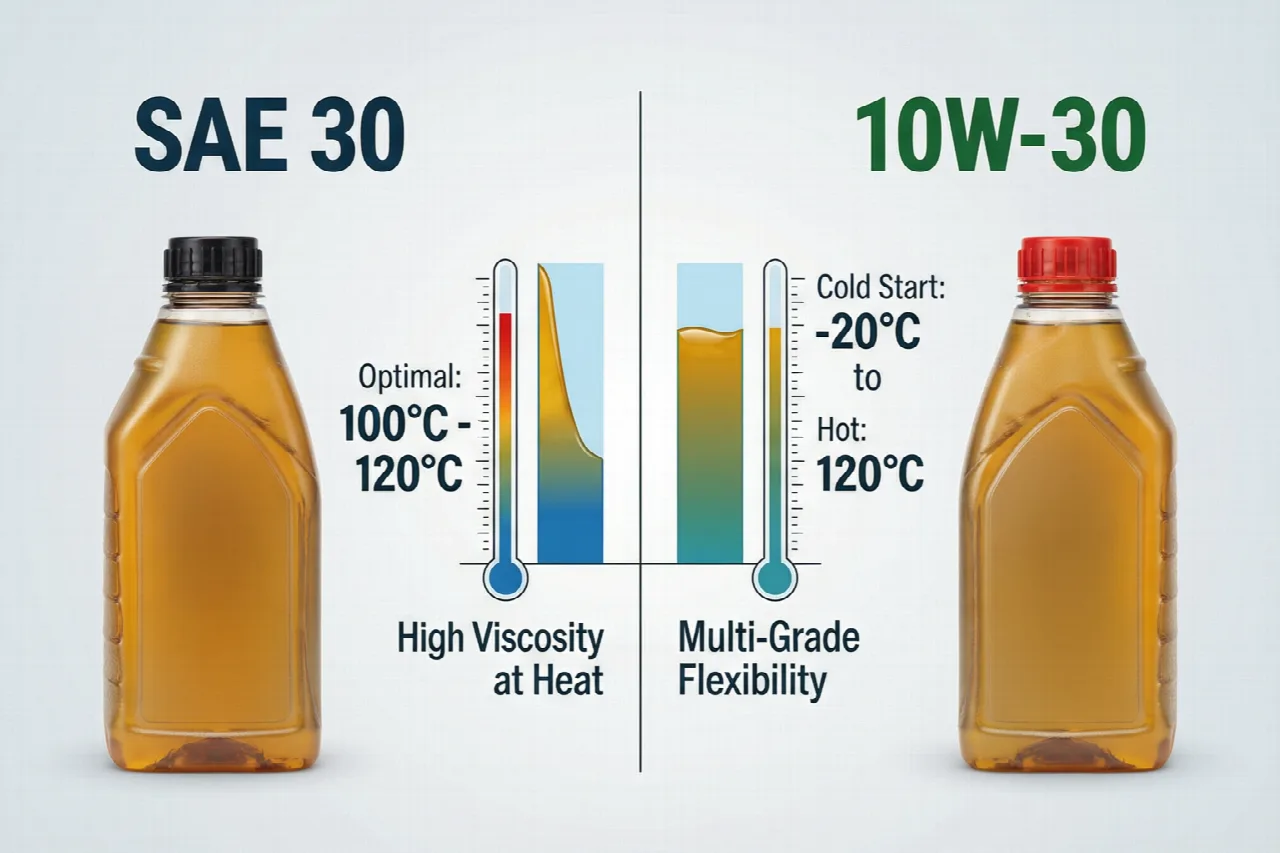
Once you have confirmed that your Toro mower has a 4-cycle engine, the next step is choosing the right viscosity grade. Viscosity refers to how thick or thin the oil is, and it is measured using the SAE scale. For most Toro mowers, the two grades you will see recommended most often are SAE 30 and 10W-30.
What Viscosity Oil Does Toro Recommend?
For most Toro 4-cycle walk-behind mowers, the manufacturer recommends a high-quality detergent oil with an API service classification of SJ or higher. The two most commonly recommended viscosity grades are SAE 30 and 10W-30. SAE 30 is a single-grade oil that works well in warm conditions, while 10W-30 is a multi-grade oil that performs across a broader range of temperatures.
It is important to use oil that carries a detergent additive. Detergent oil contains cleaning agents that help suspend dirt and combustion byproducts so they can be trapped by the oil filter or drained out during an oil change. Non-detergent oil, which is sometimes sold for older engines, does not provide this cleaning benefit and is not recommended for modern Toro mowers. Readers comparing setup options can review our technical analysis on marshall stanmore iii vs harman kardon onyx studio 8.
When Should I Use SAE 30 Versus 10W-30?
SAE 30 is a good choice if you mow primarily in warm weather and store your mower in a climate that stays above freezing for most of the mowing season. It maintains a consistent thickness at operating temperature and provides strong protection for the engine under load.
10W-30 is the more versatile option. The “10W” indicates that the oil flows well in cold temperatures, while the “30” indicates that it provides the same high-temperature protection as SAE 30. This makes 10W-30 a better choice if you mow in cooler spring or fall conditions, or if you live in a region with significant temperature swings. Many Toro owner’s manuals list 10W-30 as the preferred all-purpose grade. For complementary field maintenance guidelines, examine our breakdown of dyson v8 cyclone vs bissell featherweight stick.
Always defer to the specific recommendation in your owner’s manual. If the manual lists a range of acceptable grades, choose the one that best matches the temperatures you typically mow in.
Choosing Oil for Different Temperatures
Temperature has a direct effect on how oil behaves inside your engine. When oil is cold, it becomes thicker and flows more slowly. When it is hot, it thins out and flows more easily. Choosing the right viscosity for your climate helps ensure the oil reaches every moving part quickly on startup and maintains a protective film when the engine is hot. To evaluate matched hardware tolerances, consult our detailed overview of bissell crosswave hydrosteam vs shark stainforce.
What Oil Should I Use in Hot Summer Weather?
In hot summer conditions, SAE 30 is often the recommended choice because it maintains its thickness at high operating temperatures. This provides a robust lubricating film that protects engine components under the stress of continuous mowing in heat. If you mow large lawns in the middle of summer, SAE 30 can be a dependable option.
That said, 10W-30 also performs well in hot weather. Because the “30” rating indicates the same high-temperature viscosity as SAE 30, a quality 10W-30 oil will protect the engine just as well while also offering better cold-start performance. If you want a single oil that works year-round, 10W-30 is the practical choice.
Is a Different Oil Needed for Cold-Weather Mowing?
If you mow in cooler temperatures, such as in early spring or late fall, a multi-grade oil like 10W-30 is the better option. The “10W” rating means the oil remains fluid enough to flow quickly through the engine when it is cold, reducing strain on the starter and helping the engine reach operating temperature faster.
Some manufacturers also recommend 5W-30 for very cold conditions, though this is less common for lawn mowers. If you store your mower through the winter and only use it in warmer months, you may not need to worry about cold-weather performance at all. The key takeaway is to match the oil viscosity to the temperatures you actually mow in, and to follow the guidance in your owner’s manual.
How to Check and Change the Oil
Regular oil checks and timely oil changes are among the most important maintenance tasks you can perform on your Toro mower. Clean oil at the proper level keeps the engine cool, reduces friction, and extends the life of your equipment.
How Often Should I Change the Oil?
For most Toro mowers, the manufacturer recommends changing the oil after the first 5 hours of use on a new engine, and then at least once per mowing season or every 50 hours of operation, whichever comes first. If you mow a large lawn frequently or operate in dusty conditions, you may want to change the oil more often.
Checking the oil level before each use is a good habit. If the oil looks dirty, gritty, or milky, or if it has a burnt smell, it is time for a change regardless of how many hours you have logged. Fresh oil should have a clear amber color and a smooth consistency.
What Is the Correct Oil Capacity for My Model?
Oil capacity varies by model, so it is essential to check your owner’s manual for the exact figure. Most Toro walk-behind mowers hold somewhere between 15 and 20 ounces of oil, but this can vary depending on the engine size and design. Adding too much oil can cause the engine to smoke or leak, while too little oil can lead to inadequate lubrication and serious engine damage.
To check the oil level, make sure the mower is on a level surface and the engine is cool. Remove the dipstick, wipe it clean, reinsert it fully, and then remove it again to read the level. The oil should fall between the minimum and maximum marks on the dipstick. Add oil in small increments and recheck until the level is correct.
Common Questions on What Type Of Oil For Toro Lawn Mower Answered
Many Toro owners have additional questions about oil selection and maintenance. Here are answers to some of the most common concerns.
Can I Use Synthetic Oil in My Toro Mower?
Yes, you can use synthetic oil in most Toro mowers, provided it meets the viscosity and API service classification recommended in your owner’s manual. Synthetic oil offers better performance in extreme temperatures and can provide longer-lasting protection. However, it is more expensive than conventional oil, and it is not required for normal residential use. If you choose synthetic, select a grade such as SAE 30 or 10W-30 that matches your climate and your manual’s recommendations.
What Happens If I Use the Wrong Oil Type?
Using the wrong oil type can cause a range of problems. If you use a 2-cycle fuel mix in a 4-cycle engine, the engine will smoke excessively and may suffer serious damage because the oil is not being circulated properly. If you use a 4-cycle oil in a 2-cycle engine without mixing it into the fuel, the engine will run without lubrication and can seize quickly.
Using the wrong viscosity in a 4-cycle engine is less catastrophic but still problematic. Oil that is too thick can make starting difficult and reduce flow to critical parts, while oil that is too thin may not provide adequate protection at high temperatures. If you suspect you have used the wrong oil, drain the system and refill with the correct grade as soon as possible.
Choosing the right oil for your Toro lawn mower comes down to knowing your engine type, selecting the appropriate viscosity for your climate, and following the maintenance schedule in your owner’s manual. By using a quality detergent oil in the correct grade, you will keep your mower running reliably and extend its service life for many seasons to come.
Related Maintenance and Operating Guides
To keep your equipment running at peak operating efficiency, explore our related technical walkthroughs and maintenance tutorials:
- Consult our detailed breakdown on heavy-duty chainsaw buyer guide.
Technical Standards and Compliance
Mechanical safety standards, operational tolerances, and protective gear guidelines align with benchmark specifications established by the American National Standards Institute (ANSI).