Quick Answer: What Does Self-Propelled Mean?
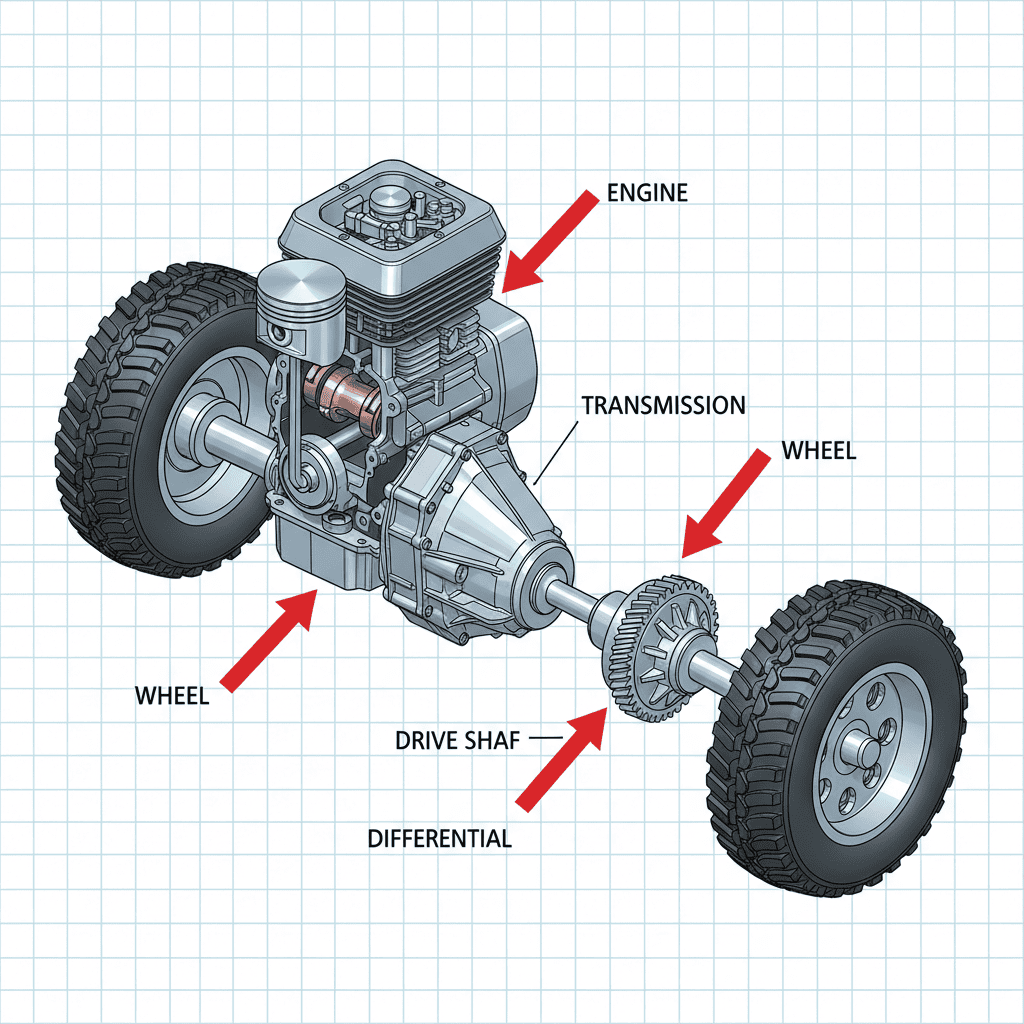
On a lawn mower, ‘self-propelled’ means the engine powers the wheels through a transmission or gearbox, driving the machine forward automatically. Instead of physically pushing the 70 to 100-pound machine, the operator simply squeezes a drive bail handle and guides the steering.
Self-propelled means having its own built-in power source or motor that enables a vehicle or machine to move under its own power, rather than being manually pushed, pulled, or towed by an external force. The term specifically refers to the method of movement (motive power), not to autonomous navigation or control. A self-propelled device can be operated by a human driver, remote control, or automated systems, what matters is that it generates its own motion.

Pros
- Powerful 60V brushless motor provides efficient gas-comparable cutting force
- Self-propelled rear-wheel drive simplifies work on uneven terrain and dense grass
- Comes complete with two 4.0Ah batteries, rapid charger, and grass bag ready for use
- 4-in-1 cutting modes and LED lights add all-day versatility
- Quiet zero-emission design with IPX4 water resistance for outdoor durability
Cons
- Runtime is limited to about 3/4 acre per charge and varies by terrain and technique
- Requires battery charging cycles unlike unlimited-run gas or corded mowers
- Exact weight and dimensions are not detailed in available specifications
The Greenworks 60V 21" Brushless Self-Propelled Cordless Lawn Mower stands out as a robust battery-powered walk-behind unit built for homeowners managing medium to large lawns. Its design focuses on cordless convenience with a durable frame, rear-wheel drive system, and IPX4 weather resistance, creating an immediate impression of modern reliability without the mess of gas engines.
Performance & Key Features center on the 60V brushless motor paired with two 4.0Ah batteries that deliver gas-like power for up to 3/4 acre per charge. Self-propelled traction handles slopes and thick grass with adjustable speed, while the 4-in-1 system supports mulching, bagging, side discharge, and turbo leaf pickup. Ultra-bright LED lights extend usable hours, and the quiet operation runs 3x quieter than gas mowers with zero emissions and instant starts. The included rapid charger and compatibility with 75+ Greenworks 60V tools further enhance daily efficiency.
Drawbacks & Considerations include the fact that runtime varies based on terrain and technique, so larger or denser areas may require careful battery management. Unlike gas models, it depends on charging cycles, and detailed weight or dimensional data is not provided in the specifications, which could influence handling preferences for some users.
Verdict: This mower delivers excellent value for eco-conscious homeowners seeking powerful, low-maintenance cordless performance on yards up to 3/4 acre. Those already in the Greenworks 60V ecosystem or wanting quiet, emission-free mowing will gain the most, especially with the dual batteries, rapid charger, and strong warranties included.

Pros
- Strong 201cc OHV engine supplies reliable cutting power
- Rear-wheel self-propelled drive eases mowing effort
- Flexible bagging, mulching, and side-discharge options
- Wide 22-inch deck speeds up lawn coverage
- Synchronized 6-position height adjustment is simple to use
Cons
- Gas engine requires regular fueling and routine maintenance such as oil changes
- Rear-wheel drive only may deliver less traction than all-wheel models on steeper slopes
- Assembly is needed using the included instruction manual
The SENIX 22 Inch Gas Lawn Mower is a walk-behind gasoline-powered unit built around a sturdy steel chassis. It pairs a 201cc 4-cycle OHV engine with variable-speed rear-wheel self-propulsion, giving homeowners a solid first impression of power and practicality for everyday residential mowing.
Performance centers on the 22-inch cutting path and 3-in-1 design that supports bagging, mulching, or side discharge. The single-handle 6-position height system ranges from 1.25 to 4 inches, while the self-propelled rear wheels help maintain steady progress across typical lawn surfaces based on the listed specifications.
Drawbacks to consider include the ongoing need for gasoline and engine maintenance, plus the limitation of rear-wheel drive that can reduce traction on steeper or uneven ground. Initial setup also requires following the instruction manual for assembly.
This mower suits owners of medium to large yards who want a gas-powered self-propelled option with versatile clipping management and solid cutting width. It delivers the most value for users comfortable with traditional fuel-powered equipment seeking efficiency and adjustability.

Pros
- Compatible with the RYOBI 18V ONE+ battery platform
- Five-stage height adjustment ranging from 25 mm to 65 mm
- EasyEdge grass combs facilitate close cutting along borders
- Foldable frame and ergonomic handle allow compact storage
Cons
- Sold as a bare tool without a battery or charger included
- Compact 33 cm cut width requires more passes on larger lawns

Pros
- Includes two 5.0Ah PowerShare Pro batteries and dual charger for ready-to-use power out of the box
- Advanced brushless motor and dual technologies deliver strong efficiency and cut quality for lawns up to half an acre
- Self-propelled drive with variable speed significantly reduces user fatigue during mowing
- Versatile 3-in-1 functionality and easy mode switching support multiple lawn care preferences
- Onboard charge indicator and collapsible design enhance practicality and convenience
Cons
- Recommended only for lawns of 1/2 acre or less, making it less suitable for larger properties
- Runtime is limited by battery capacity and grass density, potentially requiring mid-session recharges for denser areas
- As a cordless electric model it may struggle with continuous heavy-duty use compared to gas-powered alternatives
The WORX Nitro WG760 is a 21-inch cordless walk-behind lawn mower built for homeowners seeking gas-free convenience. Its solid construction pairs a vented Aerodeck cutting deck with a fully collapsible handle for vertical storage, creating an immediate impression of modern practicality and durability for medium-sized yards.
Performance shines through the brushless motor 2.0 that supplies 40% more power and 10% longer runtime, backed by two included 5.0Ah PowerShare batteries. Self-propelled variable speed up to 3.7 MPH eases the workload while IntelliCut sensors automatically adjust cutting power for thick or light grass. The 3-in-1 system handles mulching, bagging, or side discharge efficiently, and the single-lever height settings from 1.5 to 4 inches adapt quickly to different lawn conditions.
Drawbacks center on its design limits: the mower is intended for lawns of half an acre or less, so larger properties may need extra batteries or multiple sessions. Battery-dependent runtime can shorten in dense growth, and the cordless nature means it lacks the uninterrupted power of traditional gas models during extended heavy use.
Overall the WORX Nitro WG760 delivers excellent value for suburban homeowners with smaller to mid-size lawns who prioritize ease of use, versatile cutting modes, and platform expandability. Those with bigger yards or continuous heavy cutting needs should consider runtime carefully before choosing this model.

Pros
- Powerful digital brushless motor for efficient high-performance cutting
- Self-propelled variable speed drive reduces user effort on larger areas
- Convenient push-button start and weather-resistant construction for durability
- Compact foldable handle design for easy vertical storage
- Versatile 3-in-1 clipping system with adjustable deck heights
Cons
- Runtime capped at around 50 minutes which may require mid-job recharging for bigger properties
- Comes with only a single 6.0Ah battery limiting extended continuous operation
- As a battery-powered unit it needs regular charging access unlike unlimited gas mowers
The SKIL PWR CORE 40 Brushless 40V 20-Inch Self-Propelled Mower Kit is a cordless walk-behind lawn mower built for residential users seeking reliable gas-free performance. Its weather-resistant construction and foldable telescoping handle create a durable yet space-efficient design that stores vertically with ease.
Performance stands out through the digital brushless motor that powers efficient cutting on a single 6.0Ah battery charge lasting up to 50 minutes. Variable speed self-propel adjusts effortlessly to your pace while the push-button start simplifies operation and the single-lever deck offers 7 height settings from 1.5 to 4 inches. The 3-in-1 system supports bagging mulching or rear discharge for versatile yard maintenance.
Potential drawbacks include the 50-minute runtime limit which suits medium lawns but may fall short for expansive properties without a spare battery. Only one battery is included so continuous work depends on recharging with the Auto PWR JUMP charger. Battery dependency also means planning around charge cycles compared to traditional gas models.
Overall this SKIL mower delivers strong value for homeowners with average-sized yards who prioritize quiet eco-friendly power and convenient storage. It is an excellent choice for those ready to switch from gas while valuing self-propelled ease and adjustable cutting options.
Understanding the Core Definition of Self-Propelled
What Is the Literal Meaning of Self-Propelled?
The term “self-propelled” breaks down simply: “self” means the machine itself, and “propelled” means moved or driven forward. Together, self-propelled describes any machine or vehicle equipped with an engine, motor, or other power source that allows it to move independently.
In contrast, non-self-propelled equipment requires external force. A trailer, for example, must be towed by another vehicle. A manual push mower relies on human muscle power. A wheelbarrow depends on someone pushing it. Self-propelled versions of these same tools have integrated motors that do the work of moving forward.
How Does a Self-Propelled Device Differ From Manually Powered Equipment?
The key difference is energy source:
- Self-propelled equipment: Uses an internal engine (gasoline, diesel, electric) or motor to generate forward motion. The operator controls speed and direction, but the machine providesotive force.
- Manual or towed equipment: Relies on human effort, animal power, or connection to another vehicle. The equipment itself produces no motion.
For example, a self-propelled lawn mower has a small gasoline or electric motor that drives the wheels, so the operator walks behind it at the speed the mower moves. A push mower has no motor; the operator must push it with their own strength.
Does Self-Propelled Mean the Same Thing as Self-Driving or Autonomous?
No. This is one of the most common misconceptions.Self-propelled and autonomous (or self-driving) are fundamentally different concepts:
- Self-propelled: Refers only to the power source, the machine has its own motor or engine. It still requires human control or external programming to navigate and make decisions.
- Autonomous or self-driving: Refers to navigation and control, the machine can make decisions, plan routes, and operate without human intervention. It uses sensors, GPS, and artificial intelligence.
A self-propelled lawn mower requires a person to push it and steer it, even though it has its own motor. A robotic lawn mower is autonomous, it navigates your yard on its own using sensors and programming. An autonomous vehicle could be self-propelled (has a motor) or theoretically could be pulled by another vehicle (though that would be impractical).
How Self-Propelled Applies Across Different Contexts
Self-Propelled Equipment in Agriculture and Landscaping
Self-propelled machinery is standard in agriculture and landscaping because it reduces operator fatigue and increases efficiency:
- Self-propelled lawn mowers: Gas or electric motors drive the wheels while the operator controls direction and blade engagement. Common for residential and commercial landscape maintenance.
- Self-propelled sprayers: Mounted on a chassis with an engine, allowing herbicide and pesticide application over large areas without manual pushing.
- Self-propelled combines: Agricultural harvesters with powerful engines that move through fields, collecting and processing crops simultaneously.
- Self-propelled fertilizer spreaders: Use motors to propel themselves across lawns or fields while dispensing material.
In these applications, self-propelled means operators can cover more ground with less physical effort, improving productivity and safety. To compare alternative configurations, check our hands-on review of marshall stanmore iii vs harman kardon onyx studio 8.
Self-Propelled Artillery and Military Vehicles
In military contexts, self-propelled primarily describes vehicles that carry weapons and can move under their own power. Examples include:
- Self-propelled guns (SPGs): Artillery pieces mounted on tracked or wheeled chassis with onboard engines, allowing them to reposition quickly without being towed.
- Self-propelled mortars and rocket systems: Mounted on mobile platforms rather than fixed installations.
The military advantage of self-propelled systems is mobility, artillery can move to new positions rapidly without requiring a separate towing vehicle, increasing tactical flexibility. Users looking for related component recommendations can explore our dyson v8 cyclone vs bissell featherweight stick breakdown.
Self-Propelled Railcars and Rail Vehicles
In rail transport, self-propelled vehicles include:
- Self-propelled diesel multiple units (DMUs): Passenger or freight trains with onboard diesel engines, eliminating the need for a separate locomotive.
- Motorized railcars: Maintenance and inspection vehicles that operate independently on tracks.
These differ from traditional trains, which rely on a locomotive (a separate vehicle) to tow passenger or freight cars. Before finalizing equipment decisions, refer to our comprehensive bissell crosswave hydrosteam vs shark stainforce comparison.
Self-Propelled Consumer Products
Everyday examples include self-propelled snow blowers, self-propelled floor polishers, self-propelled pressure washers, and self-propelled wheelchairs. Each uses an integrated motor to reduce the physical effort required from the operator.
Key Distinctions: Self-Propelled vs. Autonomous or Remote-Controlled
Can a Self-Propelled Vehicle Also Be Autonomous?
Yes. A machine can have both qualities. An autonomous vehicle with its own engine is both self-propelled and autonomous. However, most self-propelled equipment today is not autonomous, it requires human control. The terms describe different attributes and are not mutually exclusive.
Does Self-Propelled Imply a Human Operator Is On Board?
No. Self-propelled only describes the power source. A machine can be self-propelled and operated by:
- A human driver or operator (most common)
- Remote control (self-propelled remotecontrolled vehicle)
- Automated systems or AI (autonomous self-propelled vehicle)
- Hybrid models combining human control with automated features
The defining characteristic is that the machine generates its own motion, regardless of how that motion is directed.
What Is the Primary Difference Between a Self-Propelled Lawn Mower and a Robotic Lawn Mower?
A self-propelled lawn mower has a motor that drives the wheels, butrequires a human operator to push it, steer it, and control where it mows. The operator supplies the intelligence and decision-making.
A robotic lawn mower isautonomous. It has its own motor (making it self-propelled), but it also has sensors, GPS, and programming that allow it to navigate your yard independently, avoid obstacles, and return to its charging dock without human intervention.
Both are self-propelled in the technical sense. The robotic mower adds automation on top of self-propulsion.
Common Applications and Why Self-Propulsion Matters
Efficiency and Labor Reduction
Self-propelled equipment reduces physical strain on operators and enables faster completion of tasks. A self-propelled snow blower, for example, allows one person to clear driveways in a fraction of the time manual shoveling would require.
Accessibility
Self-propelled wheelchairs and mobility devices enable people with limited mobility to move independently, improving quality of life and autonomy.
Professional and Industrial Use
In agriculture, landscaping, construction, and military applications, self-propelled equipment increases productivity and enables workers to cover larger areas, making operations more economical at scale.
Everything You Need to Know: Self Propelled Meaning FAQ
Is a self-propelled vehicle the same as a self-driving vehicle?
No. Self-propelled means the vehicle has its own motor or engine for movement. Self-driving (autonomous) means the vehicle can navigate and make decisions without human control. A vehicle can be self-propelled without being self-driving, or theoretically both, but they describe different capabilities.
What is the most common example of self-propelled equipment?
Self-propelled lawn mowers are among the most common examples for consumers. In agriculture and industry, self-propelled combines, tractors, and sprayers are widespread. Each uses an integrated motor to move without external power.
Can a self-propelled machine be operated by remote control?
Yes. A machine can be self-propelled (has its own motor) and operated via remote control. Remote control describes how the operator directs the machine; self-propulsion describes how the machine generates motion. They are independent attributes.
Why do military vehicles use self-propelled artillery instead of towed guns?
Self-propelled artillery is more mobile and flexible. Towed artillery requires a separate towing vehicle and time to position the gun. Self-propelled systems can move quickly to new positions, reposition during combat, and operate independently, providing tactical advantages in dynamic military situations.
Related Maintenance and Operating Guides
To keep your equipment running at peak operating efficiency, explore our related technical walkthroughs and maintenance tutorials:
- Consult our detailed breakdown on replace a Briggs and Stratton pull cord.
- Consult our detailed breakdown on clean a Briggs and Stratton carburetor.
- Consult our detailed breakdown on racing lawn mower build guide.
- Consult our detailed breakdown on biological goat grazing methods.
- Consult our detailed breakdown on best ride-on lawn mowers.
Technical Standards and Safety Guidelines
For general background on voluntary safety standards, see the American National Standards Institute (ANSI).