

Direct Answer: What Is a Brushless Motor Lawn Mower?
A brushless motor lawn mower uses electronically commutated (EC) motors that eliminate carbon brushes, delivering higher efficiency, extended runtime, and minimal maintenance compared to traditional brushed motors. These motors are predominantly found in cordless, battery-powered models and offer superior power delivery with less energy waste and noise.

Pros
- Brushless motor delivers quieter performance longer runtime and strong torque compared to typical gas models.
- Self-propelled variable-speed rear-wheel drive reduces physical strain across different yard sizes and slopes.
- 4-in-1 cutting system provides flexible mulching bagging discharge and leaf pickup options in one machine.
- Includes ready-to-use 5.0Ah battery charger and grass bag plus multi-tool ecosystem compatibility.
- LED headlights enable safe mowing during low-light hours without added noise.
Cons
- Only one 5.0Ah battery is included so larger yards may need extra batteries or mid-session recharging.
- Cordless design requires battery charging and offers limited continuous runtime unlike fuel-powered mowers.
- Actual mowing duration depends on grass density height and conditions as no fixed runtime is specified.
The Greenworks 40V 21 inch Self-Propelled Cordless Lawn Mower is a walk-behind model built around a durable 21-inch steel deck and brushless motor. Its overall design focuses on cordless convenience while delivering solid build quality for everyday residential lawn care.
Performance centers on the self-propelled rear-wheel drive with variable speed for controlled mowing on different terrains. The brushless motor supports efficient quiet operation while LED headlights allow flexible timing. The 4-in-1 system covers mulching bagging side discharge and turbo leaf pickup and the included 5.0Ah battery plus charger enables immediate use with broad compatibility across the Greenworks 40V lineup.
Drawbacks to consider include the single included battery which may require recharging or additional packs for larger properties. As a cordless unit it lacks the uninterrupted runtime of gas mowers and actual work time varies with lawn conditions.
This mower delivers the most value to homeowners seeking a quiet low-maintenance alternative who want to expand into the Greenworks 40V ecosystem. It suits medium-sized yards where the included battery and versatile features provide reliable eco-friendly results with solid warranty coverage.

Pros
- Rear-wheel self-propelled drive system
- Includes two 40V 4.0Ah lithium-ion batteries
- 3-in-1 mulching, rear bagging, and side discharge
- 6-position height adjustment (1.5" to 3.9")
- Brushless motor reduces vibration and noise
Cons
- Substantial unit weight of 57.5 pounds
- Single battery operation requires swapping to continue
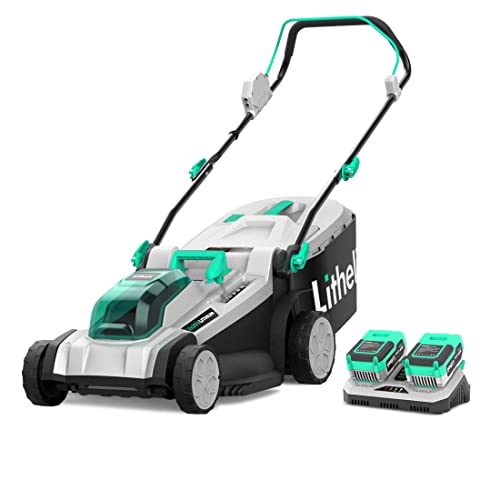
Pros
- Dual 20V batteries provide doubled power for better overall performance.
- Brushless motor offers higher efficiency with quiet and durable operation.
- Lightweight 30 lb bare design with easy-start button eases pushing and handling.
- Supports both bagging and mulching with a generous 11 gal rear bag and mulch plug.
- Six height settings from 0.98 to 2.95 inches enable versatile cutting control.
Cons
- 17-inch cutting deck means more passes are needed to cover larger lawns compared to wider models.
- Push-only design without self-propulsion can require extra effort on slopes or bigger properties.
- Exact battery runtime is not specified in the available details, so users may need to plan for charging during extended sessions.
The Litheli Cordless Lawn Mower 17 Inch is a walk-behind electric mower built for residential use. It features a lightweight 30 lb bare construction, dual 20V 4.0Ah Li-ion batteries, and a brushless motor. The design prioritizes easy pushing with an easy-start button and eliminates gas, oil, and emissions for a cleaner immediate impression.
In real-world cutting, the upgraded brushless motor provides 40% higher efficiency than traditional models for quiet, stable power. The 17-inch durable deck works with both the mulch plug and 11 gal rear bag, while six height settings from 0.98 to 2.95 inches allow flexible adjustments. Dual batteries support doubled performance so users can tackle more of the yard faster.
Potential drawbacks include the 17-inch width, which may need extra passes on expansive lawns, and the manual push style that lacks self-propulsion for effortless operation on uneven ground. Battery runtime specifics are not detailed, so users should manage power carefully for full coverage. Customer service is available within 24 hours for any issues.
This mower suits homeowners with small to medium yards who want a lightweight, low-maintenance cordless option with bagging and mulching flexibility. Those seeking wider decks or self-propelled models may prefer alternatives, but the dual-battery brushless setup delivers solid value for efficient emission-free mowing.
How Brushless Motors Work in Lawn Mowers
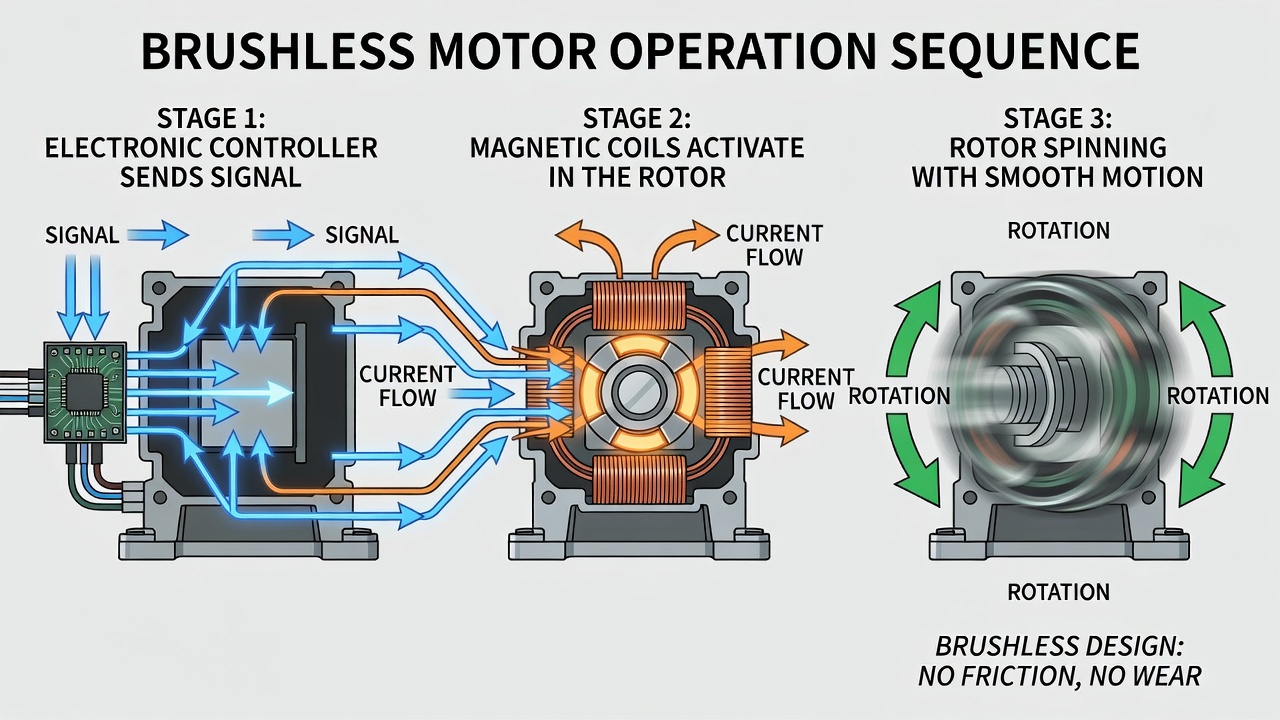
Understanding brushless motor technology requires a basic grasp of how electric motors function. Traditional brushed motors use carbon brushes and a commutator to direct electrical current to the motor’s rotating coil, creating the magnetic force needed for motion. This contact-based system generates friction, heat, and eventual wear.
Brushless motors eliminate this mechanical commutation entirely. Instead, an electronic controller, typically a microprocessor or circuit board, directs current to the motor’s coils in precise, timed sequences. This electronic commutation achieves the same rotational effect without physical brushes making contact with the motor shaft.
Why this matters for lawn mowers: Because brushless motors have no brushes wearing away, they generate significantly less heat and friction. The electronic controller also allows for variable speed management, meaning the motor can adjust power output based on cutting demand. When you’re mowing thick, dense grass, the motor draws more power; when you’re on a flat, open lawn, it reduces consumption to preserve battery.
Key Advantages of Brushless Motor Lawn Mowers
Superior Energy Efficiency
Brushless motors convert electrical energy to mechanical motion more efficiently than brushed alternatives. Without brush friction and the associated energy loss as heat, more of the battery’s stored energy goes directly into cutting. This efficiency advantage is one of the primary reasons cordless lawn mower manufacturers have adopted brushless technology as standard.
Extended Battery Runtime
Because brushless motors waste less energy as heat, they deliver longer runtime on the same battery capacity. A brushless motor mower may run 30-50% longer than a comparable brushed model on an equivalent battery. For homeowners with larger lawns, this means fewer charging interruptions or the ability to use a smaller, lighter battery without sacrificing cutting time.
Dramatically Reduced Maintenance
Carbon brushes in traditional motors wear down over time and require periodic replacement, a maintenance task most homeowners never perform, leading to degraded performance. Brushless motors eliminate this wear point entirely. There are no consumable parts to replace, no brush dust accumulation inside the motor, and no need for professional servicing beyond standard equipment care. To evaluate matched hardware tolerances, consult our detailed overview of z890 vs x870e motherboard.
Quieter Operation
The absence of brushes rubbing against the commutator eliminates a significant source of electrical noise. Brushless motors also allow for smoother, more controlled power delivery, reducing the vibration and auditory feedback associated with brush arcing. Most brushless cordless mowers operate at 60-75 decibels, compared to 80+ decibels for equivalent brushed or gas-powered alternatives.
Improved Responsiveness and Power Delivery
Electronic commutation provides precise, real-time power adjustment. The motor responds instantly to changing load conditions, ramping up power when encountering dense vegetation and reducing it on open sections. This dynamic response delivers consistent cutting performance across varied lawn conditions without the user having to adjust settings manually. When planning workspace deployment, consider the engineering criteria outlined in our marshall stanmore iii vs harman kardon onyx studio 8 guide.
Brushless vs. Brushed Motors: Core Differences
| Feature | Brushless Motor | Brushed Motor |
|---|---|---|
| Commutation Method | Electronic (microprocessor-controlled) | Mechanical (carbon brushes and commutator) |
| Efficiency | 85-90% | 70-80% |
| Heat Generation | Minimal | Significant |
| Maintenance | None (no wear parts) | Periodic brush replacement |
| Operating Noise | 60-75 dB | 75-85 dB |
| Motor Lifespan | 2,000+ hours typical use | 500-1,500 hours (brush wear dependent) |
| Power Adjustment | Electronic, real-time responsive | Limited control, fixed output |
| Cost | Higher upfront investment | Lower initial cost |
Why carbon brushes matter: In brushed motors, carbon brushes wear down progressively, causing increasing electrical resistance, reduced efficiency, and eventually motor failure. This wear is unavoidable and accelerates under high-load conditions. For lawn mowers that may sit unused for months, brushes can also corrode or become stuck, leading to starting problems.
Brushless Motors and Cordless Technology
A common misconception conflates brushless and cordless technology, they are related but distinct concepts. “Cordless” refers to battery-powered operation (versus gas or plug-in electric); “brushless” refers to the motor design specifically. A lawn mower can be cordless with a brushed motor, or corded with a brushless motor, though the industry has largely converged on brushless motors for cordless models. For additional operational safety benchmarks, see our published testing notes on dyson v8 cyclone vs bissell featherweight stick.
Why the pairing is dominant: Cordless mowers depend entirely on battery efficiency to deliver runtime. Because brushless motors waste significantly less energy as heat, they are the natural choice for battery-powered equipment. Additionally, cordless mowers often feature variable-speed technology, electronically controlling blade speed based on cutting conditions, which is easier to implement with brushless motors.
Are all cordless mowers brushless? No. Some budget cordless mowers still use brushed motors. However, all premium cordless lawn mowers (from brands like DeWalt, Ego, Toro, and Honda) use brushless technology. This is a reliable indicator: if you’re choosing between cordless mowers, brushless motor technology is now expected at the mid-to-premium price points. To compare alternative configurations, check our hands-on review of bissell crosswave hydrosteam vs shark stainforce.
Cost and Value Considerations
Upfront Investment
Brushless motor mowers typically cost $100-300 more than equivalent brushed models. For a mid-range cordless lawn mower, this represents a 20-30% premium. The higher cost reflects the electronic controller, advanced motor construction, and engineering required to manage brushless operation.
Long-Term Value
The value case for brushless technology strengthens over time. With minimal maintenance and extended motor lifespan, brushless mowers often outlive their brushed counterparts by several years. A brushless mower purchased today will likely still function reliably a decade from now, whereas a brushed motor would have required replacement years earlier.
Additionally, brushless motors extend battery life through improved efficiency. A homeowner who mows weekly can realistically expect a cordless brushless mower to require battery replacement once every 3-5 years, whereas a brushed motor might deplete the same battery 50% faster, necessitating an upgrade cycle.
Maintenance Savings
Over a typical lawn mower’s 10-year lifespan, brushless motors eliminate parts replacement and professional servicing costs associated with brush maintenance. While this may seem minor, it represents a concrete financial benefit that partially offsets the higher initial purchase price.
Practical Applications and Lawn Mower Types
Cordless Push Mowers
This is the most common application for brushless motors. Cordless push mowers from established manufacturers (Ego, DeWalt, Toro, Honda, Makita) use brushless technology exclusively. The technology enables battery-powered operation for residential lawns without the range limitations or maintenance of gas alternatives.
Robotic Lawn Mowers
Autonomous mowers almost universally employ brushless motors. The efficiency and low-heat operation are critical for robotic devices that run for extended periods with minimal supervision. Brushless motors also support the precise speed control required for programming cutting patterns and schedules.
Walk-Behind and Riding Mowers
While less common, brushless technology is increasingly appearing in residential riding mowers and zero-turn models. Higher-end battery-powered riding mowers leverage brushless motors to achieve runtime sufficient for larger properties.
Gas-Powered Mowers
Gas mowers do not use brushless motors. They rely on internal combustion engines rather than electric motors. However, some gas mowers incorporate electric start systems powered by small brushless motors, representing a hybrid approach to convenience.
Everything You Need to Know: Brushless Motor Lawn Mower FAQ
Q: Do I need a brushless motor in my cordless lawn mower?
A: If you’re purchasing a cordless mower, brushless technology is highly recommended, especially for lawns larger than a quarter-acre. The efficiency and runtime benefits justify the modest cost premium. For very small yards or occasional use, a brushed motor cordless mower may suffice, but brushless is now industry standard at mid-range prices and above.
Q: Can brushless motors fail, and are they repairable?
A: Brushless motors are extremely reliable and rarely fail during normal use. When failure does occur (typically from water damage or physical trauma), the electronic controller is usually the culprit rather than the motor itself. Repair is often not cost-effective; replacement of the entire motor assembly is standard. The lifespan of a brushless motor typically exceeds the useful life of the mower’s housing and battery system.
Q: Is a brushless motor louder or quieter than a brushed motor?
A: Brushless motors are significantly quieter. They eliminate brush noise and support smoother power delivery, typically operating 10-15 decibels lower than equivalent brushed motors. This makes brushless cordless mowers appropriate for early morning or evening mowing without disturbing neighbors.
Q: Will a brushless motor cordless mower work in wet grass or rain?
A: Most brushless cordless mowers are water-resistant but not waterproof. They can handle morning dew or light rain, but extended use in heavy moisture or puddles risks water ingress into the electronic controller, which can damage the motor. Always check the manufacturer’s specifications for water resistance ratings and avoid submerging the mower or mowing in standing water.
Choosing a Brushless Motor Lawn Mower
When evaluating brushless motor lawn mowers, prioritize the following factors beyond motor technology: battery capacity (measured in amp-hours, or Ah), cutting width, blade speed (revolutions per minute), and warranty coverage. A 5-6 Ah battery is suitable for quarter- to half-acre properties; larger areas benefit from 8 Ah or dual-battery systems. Cutting width between 18-21 inches covers most residential lawns efficiently.
Look for mowers from established power tool manufacturers (DeWalt, Makita, Milwaukee) or lawn equipment specialists (Toro, Honda, Ego, Ryobi). These brands invest in brushless motor development and support their products with warranties and replacement parts availability.
Brushless Motor Mower Basics
Brushless motors in mowers are typically paired with battery power and electronic speed control. Their construction generally means less friction and fewer parts that wear out. Readers wanting background on electrical safety for cordless tools can start with American National Standards Institute (ANSI).









