Direct Answer: What Is the Best Weed Trimmer?
There is no single “best” weed trimmer for everyone. The right choice depends on your yard size, the type of vegetation you’re cutting, how much maintenance you’re willing to do, and your budget. For most homeowners with small to medium yards, a battery-powered (cordless) trimmer offers the best balance of power, runtime, low maintenance, and quiet operation. Gas trimmers remain superior for large properties or heavy brush. Corded electric trimmers are the most affordable option for very small yards where an outlet is always within reach.

Pros
- Highly versatile multi-head system with support for a wide range of EGO attachments.
- Brushless motor and carbon fiber shaft are built for durability and reduced vibration.
- Edger attachment offers adjustable depth control for more precise curb and driveway edging.
- Works with EGO 56V ARC Lithium batteries, which is convenient for current EGO users.
Cons
- Battery and charger are not listed in the kit details, so they may need to be purchased separately.
- As a multi-head system, it may not be the simplest choice if you only need a basic standalone edger.
- The product data does not provide weight or runtime, making it harder to compare with other cordless edging options.
EGO Power+ ME0820 is a cordless multi-head edging kit that pairs the PH1420 power head with the EA0820 8-inch edger attachment. It is designed for homeowners who want one power unit that can support multiple yard-care tasks over time.
The standout feature is flexibility. The power head works with EGO's Multi-Head System attachments, while the edger itself offers up to 3 inches of depth adjustment for crisp lawn borders. A brushless motor, digital two-speed control, and IPX4 weather-resistant construction add practical value for regular outdoor use.
There are a few limitations to consider. The kit details do not include a battery or charger, so some buyers may need to add those separately. It is also best suited to users already invested in the EGO 56V platform, since the system's value is strongest when paired with other compatible attachments.
Overall, this is a strong option for EGO owners who want a durable, expandable edging system rather than a single-purpose tool. It should appeal most to users who value modularity, cleaner edging control, and compatibility with a larger cordless yard-care lineup.

Pros
- Includes both battery and charger for immediate setup.
- Compatible with RYOBI 18V ONE+ batteries for broader system flexibility.
- Lightweight design improves portability and reduces fatigue during regular yard work.
- Supports both .065 and .080 trimmer line for added line compatibility.
Cons
- 13-inch maximum cutting width is more suited to small and medium yards than large properties.
- No runtime, noise level, or weight spec is provided in the source data.
- The product details do not specify advanced features such as brushless motor technology or telescoping shaft adjustment.
Overview: The RYOBI ONE+ 18V 13 in. Cordless Battery String Trimmer/Edger is a lightweight, battery-powered lawn tool designed for basic trimming and edging tasks. Its 2-in-1 setup makes it a practical option for homeowners who want one tool for routine yard cleanup.
Performance: A pivoting head helps the tool transition into edging mode, while the variable-speed trigger gives the user more control over light trimming and tougher spots. The adjustable 11 in. to 13 in. cutting width adds flexibility, and compatibility with .065 and .080 line makes replacement easier.
Drawbacks: This model is best matched to smaller or medium-size yards because its 13-inch cutting width is modest. The provided data does not list runtime, total weight, or advanced motor details, so buyers should avoid assuming high-end performance beyond the stated features.
Verdict: For homeowners already using the RYOBI ONE+ platform, this trimmer/edger offers convenient cordless operation and broad battery compatibility. It is a sensible pick for straightforward lawn maintenance, especially when included battery and charger value matters.

Pros
- True 2-in-1 design that converts quickly between trimmer and edger modes
- Command feed spool with free spools for life program for ongoing convenience
- Two 20V batteries and charger included for extended use out of the box
- Tilting head plus rubberized wheels improve control on varied terrain
- Full Power Share compatibility with other WORX 20V and 40V tools
Cons
- 12-inch cutting diameter may require extra passes on larger lawns
- 0.065-inch line diameter best suited to light and medium grass rather than heavy brush
- Battery-powered design means runtime depends on charge levels without specified duration
The WORX WG163 is a cordless 20V string trimmer and lawn edger built for residential use. Weighing just 5.5 lbs with a compact design, it features rubberized wheels and an adjustable spacer guard that create a solid first impression of a user-friendly outdoor power tool focused on precision and ease.
In performance the 7600 rpm motor and 12 inch cutting diameter handle standard grass trimming effectively. The innovative command feed allows instant line deployment with a push button while the head tilts up to 90 degrees for slopes and tight spaces. Conversion from trimmer to edger takes only seconds and the two included Power Share batteries support the broader WORX ecosystem for ongoing convenience.
Potential drawbacks include the 12 inch path that can slow progress on expansive lawns and the 0.065 inch line suited mainly to lighter tasks. Battery runtime is not detailed in specs so users may need to plan around recharges for prolonged sessions.
Overall the WORX WG163 delivers strong value for homeowners managing small to medium yards who want a convertible cordless tool with ecosystem compatibility and straightforward operation.
What Does “Best” Actually Mean for a Weed Trimmer?
The term “weed trimmer” is used interchangeably with string trimmer, weed eater, and weed whacker — they all refer to the same tool: a handheld device that uses a rapidly spinning monofilament line to cut grass and weeds in areas a lawn mower can’t reach. What makes one trimmer “better” than another comes down to how well it matches your specific conditions.
Key Evaluative Criteria
- Power source — gas, battery (cordless), or corded electric
- Cutting swath width — wider swaths cover ground faster but require more power
- Weight and balance — determines fatigue during extended use
- Shaft design — straight vs. curved affects reach and maneuverability
- Line feed system — bump-feed vs. auto-feed changes how often you stop to advance line
- Runtime or cord length — must match your yard’s dimensions
Because these factors trade off against each other (e.g., more power usually means more weight), the “best” trimmer is the one that aligns with your priorities. Before finalizing equipment decisions, refer to our comprehensive jbl partybox club 120 vs sony srs xv500 comparison.
Gas vs. Battery vs. Corded Electric: Which Power Source Is Best for You?
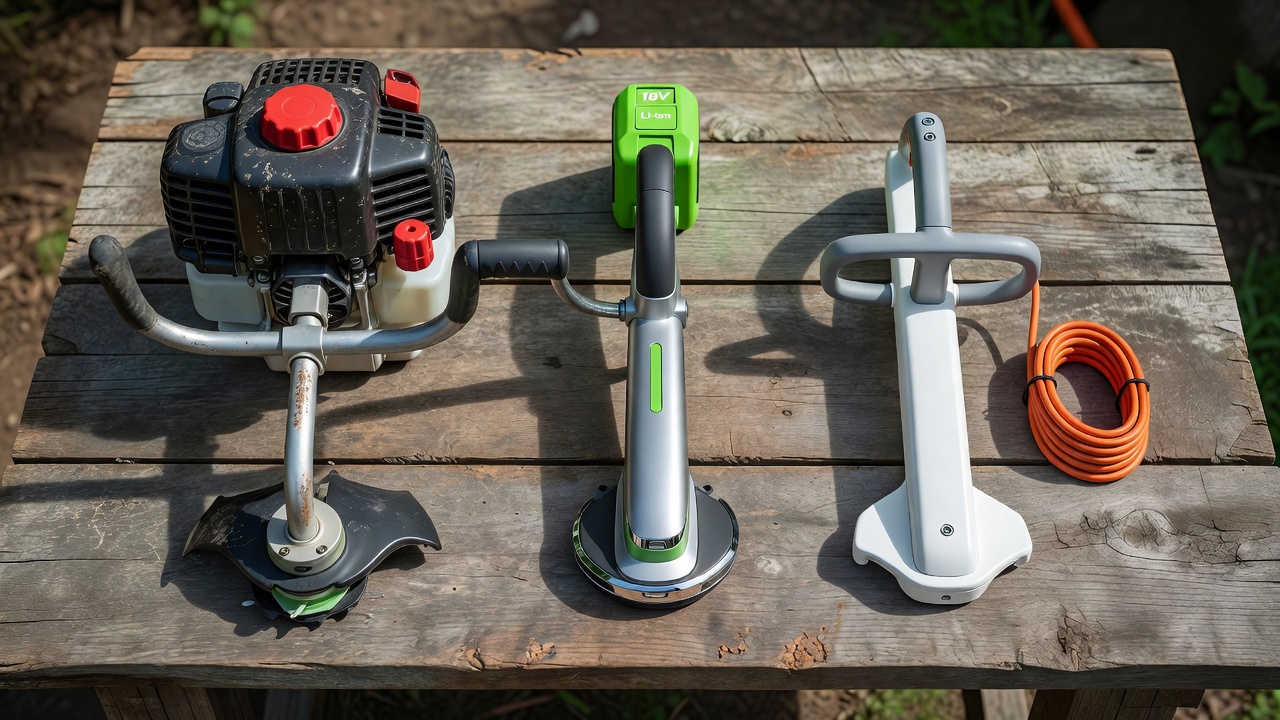
Power source is the single most important decision. It dictates runtime, maintenance, noise, upfront cost, and long-term ownership experience. Before finalizing equipment decisions, refer to our comprehensive jbl partybox club 120 vs sony srs xv500 comparison.
Gas-Powered Trimmers
Gas trimmers use a two-stroke (or occasionally four-stroke) engine that runs on a gasoline-oil mixture. They deliver the highest sustained power and unlimited runtime — you simply refill the tank and keep working.
Best for: Large properties (over ½ acre), heavy brush, thick weeds, and professional use.
Trade-offs: Heavier (10–15+ lbs), louder (90–100+ dB), require regular maintenance (spark plugs, air filters, fuel stabilization), produce emissions, and can be difficult to start in cold weather. For broader ecosystem context, read through our operational guide on z890 vs x870e motherboard.
Battery-Powered (Cordless) Trimmers
Cordless trimmers run on lithium-ion batteries, typically ranging from 18V to 80V+. Modern high-voltage platforms (40V–80V) deliver torque that rivals mid-range gas models for residential tasks. Runtime per charge ranges from 20–60 minutes depending on battery capacity (Ah rating) and load.
Best for: Most homeowners with small to medium yards (up to ½ acre), noise-sensitive neighborhoods, and users who want grab-and-go convenience. For troubleshooting and reliability insights, consult our in-depth marshall stanmore iii vs harman kardon onyx studio 8 report.
Trade-offs: Higher upfront cost (especially if buying into a new battery platform), finite runtime per charge, battery degradation over 3–5 years, and reduced power in thick brush compared to gas.
Corded Electric Trimmers
Corded models plug into a standard 120V outlet. They’re lightweight (5–8 lbs), quiet, maintenance-free, and the least expensive to buy. The cord limits range to about 100–150 feet from an outlet with a heavy-duty extension cord. Readers comparing setup options can review our technical analysis on dyson v8 cyclone vs bissell featherweight stick.
Best for: Very small yards (under ¼ acre), users on a tight budget, and properties where an outlet is always accessible.
Trade-offs: Cord management is frustrating, range is limited, and they lack the torque for heavy weeds or brush. For complementary field maintenance guidelines, examine our breakdown of bissell crosswave hydrosteam vs shark stainforce.
| Factor | Gas | Battery (Cordless) | Corded Electric |
|---|---|---|---|
| Typical Weight | 10–15+ lbs | 8–12 lbs (with battery) | 5–8 lbs |
| Noise Level | 90–100+ dB | 60–75 dB | 60–70 dB |
| Runtime | Unlimited (refuel) | 20–60 min/charge | Unlimited (plugged in) |
| Maintenance | High (engine upkeep) | Low (battery care) | Very Low |
| Upfront Cost | $150–$400+ | $150–$350+ (tool only) | $40–$100 |
| Ideal Yard Size | ½ acre+ | Up to ½ acre | Under ¼ acre |
Key Specs to Evaluate Before Buying a Weed Trimmer
Beyond power source, these specifications determine whether a trimmer will handle your workload comfortably.
Cutting Swath Width
The cutting swath (or cutting diameter) is the width of the circle the spinning line creates. Common ranges:
- 10–12 inches: Light-duty, small yards, tight spaces
- 13–15 inches: Versatile middle ground for most residential yards
- 16–18+ inches: Large properties, faster coverage, requires more power
Wider isn’t always better — a 17-inch swath on an underpowered motor will bog down in thick grass.
Trimmer Line Gauge (Diameter)
Line thickness affects cutting ability and durability:
- 0.065–0.080 inch: Light grass, electric/battery trimmers
- 0.080–0.095 inch: General residential use, mixed weeds
- 0.095–0.105+ inch: Heavy brush, gas trimmers, commercial use
Using line that’s too thick for your trimmer’s motor can cause overheating; too thin breaks constantly in tough growth.
Straight Shaft vs. Curved Shaft
- Straight shaft: Longer reach, better for trimming under decks, fences, and bushes. Preferred by professionals. Typically heavier and more expensive.
- Curved shaft: Lighter, better balance for waist-level work, easier to maneuver in tight spaces. Common on entry-level and mid-range models.
Line Feed System: Bump-Feed vs. Auto-Feed
- Bump-feed: Tap the trimmer head on the ground to advance line. Gives you control but requires technique.
- Auto-feed: Line advances automatically (usually via centrifugal force or a sensor). Convenient but can waste line and sometimes jams.
Many pros prefer bump-feed for reliability; many homeowners prefer auto-feed for convenience.
Weight and Ergonomics
A trimmer that feels light in the store may feel heavy after 30 minutes. Look for:
- Total weight with battery/fuel
- Adjustable handles and shaft length
- Shoulder strap attachment points (essential for gas and large battery models)
- Vibration damping — reduces hand fatigue
How Yard Size and Terrain Should Guide Your Choice
Small Yards (Under ¼ Acre)
A corded electric trimmer is often the most practical choice — low cost, zero maintenance, unlimited runtime. A compact 18V–24V battery trimmer works well if you prefer cordless convenience and have an outlet for charging.
Medium Yards (¼ to ½ Acre)
This is the sweet spot for 40V–60V battery platforms. A 2.5Ah–4.0Ah battery typically delivers 30–45 minutes of runtime, enough for a full trim. Look for a 13–15 inch swath and straight shaft if you have landscaping beds or fences.
Large Yards (Over ½ Acre)
Consider either a high-voltage battery system (60V–80V with 5Ah+ batteries, ideally two for swapping) or a gas trimmer. Gas eliminates runtime anxiety entirely. For heavy brush or overgrown areas, gas still holds a clear advantage in sustained torque.
Slopes, Uneven Terrain, and Obstacles
Lightweight trimmers (corded or compact battery) reduce fatigue on hills. Straight shafts reach under fences and deck edges without bending. If you’re edging along driveways or beds frequently, a trimmer with an adjustable head that rotates 90° simplifies the task.
Can a Trimmer Replace an Edger?
Most string trimmers can edge by rotating the head vertically, but a dedicated lawn edger (with a vertical metal blade) produces a cleaner, deeper, straighter cut along hard surfaces. If crisp edges are a priority, a separate edger or a convertible multi-head system is worth considering.
Budget Ranges: What Level of Investment Gets You What Performance?
Under $100 — Entry Level
Almost exclusively corded electric or low-voltage (18V–24V) battery tools. Lightweight, low torque, plastic gears, shorter warranties (1–2 years). Suitable for light grass trimming in very small yards. Not designed for heavy weeds or frequent use.
$100–$250 — Mid-Range
Solid 40V–60V battery platforms (often tool-only pricing), entry-level gas models. Metal gearboxes, better vibration control, 13–15 inch swaths, 3–5 year warranties. This tier hits the value sweet spot for most homeowners.
$250–$400+ — Premium / Prosumer
High-voltage battery systems (60V–80V) with brushless motors, commercial-grade gas trimmers. Brushless motors run cooler, last longer, and deliver more torque per amp-hour. Features include carbon-fiber shafts, lifetime gearbox warranties, and advanced ergonomics. Justified if you maintain large properties or use the tool weekly.
Trimmer vs. Trimmer/Edger Combos: Do You Need Both Functions?
A trimmer/edger combo (sometimes called a 2-in-1) is a string trimmer with a head that rotates 90° and often includes a guide wheel for edging. A dedicated edger uses a vertical steel blade for a deeper, cleaner cut.
When a Combo Makes Sense
- Occasional edging along sidewalks and driveways
- Limited storage space
- Budget constraints — one tool instead of two
When to Buy Separate Tools
- You want professional-looking, deep edges
- You edge frequently (weekly during growing season)
- You have long stretches of hardscape borders
Multi-Head Attachment Systems
Some brands offer multi-head systems (split-shaft) where a single powerhead accepts trimmer, edger, pole saw, hedge trimmer, and cultivator attachments. These are cost-effective if you need multiple tools, but the powerhead must be robust enough to drive each attachment — usually gas or high-voltage (60V+) battery.
Brand Reputation and Reliability: What the Track Record Shows
Brand matters for parts availability, warranty support, and battery ecosystem compatibility. Here’s how major players position:
- STIHL & Husqvarna: Professional-grade first, residential second. Dealer networks for service, premium pricing, excellent parts support. Overkill for occasional use but last decades.
- EGO Power+, DEWALT, Milwaukee Tool, Greenworks: Lead the high-voltage battery revolution. EGO and Greenworks focus on outdoor power equipment; DEWALT and Milwaukee leverage their pro-tool battery platforms. Strong warranties (3–5 years tool, 3 years battery).
- Black+Decker, Ryobi, Worx, Craftsman: Value-oriented, home-center brands. Good for light duty; battery platforms are broad but lower voltage (18V–40V). Warranties typically 2–3 years.
Battery platform compatibility is a major cost factor. If you already own 18V DEWALT or 40V Greenworks tools, staying in that ecosystem avoids buying new batteries and chargers.
How to Evaluate Weed Trimmer Reviews and Testing Data
Not all reviews are created equal. Here’s how to read them critically:
- Look for controlled testing: Reviews that measure cut time through standardized grass/weed thickness, runtime under load, and noise at operator ear are more reliable than subjective impressions.
- Check the test conditions: Was the battery fully charged? Was the gas trimmer broken in? Was the line fresh? Cold batteries and dull line skew results.
- Weight runtime claims: Manufacturer runtime is usually “no load” (spinning in air). Real-world runtime under load is often 40–60% of claimed.
- Red flags in user reviews: Repeated reports of gearbox failure, battery overheating, line feed jams, or poor warranty service. Single complaints about weight or vibration are often preference, not defects.
- Prioritize metrics that match your use: If you edge weekly, edge-quality matters more than max brush-cutting torque.
The Bottom Line on Weed Trimmer in 2026
Use this quick decision framework:
- What’s your yard size? Under ¼ acre → corded or compact battery. ¼–½ acre → 40V–60V battery. Over ½ acre → high-voltage battery (dual battery) or gas.
- What’s the toughest growth you’ll cut? Mostly grass/light weeds → any type. Thick weeds/brush → gas or 60V+ battery.
- How much maintenance will you tolerate? Zero → corded or battery. Some (mixing fuel, winterizing) → gas.
- Do you already own cordless tool batteries? Yes → strongly consider that brand’s trimmer. No → evaluate total system cost (tool + battery + charger).
- Do you need edging capability? Occasional → rotating head trimmer. Frequent/perfectionist → dedicated edger or multi-head system.
For most homeowners today, a 40V–60V brushless battery trimmer with a 13–15 inch swath, straight shaft, and bump-feed head from a brand whose battery platform you already own (or plan to build into) is the best all-around choice.
Everything You Need to Know: Best Weed Trimmer FAQ
What is the difference between a weed trimmer, string trimmer, weed eater, and weed whacker?
They are all the same tool. “String trimmer” is the industry-standard term. “Weed eater” originated as a brand name (Weed Eater) that became generic. “Weed whacker” is a colloquial variation. All use a spinning monofilament line to cut vegetation.
Is a battery-powered weed trimmer powerful enough to replace a gas trimmer?
For most residential use, yes. Modern 40V–80V brushless battery trimmers match mid-range gas models in torque for grass and moderate weeds. Gas still wins for sustained heavy brush clearing, all-day runtime, and extreme conditions.
How long does a battery-powered weed trimmer run on a single charge?
Typically 20–60 minutes under load, depending on battery voltage, amp-hour (Ah) rating, cutting thickness, and motor efficiency. Manufacturer “no-load” claims are higher. Buying a second battery effectively doubles runtime.
What trimmer line gauge should I use?
Match line diameter to your trimmer’s power and the vegetation: 0.065–0.080″ for light grass on electric/battery trimmers; 0.080–0.095″ for general residential use; 0.095–0.105+” for heavy brush on gas or high-voltage models. Using oversized line can overheat the motor.
Can I use a weed trimmer for edging?
Yes — most trimmers allow the head to rotate 90° for vertical edging. A guide wheel helps maintain a straight line. For deep, crisp edges along concrete, a dedicated blade edger produces better results with less effort.
For more hands-on benchmarks and buying recommendations, consult our guides on residential zero-turn lawn mower guide, as well as automated robotic lawn mower guide.
Mechanical safety standards, operational tolerances, and protective gear guidelines align with benchmark specifications established by the American National Standards Institute (ANSI).