

Quick Answer: What Motor Oil For Lawn Mower?
Selecting the correct motor oil for your lawn mower is critical to maintaining engine health and ensuring reliable operation. The type and grade of oil your mower requires depends on your engine type, local climate conditions, and manufacturer specifications. Using improper motor oil can lead to poor performance, increased wear, and potential engine damage.
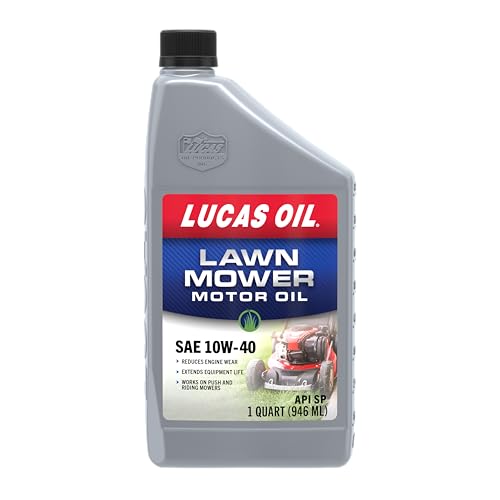
Pros
- Effectively reduces engine wear for longer mower equipment lifespan
- Works on both push and riding mowers for versatile application
- Provides overheating protection and rust prevention during storage
- Promotes easier starts and smoother overall engine running
Cons
- Available only in a single 1-quart size that may require repurchase for frequent or large-scale use
- Primarily targeted at lawn mower four-stroke engines, limiting broader multi-equipment versatility
- Lacks detailed multi-viscosity options beyond the specified SAE 10W-40 grade
The Lucas Oil 11314 SAE 10W-40 Lawn Mower Motor Oil is a specialized four-stroke engine oil from the established Lucas Oil brand, packaged in a practical 1 quart container. It presents as a straightforward maintenance product focused on lawn care equipment with a formulation tailored for reliable everyday use on outdoor power tools.
In real-world performance this oil reduces engine wear to extend equipment life while supporting both push and riding mowers. Key features include protection against overheating during operation, rust prevention for storage periods, and benefits that help the engine start easier and run smoother based on its SAE 10W-40 design for four-stroke applications.
Potential drawbacks include the single 1 quart packaging which may necessitate additional purchases for high-volume users and its primary focus on lawn mower engines that could restrict use in other four-stroke equipment. No extensive multi-viscosity or bulk options are indicated in the available details.
Overall the Lucas Oil 11314 delivers solid value for homeowners and landscapers seeking dependable lawn mower oil that prioritizes wear reduction and seasonal protection. It is best suited for owners of push or riding mowers who want to maintain smoother operation and longer equipment life without complexity.
Understand Your Engine Type
Lawn mowers use either 2-stroke or 4-stroke engines, and each has fundamentally different oil requirements. A 4-stroke engine operates with a closed-loop lubrication system where oil circulates continuously through the engine, coating moving parts and returning to the reservoir. These engines have a dedicated oil tank, dipstick, and oil filler cap. A 2-stroke engine lacks a separate lubrication system; instead, oil is premixed with fuel and burns alongside the gasoline to lubricate internal components as the engine runs.
Identifying your engine type is straightforward. Check your owner’s manual first, it will clearly state whether you have a 2-stroke or 4-stroke engine. If the manual is unavailable, look for an oil dipstick or oil fill cap on the engine block; 4-stroke engines have these, while 2-stroke engines do not. The engine’s physical size and weight also provide clues: 2-stroke engines are typically smaller and lighter than equivalent-power 4-stroke engines.
Confusing these engine types leads to serious consequences. Using 4-stroke oil in a 2-stroke engine will cause excessive carbon buildup and engine fouling. Using 2-stroke fuel-oil mix in a 4-stroke engine will damage the lubrication system. Always verify your engine type and use the appropriate oil or oil-fuel mixture for your mower.
Motor Oil Grades for 4-Stroke Mower Engines
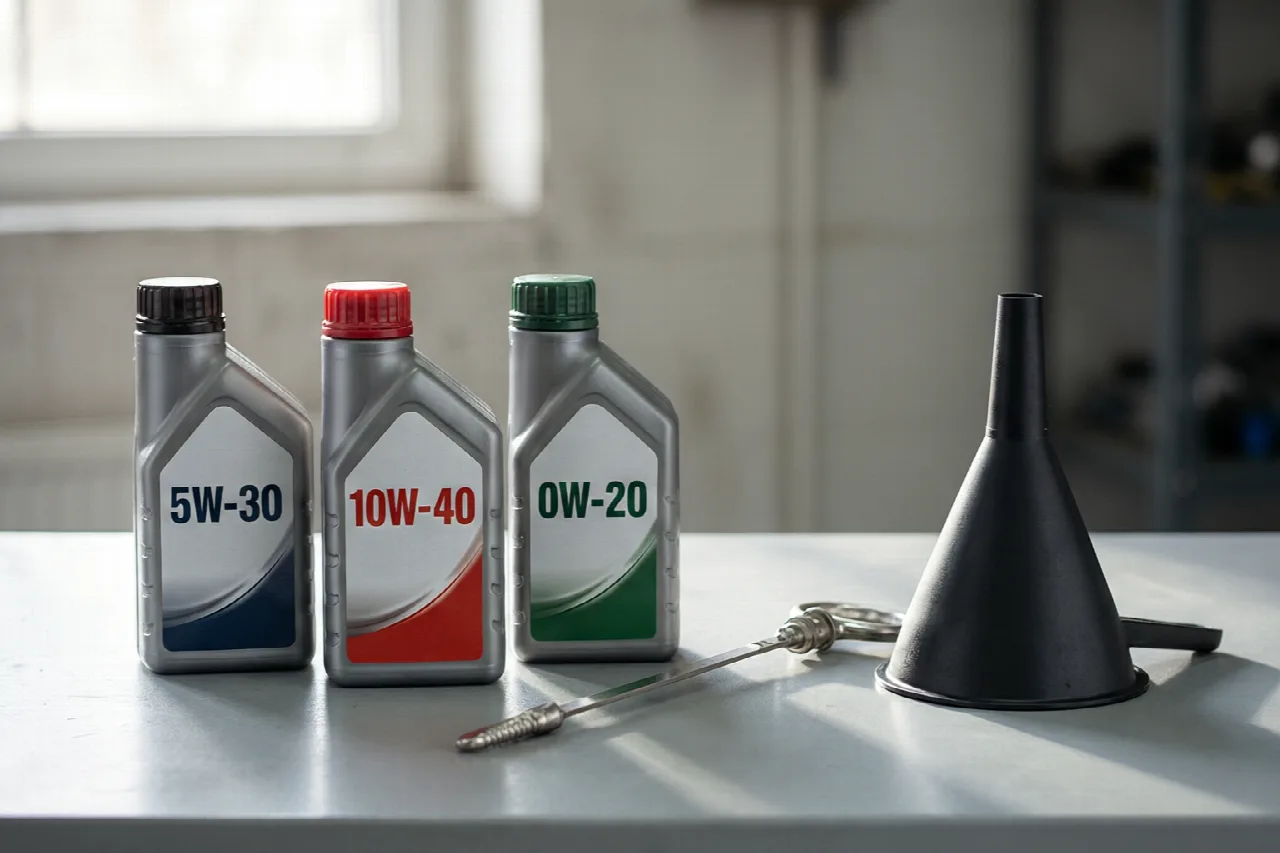
Motor oil viscosity, how thick or thin the oil is, is measured using SAE (Society of Automotive Engineers) grades. Common grades for 4-stroke lawn mower engines include SAE 30, SAE 10W-30, and SAE 5W-30. Single-grade oils like SAE 30 have one viscosity rating and work best in consistent temperatures. Multi-grade oils like 10W-30 are rated for both cold (the W number) and hot (the second number) operating conditions, providing flexibility across seasonal changes.
SAE 30 is suitable for warm and hot climates and is often used in small push mowers. The oil flows smoothly at warm temperatures but becomes thick in cold weather, potentially making engine startup difficult. SAE 10W-30 is a multi-grade formulation that maintains adequate flow at low temperatures while providing protection in heat, making it appropriate for temperate and variable climates. SAE 5W-30 is designed for cold-weather regions where winter startup reliability is important.
API (American Petroleum Institute) service classifications, such as SJ, SL, SM, or SN, indicate the oil’s quality level and protective capabilities. Older classifications like SJ work well for many lawn mowers, while newer formulations like SM or SN offer enhanced protection and detergency. Your owner’s manual will specify the minimum API classification your engine requires. Meet or exceed this specification to ensure adequate wear protection and engine cleanliness. Using a higher classification is generally safe and may provide additional benefits, though it is not necessary if a lower classification meets the manufacturer’s requirement.
2-Stroke Oil Requirements
2-stroke engines require a dedicated 2-stroke oil mixed with gasoline before fueling the engine. Unlike 4-stroke engines that have a separate oil system, 2-stroke engines rely entirely on the fuel-oil mixture to provide lubrication. The oil is burned along with the fuel, so it must be formulated to burn cleanly with minimal residue buildup.
The correct oil-to-fuel ratio varies by engine manufacturer but commonly ranges from 50:1 to 40:1, meaning 50 parts gasoline to 1 part oil, or 40 parts gasoline to 1 part oil. Your owner’s manual will specify the exact ratio for your mower. Mixing the wrong ratio compromises engine protection: too little oil leaves the engine under-lubricated and prone to damage, while too much oil causes excessive smoke, fouled spark plugs, and carbon deposits.
Always use a dedicated 2-stroke oil formulated for small engines, not regular 4-stroke motor oil or automotive oil. 2-stroke oils are engineered to mix thoroughly with gasoline and burn cleanly. Standard motor oils do not disperse adequately in fuel and will cause engine fouling. Mix the oil and fuel in a separate container before adding to the mower’s fuel tank; never mix them directly in the tank, as uneven distribution may result. Measure both components carefully using a measuring cup or syringe to ensure the correct ratio. For troubleshooting and reliability insights, consult our in-depth marshall stanmore iii vs harman kardon onyx studio 8 report.
Confirming the Specification From the Owner’s Manual
Your owner’s manual is the definitive reference for your specific mower’s oil requirements. Locate the maintenance or specifications section and note the recommended viscosity grade, API classification, and any brand-specific recommendations. The manual may also include oil capacity, change intervals, and disposal guidelines.
If you lack a physical manual, visit the manufacturer’s website and search for your mower model. Most major brands provide downloadable manuals in PDF format. You can also contact the manufacturer’s customer service with your model number to request a replacement manual or email the specifications. Local mower service centers and retailers sometimes stock or can order replacement manuals as well. Readers comparing setup options can review our technical analysis on dyson v8 cyclone vs bissell featherweight stick.
Engine labels mounted near the oil fill cap often display recommended specifications. If the label is legible, it can confirm the oil grade and API classification. However, if the label is worn or missing, refer back to your manual or the manufacturer’s website. Never guess at oil specifications; using incorrect oil can void your warranty and damage the engine.
Maintenance and Safety Considerations
Checking and changing motor oil regularly keeps your 4-stroke mower engine in good condition. Before each use or at the start of the mowing season, check the oil level using the dipstick or sight glass. The level should fall between the minimum and maximum marks. If it is low, add the correct grade of oil slowly and recheck until it reaches the proper level. Overfilling reduces performance and can cause smoking and fouling. For complementary field maintenance guidelines, examine our breakdown of bissell crosswave hydrosteam vs shark stainforce.
Most 4-stroke lawn mower engines require an oil change at the beginning of each mowing season or after every 50 operating hours, whichever comes first. Some heavy-use or commercial mowers may need more frequent changes. Drain the old oil while the engine is warm (but not hot) into a suitable container, replace the oil filter if your mower has one, and refill with fresh oil to the correct level. For 2-stroke engines, you do not change oil in the traditional sense; instead, prepare a fresh fuel-oil mixture for each fueling.
Safe disposal of used motor oil is important for environmental protection. Never pour used oil into drains, soil, or water sources. Most municipal recycling centers, automotive service shops, and some retail stores accept used motor oil for proper recycling or disposal. Contact your local waste management authority to find disposal facilities near you.
Technical Standards and Compliance
Mechanical safety standards, operational tolerances, and protective gear guidelines align with benchmark specifications established by the American National Standards Institute (ANSI).









