Quick Answer: Most 4-stroke lawn mower engines take SAE 30 motor oil in warm climates (above 40°F/4°C), 10W-30 for variable temperatures, or 5W-30 in cold climates. 2-stroke engines require a dedicated 2-cycle oil pre-mixed with gasoline — never poured into a separate reservoir. Always confirm the exact grade on the engine label or in the owner’s manual, because Briggs & Stratton, Honda, Kawasaki, and Kohler each publish specific viscosity recommendations.
4-Stroke vs. 2-Stroke Lawn Mower Engines: Why It Changes Everything

Before choosing a viscosity grade, identify which engine type you have. Using the wrong oil type — for example, pouring unmixed conventional oil into a 2-stroke engine — causes immediate lubrication failure and permanent engine damage. The two engine types require fundamentally different lubrication approaches.
How to tell which engine type you have
- Dipstick present? A dipstick or separate oil fill cap alongside a fuel cap means 4-stroke. Oil and fuel are kept separate.
- Single fill cap only? One cap that accepts both fuel and oil (pre-mixed) means 2-stroke.
- Check the engine label. Most engines stamp the stroke type, model number, and sometimes the recommended oil grade directly on the engine housing.
- Check the owner’s manual cover. It will state the engine displacement and stroke type on the first page of the specifications section.
4-stroke engines (the vast majority of modern mowers)
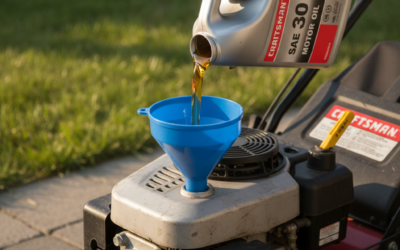
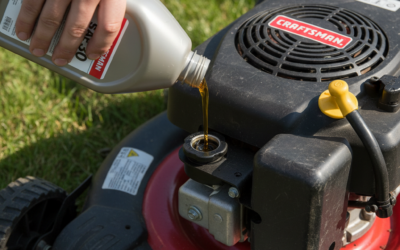
4-stroke engines have a dedicated oil reservoir accessed via a dipstick or fill cap. Oil lubricates the engine internally and is never mixed with fuel. You drain and replace it on a maintenance schedule — typically every 50 hours of operation or once per season, whichever comes first, per Briggs & Stratton and Honda maintenance schedules. This is the engine type found on virtually all push mowers, riding mowers, and zero-turn mowers sold in the last 20 years.
2-stroke engines (older push mowers and some handheld equipment)
2-stroke engines have no separate oil reservoir. Lubrication comes from 2-cycle oil pre-mixed with gasoline at a specific oil-to-gas ratio — commonly 50:1 (2.6 oz of oil per 1 gallon of fuel), though always verify the ratio on the engine label. Running a 2-stroke engine on unmixed fuel starves it of lubrication within seconds, seizing the piston. 2-stroke push mowers are rare in production today but appear frequently in older equipment and some budget models.
Lawn Mower Oil Viscosity Grades by Temperature: Quick-Reference Chart
For 4-stroke engines, the correct viscosity grade depends primarily on the ambient operating temperature. The SAE (Society of Automotive Engineers) viscosity system uses numbers to describe how oil flows at cold and hot temperatures. Multi-grade oils (e.g., 10W-30) flow well in cold starts and maintain protection at operating temperature. Single-grade oils (e.g., SAE 30) are formulated for consistent warm-weather use.
| Ambient Temperature Range | Recommended Grade | Notes |
|---|---|---|
| Above 40°F (4°C) — warm season | SAE 30 | Most common grade for standard warm-weather mowing; conventional or synthetic available |
| 0°F to 100°F (−18°C to 38°C) — variable | 10W-30 | Best all-season choice for most climates; Honda’s primary recommendation for GCV/GXV series engines |
| Below 40°F (4°C) — cold climate or winter storage start-ups | 5W-30 | Briggs & Stratton approves full synthetic 5W-30 as a replacement for SAE 30 across all temperatures |
| Above 32°F (0°C) — V-twin riding mowers | 10W-40 | Kawasaki’s primary recommendation for FR/FS/FX V-twin engines in most operating conditions |
Synthetic vs. conventional oil for lawn mowers
Both synthetic and conventional oils work in 4-stroke lawn mower engines as long as the viscosity grade and API service classification match the manufacturer’s requirement. API SJ or higher (SL, SM, SN) is required for most modern small 4-stroke engines. Full synthetic oil offers better thermal stability, slower oxidation, and improved cold-start protection — particularly useful for commercial operators or year-round mowing. Briggs & Stratton explicitly approves full synthetic 5W-30 as a drop-in replacement for SAE 30 in all their engines. Switching from conventional to synthetic mid-season does not require a flush; simply change at the next scheduled interval.
Oil Recommendations by Engine Brand: Briggs & Stratton, Honda, Kawasaki, and Kohler
Briggs & Stratton
Briggs & Stratton — the most widely used small engine brand in North American push mowers and riding mowers — recommends SAE 30 for temperatures consistently above 40°F (4°C) and 10W-30 for variable temperatures down to 0°F (−18°C). They also approve full synthetic 5W-30 as a direct replacement for SAE 30 across all temperature ranges, per their official lubrication specification documentation. Oil must meet API SJ or higher. Briggs does not require you to use their proprietary branded oil — any quality oil meeting the grade and API rating is acceptable.
Honda
Honda Power Equipment recommends 10W-30 as the primary all-season grade for its GCV and GXV series engines (the engines found in most Honda push mowers). In temperatures consistently above 60°F (15°C), Honda acknowledges SAE 30 as acceptable. Honda’s owner’s manuals note a preference for Honda-brand 10W-30 but confirm that any oil meeting the API SJ or SL classification at the correct grade is suitable. Oil capacity for a Honda GCV160 (common on the HRX and HRR series) is approximately 0.58 L (19.6 fl oz).
Kawasaki
Kawasaki recommends 10W-40 for its FR, FS, and FX V-twin engines used in riding mowers and zero-turns in most operating conditions (above 32°F/0°C). For temperatures below 32°F, Kawasaki specifies 10W-30. API SF or higher classification is required. Oil capacity for the Kawasaki FR730V (a common riding mower engine) is approximately 2.0 L (67.6 fl oz). Using 10W-30 year-round in a Kawasaki V-twin is acceptable but 10W-40 is the published primary specification.
Kohler
Kohler recommends SAE 30 for temperatures above 32°F (0°C) and 10W-30 for all-season use down to 0°F (−18°C) in its Command and Courage series engines, per Kohler engine service manuals. Synthetic 5W-30 is approved for extended temperature range use. API SJ or higher is required. Oil capacity for the Kohler SV720 (common in Cub Cadet and Husqvarna riding mowers) is approximately 2.0 L (64 fl oz).
Does the oil need to be the manufacturer’s own brand?
No. All four manufacturers above accept any motor oil meeting the specified viscosity grade and API service classification. Proprietary branded oils (e.g., Honda 10W-30, Briggs & Stratton SAE 30) are formulated to spec but offer no mechanical advantage over equivalent third-party oils at the same grade. Using a non-branded oil does not void the warranty provided the oil meets the published specification.
Push Mower vs. Riding Mower vs. Zero-Turn: Oil Type and Capacity Differences
Oil grade recommendations follow the engine brand and ambient temperature — not the mower chassis type. A Briggs & Stratton engine in a push mower takes the same grade as the same Briggs engine in a riding mower. What differs significantly is oil capacity.
| Mower Type | Typical Engine | Approximate Oil Capacity |
|---|---|---|
| Push mower (single-cylinder) | Briggs 140cc, Honda GCV160 | 15–20 fl oz (0.44–0.59 L) |
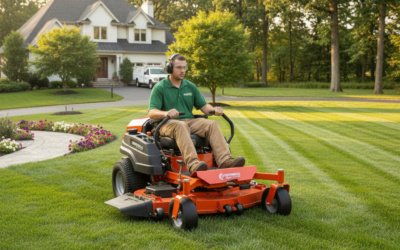
| Riding mower / zero-turn (twin-cylinder) | Kohler SV720, Kawasaki FR730V | 48–64 fl oz (1.4–1.9 L) |
Always fill to the FULL mark on the dipstick, not to a fixed volume. Overfilling is as damaging as underfilling (see Common Mistakes below). Oil change interval for both mower types is every 50 hours of operation or once per season, whichever comes first — with a mandatory oil change after the first 5 hours on a brand-new engine to flush break-in metal particles.
How to Find the Correct Oil Spec for Your Specific Mower Model
Use this process for any mower brand, including lesser-known or store-brand engines:
- Read the engine label. Look for a metal or plastic label on the engine block itself (not the mower deck). It typically states the model number, displacement, and sometimes the recommended oil grade and API classification.
- Check the oil fill cap. Many manufacturers print the recommended oil grade directly on the cap — for example, “SAE 30” or “10W-30” embossed in the plastic.
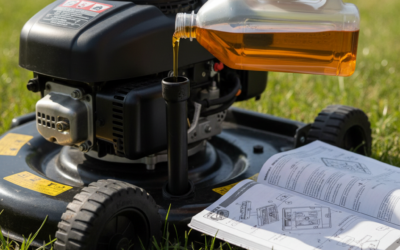
- Locate the owner’s manual. The oil specification is in the Maintenance or Specifications section. If the physical manual is lost, search “[engine brand] [model number] owner’s manual PDF” — all four major brands (Briggs & Stratton, Honda, Kawasaki, Kohler) publish free downloadable manuals on their official websites.
- Find your engine model number. On Briggs & Stratton engines, the model, type, and code are stamped on a metal tag near the valve cover or on the blower housing. On Honda engines, the engine model (e.g., GCV160) is on the engine block above the muffler. On Kawasaki and Kohler, check the top of the engine or the valve cover.
- Cross-reference the manufacturer’s website. Enter the engine model number into the manufacturer’s parts/support lookup tool to retrieve the exact oil specification, capacity, and change interval for your unit.
Common Lawn Mower Oil Mistakes and How to Avoid Them
Overfilling the oil reservoir
Filling beyond the FULL dipstick mark forces excess oil into the crankcase breather, which routes it into the air filter and combustion chamber. Symptoms include white smoke, oil-fouled air filter, and hard starting. Fix: drain to the correct level using the drain plug or a turkey baster through the fill tube.
Using car engine oil without checking the grade
Automotive motor oil is acceptable in lawn mower engines only if it matches the correct viscosity grade and meets API SJ or higher. The issue is not car oil vs. small-engine oil — it is using the wrong grade. A 0W-20 full synthetic formulated for a modern fuel-injected car engine is too thin for most air-cooled small engines. Match the grade first.
Mixing synthetic and conventional oil
Mixing synthetic and conventional oil of the same viscosity grade is not harmful to the engine — the two are chemically compatible. Oil performance degrades toward the lower-quality product in the blend. For best results, drain completely before switching types at a scheduled oil change rather than topping up across types repeatedly.
Running the engine low on or without oil
Modern Briggs & Stratton and Honda engines include a low-oil shutoff sensor that cuts the engine before oil pressure drops to a damaging level. Older engines and many budget brands do not. Running without oil seizes the engine within minutes. Check the dipstick before every mowing session — wipe, reinsert fully, withdraw, and read.
Skipping the break-in oil change
New engines ship with break-in oil. Metal particles shed during the first hours of operation contaminate it rapidly. Change the oil after the first 5 hours of use regardless of oil condition, then resume the standard 50-hour/once-per-season schedule.
Using straight 2-cycle oil in a 4-stroke engine
2-cycle oil is formulated to burn cleanly with fuel. It lacks the additive package (anti-wear, detergents, oxidation inhibitors) needed for a 4-stroke crankcase. Using it in a 4-stroke engine accelerates wear and deposits. Use the grade specified for the engine type.
Frequently Asked Questions
Can I use 10W-30 instead of SAE 30 in my lawn mower?
Yes, in most cases. Briggs & Stratton, Honda, and Kohler all list 10W-30 as an acceptable alternative to SAE 30 for warm-weather operation. The multi-grade 10W-30 provides better cold-start protection than single-grade SAE 30 and performs equivalently at normal operating temperatures. If your engine explicitly prohibits 10W-30 (rare), the owner’s manual will say so.
How do I know if my lawn mower is 2-stroke or 4-stroke?
Look for a dipstick or a separate oil fill cap distinct from the fuel cap — that is a 4-stroke engine. If there is only one fill cap and the engine instructions say to mix oil with gasoline, it is a 2-stroke engine. The engine label or owner’s manual will also state the stroke type explicitly. The vast majority of push mowers and all riding mowers sold today are 4-stroke.
How much oil does a lawn mower take?
Single-cylinder push mower engines (e.g., Briggs & Stratton 140cc, Honda GCV160) hold approximately 15–20 fl oz (0.44–0.59 L). Twin-cylinder riding mower and zero-turn engines (e.g., Kohler SV720, Kawasaki FR730V) hold approximately 48–64 fl oz (1.4–1.9 L). Fill to the FULL mark on the dipstick, not to a fixed volume, because capacity varies by engine and mower orientation.
How often should I change the oil in my lawn mower?
Every 50 hours of operation or once per season, whichever comes first — per Briggs & Stratton and Honda published maintenance schedules. Change after the first 5 hours on a new engine. If the mower sits through winter, change the oil in spring before the first mow of the season regardless of hours logged, because oil oxidizes and accumulates moisture during storage.