
Quick Answer: The Right Oil for Most Briggs & Stratton Engines
For most Briggs & Stratton lawn mower engines, use SAE 10W-30 motor oil meeting API service class SJ or higher. This multi-grade oil works across the widest temperature range (approximately 0 °F to 100 °F) and suits the majority of homeowners. Use SAE 30 for consistent warm-weather operation above 40 °F, SAE 5W-30 for cold climates below 40 °F, or full synthetic SAE 5W-30 for year-round performance and extended change intervals. All modern Briggs & Stratton mower engines are 4-stroke and require dedicated engine oil — never use 2-stroke mix.

Pros
- Large-size design named in product title
- Sharpening and balancing functions listed
- Listed as a new upgraded version

Pros
- Adjustable 15-to-45-degree range in title
- Sharpening and balancing functions listed

Pros
- Sharpener and balancer functions in title
- 15-to-45-degree adjustable setting listed
- Built for lawn mower blade maintenance
Pros
- Includes replacement gaskets and a 98079-55846 spark plug
- Matches Honda HRR216 and HRS216 lawn mower models
- Designed around the 16100-Z8B-901 carburetor specification
Cons
- Restricted to select Honda GCV160 mower applications
- Installation requires basic mechanical tools and skills
Oil Viscosity by Temperature: Which Grade Matches Your Climate
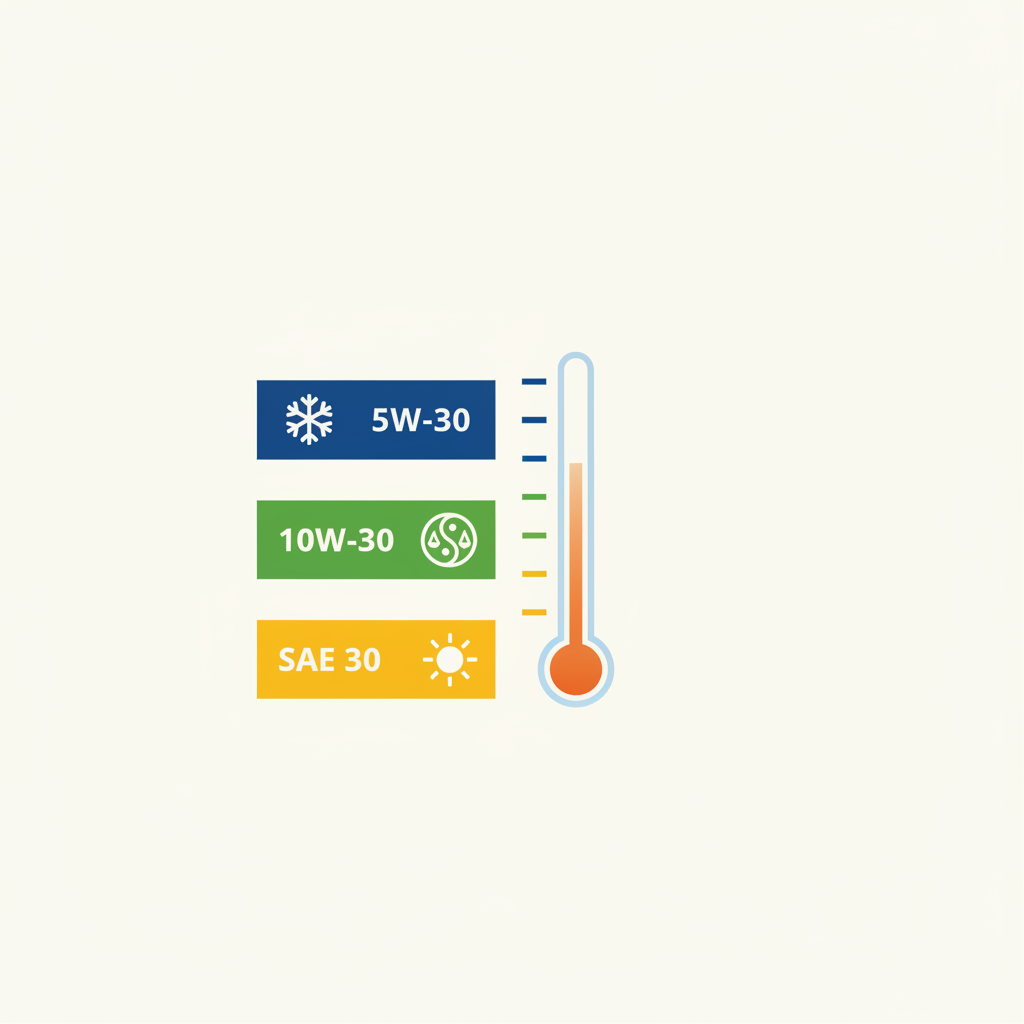
The single biggest factor in choosing the right oil is your typical operating temperature. Briggs & Stratton’s official guidance maps viscosity grades to ambient temperature ranges:
| Viscosity Grade | Temperature Range | Best For |
|---|---|---|
| SAE 30 | Above 40 °F (4 °C) | Consistent warm climates; older Classic/Quantum engines |
| SAE 10W-30 | 0 °F to 100 °F (-18 °C to 38 °C) | Best all-rounder for most homeowners; varying seasonal temps |
| SAE 5W-30 | Below 40 °F (4 °C) | Cold climates; easier cold starts |
| Synthetic 5W-30 | Full range (-20 °F to 120 °F) | Year-round use; extended intervals; maximum protection |
Why Single-Grade SAE 30 Falls Short in Variable Climates
SAE 30 is a single-grade oil. In hot summer cutting conditions it thins adequately, but on a chilly spring morning it thickens dramatically — increasing starter drag and delaying oil pressure buildup at the critical first seconds of engine life. Multi-grade oils (10W-30, 5W-30) use viscosity-index improvers to flow like a lighter oil when cold (the “W” winter rating) while maintaining the protective film of a 30-weight oil at operating temperature. For complementary field maintenance guidelines, examine our breakdown of jbl partybox club 120 vs sony srs xv500.
Oil Recommendations by Briggs & Stratton Engine Series
Briggs & Stratton produces several consumer engine lines. While the temperature-based viscosity table above applies universally, your owner’s manual may specify a preferred grade for your specific series: For complementary field maintenance guidelines, examine our breakdown of jbl partybox club 120 vs sony srs xv500.
| Engine Series | Typical Displacement | Oil Capacity | Manual-Preferred Viscosity |
|---|---|---|---|
| Classic / Sprint / Quattro | 125–190 cc | ~15–18 oz (0.44–0.53 L) | SAE 30 (above 40 °F) or 10W-30 |
| Quantum (450, 500, 550, 600, 625, 675) | 140–190 cc | ~15–18 oz (0.44–0.53 L) | SAE 30 or 10W-30 |
| Intek (Single-Cylinder) | 190–223 cc | ~18–20 oz (0.53–0.59 L) | 10W-30 or Synthetic 5W-30 |
| Professional Series | 190–223 cc | ~18–20 oz (0.53–0.59 L) | 10W-30 or Synthetic 5W-30 |
| Intek V-Twin (Riding Mowers) | 656–724 cc | ~48–64 oz (1.4–1.9 L) | 10W-30 or Synthetic 5W-30 |
| Commercial / Vanguard V-Twin | 627–993 cc | ~48–72 oz (1.4–2.1 L) | Synthetic 5W-30 or 10W-30 |
Always verify capacity in your specific engine’s owner’s manual — overfilling causes blue smoke, seal damage, and hydro-lock risk. To evaluate matched hardware tolerances, consult our detailed overview of z890 vs x870e motherboard.
Conventional vs. Synthetic Oil: Which Should You Choose?
Briggs & Stratton explicitly approves full synthetic SAE 5W-30 for all their 4-stroke engines. Here’s the trade-off:
- Conventional 10W-30: Lower upfront cost (~$4–6/qt). Change every 50 operating hours or once per season, whichever comes first. First change at 5 hours on a new engine.
- Synthetic 5W-30: Higher upfront cost (~$8–12/qt). Extends change interval to 100 hours or annually. Superior cold-flow (down to -20 °F), better high-temperature film strength, reduced oxidation and sludge formation.
For a homeowner mowing 20–30 hours per season, conventional oil changed annually is perfectly adequate. For commercial users, dusty environments, or anyone wanting “fill-and-forget” peace of mind, synthetic pays for itself in extended intervals and reduced wear.
Brand Myth-Busting
You do not need Briggs & Stratton branded oil. Any major brand (Mobil 1, Pennzoil, Valvoline, Castrol, SuperTech, etc.) meeting the viscosity and API rating requirements is acceptable. The API donut on the bottle is your proof — not the label artwork. To evaluate matched hardware tolerances, consult our detailed overview of z890 vs x870e motherboard.
API Service Rating: Why the Label Matters More Than the Brand
Every oil bottle carries an API “donut” symbol. For Briggs & Stratton engines, you need API service class SJ or higher (SJ, SL, SM, SN, SP). Here’s why:
- Additive package: Small engines run hotter, have higher oil temperatures, and lack the sophisticated emission controls of modern automotive engines. API SJ+ oils contain the right detergent/dispersant balance to handle combustion byproducts without excessive ash buildup.
- Warranty protection: Using oil without the correct API rating can void your Briggs & Stratton warranty. The owner’s manual states: “Use of oil not meeting API service class SJ or higher may result in engine damage not covered by warranty.”
- Avoid high-detergent automotive oils not rated for small engines: Some heavy-duty diesel oils (CI-4, CK-4) have excessive detergent levels that can damage small-engine seals and cause excessive oil consumption.
Oil Change Intervals and Capacity: Push Mower vs. Riding Mower
Push Mowers (Single-Cylinder Engines)
- Oil capacity: 15–20 oz (0.44–0.59 L)
- First change: 5 hours (break-in)
- Conventional: Every 50 hours or each season
- Synthetic: Every 100 hours or annually
Riding Mowers (V-Twin Engines)
- Oil capacity: 48–72 oz (1.4–2.1 L) — check manual for exact spec
- First change: 5 hours (break-in)
- Conventional: Every 50 hours or each season
- Synthetic: Every 100 hours or annually
- Oil filter: Replace at every oil change on V-twin models equipped with a filter
Step-by-Step Oil Check & Change Procedure
- Warm the engine for 2–3 minutes — warm oil drains faster and carries more contaminants.
- Disconnect spark plug wire and secure it away from the plug.
- Clean around the oil fill cap/dipstick to prevent debris entry.
- Remove dipstick and wipe clean.
- Drain old oil: Tilt mower (push mower) or remove drain plug (riding mower) into a suitable container.
- Replace drain plug (if equipped) and torque to spec.
- Refill with fresh oil — add ~80% of capacity, then check dipstick.
- Top up to “Full” mark — do not overfill.
- Reinstall dipstick, reconnect spark plug wire.
- Run engine 30 seconds, re-check level.
Common Oil Mistakes and How to Avoid Them
1. Overfilling
Symptoms: Blue/white smoke from exhaust, oil leaking from breather, hard starting, hydro-lock. Fix: Drain excess immediately. Check level on level ground with dipstick fully seated but not threaded (unless manual specifies otherwise). When planning workspace deployment, consider the engineering criteria outlined in our marshall stanmore iii vs harman kardon onyx studio 8 guide.
2. Using 2-Stroke Oil in a 4-Stroke Engine
2-stroke oil is designed to burn with fuel. In a 4-stroke crankcase it leaves heavy carbon deposits, clogs rings, and scores cylinder walls. Never use 2-stroke oil or fuel/oil mix in a Briggs & Stratton mower engine.
3. Mixing Synthetic and Conventional
Not catastrophic short-term — they’re chemically compatible — but you lose synthetic’s extended interval benefit. Best practice: pick one type and stick with it. For additional operational safety benchmarks, see our published testing notes on dyson v8 cyclone vs bissell featherweight stick.
4. Running Degraded Oil
Oil oxidizes, accumulates acids, and loses viscosity over time — even if hours are low. Change annually at minimum regardless of hour count.
5. Skipping Pre-Mow Level Checks
Check oil before every use on level ground. A 4-stroke engine can consume 1–2 oz per hour; running low causes catastrophic bearing failure in minutes. To compare alternative configurations, check our hands-on review of bissell crosswave hydrosteam vs shark stainforce.
Frequently Asked Questions About What Type Of Oil For Lawn Mower Briggs And Stratton
Can I use regular car oil in my Briggs & Stratton engine?
Yes, if it meets the correct viscosity (SAE 30, 10W-30, or 5W-30 per temperature) and carries API service class SJ or higher. Avoid heavy-duty diesel oils (CI-4, CK-4) and “high mileage” automotive oils with seal-swell additives not tested for small engines.
What happens if I use SAE 30 in freezing temperatures?
The oil will be too thick to flow properly at startup. The starter may not turn the engine over, or if it does, critical bearings may run dry for several seconds — causing accelerated wear. Switch to 5W-30 or synthetic 5W-30 for cold-weather operation.
How often should I change the oil if I only mow a few hours per year?
At least once per year. Oil degrades from oxidation, moisture contamination, and acid buildup even when the engine isn’t running. The 50-hour/season interval assumes regular use; low-use engines need time-based changes.
Is synthetic oil worth the extra cost for a residential push mower?
For most homeowners mowing 20–30 hours annually, conventional 10W-30 changed yearly is perfectly fine. Synthetic makes sense if you: mow in extreme heat or cold, want to extend intervals to 2 years, operate in dusty conditions, or simply prefer maximum protection.
For more hands-on benchmarks and buying recommendations, consult our guides on heavy-duty chainsaw buyer guide, as well as high-CFM commercial leaf blower guide, as well as automated robotic lawn mower guide.
Mechanical safety standards, operational tolerances, and protective gear guidelines align with benchmark specifications established by the American National Standards Institute (ANSI).