

Direct Answer: The Right Oil for Your Lawn Mower
For most four-stroke walk-behind lawn mowers, the correct oil is SAE 30 or 10W-30 high-detergent oil, with a typical capacity of 15 to 20 ounces. Two-stroke mowers require a pre-mixed gas-oil fuel. The definitive source for your specific mower’s oil type, viscosity, and capacity is the owner’s manual. Use a high-quality detergent oil rated for small air-cooled engines.

Pros
- Includes both Turf-Gard 10W-30 oil and an AM125424 filter in one purchase.
- Clear John Deere branding makes it easy to identify for compatible equipment owners.
- SAE 10W-30 is a widely used viscosity for four-stroke mower engines.
Cons
- Fitment is not universal, so buyers need to verify compatibility before ordering.
- The listing does not provide detailed performance specs or dimensions.
- There are no top reviews available in the manufacturer listing, so user feedback is limited here.
Overview & Design: The John Deere Turf-Gard SAE 10W-30 Oil and AM125424 Filter bundle is a maintenance-focused product for owners of compatible lawn mowers. It combines engine oil with a replacement filter, giving buyers the main items needed for a basic service in one package.
Performance & Key Features: The SAE 10W-30 oil grade is commonly used in four-stroke small engines, which makes this bundle practical for routine mower maintenance. The included AM125424 filter adds convenience for users who want to complete an oil change and filter replacement together.
Drawbacks & Considerations: The main limitation is fitment. The listing says it fits many lawn mowers, but buyers still need to confirm compatibility with their exact model. The available data also does not include detailed performance measurements, so expectations should stay grounded in the product information provided.
Verdict: This bundle is a sensible choice for John Deere owners and other users with compatible lawn mowers who want an oil and filter combo for regular maintenance. It offers convenience and clear product identification, but careful compatibility checking is essential before purchase.
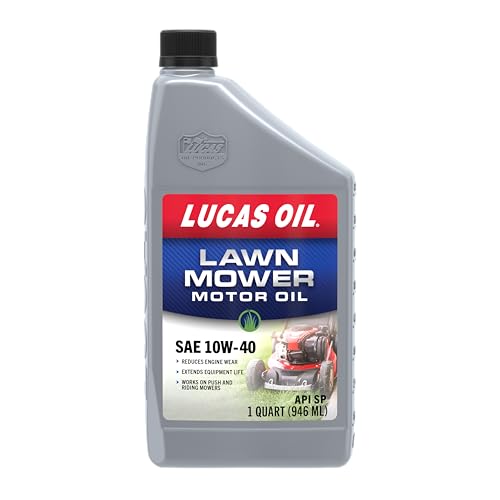
Pros
- Effectively reduces engine wear for longer mower equipment lifespan
- Works on both push and riding mowers for versatile application
- Provides overheating protection and rust prevention during storage
- Promotes easier starts and smoother overall engine running
Cons
- Available only in a single 1-quart size that may require repurchase for frequent or large-scale use
- Primarily targeted at lawn mower four-stroke engines, limiting broader multi-equipment versatility
- Lacks detailed multi-viscosity options beyond the specified SAE 10W-40 grade
The Lucas Oil 11314 SAE 10W-40 Lawn Mower Motor Oil is a specialized four-stroke engine oil from the established Lucas Oil brand, packaged in a practical 1 quart container. It presents as a straightforward maintenance product focused on lawn care equipment with a formulation tailored for reliable everyday use on outdoor power tools.
In real-world performance this oil reduces engine wear to extend equipment life while supporting both push and riding mowers. Key features include protection against overheating during operation, rust prevention for storage periods, and benefits that help the engine start easier and run smoother based on its SAE 10W-40 design for four-stroke applications.
Potential drawbacks include the single 1 quart packaging which may necessitate additional purchases for high-volume users and its primary focus on lawn mower engines that could restrict use in other four-stroke equipment. No extensive multi-viscosity or bulk options are indicated in the available details.
Overall the Lucas Oil 11314 delivers solid value for homeowners and landscapers seeking dependable lawn mower oil that prioritizes wear reduction and seasonal protection. It is best suited for owners of push or riding mowers who want to maintain smoother operation and longer equipment life without complexity.
Understanding the Question: Why Lawn Mower Oil Is Different from Car Oil
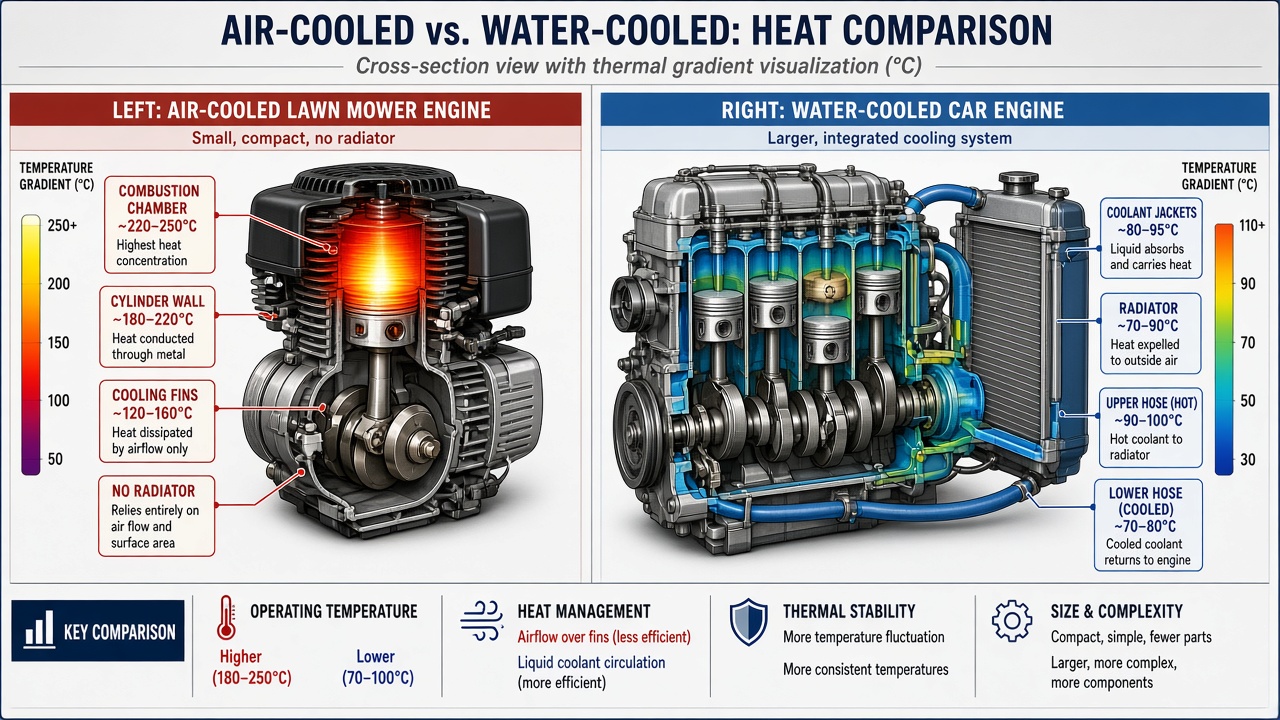
Lawn mower engines are small, air-cooled engines that operate under different conditions than car engines. They lack a liquid cooling system and oil pan, meaning the oil must handle higher temperatures and provide superior lubrication in a compact space. Using the wrong oil can lead to overheating, increased wear, and engine failure.
- Why do lawn mowers need special oil? They require high-detergent oil to combat carbon buildup and sludge in air-cooled engines, which run hotter than water-cooled car engines.
- What happens if I use the wrong oil? Incorrect viscosity can cause poor lubrication (too thin) or excessive resistance (too thick), leading to overheating, increased fuel consumption, and potential engine damage.
- What does ‘detergent oil’ mean? Detergent oil contains additives that keep engine components clean by suspending contaminants, which is critical for the longevity of small engines.
Step 1: Identify Your Engine Type, 4-Stroke vs 2-Stroke
The most critical distinction is whether your mower has a 4-stroke or 2-stroke engine, as this determines how oil is used.
- 4-Stroke Engine: Uses straight oil in a crankcase, similar to a car. You add oil to a fill tube or reservoir and check it with a dipstick. This is the most common type for modern walk-behind and riding mowers.
- 2-Stroke Engine: Requires oil to be mixed with gasoline in a specific ratio (e.g., 50:1) before being added to the fuel tank. There is no separate oil reservoir. These are more common in older or smaller handheld equipment but still found in some push mowers.
How to tell the difference: Check for a separate oil fill cap/dipstick (4-stroke) or look for a fuel tank with a note about oil-gas mix (2-stroke). Your owner’s manual will specify the engine type.
Step 2: Choose the Right Viscosity and Oil Type
Viscosity, indicated by numbers like SAE 30 or 10W-30, refers to the oil’s thickness at different temperatures. For small air-cooled engines, the choice often depends on your climate.
| Oil Type | Best For | Key Benefit |
|---|---|---|
| SAE 30 | Warm weather (above 40°F / 5°C) | Excellent protection at stable, high operating temperatures. |
| 10W-30 | Variable or moderate temperatures | Wider temperature range; easier cold starts than SAE 30. |
| 5W-30 | Cold weather (below 40°F / 5°C) | Flows easily in cold conditions for better cold-start protection. |
| Synthetic Oil | All temperatures, high-performance needs | Superior stability, reduced breakdown, and easier starts. |
Is synthetic oil safe? Yes, high-quality synthetic oils formulated for small engines are acceptable and often provide better protection, especially in extreme temperatures or for engines under heavy load. To evaluate matched hardware tolerances, consult our detailed overview of z890 vs x870e motherboard.
Step 3: Determine the Correct Amount of Oil
Overfilling or underfilling the engine with oil can cause serious damage. The correct amount is specific to your mower’s engine model.
- Typical Capacity: Most walk-behind mower engines hold between 15 to 20 ounces (about 0.5 quarts). Riding mower engines can hold significantly more, often 48 ounces or more.
- How to Check: Use the dipstick or oil fill tube. With the mower on a level surface and the engine off (but warm), remove the dipstick, wipe it clean, reinsert it fully, and remove it again to read the level. The oil should be between the “ADD” and “FULL” marks.
- Consequences of Overfilling: Too much oil can cause foaming, increased pressure, oil leaks, and potential engine damage as excess oil may enter the combustion chamber.
Step 4: Follow the Owner’s Manual as the Final Authority
General guidelines are helpful, but your mower’s owner’s manual is the ultimate reference. It provides the exact oil type, viscosity, capacity, and change intervals specified by the manufacturer for your engine. When planning workspace deployment, consider the engineering criteria outlined in our marshall stanmore iii vs harman kardon onyx studio 8 guide.
What if you lost your manual? You can often find a digital copy on the manufacturer’s website by searching for the mower’s model number, which is typically on a sticker on the mower deck or frame.
Direct Answer: Quick Oil Selection Guide by Mower Type
- Push / Walk-Behind Mower (4-Stroke): Typically uses SAE 30 or 10W-30 detergent oil. Capacity is usually 15 to 20 oz.
- Riding Mower (4-Stroke): Often requires a higher-capacity oil (e.g., 48+ oz) and may specify a different viscosity like 10W-30 or 20W-50. Always check the manual.
- 2-Stroke Mower: Requires a gas-oil mix (e.g., 50:1 ratio) using oil specifically labeled for 2-stroke small engines. Do not add straight oil to the crankcase.
Everything You Need to Know: What Oil For Lawn Mower FAQ
Can I use car oil in my lawn mower?
It is not recommended. While some car oils have similar viscosities, lawn mower engines require high-detergent oil formulated for small, air-cooled engines. Using standard car oil may not provide adequate protection against the higher operating temperatures and carbon buildup common in mower engines.
How often should I change the oil in my lawn mower?
A common guideline is to change the oil every 50 hours of operation or at least once per mowing season. For new engines, an oil change after the first 5 hours of use is often recommended to remove manufacturing debris. Always consult your owner’s manual for the manufacturer’s specific interval.
What happens if I mix up SAE 30 and 10W-30?
For occasional use, mixing them is unlikely to cause immediate damage, but it’s not ideal. SAE 30 is a single-grade oil best for warm, stable temperatures. 10W-30 is a multi-grade oil that performs well across a wider temperature range. Using the wrong one for your climate could lead to slightly reduced efficiency or protection.
Do I need to change the oil filter on my lawn mower?
Only if your mower’s engine is equipped with an oil filter. Most small walk-behind mower engines do not have a disposable oil filter. Riding mower engines and some larger vertical-shaft engines may have one. Check your engine’s components or manual to see if a filter is present and needs regular replacement.
Quick Notes on Mower Oil
Most small engines call for an oil formulated for air-cooled designs, though the manual has the final word. Checking the oil level on a flat surface gives a more accurate reading. Readers who want wider handling information for lubricants can see American National Standards Institute (ANSI).









