Direct Answer: What Size Chainsaw Do You Need?
Bar length must exceed the diameter of the wood you are cutting by at least 2 inches. For pruning and limbing, a 10–14 inch bar with a 25–35 cc engine (or 20–40V battery) is sufficient. For general homeowner use and firewood, choose 16–18 inches and 38–45 cc. For felling medium trees and bucking large logs, use 18–20 inches and 45–60 cc. For professional felling of large timber, 20–36 inches and 60–120 cc is standard. Beginners should not exceed 16 inches or 40 cc.
What Does “Chainsaw Size” Actually Mean?
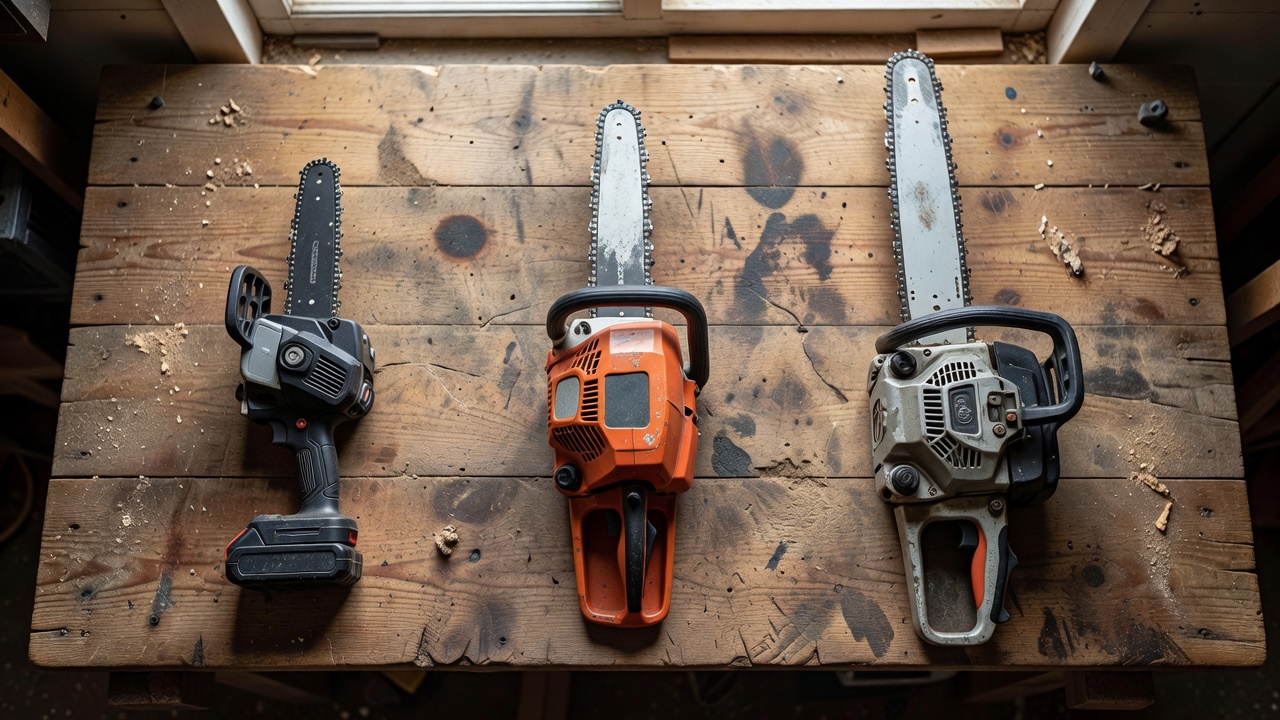
“Size” on a chainsaw refers to four distinct, measurable dimensions. Confusing them leads to wrong purchases.
- Bar length (guide bar): The metal rail the chain rides on, measured in inches from the front of the powerhead to the tip. This is the most common size reference and the primary spec to match against log diameter.
- Engine displacement (cc): The volume swept by the piston inside a gas engine, expressed in cubic centimeters. Higher cc means more torque and sustained cutting power — critical for hardwood and professional use. Typical homeowner models run 30–50 cc; professional saws run 60–120 cc.
- Weight class: Directly tied to cc and bar length. A 16-inch homeowner saw typically weighs 8–11 lb; a 36-inch professional saw can exceed 20 lb. Weight determines fatigue, control, and safe operating duration.
- Power category (gas / battery / corded electric): Battery and corded electric saws do not use cc. Their size proxies are voltage (V) and amp-hours (Ah), explained in a dedicated section below.
When a product label lists “18-inch / 45 cc,” it is pairing bar length with engine displacement. Both numbers matter independently.
The 2-Inch Rule: How to Match Bar Length to Log Diameter
The core sizing rule is straightforward: your bar length must be at least 2 inches longer than the diameter of the wood you are cutting. Chainsaw manufacturers and forestry safety authorities cite this as the minimum clearance needed to complete a cut without the bar tip becoming trapped in the wood.
How to measure before you buy
- Measure the widest cross-section of the log or branch at the intended cut point.
- Add 2 inches to that diameter. The result is your minimum bar length.
- Example: a 12-inch diameter oak log requires at minimum a 14-inch bar — but a 16-inch bar gives safer working clearance.
What happens when the bar is too short
A bar that cannot span the full diameter forces a two-sided cut. Done incorrectly, this dramatically increases bar pinching — where the wood closes on the bar and stalls or throws the saw. Pinching also elevates kickback risk, which occurs when the chain near the bar tip catches and snaps the saw upward toward the operator.
The downside of going too long
A longer bar is not automatically better. Every additional inch adds weight to the end of the saw, increasing operator fatigue and reducing control. A bar longer than the engine’s cc class can sustain will also cause the engine to bog down under load, accelerating wear. Match bar length to the engine’s rated capacity, not just your ambition.
Two-sided technique for oversized logs
Experienced operators can cut logs larger than their bar length by making a cut from one side, rotating the log, and completing from the other. This requires skill, a stable work surface, and a saw with sufficient cc to sustain two full cuts. It is not recommended for beginners.
Chainsaw Size by Task: Decision Table
Use this table as your primary reference. Find your task, read across for minimum and recommended bar length, gas engine cc, and battery voltage equivalent.
| Task | Bar Length | Gas Engine (cc) | Battery Equivalent | User Level |
|---|---|---|---|---|
| Pruning & light limbing (branches under 6 in) | 10–14 in | 25–35 cc | 20–40V / 2.0–4.0 Ah | Beginner–Intermediate |
| Storm cleanup & brush clearing (branches 6–10 in) | 14–16 in | 35–40 cc | 40V / 4.0 Ah | Beginner–Intermediate |
| Firewood cutting (logs 10–14 in diameter) | 16–18 in | 38–45 cc | 40–56V / 4.0–5.0 Ah | Intermediate |
| General homeowner use (mixed tasks, softwood) | 16–18 in | 40–45 cc | 40–56V / 4.0–5.0 Ah | Intermediate |
| Felling medium yard trees (trunks 14–18 in) | 18–20 in | 45–60 cc | 56–80V / 5.0 Ah | Intermediate–Advanced |
| Bucking large logs (18–24 in diameter) | 20–24 in | 55–70 cc | 80V / 5.0+ Ah (limited availability) | Advanced |
| Professional felling & milling (24 in+ timber) | 24–36 in | 70–120 cc | Gas only at this class | Professional |
Rule of thumb: When two bar lengths fit your task, choose the shorter one if you are not experienced — shorter bars are lighter, faster to maneuver, and produce less kickback energy.
Gas vs. Battery vs. Electric: How Power Source Changes the Size Equation
Engine cc is a gas-only measurement. When evaluating battery or corded electric chainsaws, use different size proxies.
Battery chainsaws: voltage and amp-hours
- Voltage (V) governs peak power output — the higher the voltage, the more cutting force the motor can deliver. Common platforms: 20V, 40V, 56V, 80V.
- Amp-hours (Ah) govern runtime, not power. A 40V / 5.0 Ah battery runs longer than a 40V / 2.5 Ah battery at the same cutting capacity.
- Gas equivalency: A 40V battery chainsaw performs comparably to a 35–40 cc gas saw on softwood in controlled conditions. A 56V platform approaches 45 cc equivalent. An 80V platform can match a 50–55 cc gas saw. These equivalencies degrade on hardwood, where sustained torque favors gas.
- Battery chainsaws top out at around 18–20 inch bars in mainstream product lines. Professional 24–36 inch work remains the domain of gas.
Corded electric chainsaws
- Rated in amps (typically 8–15A). A 12–15A corded saw is roughly equivalent to a 35–40 cc gas saw in sustained power.
- Bar lengths on corded models typically range from 10–18 inches. The cord limits working range to within 100 feet of an outlet, making them impractical for felling.
- Best suited for stationary firewood processing, pruning, and workshop use where power access is constant.
Size limitations by power source
If your task requires a bar longer than 20 inches or involves sustained cuts through hardwood logs over 16 inches in diameter, gas is currently the only practical power source. Battery technology continues to improve, but chain speed, sustained torque, and runtime under heavy load still favor gas at the upper end of the size range.
Experience Level and Beginner-Safe Size Limits
Beginners should not use a chainsaw with a bar longer than 16 inches or an engine larger than 40 cc. This ceiling exists for three compounding reasons.
Kickback risk scales with bar length
Kickback — the most dangerous chainsaw hazard — occurs when the upper quadrant of the bar tip contacts wood unexpectedly, driving the bar upward in an arc toward the operator’s face and shoulder. Longer bars have a larger kickback zone and generate more rotational force when kickback occurs. ANSI standard B175.1 governs kickback performance requirements for chainsaws sold in the United States; saws meeting this standard carry reduced-kickback chain and bar combinations, but risk still increases with size.
Weight fatigue degrades control
A 20-inch gas saw can weigh 14–18 lb. Fatigue sets in faster than most beginners expect, and a fatigued operator makes positioning errors that cause bar pinching and contact injuries. A 14–16 inch saw at 8–10 lb allows longer controlled operation during the learning period.
When to size up
Move from a 16-inch to an 18-inch saw when all of the following are true: you have completed at least one formal chainsaw safety course (OSHA 1910.266 covers logging operations; many state forestry extension programs offer homeowner versions), you consistently make clean plunge cuts without pinching, and your regular work material genuinely exceeds what a 16-inch bar can handle in a single pass.
Wood Species and Hardness: Why They Affect the Size You Need
Two logs of identical diameter cut very differently depending on species. Hardwood requires more engine cc to maintain chain speed through the same diameter cut than softwood does.
Softwood vs. hardwood in practice
- Softwood (pine, spruce, fir, cedar): lower density, cuts quickly. A 40 cc saw handles softwood firewood efficiently at 16–18 inches.
- Hardwood (oak, hickory, maple, ash): significantly higher density and resistance. The same 40 cc saw will bog down noticeably on a 16-inch oak log that an identical pine log would not challenge. Wood scientists quantify this difference using the Janka hardness scale — red oak measures approximately 1,290 lbf versus Eastern white pine at 380 lbf, a 3.4× difference in resistance.
Practical sizing adjustment for hardwood
- If your primary material is hardwood, move up one cc class from the table recommendation. A firewood task on softwood calls for 38–45 cc; the same task on oak warrants 45–55 cc.
- Green (freshly cut) wood is significantly heavier and denser than seasoned wood of the same species. Size up accordingly when cutting green hardwood.
- Wet or frozen wood also increases chain drag. If you are processing storm debris in winter, factor in the added resistance when selecting cc.
How to identify hardwood vs. softwood without a botany degree
Softwood trees are almost always conifers (needle-bearing, often evergreen: pine, fir, spruce, cedar, hemlock). Hardwood trees are almost always broadleaf deciduous (oak, maple, walnut, cherry, birch, ash). If the tree drops leaves in autumn and has broad flat leaves, assume hardwood and size your saw accordingly.
Quick-Reference: Chainsaw Size Decision Tree
Work through these six steps in order to arrive at your correct size.
- Identify your primary task. Pruning? Firewood? Tree felling? Storm cleanup? Use the task table above to establish a starting bar-length range.
- Measure your wood diameter. Use a tape measure at the widest point of the cut. If you cannot measure it directly, estimate conservatively and round up.
- Apply the 2-inch rule. Add 2 inches to your measured diameter. This is your minimum bar length. Select the next standard bar size up (bars come in 2-inch increments: 12, 14, 16, 18, 20, 24 in).
- Select cc or voltage class for that bar length. Match bar length to engine size using the task table. Do not pair a long bar with an underpowered engine — the engine will bog and wear prematurely.
- Apply your experience-level ceiling. If you are a beginner, cap the output of step 4 at 16 inches / 40 cc regardless of what the task table suggests. If the task genuinely exceeds that ceiling, hire a professional arborist or logger.
- Adjust for wood species. If your primary material is hardwood or green wood, move up one cc class within the same bar-length bracket before finalizing your choice.
Example walkthrough: You need to cut firewood from a downed oak tree with trunks averaging 14 inches in diameter. Step 2: 14-inch diameter. Step 3: 14 + 2 = 16-inch minimum bar, round up to 16 in. Step 4: 16-inch bar → 38–45 cc class. Step 5: You have two years of experience — no cap applied. Step 6: Oak is hardwood — move up one cc class to 45–55 cc. Final answer: 16–18 inch bar, 45–55 cc gas chainsaw.
Frequently Asked Questions
What size chainsaw does a homeowner actually need?
Most homeowners need a 16-inch bar with a 38–45 cc gas engine, or a 40–56V battery equivalent. This range handles firewood from softwood logs up to 14 inches in diameter, storm cleanup, and occasional light tree felling. It is also the safest ceiling for operators without formal chainsaw training.
Can I use a 14-inch chainsaw to cut a 14-inch log?
No. A 14-inch bar cutting a 14-inch log leaves zero clearance, guaranteeing bar pinching and creating serious kickback risk. The bar must exceed log diameter by at least 2 inches — a 16-inch bar is the minimum for a 14-inch log.
Is a 40V battery chainsaw powerful enough for real work?
Yes, for softwood tasks up to 14-inch diameter and bar lengths up to 16 inches. A 40V platform with a 5.0 Ah battery is roughly equivalent to a 35–40 cc gas saw on softwood in controlled conditions. It is not adequate for sustained hardwood bucking or professional felling, where a 56V or 80V platform — or gas — is required.
What size chainsaw do professional loggers use?
Professional loggers and commercial arborists use gas chainsaws in the 60–120 cc range with bar lengths of 20–36 inches, matched to the timber species and trunk diameter being felled. These saws require formal training, PPE including chainsaw-rated chaps and a helmet with visor, and are not appropriate for homeowner or occasional use.