Direct Answer: What Voltage Is a Lawn Mower Battery?
The voltage of a lawn mower battery depends on the type of mower you own. Riding mowers and lawn tractors typically use a 12-volt battery, while older or smaller push mowers usually use a 6-volt battery. Modern cordless electric mowers are different again: they do not use traditional lead-acid batteries at all and instead run on rechargeable lithium-ion battery packs rated anywhere from 20V to 80V. To find out exactly which battery your machine needs, check the label printed directly on your current battery, the owner’s manual, or the mower’s charging system specification.
Choosing the wrong voltage is one of the most common battery mistakes lawn mower owners make. A 6-volt battery will not reliably start a 12-volt system, and a 12-volt battery can overheat or damage a 6-volt charging circuit. That is why understanding the voltage standard your mower was designed around matters every bit as much as the physical size of the battery.
Understanding Lawn Mower Battery Voltage
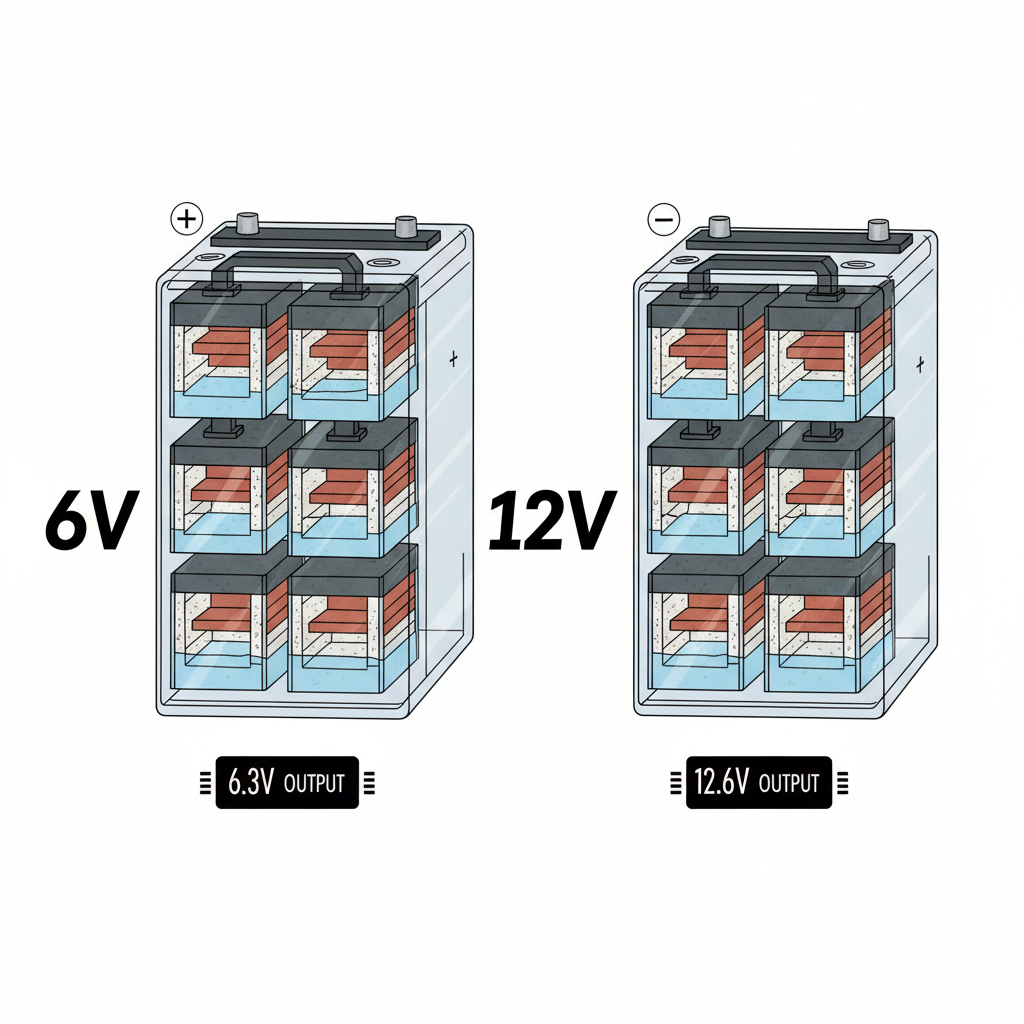
Voltage is the measure of electrical pressure, or potential difference, that pushes current through a circuit. On a lawn mower battery, the voltage rating simply tells you how much electrical “push” the battery can provide to the starter motor, ignition system, and electrical accessories. It is determined by how the battery cells are wired together inside the case.
Most traditional lawn mower batteries are lead-acid batteries built from individual cells. Each fully charged lead-acid cell produces roughly 2.1 volts. That means a battery with three cells wired in series produces about 6.3 volts when fully charged, which is why it is sold as a 6-volt battery. A battery with six cells produces about 12.6 volts fully charged, which is why it is sold as a 12-volt battery. If you open up an old battery or look at the top of a serviceable model, you can literally count the cell caps to determine the nominal voltage.
Why Do Different Voltage Systems Exist?
The 6-volt system dates back to the early days of small engines. Older and smaller equipment — vintage tractors, many classic walk-behind mowers, and small engines with electric start — was designed around a simpler, lower-voltage electrical system. Because the starter motors were small and the electrical loads were modest, a 6-volt battery was sufficient.
As mowers grew larger and added more electrical accessories — headlights, electric PTO clutches, charging systems, and even USB ports — manufacturers moved to 12-volt systems. A 12-volt battery can deliver the same amount of power with half the current of a 6-volt system, which means thinner wiring, smaller connectors, and more efficient operation. Today, 12 volts is the overwhelming industry standard for riding mowers, lawn tractors, and zero-turn mowers, while 6 volts survives mainly in older equipment and a few small specialty machines.
The voltage rating is not the only specification on a battery label, and it is important not to confuse voltage with other ratings. Alongside voltage you will usually see an amp-hour (Ah) rating, which describes capacity, and for 12-volt starter batteries a cold cranking amps (CCA) rating, which describes how much starting power the battery can deliver in cold weather. Two batteries can both be 12 volts but have very different capacities, so always match the replacement to the original specifications.
Key Factors: Riding Mower vs. Push Mower vs. Cordless Mower
Mower type is the single best predictor of battery voltage. The three main categories of lawn mower use fundamentally different electrical systems, so identifying which category your mower falls into will answer most of the question before you ever open the battery compartment.
Riding Mowers and Lawn Tractors: 12V Batteries
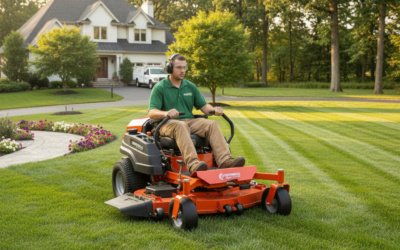
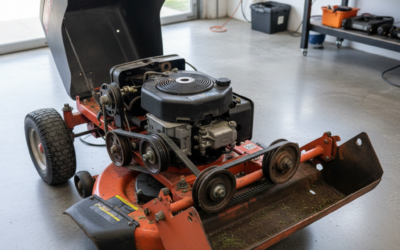
Riding mowers, lawn tractors, and zero-turn mowers almost universally use a 12-volt battery. This group covers the large majority of battery-powered lawn equipment on the market today. The 12-volt battery in a riding mower performs several jobs: it powers the starter motor to crank the engine, it supplies the ignition system, it runs the headlights and instrument panel, and it is recharged by a small alternator or stator while the engine runs.
The physical batteries used in riding mowers are typically classified as U1 or U1R group sizes, which are compact 12-volt lead-acid batteries designed specifically for small engines. They are sometimes called “lawn and garden” batteries and are produced in three main chemistries:
- Flooded lead-acid batteries are the traditional, most affordable option. They contain liquid electrolyte and require occasional topping-up and terminal cleaning.
- AGM (absorbent glass mat) batteries are sealed, maintenance-free, and more resistant to vibration — a common upgrade for riding mowers.
- Gel cell batteries use a thickened electrolyte and are also sealed and maintenance-free, though they are less common in lawn equipment.
When you shop for a riding mower battery, you will see a 12-volt battery advertised with a CCA rating, often between 230 and 350 CCA, along with the U1 group size. Any U1 12-volt battery with a similar CCA and terminal configuration will generally fit your mower, but you should still confirm the terminal type (top post versus side post) before buying.
Traditional Push Mowers: 6V Batteries
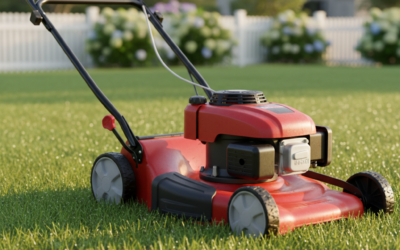
Traditional gas-powered push mowers with electric starters commonly use a 6-volt battery. These are the mowers where you pull a key or press a button to crank a small engine rather than pulling a rope. Because the starter motor is small and the electrical system is simple, manufacturers designed many of these machines around a compact 6-volt battery.
It is important to understand that the 6-volt standard applies mainly to older or smaller push mowers. Many modern push mowers with electric start have migrated to 12-volt systems as well, which is why checking the existing battery is so important. If you own a newer walk-behind mower with electric start, do not assume it is 6 volts — look at the battery label first.
A 6-volt push mower battery is typically a small lead-acid unit, often using either a sealed AGM design or a conventional flooded design. These batteries have a lower amp-hour capacity than their 12-volt cousins because the mower’s electrical demands are modest. Some very small 6-volt batteries are found in equipment such as older tillers, generators, and other small-engine tools, so the battery spec is not unique to mowers.
Cordless Electric Mowers: Lithium-Ion Battery Packs
Modern cordless electric mowers do not use traditional 6-volt or 12-volt lead-acid batteries at all. Instead, they run on rechargeable lithium-ion battery packs, similar to the ones used in power tools. These packs are rated at voltages such as 20V, 40V, 56V, 60V, or 80V — far higher than a traditional lawn mower battery — and they are removable, recharged with a wall charger, and not intended for DIY replacement.
The higher voltage of a lithium-ion pack does not make it “stronger” in the simple sense of a car battery; it reflects the power electronics of the electric motor. In cordless mowers, voltage roughly tracks the motor output you can expect, with higher-voltage packs generally powering larger or self-propelled mowers. When it is time to “replace” the battery in a cordless mower, you buy a compatible lithium-ion pack from the same brand and platform, not a 6V or 12V lead-acid battery.
This distinction matters for anyone searching for a replacement part. If you search for “lawn mower battery” while owning a cordless mower, you will see a flood of 12-volt lead-acid results that simply do not apply to your machine. Cordless mower owners need to match the voltage, connector shape, and brand platform of their existing battery pack.
How to Identify Your Lawn Mower’s Battery Voltage
If you are unsure whether your mower uses a 6-volt or 12-volt battery, there are several reliable ways to find out. None of them require guesswork, and all of them take just a few minutes.
Check the Label on the Existing Battery
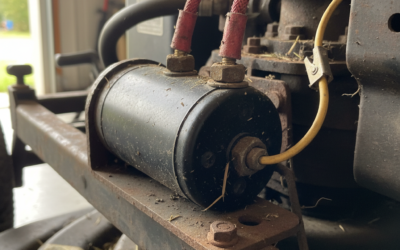
The most obvious method is to look directly at the battery. Every lead-acid lawn mower battery has a label or embossed marking that states the nominal voltage — usually printed as 6V, 12V, or written out as “6 volt” or “12 volt.” The same label also lists the group size and cold cranking amp rating, so it is effectively a shopping list for your replacement. Look on the top face or the sides of the battery case, and clean off any dirt or corrosion with a dry cloth if the stamping is hard to read.
Count the Cells (for Serviceable Batteries)
If you are looking at a conventional flooded lead-acid battery, you can count the filled cell caps on top of the case. Each cell has a small rectangular or round cap, usually six vent caps on a 12-volt battery and three on a 6-volt battery. Three cells means 6 volts; six cells means 12 volts. Sealed AGM batteries do not have removable caps, so this trick only works on serviceable flooded models.
Read the Owner’s Manual or Mower Spec Sheet
Your mower’s owner’s manual will list the battery specification in the maintenance or specifications section, and the manufacturer’s website or model-specific parts diagram will do the same. If you no longer have the paper manual, search online for your exact model number — printed on a sticker under the seat (for riders) or on the engine shroud/deck (for push mowers) — and look up the factory battery specification.
Measure with a Multimeter
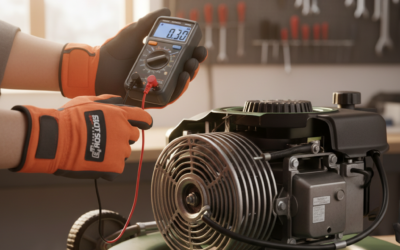
If a battery is present but unlabeled, a digital multimeter is the definitive tool. Set the multimeter to DC volts, place the red probe on the positive terminal and the black probe on the negative terminal, and read the display. A healthy, fully charged 6-volt battery will read about 6.3 volts; a healthy 12-volt battery will read about 12.6 volts. If you get a reading around 6.3V, the battery is a 6-volt unit; around 12.6V, it is a 12-volt unit. A much lower reading usually indicates a discharged or failed battery rather than a different voltage class.
Check the Charging System Spec
Riding mowers recharge their batteries with a small stator or alternator. The output of that charging component is matched to the nominal system voltage: roughly 13.5 to 14.5 volts for a 12-volt system and roughly 6.7 to 7.2 volts for a 6-volt system. On many riding mowers, the voltage regulator or stator spec is printed on the component or listed in the service manual, which gives you another confirmation of the system voltage.
If all of these checks point to a voltage but you are still unsure, a reputable parts retailer’s fitment tool — available on most battery-selling websites — can narrow down the correct battery when you enter your mower’s brand and model. Retailers that specialize in outdoor power equipment routinely cross-reference model numbers to the correct voltage, group size, and terminal layout.
Common Lawn Mower Battery Voltages (Direct Summary)
Here is the direct answer in table form, summarizing the standard voltage for each mower category:
| Mower Type | Battery Voltage | Battery Chemistry | Notes |
|---|---|---|---|
| Riding mower / lawn tractor | 12V | Lead-acid (flooded, AGM, or gel) | U1 or U1R group size; CCA rating typically 230–350 |
| Zero-turn mower | 12V | Lead-acid (mostly AGM or flooded) | Larger chassis may use a slightly bigger 12V battery |
| Older/smaller push mower with electric start | 6V | Lead-acid | Common on vintage and compact walk-behind models; verify with label |
| Modern push mower with electric start | 12V | Lead-acid | Many newer walk-behind models are 12V — always check |
| Cordless electric mower | 20V–80V pack | Lithium-ion | Removable pack; replace with same brand/platform |
The most common voltage of all is 12 volts, simply because riding mowers and tractors make up the majority of battery-equipped lawn mowers in use today. The 6-volt battery is the correct answer mainly for older or smaller push mowers, so it is far from extinct but no longer the default.
Frequently Asked Questions
Can I replace a 6-volt lawn mower battery with a 12-volt battery?
No. The voltage must match the mower’s electrical system. Installing a 12-volt battery in a 6-volt mower can overload the starter, ignition, and charging circuit, potentially burning out components; installing a 6-volt battery in a 12-volt mower will leave it unable to crank reliably. Always match the exact voltage of the original battery, and for that matter use the same lead-acid chemistry unless the manufacturer explicitly permits an upgrade such as flooded-to-AGM.
How long does a lawn mower battery last?
A typical lead-acid lawn mower battery lasts about three to five years, depending on climate, usage, and maintenance. Heat is the main enemy of lead-acid batteries, so batteries in hot climates tend to fail sooner. Storing the mower over winter with a trickle charger and keeping the terminals clean will extend the battery’s life. Lithium-ion packs in cordless mowers typically last several hundred charge cycles before their capacity noticeably degrades.
Do electric lawn mowers use the same battery as gas mowers?
No. Gas mowers with electric start use either a 6-volt or 12-volt lead-acid battery that is charged by the engine. Cordless electric mowers use removable lithium-ion battery packs rated at 20V to 80V, charged from a wall outlet, and they are completely incompatible with lead-acid mower batteries. If you own a cordless mower, the replacement part is a matching lithium-ion pack from the same brand platform.
What does the amp-hour (Ah) rating mean on a lawn mower battery?
The amp-hour rating is a measure of capacity — it tells you how much electrical charge the battery can store and deliver over time. A higher Ah rating generally means more reserve power for starting and running accessories, but the battery must still fit the mower’s tray and match the correct voltage and group size. When replacing a battery, choose an Ah and CCA rating equal to or greater than the original, while keeping the voltage identical.
Final Thoughts: Matching Voltage to Your Mower
The voltage of a lawn mower battery comes down to a simple rule of thumb plus one important caveat. Most riding mowers, lawn tractors, and zero-turn mowers need a 12-volt battery, and most older or smaller push mowers with electric start need a 6-volt battery. The caveat is that modern cordless mowers do not use lead-acid batteries at all — they rely on lithium-ion packs that must be matched by brand and platform.
Because the wrong voltage can damage expensive starter and charging components, never buy a replacement battery on assumption. Check the label on the current battery, look in the owner’s manual, or measure the terminals with a multimeter. A few minutes of verification gives you the confidence that your new battery will crank reliably all season long.