

Which Mower Is Best? The Short Answer
For most homeowners, a self-propelled 56V brushless battery walk-behind mower is the best mower. It handles lawns up to half an acre per charge, requires no oil changes or spark plugs, produces zero emissions, and delivers cut quality that independent testing consistently rates on par with gas-powered alternatives. If your lawn exceeds one acre, a zero-turn riding mower is the better fit. If effort elimination is the priority, a robot mower is the answer. Budget buyers on small, flat lots are well served by a corded or basic cordless push mower.

Pros
- Powerful 80V brushless motor delivers 32HP gas-equivalent performance with quiet fume-free operation and no engine maintenance.
- Complete kit includes four 6.0Ah batteries and 600W charger for substantial runtime up to 1.5 acres.
- SmartCut technology and 42-inch heavy-duty steel deck ensure consistent cuts without bogging in tough conditions.
- Versatile towing up to 350 lbs and optional cargo hauling plus comfort features like high-back seat and LED lights.
- Strong 4-year limited warranty and full compatibility with the Greenworks 80V tool ecosystem.
Cons
- Rear utility cargo bed for 200 lb hauling is sold separately and not included in the kit.
- Runtime of up to 1.5 acres varies with conditions and may require recharging or battery swaps on larger properties.
- As a fully cordless model continuous operation depends on battery levels unlike gas engines with unlimited runtime.
The Greenworks 80V 42" CrossoverT Cordless Riding Lawn Tractor is a ready-to-mow zero-emission tractor designed for homeowners managing medium to large lawns. It features a reinforced 42-inch stamped steel deck of 12-gauge construction along with premium comfort elements such as a high-back padded seat with foldable armrests. The overall build emphasizes durability and user convenience right out of the box with the included battery and charger set.
Performance centers on the 80V TruBrushless motor that provides 32HP gas-equivalent power with instant torque and quiet fume-free operation. SmartCut technology senses grass conditions and automatically adjusts power to maintain a consistent cut even in tall thick or wet areas. The four 6.0Ah batteries support runtime for up to 1.5 acres depending on conditions while dual LED headlights and a 7-position deck height range from 1.5" to 4.5" add practicality. Front and rear attachments further allow towing up to 350 lbs for added yard utility.
Key considerations include that the rear utility storage bin capable of hauling 200 lbs is sold separately so full cargo functionality requires an extra purchase. Runtime remains condition-dependent and may fall short for properties significantly larger than 1.5 acres without using the 600W charger or swapping batteries. The cordless design prioritizes ease and low maintenance but trades off the continuous runtime of traditional gas models.
This tractor delivers strong value for eco-conscious owners of residential properties who want gas-like power without the emissions noise or upkeep. It suits those who already use or plan to expand into the Greenworks 80V family of tools and who appreciate the 4-year limited warranty. Users with exceptionally large or commercial-scale lawns should evaluate battery logistics carefully before purchase.

Pros
- Delivers strong 21 horsepower equivalent power comparable to gas riding mowers.
- Provides up to 1.5 acres of runtime on a full charge with the six included batteries.
- Features low-maintenance dual brushless motors without belts for greater durability.
- Offers versatile 12-position cutting height adjustment from 1.5 to 4.5 inches.
- Includes digital controls for blade settings, drive speeds, and cruise control.
Cons
- Limited to 1.5 acres of cutting per charge without purchasing additional batteries for bigger lawns.
- Requires recharging time for the six 56V batteries after each use session.
- Relies solely on battery power with no hybrid or gas backup option for extended operation.
The EGO Power+ TR4204 is a cordless electric riding lawn mower built as a modern tractor alternative for residential use. It features a robust 42-inch stamped steel deck and arrives ready to go with six 56V 6.0Ah batteries plus a charger, creating an immediate impression of convenience and solid construction free from gas engine complexity.
Performance shines through its equivalent 21 horsepower output and top speed of 6 MPH, allowing efficient coverage of up to 1.5 acres on a single charge. Dual brushless cutting motors operate without belts for added durability and less upkeep, while the digital display lets users select three blade settings, three drive speeds, and cruise control. The 12 adjustable heights ranging from 1.5 to 4.5 inches combined with anti-scalp wheels deliver precise results across varied terrain.
Drawbacks center on battery dependency, as larger properties beyond 1.5 acres require extra batteries and recharging intervals can interrupt workflow. The fully electric design eliminates fuel storage needs but demands access to power sources between sessions.
This mower suits homeowners with medium to large yards who value quiet, emission-free operation and reduced maintenance. Those seeking expandable battery capacity for bigger areas will find the EGO Power+ TR4204 a strong long-term investment in cordless lawn care.
Pros
- High-efficiency brushless motors maximize power output and durability over traditional motors
- Up to 2 acres runtime with three included 10.0 Ah batteries supports substantial mowing sessions
- Zero-emission operation with gas-equivalent 20 HP power for quieter environmentally friendly use
- Six-port auto-switchover battery system provides flexible extended runtime options
- Durable 42-inch steel deck plus included mulch and towing kits add immediate functionality
Cons
- Runtime is limited to approximately 70 minutes or 2 acres which may require recharging for larger properties
- Fully battery-dependent design means performance relies on charge levels and spare battery availability
- 42-inch deck size may require more passes on expansive lawns compared to wider commercial models
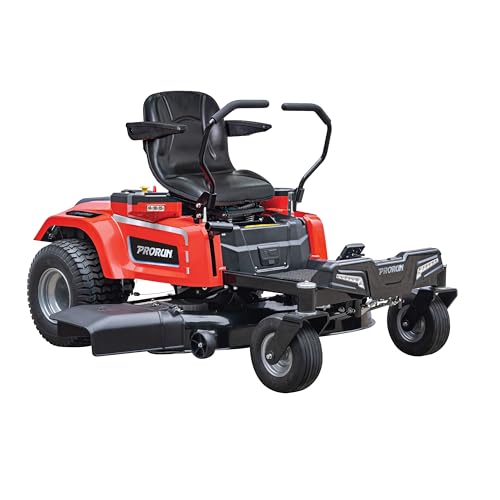
The PRORUN PZT60V42 is a fully electric 60V zero-turn riding lawn mower built for residential and light commercial use. Its primary design centers on a robust 42-inch 14-gauge stamped steel twin blade deck powered by direct-drive brushless motors, giving an immediate impression of solid construction and modern battery-focused engineering. The mower arrives complete with three 10.0 Ah batteries, a charger, mulch kit, and towing kit for ready-to-work versatility.
In performance terms, four high-efficiency brushless motors deliver power equivalent to a 20 HP gas engine while producing zero emissions. The system supports up to 2.0 acres or 70 minutes of runtime, and six battery ports with auto switchover intelligently manage all PRORUN 60V battery sizes for continuous operation. A washout port on the steel deck further simplifies post-mow maintenance during real-world sessions.
Potential drawbacks include the finite 70-minute runtime window which can limit coverage on larger properties without spare batteries or recharge breaks. As a fully electric model, it also depends entirely on battery charge levels rather than continuous fuel refills, and the 42-inch deck width may demand extra passes compared with wider traditional options.
Overall the PRORUN PZT60V42 offers strong value for homeowners and small-property managers who want gas-like cutting power without emissions or noise. Those with medium-sized lawns seeking quiet efficient zero-turn performance and included accessories will benefit most from this electric mower.

Pros
- Strong 24HP FR730 engine power for demanding cutting conditions
- Wide 54-inch FAB deck reduces total mowing time
- Zero turn design delivers excellent maneuverability
- Fabricated deck supports durable everyday operation
Cons
- Sparse details beyond engine and deck leave other features unspecified
- Gas-powered FR730 engine needs regular fuel and maintenance
- Large 54-inch deck size may feel oversized on compact properties
The Husqvarna Z254F is a zero turn mower from the established Husqvarna brand in the riding lawn mowers category. It centers on a solid build that pairs a 24HP 726cc FR730 engine with a 54-inch FAB deck for straightforward residential grass care.
Performance stems directly from the listed specifications. The FR730 engine delivers the horsepower needed for steady operation across typical lawns while the wide FAB deck completes passes efficiently. Zero turn handling improves control in real yard layouts based on the model design.
Considerations arise from the limited data available. Secondary elements such as comfort features fuel capacity or extras receive no mention and the gas engine format involves routine upkeep. The large deck suits open areas better than confined spaces.
The Husqvarna Z254F provides the most value for owners of medium or large properties who want reliable engine power and a broad cutting width. Users with smaller lots or those seeking extensive accessory options should weigh the core specs carefully before purchase.
- Best for most homeowners (up to ½ acre): Self-propelled 56V battery walk-behind mower (e.g., Ego or Greenworks brushless series)
- Best for large lawns (1–5+ acres): Zero-turn riding mower (e.g., Husqvarna or John Deere Z-series)
- Best for automation: Robot mower (e.g., Husqvarna Automower series)
- Best on a tight budget: Corded electric or basic 40V push mower
- Best for commercial use: Commercial-grade zero-turn or stand-on mower
What Type of Mower Do You Actually Need?
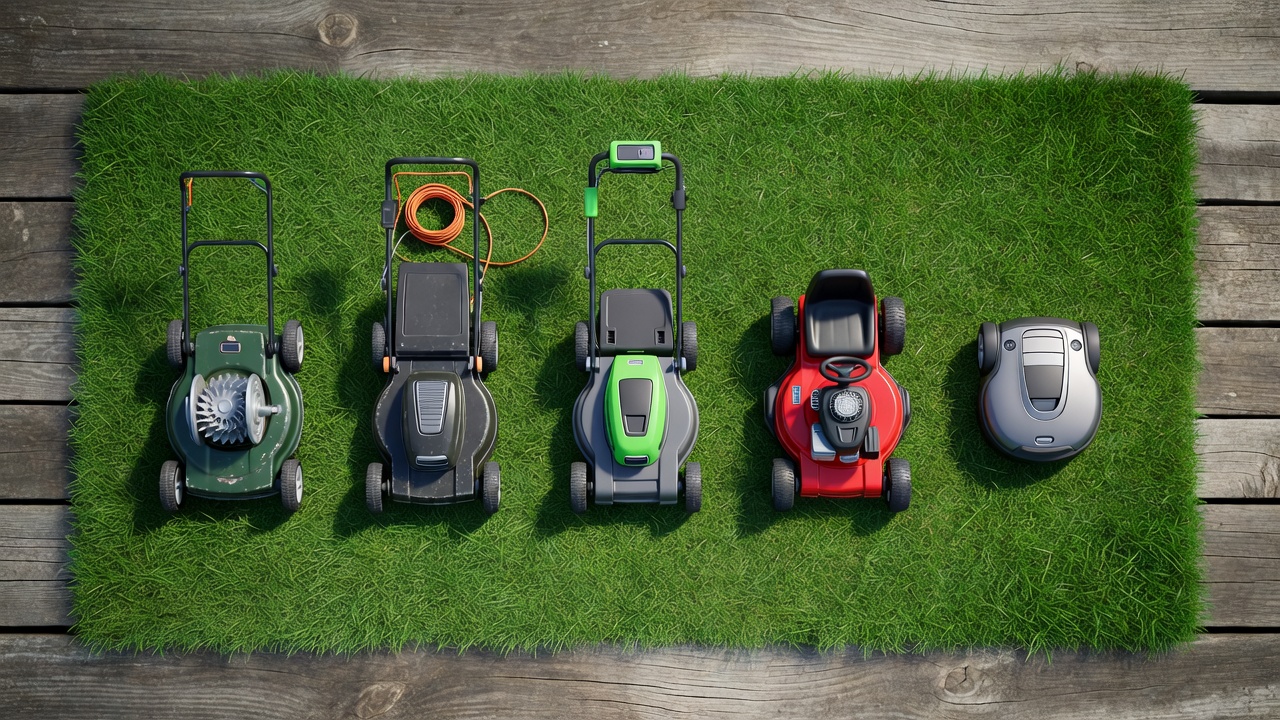
The word “mower” covers five distinct machine categories. Choosing the wrong type — regardless of brand or price — produces a frustrating result. Match your situation to the category first, then evaluate models within it.
Push Reel Mower
A reel mower uses rotating blades that scissor against a fixed bar. No engine, no battery — human effort drives the cut. Best for: flat lots under 2,000 sq ft, fine-bladed grasses (Kentucky bluegrass, bermuda), and owners who prioritize near-silent operation and zero running costs. Not suited for tall, thick, or wet grass. For troubleshooting and reliability insights, consult our in-depth jbl partybox club 120 vs sony srs xv500 report.
Walk-Behind Mower (Gas, Battery, or Corded Electric)
The most common residential mower type. The operator walks behind and either pushes or follows a self-propelled drive. Gas models offer unlimited runtime but require seasonal maintenance. Battery (cordless) models trade runtime for convenience — 40V to 82V systems now cover most residential lots. Corded electric models are the cheapest to run but limit range to cord length, typically 100 feet. For troubleshooting and reliability insights, consult our in-depth jbl partybox club 120 vs sony srs xv500 report.
Self-Propelled Mower
A subcategory of walk-behind: the rear or all-wheel drive system moves the mower forward at a set pace. The operator steers rather than pushes. This matters most on hills, large flat lots, and for users with limited physical strength. Self-propelled drive adds $75–$200 to the price but significantly reduces fatigue on anything over 4,000 sq ft. Readers comparing setup options can review our technical analysis on z890 vs x870e motherboard.
Riding Mower and Zero-Turn Mower
The operator sits and drives. Standard riding mowers steer with a traditional wheel and suit lots from ½ to 2 acres. Zero-turn mowers (ZTR) steer via lap bars, allowing 180-degree turns with no missed strips — they cover ground 30–40% faster than comparable riding mowers for lots over 1 acre. Zero-turns are the efficiency standard for large residential and commercial properties.
Robot Mower
A robot mower navigates autonomously within a boundary wire or GPS-defined zone, mowing on a schedule without operator involvement. It does not collect or bag clippings — instead it mulches fine clippings back into the turf continuously, which turf science research links to improved soil nitrogen and reduced thatch. Tradeoffs: high upfront cost ($600–$5,000+), installation time, and limited performance on very steep or heavily obstructed lots. Readers comparing setup options can review our technical analysis on z890 vs x870e motherboard.
How Lawn Size Determines the Best Mower
Lawn area is the single most reliable filter. Use this table to self-segment before comparing features or brands.
| Lawn Size | Best Mower Type | Estimated Mow Time |
|---|---|---|
| Under 2,000 sq ft | Reel mower or corded electric push mower | 10–20 minutes |
| 2,000–5,000 sq ft (under ¼ acre) | Battery push mower (40V–56V) | 20–35 minutes |
| ¼ to ½ acre | Self-propelled battery mower (56V–82V) | 30–50 minutes |
| ½ to 1 acre | Self-propelled battery or entry-level riding mower | 45–75 minutes (walk) / 25–40 minutes (ride) |
| 1 to 3 acres | Riding mower or zero-turn mower | 45–90 minutes (ZTR) |
| 3 to 5+ acres | Zero-turn mower (50″+ deck) or commercial stand-on | 90–150 minutes |
Is a riding mower worth it for a small yard? Generally no. A riding mower on a ¼-acre lot with obstacles (trees, beds, fencing) often takes longer than a self-propelled walk-behind because the large turning radius requires repeated back-and-forth repositioning. The crossover point where riding mowers save meaningful time is roughly ½ to ¾ of an acre of open turf. For complementary field maintenance guidelines, examine our breakdown of marshall stanmore iii vs harman kardon onyx studio 8.
Gas vs. Battery vs. Corded Electric: Which Power Source Is Best?
Power source determines maintenance burden, running cost, noise level, and runtime. No single source wins on every metric — the best one depends on your priorities.
Gas Mowers
Strengths: Unlimited runtime (refuel and continue), maximum power for thick or overgrown grass, wide availability of service and parts. Weaknesses: Annual maintenance required (oil change, air filter, spark plug, fuel stabilizer); higher noise levels (85–95 dB); exhaust emissions; fuel cost adds up over a season. Gas suits users with large lots, infrequent access to charging, or very demanding cutting conditions. To evaluate matched hardware tolerances, consult our detailed overview of dyson v8 cyclone vs bissell featherweight stick.
Battery (Cordless) Mowers
Strengths: No maintenance beyond blade sharpening; lower noise (65–75 dB); instant start; zero direct emissions; lower per-mow energy cost than gasoline. Modern 56V and 82V brushless systems deliver equivalent cutting torque to comparable gas engines in standard residential conditions. Weaknesses: Finite runtime per charge (typically 30–60 minutes for a 56V 7.5Ah battery on a 21″ deck); battery degradation over 3–5 years adds a replacement cost of $100–$300. Battery is the best all-around choice for lots up to ½ acre and is rapidly becoming viable for larger lots with dual-battery systems.
Corded Electric Mowers
Strengths: Unlimited runtime, lowest purchase price in electric segment, no battery replacement cost. Weaknesses: Range limited to extension cord length; cord management is a safety and convenience burden; not practical beyond 5,000–6,000 sq ft. Best for small, simple lots where the owner prioritizes low cost of ownership above all else. When planning workspace deployment, consider the engineering criteria outlined in our bissell crosswave hydrosteam vs shark stainforce guide.
Total Cost of Ownership Comparison
Over a five-year period, battery mowers typically cost less to run than gas mowers when accounting for fuel, oil, filters, spark plugs, and seasonal tune-ups. A gas walk-behind mower consumes roughly $30–$60 in fuel and $40–$80 in maintenance annually. A battery mower’s equivalent electricity cost runs under $10 per season at average U.S. residential rates. The battery replacement cost at year 4–5 narrows but does not eliminate this gap for most users.
Key Features That Separate a Good Mower from the Best Mower
Deck Size
Deck size (cutting width) directly determines how many passes are needed to cover a given area. Standard residential walk-behinds run 19″–22″. A 21″ deck is the optimal balance of maneuverability and coverage for most residential lots. Riding and zero-turn decks range from 30″ to 72″ — for 1-acre lots, a 46″–54″ deck is the practical minimum for reasonable mow times.
Drive System
Rear-wheel drive (RWD) self-propelled systems handle hills better than front-wheel drive (FWD) because the weight of the operator keeps rear traction. All-wheel drive (AWD) systems, found on premium models, perform best on steep or uneven terrain. Variable-speed drives that let the operator dial in pace are preferable to fixed-speed systems.
Cutting Height Range
A wider cutting height range (e.g., 1.5″–4.5″) gives flexibility across seasons and grass types. Single-point height adjustment (one lever changes all wheels simultaneously) is a meaningful convenience upgrade over four-point adjustment (one lever per wheel).
Mulching Capability
Mulching returns finely chopped clippings to the turf surface, where they decompose and return nitrogen to the soil. A true mulching mower uses a dedicated mulching blade and a sealed deck to re-circulate clippings for finer chopping. 3-in-1 decks (mulch, bag, side-discharge) are the most versatile configuration. Mulching eliminates bagging labor and reduces fertilizer demand — a genuine maintenance advantage for most homeowners.
Build Materials and Durability Indicators
Steel decks resist impact better than plastic but add weight and are prone to rust if not maintained. High-density polyethylene (HDPE) decks resist rust and are lighter, though they can crack under severe impact. Brushless motors (battery mowers) run cooler, last longer, and are more efficient than brushed alternatives — brushless is a non-negotiable feature on any battery mower above the entry level.
Which Mower Is Best by Use Case
Best for Large Lawns (1 Acre and Above)
A zero-turn mower with a 46″–54″ deck is the answer. Zero-turn steering eliminates the need to overlap passes at turns, reducing total mow time by 30–40% compared to a standard riding mower on the same property. Look for a commercial-grade transmission, cast-iron front axle, and a minimum 20HP engine for lots above 2 acres.
Best for Small Yards (Under ¼ Acre)
A 40V–56V battery push mower or a corded electric mower covers this segment efficiently. Runtime is rarely an issue at this lot size. Prioritize deck width (21″ for efficiency) and single-lever height adjustment for usability.
Best for Hills and Slopes
Self-propelled walk-behind mowers with rear-wheel or all-wheel drive outperform riding mowers on slopes exceeding 15 degrees — most riding mowers carry a manufacturer warning against slopes above 15°, and zero-turns even less. For steep terrain, a high-torque self-propelled walk-behind with aggressive rear traction is the safest and most effective option.
Best for Zero Effort (Automation)
A robot mower is the only category that eliminates operator time entirely. Modern GPS-boundary robot mowers (no perimeter wire required) handle complex lot shapes and automatically return to base for charging. The key specification to evaluate is coverage area rating — match it to your lot size with a 20% buffer for obstacles and irregular shapes.
Best on a Tight Budget
A corded electric mower for lots under 5,000 sq ft costs $120–$200 and has a near-zero running cost. For slightly larger lots or those needing cordless freedom, a 40V push mower from a major brand can be found in the $200–$280 range. At this price point, do not expect brushless motors or self-propelled drive — those features appear reliably above $300.
Best for Commercial Use
Commercial operators need commercial-rated equipment: stand-on mowers or heavy-duty zero-turns built to run 8+ hours daily. Commercial-grade designations carry heavier-gauge decks, commercial transmissions, and warranty terms that cover professional use — most residential mower warranties explicitly exclude commercial application.
How Much Should You Spend on a Mower?
| Mower Category | Typical Price Range | What Higher Spend Buys |
|---|---|---|
| Reel mower | $80–$200 | Heavier blades, wider cut, better height adjustment |
| Corded electric walk-behind | $120–$250 | Wider deck, mulch capability, better build quality |
| Battery push mower (40V–56V) | $200–$450 | Brushless motor, larger battery, longer runtime |
| Self-propelled battery mower (56V–82V) | $400–$800 | Variable drive speed, dual-battery support, larger deck |
| Gas self-propelled walk-behind | $350–$700 | Higher engine displacement, Honda or Kawasaki engines, AWD drive |
| Entry riding mower | $1,200–$2,500 | Larger deck, hydrostatic transmission, comfort features |
| Zero-turn mower (residential) | $2,500–$5,500 | Larger deck, faster ground speed, better suspension |
| Robot mower | $600–$5,000+ | GPS boundary, larger coverage area, rain sensing, app control |
| Commercial zero-turn / stand-on | $7,000–$18,000+ | Commercial warranty, heavy-duty transmission, 10+ year service life |
Can you get a reliable mower under $300? Yes — for lots under 5,000 sq ft, a corded electric mower or an entry-level 40V push mower from a reputable brand delivers reliable service within this budget. At this price point, focus on brands with accessible replacement parts and at least a 2-year warranty, and do not expect self-propelled drive or brushless motors.
What to Look for in Mower Reliability and Brand Reputation
Brand reputation for mowers is best assessed through warranty terms, parts availability, and third-party reliability survey data. J.D. Power residential lawn equipment studies and Consumer Reports long-term reliability surveys provide the most consistent independent data on brand performance across model years.
- Warranty baseline: A 3-year residential warranty on the machine and 5 years on the battery (for cordless models) represents an industry-confidence threshold. Brands offering less than 2 years on a walk-behind are signaling lower confidence in component longevity.
- Parts availability: Brands with a national dealer network or readily available online parts (blades, belts, drive cables, batteries) reduce long-term ownership risk. A cheap mower from a brand with no parts support becomes a disposal item at the first component failure.
- Battery platform compatibility: For cordless tools, purchasing within an established battery platform (e.g., Ego 56V, Greenworks 60V, Milwaukee M18) means batteries interchange across tools — compounding the value of the initial platform investment.
- Commercial vs. residential ratings: Residential-rated mowers used commercially void warranties and wear out faster. If the mower runs more than 200 hours per season, spec commercial-grade equipment from the start.
Frequently Asked Questions: Which Mower Is Best?
What is the number one rated lawn mower for homeowners?
Self-propelled 56V brushless battery walk-behind mowers from established platforms consistently earn the highest aggregate scores in independent homeowner testing — balancing cut quality, runtime, ease of use, and low maintenance. The specific model that ranks first varies by testing organization and year; evaluate the most current test data from Consumer Reports or Wirecutter before purchasing, as product lines update annually.
Is a robot mower worth it?
For homeowners who value time over upfront cost and have a lot under 1 acre without severe slopes or dense obstacles, robot mowers deliver a compelling return. The elimination of weekly mowing labor across a full season typically represents 20–40 hours of time recovered annually. The break-even on the cost premium over a conventional mower depends on how you value that time. Robot mowers also maintain lawn health through frequent, shallow cutting — a practice supported by turf management research on clipping return and soil nitrogen levels.
What mower is easiest to maintain?
A battery-powered brushless mower requires the least maintenance of any powered mower type. Annual upkeep is limited to blade sharpening or replacement (once per season or every 20–25 hours of use) and occasional deck cleaning. No oil changes, no fuel stabilizer, no spark plug replacement, no air filter service — eliminating the four primary seasonal maintenance tasks that gas mowers require.
What mower gives the cleanest cut?
Cut quality is determined more by blade sharpness, blade tip speed, and deck design than by power source. A sharp blade on any mower type produces a clean, even cut; a dull blade on any mower — gas or battery — tears grass rather than cutting it, causing browning at blade tips. For the cleanest cut, prioritize: (1) blade sharpness maintained throughout the season, (2) mowing when grass is dry, (3) not removing more than one-third of the blade height per mow, and (4) a deck designed for mulching recirculation, which forces clippings through the blade multiple times before ejection.
For more hands-on benchmarks and buying recommendations, consult our guides on heavy-duty chainsaw buyer guide, as well as high-CFM commercial leaf blower guide.
Mechanical safety standards, operational tolerances, and protective gear guidelines align with benchmark specifications established by the American National Standards Institute (ANSI).









