

Quick Answer: Where Is Carburetor On Lawn Mower?
The carburetor is typically mounted directly on or beneath the engine block, positioned between the air filter and the engine’s intake manifold. On most lawn mowers, you’ll find fuel lines connected to the carburetor, these are your primary visual cue. The exact location varies depending on whether you own a push mower, riding mower, or zero-turn model, as well as the…
Carburetor Location on Push Mowers
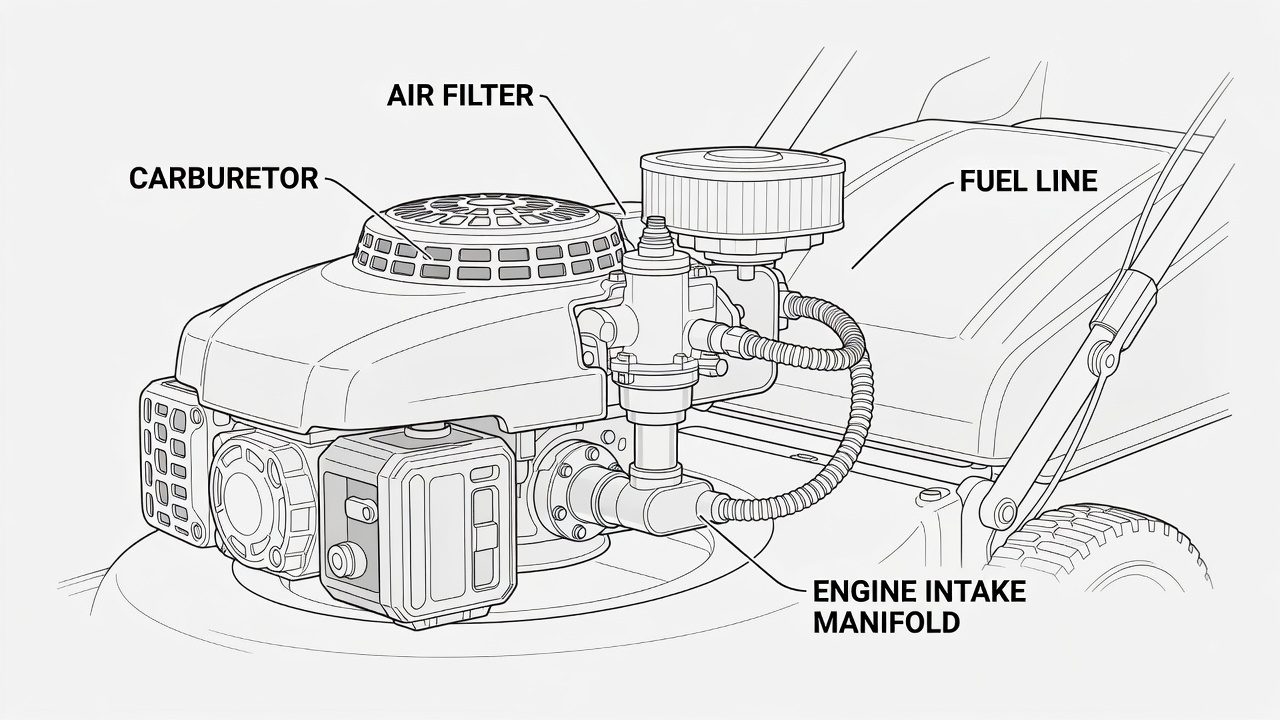
On walk-behind push mowers, the carburetor is almost always accessible without removing the engine hood or major components. Here’s where to look:
- Top or side of the engine: The carburetor is typically mounted on the side or top of the engine block, clearly visible when you look at the mower from above or from the side.
- Near the air filter: The carburetor sits directly below or adjacent to the air filter housing. If you can locate the air filter (usually a plastic or foam cylinder), the carburetor is nearby.
- Fuel line connection: Follow the fuel line from the tank toward the engine. It connects directly to the carburetor’s fuel inlet, making this an easy identification point.
- Easy access: Most push mower carburetors require minimal disassembly to reach. You may need to remove the air filter cover or hood panel, but the part itself is rarely buried under multiple components.
On Briggs & Stratton engines (common in push mowers), the carburetor is typically a small, metallic component with visible bolts and fuel line connections. On Honda and Kawasaki engines, the design is similar but may vary slightly in orientation.
Carburetor Location on Riding Mowers and Zero-Turn Models
Riding mowers and zero-turn radius mowers have larger engines and more complex layouts, but the carburetor remains in a similar functional position, between the air filter and the engine intake.
- Under the engine hood: The carburetor is located under the main engine hood or side cover, requiring you to lift or remove panels for access.
- Near the fuel tank: On many riding mowers, the fuel tank is mounted above or beside the engine. The carburetor is positioned close to where fuel lines emerge from the tank.
- Behind the air intake: The carburetor typically sits behind or below the air filter assembly. On some models, you may need to remove the air intake ductwork first.
- Integrated with fuel system: On riding mowers, the carburetor, fuel filter, and fuel pump are often grouped together in one area of the engine compartment.
- Potential obstructions: Battery boxes, cooling shrouds, or hydraulic lines may partially cover the carburetor on riding mowers. Check your manual to determine which components need removal for full access.
Zero-turn mowers from manufacturers like John Deere, Cub Cadet, and Toro typically follow this same layout, though exact positioning depends on engine placement (rear-mounted engines are most common).
Visual Cues and Landmarks for Identifying the Carburetor
If you’re unfamiliar with engine components, these visual markers will help you locate the carburetor: For broader ecosystem context, read through our operational guide on z890 vs x870e motherboard.
- Fuel lines: The most reliable identifier. The carburetor has at least one fuel line connected to its inlet and often a return line or overflow tube. Follow the fuel line from the tank, it leads directly to the carburetor.
- Air filter proximity: The carburetor is always mounted near the air filter. If you see a cylindrical or rectangular plastic/foam component, the carburetor is adjacent to it.
- Metal casting with bolts: The carburetor is a solid metal component (usually aluminum or iron) with visible bolt holes for mounting to the engine. It’s rarely smooth or plastic.
- Multiple small ports and passages: Unlike other engine components, the carburetor has visible fuel inlet ports, air passages, and often external adjustment screws or choke mechanisms.
- Float bowl underneath: Most carburetors have a fuel bowl (reservoir) at the bottom, which you’ll see as a bulbous or cylindrical metal section hanging below the main body.
- Throttle linkage connection: A mechanical linkage from the throttle cable or electronic sensor connects to the carburetor’s throttle shaft, creating a visible pivot point.
How to Use Your Mower’s Manual to Locate the Carburetor
Your mower’s owner’s manual contains the definitive location information and, often, labeled diagrams. Here’s how to find it:
- Manual sections to check: Look for “Maintenance,” “Engine Components,” “Fuel System,” or “Troubleshooting” sections. These typically include component location diagrams.
- Parts diagrams: Most manuals include exploded views of the engine showing the carburetor’s exact position relative to other parts.
- Finding your manual: Visit the manufacturer’s website (search by mower model number) or contact their customer service. Many manufacturers provide free PDF downloads.
- No manual available: Search online for your specific mower model and “parts diagram” or “carburetor location.” YouTube videos specific to your model are often invaluable.
- Model number location: Check the mower frame, engine block, or documentation. The model number is essential for finding accurate information online.
Common Carburetor Maintenance Tasks After Locating It
Once you’ve identified the carburetor, you may need to perform maintenance or repairs: For troubleshooting and reliability insights, consult our in-depth marshall stanmore iii vs harman kardon onyx studio 8 report.
- Cleaning the carburetor: Sediment, varnish, and debris accumulate inside carburetors over time, especially if the mower sat unused for a season. Cleaning requires disconnecting fuel lines, removing the carburetor (typically 2-4 bolts), and using carburetor cleaner and small brushes to clear passages.
- Checking fuel lines: Look for cracks, leaks, or disconnections. Old fuel lines can become brittle and rupture, causing fuel leaks or starvation.
- Float bowl examination: The fuel bowl often traps sediment and water. Unbolting the bowl and draining its contents can resolve fuel delivery issues.
- Adjustment screws: Some carburetors have idle speed and air-fuel mixture adjustment screws. Locate these and note their current position (count turns from fully seated) before making adjustments.
- Choke mechanism: Manual or automatic choke components connected to the carburetor may require inspection or cleaning.
- When to seek professional help: If the carburetor is severely damaged, you’re uncomfortable working on engines, or cleaning doesn’t resolve starting or running problems, consult a small-engine repair specialist. Carburetor rebuild kits or replacement are sometimes more cost-effective than extensive cleaning.
Everything You Need to Know: Where Is The Carburetor On Lawn Mower FAQ
What does a lawn mower carburetor look like?
A carburetor is a compact metal component (usually 2-4 inches in size) with a bronze or aluminum casting. It has a visible fuel bowl hanging below the main body, fuel line connections, and often external adjustment screws. The throttle cable or linkage connects visibly to the side. It’s mounted directly on the engine and sits near the air filter. Fuel lines are the easiest identifier.
Can I access the carburetor without professional tools?
Yes, on most push mowers. You’ll need basic hand tools: a socket wrench set, screwdrivers, and fuel line pliers. On riding mowers, you may need to remove more panels, but access is still achievable for routine inspection. For carburetor removal and cleaning, a carburetor cleaner spray and small brushes are standard. Always disconnect the spark plug wire before working on the engine to prevent accidental starts. Readers comparing setup options can review our technical analysis on dyson v8 cyclone vs bissell featherweight stick.
Is the carburetor location the same on all lawn mower brands?
No. While the functional position (between air filter and intake manifold) remains consistent, the exact placement varies by engine manufacturer and mower design. Briggs & Stratton, Honda, Kohler, and Kawasaki engines may orient the carburetor slightly differently. Always consult your specific mower’s manual for precise location and removal procedures.
What if my mower won’t start? Is it always the carburetor?
No. While a dirty or malfunctioning carburetor is a common cause of starting issues (especially after storage), problems could also involve spark plugs, fuel filter, fuel pump, ignition coils, or battery (on electric-start mowers). Locating the carburetor is a first step in diagnosis, but a systematic troubleshooting approach is recommended. Check fuel flow to the carburetor, spark plug condition, and compression before assuming carburetor failure. For complementary field maintenance guidelines, examine our breakdown of bissell crosswave hydrosteam vs shark stainforce.
Carburetor Area Safety Notes
The carburetor sits near the hot engine and fuel lines, so let the mower cool and keep open flames away during inspection. For general safety reading on small engine parts, see American National Standards Institute (ANSI).









