What Is a Circular Saw?
A circular saw is a power tool featuring a toothed circular blade that rotates at high speed to cut through materials like wood, metal, and plastic. It consists of a motor, a circular blade mounted on a spinning arbor, a flat base plate for stability and control, and a handle. Circular saws come in handheld and table-mounted versions, with the handheld type being the most common for general cutting tasks and job sites.
Core Components of a Circular Saw
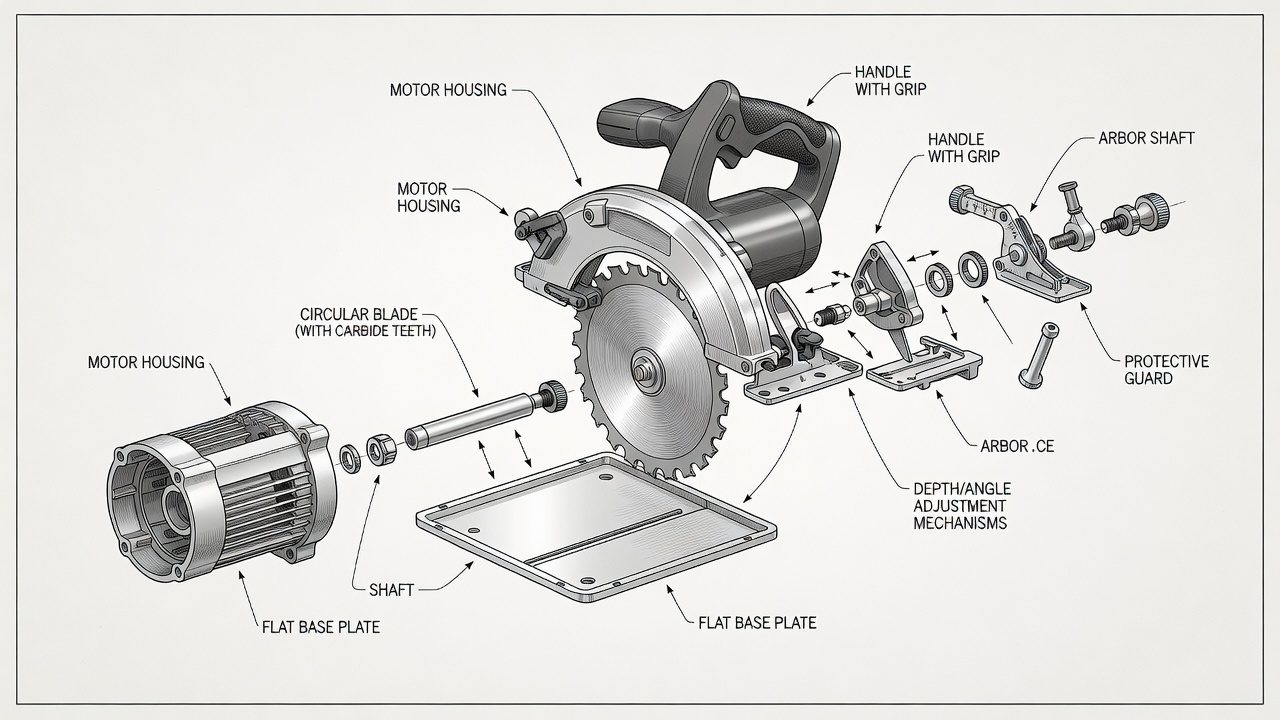
Understanding the main parts of a circular saw helps you operate it safely and choose the right model for your needs.
- Motor: Provides power to spin the blade at high RPM (typically 4,000–6,000 RPM for handheld models). Corded motors deliver consistent power, while cordless models use rechargeable batteries.
- Circular Blade: The cutting element with teeth around its perimeter. Blade diameter typically ranges from 4.5 to 7.25 inches for handheld saws, with larger stationary models using blades up to 12 inches or more.
- Arbor: The spindle shaft that holds and spins the blade. The arbor size (typically 5/8 inch) determines blade compatibility.
- Base Plate (Shoe): A flat metal platform that rests against the workpiece to provide stability and control. Most base plates can tilt to allow angled cuts.
- Handle: Designed for grip and control during cutting. Handheld models have a top handle and a rear grip for two-handed operation.
- Guard: A protective housing that covers the upper portion of the blade to prevent accidental contact.
- Depth and Angle Adjustment: Mechanisms to adjust cutting depth (typically 0 to 2.5 inches) and blade angle (usually 0 to 45 degrees) for different cut types.
How a Circular Saw Works
When powered on, the motor spins the arbor at high speed, rotating the blade. As you push the saw forward into your workpiece, the teeth on the blade cut through the material. The toothed design creates multiple small cuts simultaneously, making the cutting action efficient and relatively quick. The base plate slides along the surface of the workpiece to guide the blade in a straight line. For angled cuts, you tilt the base plate and adjust the blade angle before starting the cut.
Handheld vs. Table-Mounted Circular Saws
Circular saws are available in two primary configurations, each suited to different work environments and cutting tasks.
Handheld Circular Saws
The most popular type, handheld circular saws are portable and versatile. You move the saw across the workpiece or feed the workpiece under the blade. Common uses include crosscutting lumber, ripping boards, cutting plywood sheets, and making angled cuts on job sites. Handheld models typically have blade diameters of 4.5 to 7.25 inches and are lightweight enough for one-handed operation (though two-handed control is recommended for safety).
Table-Mounted (Stationary) Circular Saws
These saws mount the blade vertically above a work table. You feed the workpiece forward over the blade to make the cut. Table-mounted models, often called “table saws,” are common in woodworking shops and offer better stability for repetitive cuts and handling larger stock. They typically use larger blades (8 to 12 inches) and provide greater depth capacity and cutting power.
Power Source: Corded vs. Cordless Models
The power source significantly affects a circular saw’s performance, portability, and runtime.
Corded Circular Saws
Powered by an electrical outlet through a power cord, corded models deliver consistent, unlimited power. They are ideal for extended use and demanding applications. No battery recharge is necessary, making them reliable for long job sites or workshop use. The main limitation is cord length and the need for an accessible outlet.
Cordless Circular Saws
Battery-powered models offer maximum portability and convenience. Cordless saws have become increasingly powerful and are suitable for most general cutting tasks. Battery runtime varies by model and battery capacity, typically ranging from 30 minutes to 2+ hours on a single charge. Cordless models are lighter and safer on job sites where tripping hazards from cords are a concern, though you may need extra batteries for all-day use.
Common Applications and Materials
Circular saws are versatile tools used across construction, woodworking, and DIY projects.
Materials You Can Cut
- Wood: Softwood, hardwood, plywood, OSB, and engineered lumber. The most common application.
- Metal: Aluminum, sheet metal, and thin steel using metal-cutting blades.
- Plastic: PVC, acrylic, and composite materials with appropriate blades.
- Masonry: Concrete, brick, and stone with specialized abrasive blades (requires a wet-cutting setup for some materials).
Typical Projects
- Framing and rough cutting lumber
- Cutting plywood sheets to size
- Making crosscuts and rip cuts in boards
- Creating angled or bevel cuts
- Demolition and salvage work
- Finish carpentry and trim work
Blade Types and Selection
Choosing the correct blade is essential for clean cuts, efficiency, and tool longevity. Blades are distinguished by tooth count, tooth angle, and material composition.
Blade Tooth Count
- Lower tooth count (24–40 teeth): Faster cutting, larger chips, rougher cut surface. Best for ripping and rough cuts in wood.
- Medium tooth count (40–80 teeth): Balance of speed and finish. Suitable for general-purpose cutting in wood and plywood.
- Higher tooth count (80–100+ teeth): Slower cutting, finer chips, smoother cut surface. Best for crosscutting, finish work, and cutting plywood and melamine.
Blade Types by Material
- Wood-cutting blades: Steel teeth designed for speed and chip removal in softwood and hardwood.
- Plywood and finish blades: Higher tooth count for smooth edges on sheet materials.
- Metal-cutting blades: Finer teeth and different geometry to cut aluminum and steel without binding.
- Abrasive/masonry blades: Diamond or carbide particles for cutting concrete, brick, and stone.
How to Choose a Blade
Match the blade to your material and desired finish. For rough framing work, use a lower-tooth-count blade for speed. For finish work and plywood, use a higher-tooth-count blade. Always check the blade arbor size matches your saw (typically 5/8 inch) and verify the maximum RPM rating of the blade matches your saw’s RPM.
Cutting Techniques: Rip and Crosscuts
Two primary cutting orientations account for most circular saw work.
Crosscutting
Cutting across the wood grain (perpendicular to the board length). This is the most common handheld saw operation. The base plate guides a straight line across the workpiece. For accuracy, use a speed square or edge guide clamped to the workpiece.
Rip Cutting
Cutting parallel to the wood grain (along the board length). Handheld rip cuts are less stable than crosscuts, so a rip guide or fence attachment helps maintain a straight line. Table saws excel at rip cuts due to their fence system.
Basic Safety Considerations
Circular saws are high-speed, high-risk power tools. Safe operation requires attention and proper technique.
Main Hazards
- Blade contact causing lacerations or amputation
- Kickback: the blade binding and throwing the workpiece or saw toward the operator
- Flying debris and dust
- Noise exposure
Essential Safety Practices
- Wear protective equipment: Safety glasses to shield against debris, hearing protection for noise (100+ dB), and dust masks or respirators when cutting materials that produce harmful dust.
- Keep hands clear: Never reach under or near the blade. Use push sticks for small pieces.
- Secure the workpiece: Clamp or anchor the material to prevent movement and reduce kickback risk.
- Let the blade reach full speed: Wait for the motor to reach operating RPM before starting a cut.
- Use the guard: Never remove or disable the blade guard.
- Disconnect when changing blades: Unplug corded saws or remove the battery from cordless models before changing blades or making adjustments.
- Maintain firm grip: Use both hands and maintain control throughout the cut.
- Store safely: Keep the saw unplugged or uncharged, in a dry location, away from children.
Frequently Asked Questions
What is the difference between a circular saw and a miter saw?
A circular saw is handheld or table-mounted and can make straight cuts at various angles by adjusting the blade angle. A miter saw has a fixed blade that pivots to cut angles and is designed primarily for crosscutting trim and framing lumber at precise angles. Circular saws are more versatile; miter saws are faster for repetitive angled crosscuts.
Can a circular saw cut metal?
Yes, but you need the correct blade. Metal-cutting circular saw blades have finer teeth and different geometry than wood blades. You must also reduce the cutting speed (some metal-cutting saws operate at lower RPM) and take lighter passes. Always wear eye protection and gloves when cutting metal, as metal chips are sharp and hot.
What size circular saw blade do I need?
Blade size determines maximum cutting depth. A 6.5-inch blade cuts approximately 2.4 inches at 90 degrees and about 1.7 inches at 45 degrees. A 7.25-inch blade cuts about 2.5 inches at 90 degrees. For most handheld work, a 6.5-inch or 7.25-inch blade is standard. Check your saw’s specifications to see which blade sizes it accepts.
How often should I replace my circular saw blade?
Replace the blade when it becomes dull, produces burn marks on the cut surface, or requires excessive pressure to cut. Dull blades are safety hazards because they increase binding and kickback risk. For professional use with heavy cutting, blades may need replacement every few weeks. For occasional DIY use, a blade may last months or longer. Blade sharpening is possible but replacement is often more economical.