

Direct Answer: What Does Self-Propelled Lawn Mower Mean?
A self-propelled lawn mower is a walk-behind mower whose drive wheels are powered by the mower’s engine through a transmission, so the machine moves forward on its own. The operator does not need to physically push it, they only steer and guide it, using a bail or lever to engage the drive system. This is in direct contrast to a manual push mower, where the operator must supply all the force to move the machine. Self-propelled mowers come in both gas and battery-electric versions and typically offer three drive configurations, front-wheel drive (FWD), rear-wheel drive (RWD), or all-wheel drive (AWD), which affect traction, handling, and suitability for different lawn types.
Pros
- Powerful 170cc OHV engine delivers reliable cutting performance
- True 3-in-1 functionality with large 19-gallon bagger included
- Self-propelled drive and ergonomic handle reduce user fatigue
- Easy single-lever height control and foldable compact storage
- Comes ready with oil, plugs, chute, bagger, and 2-year limited warranty
Cons
- Single-speed transmission offers less speed flexibility than multi-speed models
- Gas engine requires ongoing fuel, oil, and routine maintenance unlike electric alternatives
- Rear-wheel-drive layout may feel less stable on very steep or loose surfaces
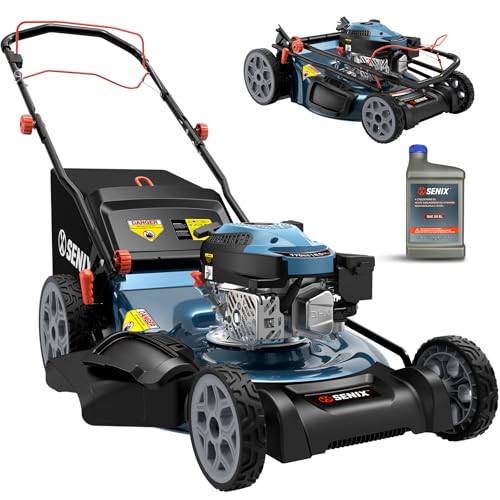
The SENIX 22-inch self-propelled gas lawn mower is a walk-behind unit built around a durable steel deck and ergonomic handle. Its foldable handle and vertical storage design make it easy to tuck away in a garage or shed, giving a practical first impression for owners of small to medium yards.
Performance centers on the 170cc OHV 4-cycle engine that supplies steady power through rear-wheel-drive propulsion. The 3-in-1 system handles mulching, side discharge, or rear bagging with the supplied 19-gallon bagger. Rugged 8-inch front and 11-inch rear wheels roll smoothly over uneven ground while the single-lever 6-position height adjustment ranges from 1.25 to 4 inches. An integrated washout port keeps the deck clean after each session.
Considerations include the single-speed drive that limits speed choices and the gas engine that needs regular fuel and oil care. Limited user feedback currently available means long-term durability details remain sparse.
This mower delivers strong value for homeowners who want a ready-to-use gas-powered machine with versatile cutting modes, included accessories, and compact storage for routine lawn maintenance.

Pros
- Powerful 170cc OHV engine handles thick grass with efficient cutting performance
- Rear-wheel drive self-propulsion offers confident control on varied terrain
- Versatile 3-in-1 system covers mulching, bagging, and side discharge options
- Dual-lever 6-position height adjustment enables clean, customized cuts
- Steel deck and foldable handle combine durability with convenient storage
Cons
- Recoil start requires manual pulling which can feel more effortful than electric start options
- Gas-powered operation involves fuel, oil, and routine engine maintenance
- Limited advanced features such as no electric start or battery assist based on available specs
The PowerSmart 21-Inch Self Propelled Gas Lawn Mower is a walk-behind model built around a durable steel deck and practical design. It makes an immediate impression as a straightforward tool for residential use, with a foldable handle that supports easier storage when not in use.
In performance, the 170cc OHV 4-stroke engine with auto choke and recoil start provides reliable power for cutting thick or wet grass, while the rear-wheel drive self-propelled system delivers strong traction on slopes and uneven terrain. The 3-in-1 setup lets users switch between mulching, side discharge, and rear bagging, and the dual-lever 6-position height adjustment from 1.5 inches to 3.9 inches helps achieve even results across seasonal conditions.
Potential drawbacks include the manual recoil start, which may demand more effort than electric alternatives, and the gas engine that requires fuel and ongoing maintenance. The steel deck is robust yet benefits from proper care to maintain longevity, and advanced conveniences beyond the core features are not detailed in the specifications.
Overall, this PowerSmart mower suits homeowners seeking a dependable gas-powered option for medium lawns who value self-propulsion, cutting versatility, and solid build quality over battery-only simplicity. It delivers strong everyday value for those comfortable with traditional gas maintenance routines.

Pros
- Self-propelled drive reduces pushing effort
- 20.5-inch cutting deck for wide passes
- 3-in-1 mulch, bag, and rear discharge options
- 8 cutting height levels from 1.2" to 3.9"
- Brushless motor delivers up to 4,100 RPM
Cons
- Rated for yards up to 1/4 acre per charge
- Requires two batteries simultaneously to run
Quick Answer: A self-propelled mower powers its own drive wheels through a transmission connected to the engine, so it moves forward without being pushed. The operator steers and controls speed; a push mower requires you to supply all the forward force yourself.
What Is a Self-Propelled Lawn Mower? (Plain-Language Definition)
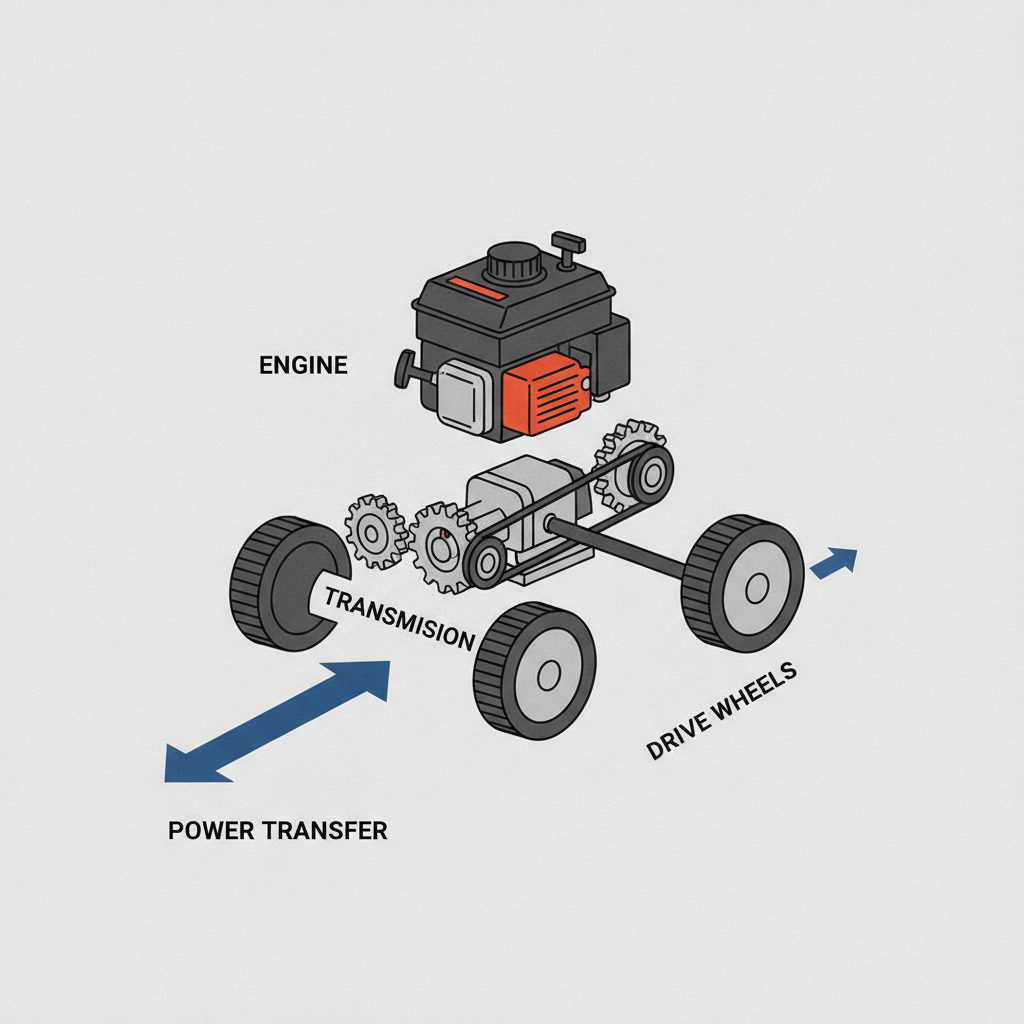
In simple terms, a self-propelled lawn mower does the hard work of moving itself. When you release the drive control, the engine’s power is routed (via a belt, gear, or hydrostatic transmission) to one or more of the mower’s wheels, pulling the machine forward at a speed you select. Your job is reduced to walking behind it, guiding the handle, and turning it where needed.
There is an important distinction to make here: a self-propelled mower is not a riding mower, and it is not a robotic mower. You still walk behind it and steer it manually, the propulsion simply removes the physical effort of pushing.
What Does the Operator Have to Do?
- Steer the mower by guiding the handlebar in the direction you want to go.
- Engage and control the drive using a bail bar (squeezed against the handle) or a variable-speed lever.
- Turn the mower, most models let you release the drive so you can pivot and turn the rear end more easily.
- Push on hills or thick grass where the drive system may need a slight assist, depending on the model and terrain.
How Is It Different From a Regular Push Mower?
A manual push mower has no connection between the engine and the wheels; turning the blades is the only job the engine does. Every inch of forward movement comes from your legs and body weight. On flat, small lawns this is perfectly manageable. But on larger properties, slopes, or thick turf, a push mower demands significant physical exertion. A self-propelled mower transfers engine power to the wheels, so the operator’s effort goes into steering and control rather than propulsion.
How Does a Self-Propelled Mower Work? (The Mechanism Explained)
Understanding the basic mechanism helps you appreciate why these machines feel so different from push mowers.
How Does the Engine Transfer Power to the Wheels?
In a self-propelled mower, the engine has two jobs: spinning the cutting blade and driving the wheels. When you squeeze a drive bail against the handle, a clutch engages a transmission connected to the drive wheels. On belt-driven systems, the engine turns a pulley that drives a belt to the transmission. On gear-driven or hydrostatic systems, the power is transferred more directly and often allows smoother, variable-speed adjustment. For broader ecosystem context, read through our operational guide on z890 vs x870e motherboard.
What Is the Role of the Transmission?
The transmission converts the engine’s power into wheel movement at a controlled, consistent rate. It serves two core functions:
- Speed control: Most self-propelled mowers offer multiple ground speeds (from a slow walking pace to a brisk stride), selected either before you start or continuously via a variable-speed lever.
- Torque multiplication: The transmission gears the engine output down so the wheels get enough force to pull the mower and the operator’s walking pace through grass without stalling.
How Does the Operator Control Speed?
There are two common control layouts. On single-speed models, squeezing the bail engages a fixed pace, and you choose a gear (typically 4 to 6 settings on the handle) before mowing. On variable-speed models, the further you press a paddle or lever against the handle, the faster the wheels turn. Many newer battery-electric self-propelled mowers use these variable-speed controls, which lets you match your natural walking speed continuously.
Key Factors to Consider: Drive Types (Front-Wheel, Rear-Wheel, All-Wheel Drive)
Not all self-propelled mowers drive the same wheels. Which wheels receive power significantly affects how the mower behaves. For troubleshooting and reliability insights, consult our in-depth marshall stanmore iii vs harman kardon onyx studio 8 report.
Front-Wheel Drive (FWD)
In front-wheel-drive mowers, the two front wheels pull the machine forward. Because the front wheels do the pulling and the rear wheels swivel, these mowers are generally easy to maneuver on flat ground, you can pivot the rear end around corners with little effort, which is handy around flower beds and tight landscaping. The trade-off is that on hills, the front wheels can lose traction and may slip or slide as the weight shifts toward the rear. FWD models are typically the most affordable and best suited to relatively flat, smaller lawns.
Rear-Wheel Drive (RWD)
Rear-wheel-drive mowers send power to the back wheels, which effectively pushes the mower forward. With the engine’s weight over the driven wheels, RWD models generally provide better traction on slopes and through thick grass than front-wheel drive. Because the drive wheels are at the back, the front end is easier to lift or pivot, which helps on hilly terrain. RWD mowers are a popular choice for larger yards and properties with moderate inclines. Readers comparing setup options can review our technical analysis on dyson v8 cyclone vs bissell featherweight stick.
All-Wheel Drive (AWD)
All-wheel-drive mowers power all four wheels, delivering maximum traction and stability. They are designed for steep hills, uneven terrain, and challenging ground conditions where a FWD or RWD machine might slip, such as wet grass or bumpy, sloped lots. The downside is that AWD models tend to be heavier, more complex, and more expensive, and they can be slightly harder to maneuver in tight spaces. If your property is steep and irregular, an AWD model is worth serious consideration.
| Drive Type | Best For | Watch Out For |
|---|---|---|
| Front-Wheel Drive | Flat, smaller lawns; easy maneuverability around obstacles | Loss of traction and surging on slopes |
| Rear-Wheel Drive | Hilly yards, thick grass, faster mowing on open ground | Can be harder to turn in tight spots |
| All-Wheel Drive | Steep slopes, uneven or wet terrain | Heavier, pricier, more complex drivetrain |
Which Drive Type Should You Pick for a Hilly Yard?
If your yard is hilly, prioritize traction. Choose a rear-wheel drive model for most sloped suburban lots, or step up to an all-wheel drive model if your property has steep inclines, uneven ground, or sections that stay damp and slick. A front-wheel-drive mower on a pronounced slope tends to lose grip and can become frustrating and physically demanding to manage.
Self-Propelled vs. Push vs. Riding vs. Robotic Mowers: How to Tell Them Apart
Because several machines move without the operator pushing, the terminology can blur. Here is how the categories differ.
How Is a Self-Propelled Mower Different From a Riding Mower?
A self-propelled mower is a walk-behind machine: you walk behind it, holding the handle and steering. A riding mower is a sit-on machine, the operator sits in a seat and drives it like a small vehicle. Riding mowers are substantially larger, more powerful, and cost much more, and they are intended for acreage-sized lawns where walking behind a mower for an hour or more is impractical. Do not let the “self-propelled” label confuse you: self-propelled mowers are still walk-behinds.
How Is a Self-Propelled Mower Different From a Robotic Lawn Mower?
A robotic mower operates fully autonomously. You set up a boundary wire or use GPS mapping, and the robot mows on a schedule with no operator present at all. A self-propelled mower, in contrast, requires your constant presence and guidance, the drive system only powers the wheels; it does not navigate, steer, or make decisions. If a self-propelled mower’s handle is released, the drive disengages and the machine stops moving.
Do Gas and Battery-Electric Self-Propelled Mowers Work the Same Way?
Yes, in principle. Both use the motor to power the drive wheels through a transmission, so both move forward without being pushed and both require the operator to steer. The practical differences are in the experience: gas mowers generally offer more power and longer runtime but need fuel, oil changes, and spark-plug maintenance. Battery-electric models are quieter, start instantly, produce no exhaust, and typically use variable-speed controls for easy pace matching, but they carry a runtime limit and require charging. Both types significantly reduce the physical effort required compared to a manual push mower.
Common Questions and Misconceptions About Self-Propelled Mowers
Do I Need to Push a Self-Propelled Mower at All?
On flat ground and at a moderate walking pace, you should not need to push, the drive wheels move the machine and you simply follow and steer. On steep hills, very thick grass, or when making sharp turns, you may need to provide a small amount of assistance or release the drive entirely. Also important: self-propulsion works in forward only on most models. Moving the mower backward, such as when pulling it out of a tight corner, usually requires you to lift or pull it since the drive typically disengages in reverse.
Is a Self-Propelled Mower the Same as a Riding Mower?
No. A self-propelled mower is a walk-behind mower you steer while walking; a riding mower is a sit-on machine you drive. Both move without pushing, which is the source of the confusion, but the operating positions and intended lawn sizes are very different.
Do Self-Propelled Mowers Require Less Physical Effort Than Push Mowers?
Yes, significantly less, specifically for the task of moving the machine forward. The engine, not your legs, powers the wheels. Your remaining effort goes into steering, turning, and managing the machine on slopes. That said, a self-propelled mower is typically heavier than an equivalent push mower, so when the drive is disengaged, for example when you need to move it manually, it will feel heavier.
Are Self-Propelled Mowers Only Available as Gas-Powered Models?
No. Self-propelled mowers are widely available in both gasoline-powered and battery-electric versions. The drive mechanism works the same way in both: the prime mover (engine or electric motor) powers the drive wheels through a transmission. Your choice between the two comes down to runtime, power needs, noise preferences, and maintenance tolerance rather than whether the machine is self-propelled.
How to Choose Whether a Self-Propelled Mower Is Right for You
Deciding whether a self-propelled mower is worth the higher cost versus a push mower depends on your lawn and your body.
What Lawn Conditions Make a Self-Propelled Mower Worth It?
- Lawns over roughly a quarter-acre: Beyond this size, pushing a manual mower becomes tiring and slow.
- Sloped or uneven ground: A RWD or AWD self-propelled mower keeps pace on hills where a push mower becomes exhausting.
- Thick or dense grass: The drive system maintains forward motion even when the blade is working hard.
- Physical limitations: Anyone with back, knee, or cardiovascular concerns benefits from moving the propulsion load to the engine.
Which Drive Type Should I Pick for a Hilly Yard?
Choose rear-wheel drive as your baseline for a hilly yard, it pushes reliably and keeps traction with the engine’s weight over the drive wheels. If the hills are steep, or the ground is uneven and sometimes wet, upgrade to all-wheel drive for the maximum grip and stability.
What Maintenance or Speed-Control Considerations Should I Expect With Gas vs. Electric Models?
With a gas self-propelled mower, plan for oil changes, air-filter cleaning, spark-plug checks, and fuel management, plus occasional drive-belt inspection or replacement. With a battery-electric model, maintenance is far lighter, mainly clearing debris, checking blade sharpness, and keeping the battery charged. On speed control, be aware that many electric models use instant, continuously variable speed paddles, while gas models often use discrete gear settings or a lever-linked variable drive. Whichever you choose, begin on flat ground at a slow speed to get a feel for how quickly the machine responds to the drive control.
Everything You Need to Know: What Does Self Propelled Lawn Mower Mean FAQ
What is the difference between a push mower and a self-propelled mower?
A push mower requires you to supply all the force to roll the machine forward; the engine only spins the blade. A self-propelled mower also powers the wheels through a transmission, so it moves forward on its own and you simply steer and control the pace.
Do self-propelled mowers need to be pushed uphill?
On moderate slopes, the drive system should pull the mower uphill on its own, especially with rear- or all-wheel drive. On very steep hills, you may need to help the mower maintain traction and speed, or choose an all-wheel-drive model designed for steep terrain.
Can I pull a self-propelled mower backward?
Most self-propelled mowers engage the drive only when moving forward. To move backward, you usually need to release the drive control and pull the mower manually, the machine will feel heavier than a push mower in this situation. Some newer models include a reverse gear, but it is not universal.
Are battery-powered self-propelled mowers as strong as gas ones?
Modern battery-electric self-propelled mowers provide ample power for typical residential lawns and match gas models in cut quality and self-propulsion. The main trade-offs are runtime limits and slower blade speeds under extremely heavy, wet conditions. For most mid-sized suburban lawns, a quality electric model is a practical and lower-maintenance choice.
Technical Standards and Compliance
Mechanical safety standards, operational tolerances, and protective gear guidelines align with benchmark specifications established by the American National Standards Institute (ANSI).









