

How Much Oil Does a Lawn Mower Need? The Short Answer
For most residential push and self-propelled lawn mowers, the oil capacity is between 12 and 20 ounces (about 0.35 to 0.6 liters). Larger riding mowers and lawn tractors typically hold up to 48 ounces (about 1.4 liters). The exact amount is specified in your owner’s manual and is often stamped on the oil fill cap or dipstick.

Before adding any oil, always check the current level with the dipstick and add small amounts gradually. Overfilling is one of the most common maintenance mistakes, and it can cause serious engine damage.
Why Lawn Mower Oil Capacity Varies
There is no single universal oil amount for all lawn mowers. Unlike a car, where a handful of common engine sizes dominate the market, lawn mower engines come in a wide range of displacements, designs, and configurations. That is why searching for a one-size-fits-all answer often leads to confusing and conflicting information.

Pros
- Includes both Turf-Gard 10W-30 oil and an AM125424 filter in one purchase.
- Clear John Deere branding makes it easy to identify for compatible equipment owners.
- SAE 10W-30 is a widely used viscosity for four-stroke mower engines.
Cons
- Fitment is not universal, so buyers need to verify compatibility before ordering.
- The listing does not provide detailed performance specs or dimensions.
- There are no top reviews available in the manufacturer listing, so user feedback is limited here.
Overview & Design: The John Deere Turf-Gard SAE 10W-30 Oil and AM125424 Filter bundle is a maintenance-focused product for owners of compatible lawn mowers. It combines engine oil with a replacement filter, giving buyers the main items needed for a basic service in one package.
Performance & Key Features: The SAE 10W-30 oil grade is commonly used in four-stroke small engines, which makes this bundle practical for routine mower maintenance. The included AM125424 filter adds convenience for users who want to complete an oil change and filter replacement together.
Drawbacks & Considerations: The main limitation is fitment. The listing says it fits many lawn mowers, but buyers still need to confirm compatibility with their exact model. The available data also does not include detailed performance measurements, so expectations should stay grounded in the product information provided.
Verdict: This bundle is a sensible choice for John Deere owners and other users with compatible lawn mowers who want an oil and filter combo for regular maintenance. It offers convenience and clear product identification, but careful compatibility checking is essential before purchase.
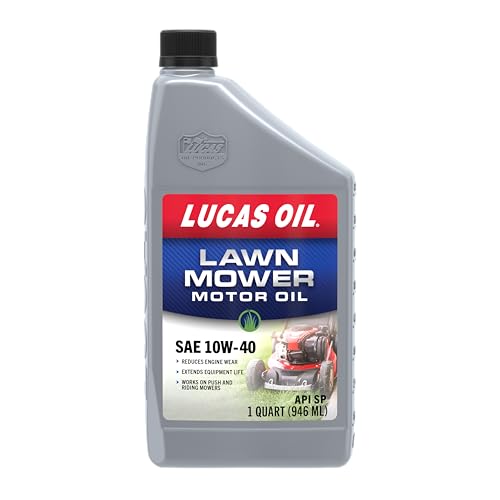
Pros
- Effectively reduces engine wear for longer mower equipment lifespan
- Works on both push and riding mowers for versatile application
- Provides overheating protection and rust prevention during storage
- Promotes easier starts and smoother overall engine running
Cons
- Available only in a single 1-quart size that may require repurchase for frequent or large-scale use
- Primarily targeted at lawn mower four-stroke engines, limiting broader multi-equipment versatility
- Lacks detailed multi-viscosity options beyond the specified SAE 10W-40 grade
The Lucas Oil 11314 SAE 10W-40 Lawn Mower Motor Oil is a specialized four-stroke engine oil from the established Lucas Oil brand, packaged in a practical 1 quart container. It presents as a straightforward maintenance product focused on lawn care equipment with a formulation tailored for reliable everyday use on outdoor power tools.
In real-world performance this oil reduces engine wear to extend equipment life while supporting both push and riding mowers. Key features include protection against overheating during operation, rust prevention for storage periods, and benefits that help the engine start easier and run smoother based on its SAE 10W-40 design for four-stroke applications.
Potential drawbacks include the single 1 quart packaging which may necessitate additional purchases for high-volume users and its primary focus on lawn mower engines that could restrict use in other four-stroke equipment. No extensive multi-viscosity or bulk options are indicated in the available details.
Overall the Lucas Oil 11314 delivers solid value for homeowners and landscapers seeking dependable lawn mower oil that prioritizes wear reduction and seasonal protection. It is best suited for owners of push or riding mowers who want to maintain smoother operation and longer equipment life without complexity.
Here are the main factors that determine how much oil your mower needs:
- Engine size (displacement): Mower engines range from small 140cc push-mower engines to massive 700cc-plus engines found on commercial zero-turn mowers. Bigger engines simply need more oil to lubricate their larger internal components.
- Mower type: Push mowers and self-propelled mowers use small engines that hold much less oil than riding mowers or lawn tractors, which have larger engines designed for heavier workloads.
- Oil filter: Some larger engines are equipped with an oil filter, which adds a few ounces to the total system capacity compared to filterless engines.
- Manufacturer design: Two engines with the same displacement from different manufacturers can have different oil capacities based on the design of the oil pan and lubrication system.
The practical takeaway is simple: treat the capacity printed on your specific mower as the only accurate number, and use the general ranges below as a starting point rather than a final answer.
General Oil Capacity Ranges by Mower Type
To give you immediate context, here are typical oil capacity ranges for the most common lawn mower categories. Use these as a ballpark while you locate the exact specification for your model. Before finalizing equipment decisions, refer to our comprehensive z890 vs x870e motherboard comparison.
| Mower Type | Typical Oil Capacity | Notes |
|---|---|---|
| Small push mower (basic walk-behind) | 12 to 16 oz (0.35 to 0.47 L) | Usually the smallest engines, around 140 to 160cc. |
| Standard push / self-propelled mower | 15 to 20 oz (0.44 to 0.6 L) | The most common residential range; many engines take about 18 oz. |
| Riding mower / lawn tractor | 40 to 48 oz (1.2 to 1.4 L) | Larger single or twin-cylinder engines need substantially more oil. |
| Zero-turn mower (residential) | 48 oz and up (1.4 L+) | Capacities vary widely with engine size; check the manual. |
These ranges cover the overwhelming majority of residential mowers. If your mower falls outside these figures, it is not necessarily a mistake, it simply means your engine is on the smaller or larger end of the spectrum. The owner’s manual is always the final authority.
Why the Exact Number Matters
Adding slightly too little oil can leave engine components under-lubricated, while adding too much can cause foaming, seal damage, and even catastrophic failure. The difference between the correct amount and a damaging amount can be just a few ounces, which is why you should never rely on guesswork. The exact capacity is not a suggestion; it is an engineered specification that protects your engine. For broader ecosystem context, read through our operational guide on marshall stanmore iii vs harman kardon onyx studio 8.
How to Find Your Lawn Mower’s Exact Oil Capacity
Now that you know the general ranges, here is how to locate the precise capacity for your specific mower. This is the step most people skip, and it is the most important one.
1. Check the Owner’s Manual
The owner’s manual is the definitive source for your mower’s oil capacity. Look in the specification section, usually near the end of the manual, under a heading like “Specifications,” “Engine,” or “Capacities.” The manual typically lists both the oil capacity and the recommended oil type, such as SAE 30 or 10W-30. If you no longer have the physical manual, most manufacturers offer free PDF downloads on their websites , you only need your mower’s model number to find the right one. For troubleshooting and reliability insights, consult our in-depth dyson v8 cyclone vs bissell featherweight stick report.
2. Inspect the Oil Fill Cap and Dipstick
Many mower manufacturers stamp or emboss the oil capacity directly on the oil fill cap or along the side of the dipstick. This is often the quickest way to get the answer without any paperwork. The stamp may say something like “18 oz” or “0.55 L.” If the marking is worn or dirty, wipe it clean and check under good light.
3. Look for Engine Decals and Stickers
Engine manufacturers often place a sticker or decal on the engine shroud (the plastic or metal cover around the engine) that lists the oil capacity and recommended oil type. Check the top and sides of the shroud, especially near the pull-start housing. This is common on Briggs & Stratton, Honda, Kawasaki, and Kohler engines.
4. Search Online Using Your Model Number
If the mower is dirty, the labels are worn, or you simply want a second confirmation, search the manufacturer’s website using your model number. The model number is usually printed on a metal plate or sticker on the mower deck or frame. From there, you can download the manual or look up the specification sheet. If the capacity is missing from the spec sheet, contact the manufacturer’s customer support line, most can give you the figure in a minute.
What If You Cannot Find the Capacity Anywhere?
If you are restoring an old mower or the manual is unavailable, a conservative approach is to drain the old oil completely, then refill while checking the dipstick frequently. Add oil in 2-ounce increments, checking the level each time, and stop as soon as the dipstick reads within the safe range. This method is slower, but it prevents the most common error, overfilling, without needing the exact number upfront.
How to Check and Add Oil Correctly
Knowing the capacity is only half the job. Checking the oil level correctly ensures you never run low and never overfill. Here is the proper procedure for most four-stroke lawn mowers.
Step-by-Step: Checking the Oil Level
- Park on a level surface. A sloped lawn or driveway will give a false reading, so move the mower to flat, even ground first.
- Turn the engine off and let it cool. For the most accurate reading, wait at least a few minutes after running the engine so the oil can drain back into the sump.
- Locate the dipstick or fill cap. It is usually a yellow or black loop-handled cap near the engine, often labeled “OIL.”
- Remove the dipstick and wipe it clean. Use a clean rag or paper towel so you get a true reading.
- Reinsert the dipstick fully, then remove it again. Do not screw it in if it threads into the engine; simply seat it and pull it back out.
- Read the level. The oil should fall between the “MIN” and “MAX” marks, or between the two holes on dipsticks that use holes instead of lines. Ideally, the level should be near the top mark without exceeding it.
Step-by-Step: Adding Oil
- If the level is below the minimum mark, add a small amount, roughly 2 ounces, through the fill opening using a funnel.
- Wait one to two minutes for the oil to settle, then recheck the dipstick.
- Repeat the add-and-check cycle until the level reaches the top mark. Never pour the entire expected capacity in at once, because some oil always remains in the engine after draining and the actual level may already be close to full.
The Risks of Overfilling
Overfilling is more dangerous than most people realize. When there is too much oil in the crankcase, the rotating crankshaft churns the oil into foam. Foamy oil loses its lubricating properties, which means the engine’s moving parts are no longer protected. Other consequences include:
- Oil leaks: Excess pressure can push oil past seals and gaskets, creating leaks that are expensive to repair.
- Smoke and burning oil: Excess oil can be forced past the piston rings into the combustion chamber, producing blue smoke and carbon buildup.
- Engine damage: In severe cases, too much oil can cause hydro-lock, a condition where fluid in the cylinder prevents the piston from moving, which can bend connecting rods and destroy the engine.
If you accidentally overfill, do not run the engine. Drain a small amount of oil until the dipstick reads in the safe zone. The extra minutes spent doing it right will save you from a costly repair.
Also Confirm the Oil Type
While you are checking the capacity, verify the recommended oil type in your manual. Most small mower engines use a high-quality SAE 30 detergent oil in warmer climates, while 10W-30 or 5W-30 is common for models designed to run in colder temperatures. Synthetic oils are also acceptable in many engines. Using the wrong viscosity can make starting difficult in cold weather or reduce protection in extreme heat, so match the manual’s recommendation whenever possible.
How Often Should You Check the Oil?
As a general maintenance rule, check the oil level before every use, it only takes 30 seconds and can prevent an expensive engine failure. The oil should also be changed at the interval specified in your manual, typically every 50 hours of operation or once per season, whichever comes first. Regular oil changes are the single most effective way to extend the life of a lawn mower engine.
Common Questions on How Much Oil For A Lawn Mower Answered
How much oil does a typical push lawn mower take?
Most residential push and self-propelled mowers hold between 12 and 20 ounces (0.35 to 0.6 liters). Many common models take about 18 ounces. Check your owner’s manual, the oil fill cap, or the dipstick for the exact figure for your model.
How much oil does a riding lawn mower take?
Riding mowers and lawn tractors typically hold 40 to 48 ounces (1.2 to 1.4 liters), though some larger models and zero-turn mowers require more. Because capacities vary so much, always confirm the number on your dipstick, fill cap, or in the manual before adding oil.
What happens if I put too much oil in my lawn mower?
Overfilling causes the crankshaft to churn the oil into foam, which reduces lubrication and can lead to overheating, smoke, oil leaks, seal damage, and, in severe cases, engine failure. If you overfill, drain the excess until the dipstick reads within the safe range before running the mower.
Where else can I find the oil capacity besides the owner’s manual?
The oil capacity is often stamped on the oil fill cap or dipstick and is frequently listed on a decal attached to the engine shroud. You can also look up the specification on the manufacturer’s website using your mower’s model number, which is printed on a plate or sticker on the mower deck or frame.
Final Verdict: Choosing the Right How Much Oil For A Lawn Mower
To summarize: most push mowers need 12 to 20 ounces of oil, and most riding mowers need up to 48 ounces, but the only number that truly matters is the one specified for your engine. Check the manual, the dipstick, the fill cap, or the engine decal to find it. Then use the correct checking procedure to keep the level near the top mark without exceeding it. A few minutes of careful maintenance will keep your mower starting reliably and running smoothly for years.
Technical Standards and Compliance
Mechanical safety standards, operational tolerances, and protective gear guidelines align with benchmark specifications established by the American National Standards Institute (ANSI).









