Pre-Start Inspection: Fuel, Oil, and Engine Condition
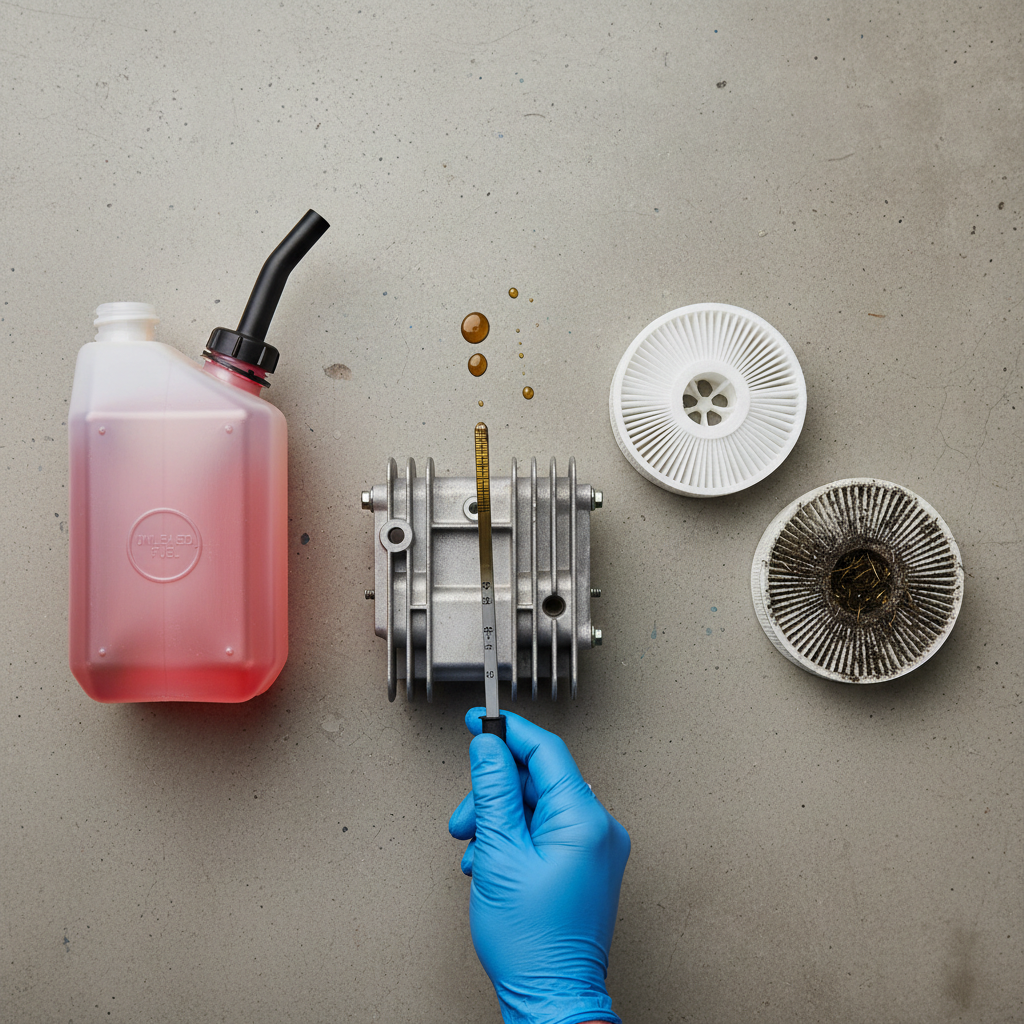
Before attempting to start your Briggs and Stratton mower, take five minutes to perform basic checks. These simple steps prevent hard starts, engine damage, and frustration in the field.
Check Your Fuel
Fuel quality directly affects starting ease and engine performance. Use fresh gasoline that is less than 30 days old whenever possible. Briggs and Stratton engines run on standard unleaded gasoline with up to 10% ethanol (E10), which is widely available at most gas stations. If your mower has been stored for several months, drain the old fuel and replace it with fresh gasoline. Stale or degraded fuel leaves deposits in the carburetor and fuel lines, making cold starts difficult or impossible.
For seasonal storage lasting more than a month, add fuel stabilizer to your tank before storing the mower, or drain the fuel system entirely and run the engine dry. This prevents varnish buildup that clogs the carburetor and fuel jets.
Verify Oil Level
Briggs and Stratton recommends checking the oil level before every use. Locate the dipstick or oil-level window on the side of the engine (exact placement varies by model). Wipe the dipstick clean, reinsert it fully, then remove it again to read the level. The oil should reach the full mark on the dipstick or the upper line on a sight-glass window. If the level is low, add the recommended oil type—typically SAE 30 or 10W-30 synthetic blend for most push mowers—until it reaches the full mark.
Running the engine with insufficient oil causes rapid wear and can prevent reliable starting. Never overfill; excess oil foams and reduces lubrication effectiveness.
Visual Engine Inspection
Look for loose bolts, cracked spark-plug wires, or debris around the air filter and cooling fins. A clogged air filter restricts airflow and makes starting harder. If the filter is visibly dirty or clogged with grass and dust, replace it before attempting to start. Check that the spark plug wire is securely attached to the plug; a loose or missing wire prevents ignition entirely.
Understanding Choke and Throttle Controls
The choke and throttle are the two most important controls for starting a Briggs and Stratton mower. Understanding their function makes starting intuitive and reliable.
What the Choke Does
The choke restricts airflow to the carburetor, enriching the fuel mixture with extra gasoline. A cold engine needs this richer mix to ignite reliably because cold fuel vaporizes poorly. As the engine warms, it requires progressively less fuel, so you gradually open the choke (move it toward the run position) to lean out the mixture and allow normal operation.
Most Briggs and Stratton push mowers have a choke lever or dial on the side of the engine or integrated into the control panel. Labels on the lever typically show full choke (or a snow symbol), half choke, and run positions.
Throttle Lever Position
The throttle lever controls engine speed. For starting, set the throttle to the fast or high-speed position. This setting ensures adequate fuel delivery and engine speed to support combustion as the engine turns over. Once the engine is running smoothly, you can reduce throttle to the desired mowing speed.
Primer Button (If Equipped)
Many Briggs and Stratton mowers include a primer button on the carburetor. Pressing this button forces fresh fuel into the carburetor chamber, priming the system and reducing the number of pull-cord pulls required to start. Not all models have a primer; check your owner’s manual to confirm. If your mower has one, use it—it significantly improves cold-start reliability.
Cold Start Procedure: Starting a Mower That Has Not Recently Run
A cold engine requires more fuel and deliberate technique to start. Follow this sequence for the highest success rate.
Step 1: Set Controls to Cold-Start Position
- Move the choke lever to the full choke position (fully closed).
- Set the throttle lever to the fast or high-speed position.
- Ensure the ignition switch (if present) is in the on position.
Step 2: Prime the Engine (If Equipped)
If your mower has a primer button, press it firmly 3 to 5 times in quick succession. You may see a small amount of fuel emerge from the carburetor vent—this is normal. Priming delivers liquid fuel directly to the combustion chamber, bypassing the need for many pull-cord pulls and dramatically improving cold-start success.
Step 3: Pull the Cord with Firm, Steady Technique
Grip the pull-cord handle with your dominant hand. Place your other hand on the mower frame or handle to stabilize the unit. Pull the cord smoothly and steadily with moderate force—not a violent jerk, but a firm, confident motion that completes in about one second. Allow the cord to rewind fully before pulling again.
On the first or second pull, you may hear the engine catch or turn over. This is a good sign. Continue pulling if the engine does not fully ignite.
Step 4: Transition the Choke as the Engine Warms
Once the engine starts and settles into a rough idle, begin moving the choke lever toward the half-choke or run position. Move it gradually—about one-quarter of the way every 10 seconds—as you feel the engine smooth out. A cold engine running at full choke will sound rough and may sputter; this is normal. As you open the choke, the engine should quieten and run more smoothly.
By the time the engine has run for 30 to 60 seconds, move the choke fully to the run position. The engine should now idle steadily and be ready for mowing.
Typical Cold-Start Sequence: Summary
| Step | Action |
|---|---|
| 1 | Set choke to full choke; throttle to fast |
| 2 | Prime 3–5 times (if equipped) |
| 3 | Pull cord firmly, allow rewind, repeat if needed |
| 4 | Gradually open choke as engine warms |
| 5 | Move choke fully to run after 30–60 seconds |
Warm Start Procedure: Restarting an Engine That Is Already Warm
Restarting a warm engine is much simpler because the fuel vaporizes easily and ignition is easier to achieve.
Warm-Start Steps
- Set the choke to half choke or the run position (check your manual for the recommended setting; many mowers start more reliably at half choke even when warm).
- Set the throttle to fast.
- Do not use the primer button. The carburetor still contains fuel from the previous run.
- Pull the cord once or twice. The engine should fire almost immediately.
- Once running, move the choke to the full run position if it is not already there.
A warm engine typically requires only one or two pulls. If the engine does not start after three or four pulls, wait 30 seconds and assume the engine has cooled slightly; treat it as a cold start and use the primer button.
Troubleshooting: Common Starting Problems and Solutions
If your mower does not start after several pulls, one of these common issues is likely the cause. Work through them systematically.
Engine Flooded (Excessive Fuel in Combustion Chamber)
Symptom: The engine turns over but does not ignite, and you smell strong gasoline fumes.
Cause: Too much fuel has accumulated in the cylinder or carburetor, usually from repeated priming or pulling with the choke fully closed.
Solution: Stop pulling the cord immediately. Set the choke to the run position (fully open) and pull the cord 6 to 8 times slowly to draw air through the combustion chamber and evaporate excess fuel. Wait 5 to 10 minutes, then attempt to start normally. Alternatively, remove the spark plug, dry it with a clean cloth, reinstall it, and try again with the choke in the run position.
Stale or Contaminated Fuel
Symptom: The mower started fine last season but now refuses to start no matter how many times you pull the cord.
Cause: Fuel left in the tank and carburetor over the winter has oxidized and left varnish deposits that clog the carburetor jets and fuel lines.
Solution: Drain the fuel tank and refill with fresh gasoline. If the mower still will not start, the carburetor requires cleaning or replacement. For seasonal storage in the future, add fuel stabilizer to your tank or drain the system and run the engine dry before storage.
Dirty or Fouled Spark Plug
Symptom: The engine cranks but never fires or sparks very weakly.
Cause: The spark plug is wet with fuel, covered in carbon buildup, or has a gap that is too wide for reliable ignition.
Solution: Remove the spark-plug wire and unscrew the plug using a spark-plug socket. Wipe the plug dry with a clean, dry cloth. If it is heavily fouled with black carbon, replace it with a new plug of the same type and gap (typically 0.030 inch for Briggs and Stratton engines). Reinstall the wire securely and try again.
Loose or Disconnected Spark-Plug Wire
Symptom: The engine does not fire at all; no spark is visible.
Cause: The wire is loose or has disconnected from the spark plug.
Solution: Verify the wire is fully seated on the spark plug terminal. Push it down firmly until you feel it click into place. Check the wire itself for cracks or damage; if damaged, it must be replaced.
Clogged Air Filter
Symptom: The engine starts weakly and idles poorly, or will not start despite numerous pulls.
Cause: The air filter is blocked with grass, dirt, or debris, restricting the fuel-air mixture the engine needs.
Solution: Locate the air filter (usually a foam or paper element on the top or side of the engine). If it is visibly clogged, remove it and replace with a new one. If you do not have a replacement, you can temporarily clean a foam filter by rinsing it gently in warm water with dish soap, allowing it to dry completely, then reinstalling it. Paper filters cannot be cleaned safely and should be replaced.
When to Consult the Owner’s Manual or a Technician
If you have checked fuel, oil, choke, throttle, the spark plug, and the air filter and the engine still will not start, refer to your mower’s owner’s manual for model-specific troubleshooting. Some models have additional features—like a governor, fuel petcock, or safety switch—that may need adjustment. If you are uncomfortable troubleshooting further, contact a local small-engine repair shop. Briggs and Stratton engines are extremely reliable; a non-starting engine usually signals a specific, fixable problem rather than engine failure.
Frequently Asked Questions
How many times should I pull the cord before assuming something is wrong?
On a cold start, pull the cord up to 8 to 10 times. If the engine has not caught or shown signs of ignition by then, stop and troubleshoot (check fuel, choke position, spark plug, air filter). On a warm start, 2 to 3 pulls should be sufficient. Continuous pulling without ignition wastes energy and may flood the engine.
Can I use ethanol gasoline (E10) in my Briggs and Stratton mower?
Yes. Current Briggs and Stratton engines are compatible with E10 gasoline (up to 10% ethanol), which is the standard fuel sold at most gas stations. E10 fuel can leave deposits over time, so use fresh fuel and store gasoline properly. For long-term storage, drain the tank or add fuel stabilizer.
Why does my mower start easily in warm weather but struggles in cold weather?
Cold air and cold fuel vaporize poorly, making combustion harder to achieve. In cold weather, fuel droplets do not ignite as readily, and the engine requires more aggressive choke enrichment and possibly more primer pumps. Additionally, cold engine oil is thicker and increases resistance to turning the engine over. These are normal challenges; use full choke, prime thoroughly, and be patient with pull-cord technique.
What should I do if the pull cord feels stuck or very hard to pull?
A hard-pulling cord usually indicates the engine is seized or the internal components are stuck. Do not force it. This can happen if fuel has dried inside the cylinder or if the engine has been idle for years. Try adding fresh fuel to the tank, allowing it to sit for 30 minutes to dissolve varnish, then pull gently. If the cord remains stuck, stop and consult a technician—forcing a seized engine can cause permanent damage.