
Direct Answer: What Are Hand Tools?
Hand tools are manually operated instruments that rely entirely on human force, not electricity or motors, to perform tasks. They span a wide range of functions: striking, fastening, gripping, cutting, measuring, and shaping. Examples include hammers, screwdrivers, wrenches, pliers, hand saws, chisels, tape measures, and levels. Compared to power tools, hand tools offer greater control, require no external power source, and are generally safer and more portable.
What Are Hand Tools? (Definition and Core Characteristics)
The hand tools definition is straightforward: any tool that is powered and controlled by the operator’s own physical effort, without the assistance of electricity, compressed air, or combustion. The operator’s grip, push, pull, or strike provides all the working force.
Three characteristics define a hand tool:
- Human-powered: All force comes from the user. No cord, battery, or fuel required.
- Portable and self-contained: A hand tool works anywhere, on a job site, in a workshop, or in the field, with no infrastructure needed.
- Direct tactile feedback: Because the user’s hand is the power source, they feel resistance, grain, tension, and bite directly. This feedback enables precision that many power tools cannot replicate.
Hand tools remain widely used despite the proliferation of power tools for several reasons. They are quieter, lower-risk, easier to transport, require no charging or fuel, and often cost significantly less. In tight spaces, inside a wall cavity, on a ladder rung, or at the back of a cabinet, a hand tool frequently outperforms its powered counterpart. In fine woodworking and finish carpentry, the control offered by a hand plane or a sharp chisel produces results that power tools struggle to match.
Manual tools and non-powered tools are synonymous terms used interchangeably with hand tools in trade and industrial contexts.
Types of Hand Tools by Function
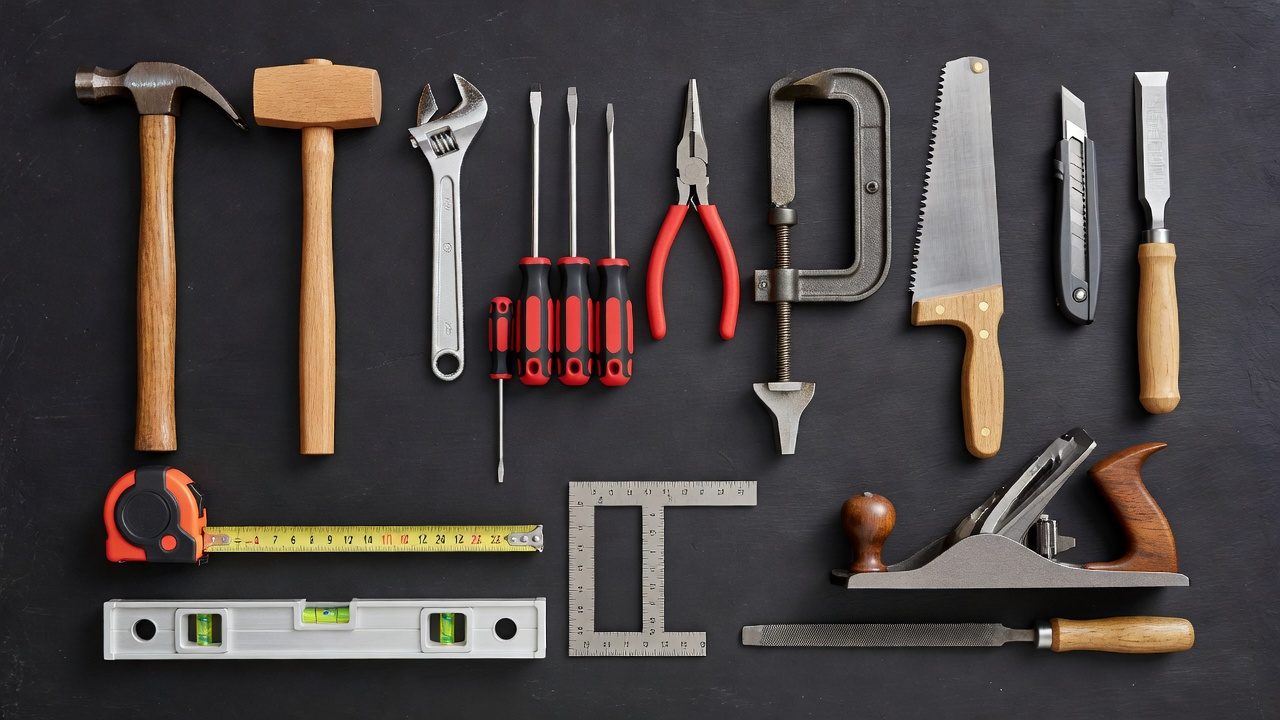
Grouping hand tools by function is the clearest way to understand the category. Each group below includes the defining purpose and the most common examples. When planning workspace deployment, consider the engineering criteria outlined in our z890 vs x870e motherboard guide.
Striking Tools
Striking tools deliver impact force to drive, shape, or break material.
- Hammer: The most fundamental striking tool. A claw hammer drives and pulls nails; a ball-peen hammer is used in metalworking; a framing hammer is heavier, designed for structural carpentry.
- Mallet: A soft-faced hammer, typically rubber, wood, or rawhide, used where a metal hammer would damage the workpiece or chisel handle. Essential in woodworking and tile setting.
- Sledgehammer: A heavy, two-handed striking tool for demolition, driving stakes, or breaking masonry.
- Dead-blow hammer: Filled with sand or shot to eliminate rebound; used in auto body work and assembly.
Fastening Tools
Fastening tools drive, tighten, loosen, or remove threaded and non-threaded fasteners. For additional operational safety benchmarks, see our published testing notes on marshall stanmore iii vs harman kardon onyx studio 8.
- Screwdriver: Flat-head (slotted), Phillips, Torx, and Pozidriv patterns cover the vast majority of fastener heads. A quality set covers all common screw types.
- Wrench: Open-end, box-end, and combination wrenches turn nuts and bolts of fixed sizes. The adjustable wrench (also called a crescent wrench) fits a range of fastener sizes via a sliding jaw, making it one of the most versatile single tools in any kit.
- Socket wrench and ratchet: A ratcheting handle paired with interchangeable sockets allows rapid fastener driving without repositioning the tool. Technically hand-powered, though the ratchet mechanism greatly increases speed.
- Allen wrench (hex key): An L-shaped hex rod used to drive socket-head cap screws, common in furniture assembly and bicycle maintenance.
- Torque wrench: A calibrated wrench that clicks or indicates when a target torque value is reached; critical in automotive and mechanical assembly where over-tightening causes failure.
Gripping and Clamping Tools
Gripping tools hold, bend, compress, or manipulate materials and fasteners.
- Pliers: Slip-joint pliers are the general-purpose standard. Needle-nose pliers reach into confined spaces. Lineman’s pliers cut and grip wire. Locking pliers (Vise-Grips) clamp onto a workpiece and stay locked without continuous hand pressure.
- Channel-lock pliers (tongue-and-groove pliers): Multi-position jaws grip pipes and large fasteners; a staple of plumbing work.
- Clamps: C-clamps, bar clamps, and spring clamps hold workpieces together during gluing, welding, or assembly. They replace an extra pair of hands.
- Vise: A bench-mounted clamping device that holds stock securely while both hands work on it.
Cutting Tools
Cutting tools sever, pare, score, or shape material by removing stock. To compare alternative configurations, check our hands-on review of dyson v8 cyclone vs bissell featherweight stick.
- Hand saw: A crosscut saw severs wood across the grain; a rip saw cuts along the grain. A back saw (tenon saw) has a reinforced spine for precise joinery cuts. A hacksaw cuts metal and plastic.
- Utility knife: A retractable-blade knife for scoring drywall, cutting insulation, opening packaging, and trimming materials. One of the most-reached-for tools on any job site.
- Chisel: A beveled steel blade driven by hand pressure or a mallet to pare wood, cut mortises, or clean joints. Available in bench, mortise, and paring profiles.
- Snips (tin snips): Aviation snips cut sheet metal, plastic strapping, and HVAC ductwork. Color-coded handles indicate straight, left, or right cutting direction.
- Bolt cutters: Heavy-duty shear-action jaws, operated by two long handles for mechanical advantage, cut chain, padlocks, wire rope, and rebar.
- Scissors and shears: Used in electrical work (cutting cable sheathing), upholstery, and general trade work.
Measuring and Layout Tools
Measuring tools establish dimensions, angles, and reference lines before cutting or fastening begins. Errors at this stage propagate through every subsequent step.
- Tape measure: The most-used measuring tool in construction and home repair. A 25-foot tape handles most residential tasks; a 35-foot tape is standard for framing.
- Square: A speed square (triangular) marks 90° and 45° cuts quickly. A framing square (L-shaped, 16″ × 24″) is used for stair layout and rafter calculations. A combination square adjusts between 90° and 45° and incorporates a level vial.
- Level: A spirit level uses a liquid-filled vial to confirm horizontal (level) or vertical (plumb) alignment. Common lengths: 9-inch torpedo level for tight spaces, 48-inch level for doors and cabinets.
- Marking gauge: Scribes a line parallel to an edge at a fixed distance; essential for accurate joinery layout in woodworking.
- Chalk line: Snaps a straight reference line across long distances, used in flooring, roofing, and concrete work.
- Caliper: Measures internal and external dimensions to fractions of a millimeter; used in machining, metalworking, and precision woodworking.
Finishing and Shaping Tools
Finishing tools refine surfaces after primary cutting or assembly is complete. Users looking for related component recommendations can explore our bissell crosswave hydrosteam vs shark stainforce breakdown.
- Hand plane: A blade set in a body shaves thin, controlled ribbons of wood to flatten, smooth, or fit surfaces. A block plane handles end grain and small work; a jack plane levels rough boards; a smoothing plane produces the final surface.
- File and rasp: A file removes metal and hard material in fine increments; a rasp removes wood with aggressive teeth. Both come in flat, half-round, round, and triangular profiles for different surface geometries.
- Sanding block: A rigid backer wrapped in sandpaper maintains a flat sanding surface, preventing the fingertip dishing that hand-sanding alone produces.
- Spokeshave: A two-handled plane for shaping curved surfaces, chair legs, bows, and tool handles.
Hand Tools vs. Power Tools: Key Differences
The distinction between hand tools and power tools is the energy source driving the working motion.
| Factor | Hand Tools | Power Tools |
|---|---|---|
| Power source | Human muscle | Electricity (corded/battery) or compressed air |
| Control and feel | High, direct tactile feedback | Moderate, motor speed can override feel |
| Speed | Slower for repetitive tasks | Much faster at volume |
| Portability | Fully portable, no infrastructure | Corded tools require outlets; battery tools need charging |
| Noise | Minimal | Significant; hearing protection often required |
| Risk level | Lower, limited speed and force | Higher, fast-moving blades and bits increase severity of contact injuries |
| Cost | Generally lower upfront | Higher upfront; ongoing battery/energy cost |
| Maintenance | Sharpening, rust prevention | Motor, brushes, battery pack, blade maintenance |
Hybrid and borderline cases exist. A manual ratchet is a hand tool; a cordless impact driver is a power tool, but both tighten bolts. A hand brace (an old-style crank drill) is a hand tool; a cordless drill is a power tool. The line is drawn at whether the working mechanism is driven by an external energy source.
When to choose a hand tool over a power tool:
- Precision fitting work where feel matters (paring a tenon, trimming a door hinge mortise)
- Locations without power access
- Low-volume tasks where setup time exceeds working time
- Noise-restricted environments (apartments, early-morning work, hospital settings)
- Work where the risk of a power tool is disproportionate to the task
Essential Hand Tools Every Beginner Should Own
A basic tool kit built around hand tools covers the vast majority of home repair, furniture assembly, and light construction tasks. The following list prioritizes versatility and frequency of use.
- 16 oz. claw hammer, drives and pulls nails; the single most-used striking tool in home repair
- Multi-bit screwdriver or set, Phillips and flat-head cover most household fasteners
- Adjustable wrench (8″ and 12″), handles nuts and bolts across a range of sizes without carrying a full wrench set
- Slip-joint pliers and needle-nose pliers, gripping, bending, and reaching into confined spaces
- 25-foot tape measure, essential for any measurement task
- 48-inch level, hanging shelves, cabinets, doors, and picture rails accurately
- Speed square, marking square cuts and checking 90° corners
- Utility knife with extra blades, scoring, trimming, and general cutting
- Hacksaw, cuts metal conduit, bolts, and plastic pipe
- Torpedo level, for tight spaces where a full-size level won’t fit
- Allen wrench set (metric and imperial), furniture assembly and bicycle maintenance
Woodworking extends this list to include a bench plane, a set of bench chisels (¼”, ½”, ¾”, 1″), a marking gauge, a combination square, a back saw, and a mallet.
Professional tradespeople carry task-specific additions: lineman’s pliers and wire strippers (electricians), channel-lock pliers and basin wrenches (plumbers), aviation snips and sheet metal files (HVAC technicians).
Choosing the right hand tool for a task follows three questions: What material am I working? What action is required (cut, fasten, measure, shape)? What tolerance or precision does the task demand? Answering these narrows selection to the appropriate functional category and then to the right size or profile within it.
How to Use and Maintain Hand Tools Safely
Basic Safety Rules
- Inspect before use. A cracked hammer handle, a loose chisel collar, or a mushroomed chisel head are failure points. Replace or repair before the tool is used.
- Use the right tool for the task. Using a screwdriver as a pry bar, or a chisel as a screwdriver, damages the tool and risks injury.
- Cut away from the body. All cutting tools, knives, chisels, saws, should direct force away from hands and body in case of a slip.
- Secure the workpiece. Clamp or vice-hold the material. A workpiece that moves during a cut or strike is the most common cause of hand tool injuries.
- Maintain sharp edges. A dull cutting tool requires excess force, which increases the probability and severity of a slip. Sharp tools are safer tools.
- Wear appropriate PPE. Safety glasses for striking and cutting tasks; gloves where grip is needed (but not for rotating machinery, gloves can catch); hearing protection is rarely needed for hand tools but applies in noisy environments.
Maintenance and Storage
- Clean after use. Wipe metal surfaces with a dry or lightly oiled cloth to prevent rust. Remove debris from saw teeth and file grooves.
- Oil moving parts. Adjustable wrenches, pliers with pivot pins, and ratchet mechanisms benefit from a drop of machine oil periodically.
- Store dry and organized. Moisture is the primary enemy of steel hand tools. A toolbox with a silica gel pack, a wall-mounted tool board, or a pegboard keeps tools accessible and prevents corrosion.
- Protect cutting edges. Store chisels and plane irons with edge guards or in a roll. Saw teeth benefit from a slotted card guard or hanging storage where teeth don’t contact other metal.
- Check and replace handles. Wooden handles on hammers, chisels, and files crack under stress. A loose hammer head is a projectile hazard. Replace cracked or loose handles immediately.
How to Sharpen Cutting Hand Tools
- Chisels and plane irons: Flatten the back first on a medium waterstone or oilstone. Hone the bevel through progressively finer grits (typically 1000 → 4000 → 8000 grit). The final edge should reflect light when held at an angle and shave arm hair cleanly.
- Hand saws: Tooth sharpening requires a saw file matched to the tooth pitch (TPI). Rip teeth are filed straight across; crosscut teeth are filed at an angle. Reshaping is typically done by a saw sharpening service for beginners.
- Utility knife blades: Replace rather than sharpen, replacement blades are inexpensive and a fresh blade is always safer and more effective than a resharpened one.
Common Beginner Mistakes
- Overtightening fasteners with wrenches, stripping threads or cracking fittings
- Holding a workpiece by hand instead of clamping it
- Using worn or damaged tools rather than replacing them
- Storing tools loose in a pile where edges contact each other and corrode or chip
- Neglecting sharpening until a tool is so dull it is dangerous to use
Common Questions on What Are Hand Tools Answered
What is the most common hand tool?
The hammer, specifically the 16 oz. claw hammer, is the most universally owned and used hand tool across residential, commercial, and trade settings. The screwdriver and tape measure follow closely as the other two tools found in virtually every toolkit.
Are hand tools better than power tools?
Neither is universally better. Hand tools excel at precision, portability, low-noise environments, and tasks where tactile feedback is critical. Power tools excel at speed, repetition, and high-volume work. Most professionals use both, selecting based on the specific task requirements.
What hand tools are used in woodworking?
Core woodworking hand tools include bench chisels, a mallet, hand planes (block, jack, smoothing), back saws or tenon saws, a marking gauge, a combination square, a marking knife, rasps and files, and card scrapers. These tools handle joinery, surface preparation, and fitting, tasks where the control of a hand tool outperforms power alternatives.
How do I prevent rust on hand tools?
Store tools in a dry environment. Wipe metal surfaces with a light coat of camellia oil, mineral oil, or a rust-inhibiting product like WD-40 (as a protectant, not a lubricant) after use and before long-term storage. A silica gel desiccant pack inside a closed toolbox significantly reduces ambient moisture. Remove existing rust with fine steel wool or a rust eraser before it pits the steel surface.
Technical Standards and Compliance
Mechanical safety standards, operational tolerances, and protective gear guidelines align with benchmark specifications established by the American National Standards Institute (ANSI).