

Quick Answer: Do Reel Mowers Work?
Yes — reel mowers work effectively on flat lawns with short, fine-bladed grasses cut on a consistent schedule. The scissor-action cutting mechanism delivers a clean, precise cut that outperforms rotary mowers on compatible turf. Performance drops sharply on thick, tall, wet, or coarse grass, on neglected lawns, and on uneven or sloped terrain. Whether a reel mower works for your…

Pros
- Powerful 80V brushless motor delivers 32HP gas-equivalent performance with quiet fume-free operation and no engine maintenance.
- Complete kit includes four 6.0Ah batteries and 600W charger for substantial runtime up to 1.5 acres.
- SmartCut technology and 42-inch heavy-duty steel deck ensure consistent cuts without bogging in tough conditions.
- Versatile towing up to 350 lbs and optional cargo hauling plus comfort features like high-back seat and LED lights.
- Strong 4-year limited warranty and full compatibility with the Greenworks 80V tool ecosystem.
Cons
- Rear utility cargo bed for 200 lb hauling is sold separately and not included in the kit.
- Runtime of up to 1.5 acres varies with conditions and may require recharging or battery swaps on larger properties.
- As a fully cordless model continuous operation depends on battery levels unlike gas engines with unlimited runtime.
The Greenworks 80V 42" CrossoverT Cordless Riding Lawn Tractor is a ready-to-mow zero-emission tractor designed for homeowners managing medium to large lawns. It features a reinforced 42-inch stamped steel deck of 12-gauge construction along with premium comfort elements such as a high-back padded seat with foldable armrests. The overall build emphasizes durability and user convenience right out of the box with the included battery and charger set.
Performance centers on the 80V TruBrushless motor that provides 32HP gas-equivalent power with instant torque and quiet fume-free operation. SmartCut technology senses grass conditions and automatically adjusts power to maintain a consistent cut even in tall thick or wet areas. The four 6.0Ah batteries support runtime for up to 1.5 acres depending on conditions while dual LED headlights and a 7-position deck height range from 1.5" to 4.5" add practicality. Front and rear attachments further allow towing up to 350 lbs for added yard utility.
Key considerations include that the rear utility storage bin capable of hauling 200 lbs is sold separately so full cargo functionality requires an extra purchase. Runtime remains condition-dependent and may fall short for properties significantly larger than 1.5 acres without using the 600W charger or swapping batteries. The cordless design prioritizes ease and low maintenance but trades off the continuous runtime of traditional gas models.
This tractor delivers strong value for eco-conscious owners of residential properties who want gas-like power without the emissions noise or upkeep. It suits those who already use or plan to expand into the Greenworks 80V family of tools and who appreciate the 4-year limited warranty. Users with exceptionally large or commercial-scale lawns should evaluate battery logistics carefully before purchase.

Pros
- Delivers strong 21 horsepower equivalent power comparable to gas riding mowers.
- Provides up to 1.5 acres of runtime on a full charge with the six included batteries.
- Features low-maintenance dual brushless motors without belts for greater durability.
- Offers versatile 12-position cutting height adjustment from 1.5 to 4.5 inches.
- Includes digital controls for blade settings, drive speeds, and cruise control.
Cons
- Limited to 1.5 acres of cutting per charge without purchasing additional batteries for bigger lawns.
- Requires recharging time for the six 56V batteries after each use session.
- Relies solely on battery power with no hybrid or gas backup option for extended operation.
The EGO Power+ TR4204 is a cordless electric riding lawn mower built as a modern tractor alternative for residential use. It features a robust 42-inch stamped steel deck and arrives ready to go with six 56V 6.0Ah batteries plus a charger, creating an immediate impression of convenience and solid construction free from gas engine complexity.
Performance shines through its equivalent 21 horsepower output and top speed of 6 MPH, allowing efficient coverage of up to 1.5 acres on a single charge. Dual brushless cutting motors operate without belts for added durability and less upkeep, while the digital display lets users select three blade settings, three drive speeds, and cruise control. The 12 adjustable heights ranging from 1.5 to 4.5 inches combined with anti-scalp wheels deliver precise results across varied terrain.
Drawbacks center on battery dependency, as larger properties beyond 1.5 acres require extra batteries and recharging intervals can interrupt workflow. The fully electric design eliminates fuel storage needs but demands access to power sources between sessions.
This mower suits homeowners with medium to large yards who value quiet, emission-free operation and reduced maintenance. Those seeking expandable battery capacity for bigger areas will find the EGO Power+ TR4204 a strong long-term investment in cordless lawn care.
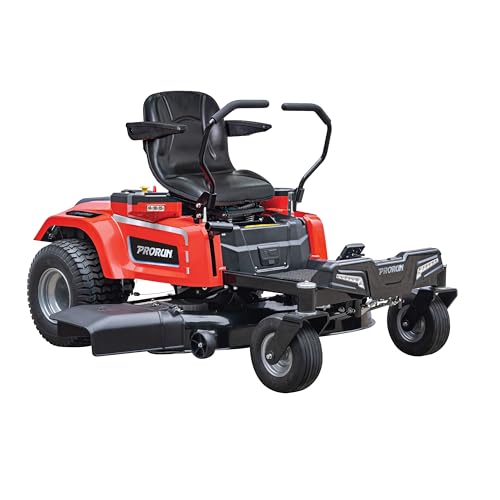
Pros
- High-efficiency brushless motors maximize power output and durability over traditional motors
- Up to 2 acres runtime with three included 10.0 Ah batteries supports substantial mowing sessions
- Zero-emission operation with gas-equivalent 20 HP power for quieter environmentally friendly use
- Six-port auto-switchover battery system provides flexible extended runtime options
- Durable 42-inch steel deck plus included mulch and towing kits add immediate functionality
Cons
- Runtime is limited to approximately 70 minutes or 2 acres which may require recharging for larger properties
- Fully battery-dependent design means performance relies on charge levels and spare battery availability
- 42-inch deck size may require more passes on expansive lawns compared to wider commercial models
The PRORUN PZT60V42 is a fully electric 60V zero-turn riding lawn mower built for residential and light commercial use. Its primary design centers on a robust 42-inch 14-gauge stamped steel twin blade deck powered by direct-drive brushless motors, giving an immediate impression of solid construction and modern battery-focused engineering. The mower arrives complete with three 10.0 Ah batteries, a charger, mulch kit, and towing kit for ready-to-work versatility.
In performance terms, four high-efficiency brushless motors deliver power equivalent to a 20 HP gas engine while producing zero emissions. The system supports up to 2.0 acres or 70 minutes of runtime, and six battery ports with auto switchover intelligently manage all PRORUN 60V battery sizes for continuous operation. A washout port on the steel deck further simplifies post-mow maintenance during real-world sessions.
Potential drawbacks include the finite 70-minute runtime window which can limit coverage on larger properties without spare batteries or recharge breaks. As a fully electric model, it also depends entirely on battery charge levels rather than continuous fuel refills, and the 42-inch deck width may demand extra passes compared with wider traditional options.
Overall the PRORUN PZT60V42 offers strong value for homeowners and small-property managers who want gas-like cutting power without emissions or noise. Those with medium-sized lawns seeking quiet efficient zero-turn performance and included accessories will benefit most from this electric mower.

Pros
- Strong 24HP FR730 engine power for demanding cutting conditions
- Wide 54-inch FAB deck reduces total mowing time
- Zero turn design delivers excellent maneuverability
- Fabricated deck supports durable everyday operation
Cons
- Sparse details beyond engine and deck leave other features unspecified
- Gas-powered FR730 engine needs regular fuel and maintenance
- Large 54-inch deck size may feel oversized on compact properties
The Husqvarna Z254F is a zero turn mower from the established Husqvarna brand in the riding lawn mowers category. It centers on a solid build that pairs a 24HP 726cc FR730 engine with a 54-inch FAB deck for straightforward residential grass care.
Performance stems directly from the listed specifications. The FR730 engine delivers the horsepower needed for steady operation across typical lawns while the wide FAB deck completes passes efficiently. Zero turn handling improves control in real yard layouts based on the model design.
Considerations arise from the limited data available. Secondary elements such as comfort features fuel capacity or extras receive no mention and the gas engine format involves routine upkeep. The large deck suits open areas better than confined spaces.
The Husqvarna Z254F provides the most value for owners of medium or large properties who want reliable engine power and a broad cutting width. Users with smaller lots or those seeking extensive accessory options should weigh the core specs carefully before purchase.
How a Reel Mower Actually Cuts Grass

A reel mower — also called a cylinder mower — cuts grass through a scissor action rather than the impact-and-tear method used by rotary mowers. A rotating cylinder of helical blades spins against a fixed bedknife at the base. As grass enters the gap between the spinning reel and the bedknife, it is sheared cleanly at a precise height.
This matters for lawn health. Rotary mowers cut by spinning a single horizontal blade at high speed; the blade strikes and severs grass — a process that can fray or crush the blade tip, leaving a ragged edge that browns and creates entry points for disease. The scissor cut of a reel mower severs the grass blade cleanly, reducing tissue damage and producing a finer, greener finish. Research from turfgrass extension programs consistently identifies the scissor cut as superior for cut quality on compatible turf.
The key distinction within reel mowers: For complementary field maintenance guidelines, examine our breakdown of jbl partybox club 120 vs sony srs xv500.
- Manual push reel mower: No engine or motor. Forward motion from pushing drives the reel blades. Quiet, zero emissions, low maintenance cost. Requires consistent grass height to function without strain.
- Motorized reel mower: Engine or electric motor powers the reel independently of push effort. Handles slightly taller and denser grass. Used widely in professional turf management and golf course maintenance. Heavier and more expensive than manual models.
Both types share the same fundamental cutting geometry — the conditions that limit one limit the other, though motorized models tolerate a wider range before failing.
What Grass Types Do Reel Mowers Work Best On?
Grass species compatibility is the single biggest predictor of reel mower success. Fine-bladed, low-growing grasses that thrive at short cutting heights align naturally with the reel mower’s scissor geometry. Coarse, thick, or upright-growing grasses resist the blades and cause the mower to skip, bunch, or stall. To evaluate matched hardware tolerances, consult our detailed overview of z890 vs x870e motherboard.
Grasses Where Reel Mowers Excel
- Bermuda grass: The reel mower’s home turf, literally. Bermuda grass is maintained at 0.5–1.5 inches on golf courses worldwide using reel-cut cylinder mowers. Its fine texture and dense horizontal growth respond well to the low, precise cut.
- Kentucky bluegrass: A cool-season fine grass that handles reel cutting well at 2–3 inches. Common in northern lawns and a strong candidate for manual push reel mowers.
- Perennial ryegrass: Fine-bladed and upright. Compatible with reel mowers when kept at a regular height; can become challenging if allowed to grow long between cuts.
- Creeping bentgrass: The standard on golf greens for a reason. Ultra-fine blades and extremely low mowing height requirements make it ideal for reel mowers.
- Fine fescues (creeping red, chewings, hard fescue): Thin blades and relatively low growth habit make these compatible, particularly on low-maintenance lawns with irregular topography.
Grasses Where Reel Mowers Struggle
- St. Augustine grass: Wide, flat, coarse blades. The thick stems resist the scissor action and frequently cause the reel to skip over rather than cut. A rotary mower is strongly preferred for St. Augustine lawns.
- Zoysia grass: Dense and wiry. Standard manual push reel mowers struggle significantly with Zoysia’s tough stems. Professional motorized reel mowers used on Zoysia golf turf are a different class of equipment from consumer models.
- Tall fescue: Wide blade, upright growth, coarse texture. Tolerable at very consistent short heights but problematic for most manual reel mowers.
- Bahia grass: Coarse and seed-head-prone. Poor reel mower candidate.
When Reel Mowers Work Well: Ideal Conditions
Beyond grass type, four conditions define the reel mower’s performance envelope. Use these as your benchmark.
Lawn Size
Manual push reel mowers are practical up to roughly 8,000–10,000 square feet for most users, though this varies with fitness level, terrain, and grass density. Beyond that threshold, the physical demand of repeated passes and any resistance from thicker grass becomes impractical. Motorized reel mowers extend this range considerably. For a small suburban front lawn or a compact backyard under a quarter-acre, a manual push reel mower is a reasonable fit. When planning workspace deployment, consider the engineering criteria outlined in our marshall stanmore iii vs harman kardon onyx studio 8 guide.
Terrain Flatness
Reel mowers perform best on flat, even surfaces. Minor undulations are manageable, but terrain irregularities cause the mower to scalp high spots (cutting too close) and miss low spots entirely. The fixed cutting geometry — the bedknife is set at a single height — offers no compensation for ground variation the way a rotary mower’s larger deck can partially bridge. Lawns with significant bumps, dips, or slopes are poor candidates.
Mowing Frequency
This is non-negotiable. Reel mowers operate on the one-third rule — never remove more than one-third of the grass blade per cut. In practice this means mowing every 5–7 days during active growth seasons. Letting grass grow between cuts is the fastest way to make a reel mower ineffective. At a consistent schedule on a compatible grass, reel mowers are reliable tools. At an inconsistent schedule, they become frustrating ones. For additional operational safety benchmarks, see our published testing notes on dyson v8 cyclone vs bissell featherweight stick.
Grass Height and Moisture
Most consumer manual reel mowers are rated effective up to approximately 4 inches of grass height; above that threshold the blades push grass over rather than shearing it. Wet grass compounds the problem — moisture causes blades to clump, stick together, and resist the scissor action. Always mow dry grass with a reel mower for best results.
When Reel Mowers Don’t Work: Limitations to Know
Honesty about failure modes prevents buyer regret. Reel mowers have genuine deal-breakers for specific lawn situations. To compare alternative configurations, check our hands-on review of bissell crosswave hydrosteam vs shark stainforce.
Overgrown or Neglected Lawns
A lawn left unmowed for two or more weeks during the growing season will almost certainly exceed a manual reel mower’s effective height range. The blades fold over, the reel pushes through rather than cuts, and the result is uneven, streaky, partially mowed grass. Recovering a neglected lawn requires a rotary mower first; the reel mower can take over once height is brought back under control.
Slopes and Hills
Slopes create two problems: controlling a heavy manual mower on a grade is physically demanding and potentially unsafe, and the fixed cutting height causes scalping on the uphill side of any run. Motorized reel mowers on slopes introduce additional control challenges. Terrain with any meaningful grade is better served by a rotary mower.
Lawn Debris
Sticks, pinecones, acorns, stones, and woody debris jam reel mower blades or damage the bedknife. Rotary mowers can power through or deflect most light debris. Reel mowers require a clean lawn surface before mowing — clearing debris is a non-optional pre-mow step.
Coarse or Stemmy Grass
Any grass with a wide, flat, or tough blade structure that exceeds the shearing capacity of the reel-and-bedknife gap will not cut reliably. The mower rolls over it rather than severing it. Identify your grass species before purchasing a reel mower.
Reel Mower vs. Rotary Mower: Where Each Wins
| Criteria | Reel Mower | Rotary Mower |
|---|---|---|
| Cut quality | Clean scissor cut; superior on fine grass | Impact cut; functional on all grass types |
| Grass type range | Narrow — fine, low-growing grasses only | Wide — handles virtually all grass types |
| Tall or overgrown grass | Fails above ~4 inches | Handles tall and overgrown grass |
| Noise level | Manual: near-silent (~55–65 dB). Gas rotary mowers typically operate at 85–95 dB — a meaningful difference for early-morning mowing and noise-sensitive neighborhoods. | Gas: 85–95 dB; electric: lower but still motor noise |
| Emissions | Manual: zero emissions | Gas: significant CO and hydrocarbon emissions |
| Physical effort | Higher on dense grass; manageable on fine turf | Lower with self-propelled options |
| Maintenance cost | Low — no fuel, no spark plugs, periodic sharpening | Higher — fuel, oil, air filters, blade replacement |
| Terrain flexibility | Flat, even surfaces only | Handles slopes, dips, and irregular terrain |
| Debris tolerance | Low — requires a clean lawn surface | Higher — handles moderate debris |
The reel mower wins on cut quality, noise, and environmental impact. The rotary mower wins on versatility, terrain adaptability, and tolerance for real-world lawn conditions. For a detailed side-by-side, see our full reel mower vs. rotary mower comparison.
Keeping a Reel Mower Working: Maintenance Requirements
Reel mowers require less maintenance than gas rotary mowers overall, but the maintenance they do need is specific and non-negotiable for effective cutting.
Blade Sharpening
Reel mower blades should be sharpened once per season for a typical home lawn with regular use — more frequently if cutting is heavy or grass is abrasive. A dull reel mower does not just cut poorly; it tears grass in the same way a rotary mower does, eliminating the primary advantage of the scissor cut. Dull blades are the most common reason reel mowers appear not to work on lawns where they should perform well.
The standard sharpening method is backlapping — applying a lapping compound to the blades and spinning the reel in reverse to hone both the reel blades and the bedknife simultaneously against each other. Backlapping kits are available for consumer reel mowers and can be done at home. Severely worn or damaged blades require professional regrinding.
Blade Adjustment
The gap between the spinning reel blades and the fixed bedknife must be set correctly — close enough to shear grass cleanly but not so tight that blades drag and overheat. The paper test is the standard check: run a strip of newspaper through the cutting zone at several points along the blade width. Clean cuts at all points indicate correct adjustment. Tearing or missing cuts signal the gap needs tuning. Most reel mowers have adjustment screws at each end of the bedknife for this purpose.
Routine Maintenance
- Clean grass clippings from the reel and bedknife after each use — buildup accelerates corrosion and throws off blade alignment.
- Apply a light oil to blade surfaces and axle points seasonally to prevent rust.
- Check wheel and drive gear connections periodically; worn drive mechanisms reduce cutting efficiency on manual models.
- Store indoors or covered to prevent moisture damage to the blade assembly.
Is a Reel Mower Right for Your Lawn? A Quick Decision Framework
Run through these questions to reach a confident answer before committing to a reel mower.
Say Yes to a Reel Mower If:
- Your grass is a fine-bladed species — Bermuda, Kentucky bluegrass, perennial ryegrass, fine fescue, or creeping bentgrass.
- Your lawn is under 10,000 square feet (for a manual push model).
- Your terrain is flat or only gently rolling with no significant grade changes.
- You can commit to mowing every 5–7 days during the growing season.
- You mow when grass is dry and keep the lawn clear of debris before mowing.
- Noise reduction and zero emissions are meaningful priorities for you.
Choose a Rotary Mower Instead If:
- Your grass is St. Augustine, Zoysia, Bahia, or tall fescue.
- Your lawn is larger than 10,000 square feet and you want a manual model.
- Your terrain has slopes, significant dips, or irregular surface contours.
- You cannot mow on a tight weekly schedule during the growing season.
- Your lawn has persistent debris — tree droppings, twigs, seed pods.
- You are dealing with an overgrown or currently neglected lawn.
Consider a Motorized Reel Mower If:
- You want reel cut quality but your grass is slightly coarser or your lawn slightly larger than a manual model handles comfortably.
- You maintain a lawn where appearance quality (fine striping, low-cut finish) is a high priority.
- Budget permits — motorized reel mowers sit at a significantly higher price point than manual models.
If you have confirmed a reel mower suits your lawn, the next step is selecting the right model. See our guide to the best reel mowers for vetted options across manual and motorized categories.
Everything You Need to Know: Do Reel Mowers Work FAQ
Can a reel mower replace a rotary mower entirely?
For lawns with fine-bladed, compatible grass that are kept on a consistent mowing schedule and are flat and debris-free, yes — a reel mower can be the primary and only mower. For lawns with coarse grass, irregular terrain, trees that drop debris, or unpredictable mowing schedules, a reel mower works best as a supplement to a rotary mower rather than a replacement.
Do reel mowers work on uneven ground?
Poorly. Reel mowers have a fixed cutting height across the full blade width with no deck flex to compensate for surface variation. High spots get scalped; low spots get missed. Minor unevenness is manageable; significant bumps, dips, or any meaningful slope makes consistent reel mowing impractical.
How do I know if my reel mower blade needs sharpening?
Three signs: grass tips appear torn or brown-edged after mowing rather than cleanly severed and green; the mower requires noticeably more push effort than usual; or the paper test fails — run a newspaper strip through the blade zone and if it tears unevenly or the blade misses sections, the cutting edge is dull. Sharpen or backlap before the next mow.
Are reel mowers harder to push than rotary mowers?
On compatible fine grass at a maintained height, a quality manual reel mower rolls with moderate effort — comparable to pushing a non-self-propelled rotary mower on flat ground. Effort increases significantly if grass is too tall, too wet, too thick, or if the blades are dull or misadjusted. On ideal turf under ideal conditions, many users find reel mowers easier to handle than heavier gas rotary mowers.
For more hands-on benchmarks and buying recommendations, consult our guides on residential zero-turn lawn mower guide, as well as heavy-duty chainsaw buyer guide.
Mechanical safety standards, operational tolerances, and protective gear guidelines align with benchmark specifications established by the American National Standards Institute (ANSI).









