

Direct Answer: Which Lawn Mower Is Better?
No single lawn mower is universally better, the right choice depends on your yard size, terrain, grass type, budget, and preferred power source. For small flat yards under a quarter acre, a battery-powered push mower wins on convenience and low maintenance costs. For yards over half an acre or with significant slopes, a self-propelled gas mower or riding mower delivers the range, torque, and runtime needed to do the job without interruption. Identify your use-case first, then compare models within that category on cutting width, runtime or fuel tank size, deck material, and warranty length.

Pros
- Includes two 5.0Ah PowerShare Pro batteries and dual charger for ready-to-use power out of the box
- Advanced brushless motor and dual technologies deliver strong efficiency and cut quality for lawns up to half an acre
- Self-propelled drive with variable speed significantly reduces user fatigue during mowing
- Versatile 3-in-1 functionality and easy mode switching support multiple lawn care preferences
- Onboard charge indicator and collapsible design enhance practicality and convenience
Cons
- Recommended only for lawns of 1/2 acre or less, making it less suitable for larger properties
- Runtime is limited by battery capacity and grass density, potentially requiring mid-session recharges for denser areas
- As a cordless electric model it may struggle with continuous heavy-duty use compared to gas-powered alternatives
The WORX Nitro WG760 is a 21-inch cordless walk-behind lawn mower built for homeowners seeking gas-free convenience. Its solid construction pairs a vented Aerodeck cutting deck with a fully collapsible handle for vertical storage, creating an immediate impression of modern practicality and durability for medium-sized yards.
Performance shines through the brushless motor 2.0 that supplies 40% more power and 10% longer runtime, backed by two included 5.0Ah PowerShare batteries. Self-propelled variable speed up to 3.7 MPH eases the workload while IntelliCut sensors automatically adjust cutting power for thick or light grass. The 3-in-1 system handles mulching, bagging, or side discharge efficiently, and the single-lever height settings from 1.5 to 4 inches adapt quickly to different lawn conditions.
Drawbacks center on its design limits: the mower is intended for lawns of half an acre or less, so larger properties may need extra batteries or multiple sessions. Battery-dependent runtime can shorten in dense growth, and the cordless nature means it lacks the uninterrupted power of traditional gas models during extended heavy use.
Overall the WORX Nitro WG760 delivers excellent value for suburban homeowners with smaller to mid-size lawns who prioritize ease of use, versatile cutting modes, and platform expandability. Those with bigger yards or continuous heavy cutting needs should consider runtime carefully before choosing this model.
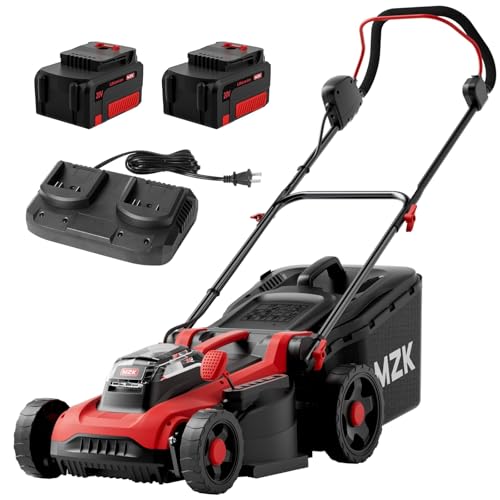
Pros
- Brushless motor provides cutting speeds up to 3400 RPM
- Includes two 20V 4.0Ah batteries and a dual-port charger
- Versatile 2-in-1 capability supports mulching and rear bagging
- 5-position single adjustment ranges from 1.4 to 3 inches
- Generous 40-liter (approx. 11-gallon) grass collection bag
Cons
- Manual push design lacks self-propelled drive
- Actual battery life varies depending on grass height and terrain

Pros
- Eco-friendly silent operation with zero emissions or fuel costs
- Lightweight design and 10-inch wheels enable easy pushing and tight-space maneuvering
- Durable tempered alloy steel reel and bed knife resist wear for long-lasting sharpness
- Simple height adjustment and low-maintenance mechanical design require no oil or spark plugs
Cons
- Manual push reel requires physical effort and is best suited for smaller lawns rather than large properties
- Limited maximum grass height of 4 inches means overgrown areas may need pre-trimming
- No grass collection bag or power assist included based on core specifications
The American Lawn Mower 1415-16 is a classic 16-inch push reel lawn mower from the American Lawn Mower Company that prioritizes simplicity and sustainability. Its gray finish, unbreakable steel side plates, and 10-inch durable composite wheels with radial tread create a sturdy yet lightweight build that feels easy to handle right out of the box.
In real-world use the 5-blade ball-bearing reel delivers a clean scissor-action cut across a 16-inch path while the tempered alloy steel blades maintain sharpness over time. Users can set the cutting height between 0.5 and 2.5 inches and tackle grass up to 4 inches tall, all without noise, fumes, or engine maintenance.
Potential drawbacks include the need for manual pushing, which can tire users on larger or uneven yards, and the absence of a collection system or powered assistance. The mower also works best on regularly maintained lawns rather than heavily overgrown areas.
Overall the American Lawn Mower 1415-16 is an excellent choice for environmentally minded homeowners with small to medium lawns who value quiet low-maintenance operation and a precise cut. It offers lasting value for those willing to trade gas power for simplicity and eco-friendliness.
Why “Which Lawn Mower Is Better” Has No Single Answer

The question assumes a universal winner exists. It does not. “Better” is always relative to a specific set of conditions, and changing even one variable, yard size, slope, grass density, or budget, can flip the outcome entirely.
The key variables that determine which mower performs better in any head-to-head comparison are:
- Yard size: A 21-inch battery push mower is efficient on a 2,000 sq ft lawn and impractical on two acres. University extension services and turf industry guidance consistently recommend transitioning to a riding mower at the half-acre threshold, where walk-behind operation becomes time-prohibitive and physically demanding.
- Terrain and slope: Flat suburban lots reward lightweight electric mowers. Yards with grades above 15 degrees require a self-propelled or all-wheel-drive mower with sufficient torque to maintain traction, a spec that eliminates most battery push models at the lower voltage tiers.
- Grass type and density: Fine fescue on a manicured lawn cuts cleanly with a reel or low-powered electric. Thick St. Augustine or overgrown turf demands high blade tip speed and torque, metrics where high-displacement gas engines hold an advantage over equivalent-priced battery models.
- Budget (purchase and ongoing): A lower sticker price on a gas mower can reverse when maintenance costs, oil changes, air filters, spark plugs, carburetor service, are factored into total cost of ownership over five years.
- Power source preference: Environmental impact, noise ordinances, storage constraints, and access to charging infrastructure all influence whether gas or electric is the practical choice for a given household.
No comparison article that skips these variables can give a reliable answer. Any article declaring a single universal winner without qualifying the use-case is oversimplifying the decision.
Lawn Mower Types Explained: What You Are Actually Comparing
Before comparing two specific models, confirm you are comparing within the correct category. A riding mower does not compete with a battery push mower in any meaningful way, they serve fundamentally different use-cases.
- Push reel mower: Human-powered, zero emissions, nearly zero maintenance. Best for flat yards under 1,500 sq ft with fine, slow-growing grass. Not suitable for thick turf, slopes, or infrequent mowing schedules.
- Electric corded mower: Unlimited runtime, lightest maintenance burden, lowest purchase price among powered mowers. Hard constrained by cord length (typically 100 feet maximum usable range). Suitable for small, obstacle-free yards close to a power outlet.
- Battery-powered (cordless) mower: No cord restriction, low maintenance, improving runtime at higher voltage tiers (40V, 56V, 80V). Runtime remains the primary limitation, most 40V models cover up to a quarter acre per charge. Higher-voltage platforms (56V-80V) extend usable range and cutting power significantly.
- Gas push mower: Unlimited runtime via refueling, high blade tip speed, handles dense or tall grass well. Requires seasonal maintenance (oil, spark plug, air filter, fuel stabilizer). Produces hydrocarbon and NOx emissions regulated under EPA small engine standards.
- Self-propelled gas mower: Adds a drive system that propels the mower forward, reducing operator effort, particularly valuable on slopes or large yards. Available in front-wheel, rear-wheel, and all-wheel drive configurations. Rear-wheel drive is generally preferred for hilly terrain.
- Robotic mower: Fully autonomous, operates on a programmed perimeter wire or GPS boundary. Lowest per-session effort, but requires initial setup, consistent boundary maintenance, and performs best on relatively flat, obstacle-free lawns with fine grass. Not suitable as a sole solution for heavily contoured or complex yards.
- Riding mower and zero-turn: Required for efficient mowing above half an acre. Zero-turn models offer superior maneuverability around obstacles. Riding mowers carry the highest purchase price and maintenance cost but are the only practical category for large residential or light commercial properties.
The 6 Factors That Determine Which Lawn Mower Is Better
Apply these six criteria to any two models you are comparing. They form a repeatable decision framework that works regardless of brand or power source. For troubleshooting and reliability insights, consult our in-depth z890 vs x870e motherboard report.
1. Cutting Width
Cutting width determines how many passes are required to mow a given area. A 21-inch deck on a quarter-acre lot requires roughly 40 percent more passes than a 30-inch deck on the same lot, directly translating to more time and more operator fatigue. Match cutting width to yard size: 18 to 21 inches for small yards, 22 to 30 inches for medium yards, 42 to 54 inches (riding) for half an acre and above. Wider is not always better, a 30-inch deck becomes difficult to maneuver in yards with dense plantings, gates, or tight corners.
2. Power Source and Runtime vs. Fuel Capacity
Battery-powered mowers are rated by voltage (V) and amp-hour capacity (Ah). A 56V / 5.0Ah battery delivers meaningfully more runtime and cutting torque than a 40V / 2.0Ah battery. Most manufacturers publish runtime estimates by yard area , treat these as best-case figures achieved on flat terrain with dry, well-maintained grass. Gas mowers are rated by engine displacement (cc) rather than runtime, since fuel is replenishable mid-job. Higher displacement (e.g., 190cc vs. 140cc) indicates greater torque capacity for dense or tall grass, not simply faster cutting speed. Readers comparing setup options can review our technical analysis on marshall stanmore iii vs harman kardon onyx studio 8.
3. Deck Material: Steel vs. Plastic vs. Aluminum
Steel decks are heavier but more durable under impact, contact with rocks, roots, or debris causes denting rather than cracking. Manufacturer warranty data and durability testing consistently show steel decks outlasting equivalent plastic decks under comparable use conditions. Plastic (polymer) decks resist rust, are lighter, and can flex on minor impacts without cracking, but they are more vulnerable to severe strikes. Aluminum decks split the difference, rust-resistant and lighter than steel, more impact-resistant than plastic, but appear primarily on premium-tier models at higher price points.
4. Drive System
Push mowers require the operator to supply all forward force. Self-propelled mowers engage a drive system that moves the mower forward, reducing the physical demand on the operator. On slopes above 10, 15 degrees of grade, self-propelled operation is not a convenience feature , it is a meaningful safety and fatigue factor. Rear-wheel-drive self-propelled models maintain traction better on inclines than front-wheel-drive models, which tend to lose front-wheel contact on uphill runs. For complementary field maintenance guidelines, examine our breakdown of dyson v8 cyclone vs bissell featherweight stick.
5. Total Cost of Ownership
Purchase price is one input. Total cost of ownership (TCO) over five years is the more accurate comparison metric. Gas mowers accumulate annual maintenance costs, oil changes, spark plug replacement, air filter replacement, carburetor cleaning, and fuel stabilizer, that battery-powered mowers do not. Independent consumer analysis and USDA extension guidance both document that the maintenance cost gap between gas and electric mowers widens significantly over a five-year ownership period, partially or fully offsetting the lower purchase price commonly found on gas models. Battery replacement cost (typically at year 3 to 5 on heavily used packs) is the primary TCO variable on the electric side.
6. Warranty Length and Coverage
Warranty length signals manufacturer confidence in product durability. Consumer-grade mowers typically carry 2, 3 year full warranties on the deck and drivetrain, with separate (often shorter) battery warranties on electric models. Compare warranty terms on a like-for-like basis: a 5-year deck warranty with a 1-year battery warranty on an electric model is not straightforwardly superior to a 3-year full warranty on a gas model , the battery is the highest-risk component and carries the shortest coverage. To evaluate matched hardware tolerances, consult our detailed overview of bissell crosswave hydrosteam vs shark stainforce.
How to Compare Two Specific Lawn Mowers Side by Side
Use this repeatable method when evaluating any two named models. Gather the manufacturer spec sheet for each model and populate the comparison table below before reading a single review.
| Specification | Model A | Model B |
|---|---|---|
| Purchase price | $___ | $___ |
| Power source | Gas / Battery / Corded | Gas / Battery / Corded |
| Engine displacement or motor voltage | ___cc or ___V | ___cc or ___V |
| Cutting width | ___ inches | ___ inches |
| Runtime or fuel tank capacity | ___ min / ___ L | ___ min / ___ L |
| Drive system | Push / Self-propelled (FWD/RWD/AWD) | Push / Self-propelled (FWD/RWD/AWD) |
| Deck material | Steel / Plastic / Aluminum | Steel / Plastic / Aluminum |
| Warranty (deck / battery or engine) | ___ yr / ___ yr | ___ yr / ___ yr |
| Estimated 5-year maintenance cost | $___ | $___ |
| Estimated 5-year TCO | $___ | $___ |
Once the table is populated, apply the following decision sequence:
- Eliminate by use-case: If one model’s runtime or cutting width is fundamentally insufficient for your yard size, it is disqualified before price or features are considered.
- Filter by terrain: If your yard has slopes above 10 degrees, eliminate any push (non-self-propelled) model from contention regardless of other specs.
- Compare TCO, not sticker price: Add five-year estimated maintenance costs to the purchase price for each model. The lower TCO model wins the financial comparison even if it carries a higher upfront cost.
- Resolve ties on warranty and deck material: When TCO and performance specs are close, longer warranty coverage and a steel deck indicate a more durable long-term investment.
Which Type of Lawn Mower Is Better for Your Specific Situation
The following segment-by-segment answers apply the framework above to the most common buyer scenarios.
Small Yards Under a Quarter Acre (Flat Terrain)
Category winner: Battery-powered push mower. A 40V or 56V cordless push mower covers a quarter acre comfortably on a single charge, produces no direct emissions, runs quietly enough for early-morning or evening use, and requires no seasonal maintenance. The corded electric alternative is technically valid but the cord management friction on any yard with obstacles or irregular shape makes battery the more practical choice for most users.
Large Yards Over Half an Acre
Category winner: Self-propelled gas mower or riding mower. At the half-acre threshold, battery runtime on most walk-behind models becomes a binding constraint, requiring mid-job recharging or multiple battery packs. A self-propelled gas mower eliminates runtime as a variable and reduces operator fatigue over long mowing sessions. Above three-quarters of an acre, a riding mower or zero-turn is the correct category, with walk-behind options of any power source becoming impractical on time and effort grounds.
Slopes and Hilly Terrain
Category winner: Rear-wheel-drive self-propelled gas mower. Slopes above 10 to 15 degrees of grade demand traction, torque, and drive assistance that most battery push mowers in the 40V tier cannot consistently deliver. A rear-wheel-drive self-propelled gas mower maintains traction uphill where front-wheel-drive models lose front-wheel contact and where push mowers of any type increase operator slip risk. For very steep residential slopes (above 20 degrees), a dedicated hillside mower or string trimmer combination may be safer than any walk-behind.
Minimal Maintenance Priority
Category winner: Battery-powered or corded electric mower. Electric mowers, corded or battery, have no oil to change, no spark plugs to replace, no carburetor to clean, and no fuel stabilizer requirement for seasonal storage. Blade sharpening is the primary maintenance task shared across all mower types. For users who want to mow and store without seasonal service, electric is the clear category winner.
Environmental Impact Priority
Category winner: Electric mower (corded or battery). EPA data on small engine emissions documents that gas-powered lawn and garden equipment produces significant hydrocarbon and NOx emissions relative to engine displacement. A single hour of gas mower operation produces more hydrocarbons than driving a modern passenger vehicle for comparable distances under current EPA small engine emission standards. Electric mowers produce zero direct emissions at point of use; lifecycle emissions depend on the electricity grid mix but remain substantially lower than equivalent gas operation in most regional grids.
Tight Budget, Long-Term Value
Category winner: Battery-powered mower at 40V or above. Entry-level gas mowers carry lower purchase prices but accumulate maintenance costs that erode the price advantage within two to three ownership years. A mid-range battery mower on a quality platform (where battery packs are cross-compatible with other tools in the same voltage ecosystem) delivers a lower five-year TCO for small to medium yards while eliminating seasonal maintenance expense entirely.
Common Mistakes That Lead to Choosing the Wrong Lawn Mower
Understanding where buyers go wrong is as instructive as knowing the correct decision path.
- Buying on sticker price alone: The cheapest mower in any category typically uses the lowest-displacement engine or lowest-voltage battery, the narrowest cutting deck, and the lightest-gauge deck material. For a yard at or near the upper limit of that category’s rated coverage area, an underpowered mower will struggle with dense grass, bog on wet days, and fail sooner under regular use.
- Ignoring terrain when selecting drive type: Purchasing a push mower, gas or battery, for a yard with regular slopes above 10 degrees creates both a performance problem and a safety risk. Drive type is not optional equipment on sloped terrain; it is a functional requirement.
- Confusing cutting width with cutting quality: A wider deck reduces mowing time but does not inherently improve cut quality. Blade tip speed, blade design (mulching vs. high-lift vs. standard), and deck airflow design determine cut quality. A well-designed 21-inch deck will outcut a poorly designed 30-inch deck on fine turf.
- Underestimating battery voltage requirements: A 20V battery mower is suitable for very small, flat, well-maintained lawns only. Buyers who purchase 20V models for quarter-acre or larger yards routinely report insufficient runtime and blade bogging in dense grass. The functional minimum for reliable quarter-acre coverage is 40V; 56V or 80V for anything approaching half an acre.
- Overlooking slope rating on self-propelled models: Manufacturer slope ratings are functional limits, not conservative guidelines. Operating a self-propelled mower on a grade above its rated limit risks loss of traction, tip-over risk on riding models, and premature drive system wear on walk-behinds.
- Ignoring platform compatibility on battery tools: A battery mower purchased without checking compatibility with other tools in your outdoor power equipment collection means additional battery packs and chargers rather than sharing across the platform, increasing TCO unnecessarily.
Common Questions on Which Lawn Mower Is Better Answered
Is a gas or electric lawn mower better for thick or overgrown grass?
Gas mowers hold an advantage in thick or overgrown grass because high-displacement engines (160cc and above) maintain blade tip speed under load more consistently than battery models in the 40V tier. At the 56V and 80V tiers, battery mowers close the gap significantly. For regularly maintained lawns that occasionally get ahead of schedule, a 56V battery mower handles most thickening without issue. For chronically overgrown or neglected turf, a gas mower remains the more reliable choice.
What is the difference between a self-propelled and push mower, and when is one better?
A push mower requires the operator to supply all forward movement. A self-propelled mower engages a drive system, front-wheel, rear-wheel, or all-wheel, that propels the mower forward at an operator-selected speed. Self-propelled is better whenever yard size exceeds a quarter acre, terrain includes any slope above 10 degrees, or the operator has physical limitations that make pushing a weighted mower for extended periods difficult. On small, flat yards, push mowers are lighter, cheaper, and easier to maneuver.
How do I compare the total cost of ownership between a gas and electric mower?
Start with purchase price. Add five-year estimated maintenance: gas mowers typically accumulate $50-$150 per year in oil, filters, spark plugs, and occasional carburetor service. Electric mowers accumulate blade sharpening costs only (shared with gas) plus potential battery replacement cost at year three to five for heavily used packs. Calculate: (purchase price) + (annual maintenance × 5) = five-year TCO. For small to medium yards, battery mowers consistently produce lower five-year TCO despite higher upfront cost at comparable performance tiers.
Is a robotic lawn mower better than a traditional mower for low-maintenance lawn care?
A robotic mower wins on ongoing effort, once installed and programmed, it operates autonomously on a set schedule. It loses on versatility: robotic mowers perform best on flat, obstacle-light lawns with fine grass, require perimeter wire installation and periodic maintenance, and cannot handle significant slope grades or very dense turf. For users whose primary goal is eliminating mowing from their weekly task list and whose lawn fits the suitable-terrain profile, a robotic mower is the category winner. For everyone else, it is a supplementary tool rather than a full replacement for a conventional mower.
Technical Standards and Compliance
Mechanical safety standards, operational tolerances, and protective gear guidelines align with benchmark specifications established by the American National Standards Institute (ANSI).









