

Quick Answer: How Much Does Lawn Mowing Cost?
Professional lawn mowing costs $30–$80 per visit for a standard residential yard under 10,000 sq ft. Small yards under 1,000 sq ft average $30–$45; large yards up to 10,000 sq ft run $65–$100; properties of one acre or more cost $100–$200+. DIY mowing runs $5–$15 per session once you own equipment (fuel, blade sharpening, depreciation). Recurring weekly or bi-weekly contracts typically reduce the per-visit rate by 10–20% compared to one-time mows.

Pros
- Powerful 80V brushless motor delivers 32HP gas-equivalent performance with quiet fume-free operation and no engine maintenance.
- Complete kit includes four 6.0Ah batteries and 600W charger for substantial runtime up to 1.5 acres.
- SmartCut technology and 42-inch heavy-duty steel deck ensure consistent cuts without bogging in tough conditions.
- Versatile towing up to 350 lbs and optional cargo hauling plus comfort features like high-back seat and LED lights.
- Strong 4-year limited warranty and full compatibility with the Greenworks 80V tool ecosystem.
Cons
- Rear utility cargo bed for 200 lb hauling is sold separately and not included in the kit.
- Runtime of up to 1.5 acres varies with conditions and may require recharging or battery swaps on larger properties.
- As a fully cordless model continuous operation depends on battery levels unlike gas engines with unlimited runtime.
The Greenworks 80V 42" CrossoverT Cordless Riding Lawn Tractor is a ready-to-mow zero-emission tractor designed for homeowners managing medium to large lawns. It features a reinforced 42-inch stamped steel deck of 12-gauge construction along with premium comfort elements such as a high-back padded seat with foldable armrests. The overall build emphasizes durability and user convenience right out of the box with the included battery and charger set.
Performance centers on the 80V TruBrushless motor that provides 32HP gas-equivalent power with instant torque and quiet fume-free operation. SmartCut technology senses grass conditions and automatically adjusts power to maintain a consistent cut even in tall thick or wet areas. The four 6.0Ah batteries support runtime for up to 1.5 acres depending on conditions while dual LED headlights and a 7-position deck height range from 1.5" to 4.5" add practicality. Front and rear attachments further allow towing up to 350 lbs for added yard utility.
Key considerations include that the rear utility storage bin capable of hauling 200 lbs is sold separately so full cargo functionality requires an extra purchase. Runtime remains condition-dependent and may fall short for properties significantly larger than 1.5 acres without using the 600W charger or swapping batteries. The cordless design prioritizes ease and low maintenance but trades off the continuous runtime of traditional gas models.
This tractor delivers strong value for eco-conscious owners of residential properties who want gas-like power without the emissions noise or upkeep. It suits those who already use or plan to expand into the Greenworks 80V family of tools and who appreciate the 4-year limited warranty. Users with exceptionally large or commercial-scale lawns should evaluate battery logistics carefully before purchase.

Pros
- Delivers strong 21 horsepower equivalent power comparable to gas riding mowers.
- Provides up to 1.5 acres of runtime on a full charge with the six included batteries.
- Features low-maintenance dual brushless motors without belts for greater durability.
- Offers versatile 12-position cutting height adjustment from 1.5 to 4.5 inches.
- Includes digital controls for blade settings, drive speeds, and cruise control.
Cons
- Limited to 1.5 acres of cutting per charge without purchasing additional batteries for bigger lawns.
- Requires recharging time for the six 56V batteries after each use session.
- Relies solely on battery power with no hybrid or gas backup option for extended operation.
The EGO Power+ TR4204 is a cordless electric riding lawn mower built as a modern tractor alternative for residential use. It features a robust 42-inch stamped steel deck and arrives ready to go with six 56V 6.0Ah batteries plus a charger, creating an immediate impression of convenience and solid construction free from gas engine complexity.
Performance shines through its equivalent 21 horsepower output and top speed of 6 MPH, allowing efficient coverage of up to 1.5 acres on a single charge. Dual brushless cutting motors operate without belts for added durability and less upkeep, while the digital display lets users select three blade settings, three drive speeds, and cruise control. The 12 adjustable heights ranging from 1.5 to 4.5 inches combined with anti-scalp wheels deliver precise results across varied terrain.
Drawbacks center on battery dependency, as larger properties beyond 1.5 acres require extra batteries and recharging intervals can interrupt workflow. The fully electric design eliminates fuel storage needs but demands access to power sources between sessions.
This mower suits homeowners with medium to large yards who value quiet, emission-free operation and reduced maintenance. Those seeking expandable battery capacity for bigger areas will find the EGO Power+ TR4204 a strong long-term investment in cordless lawn care.
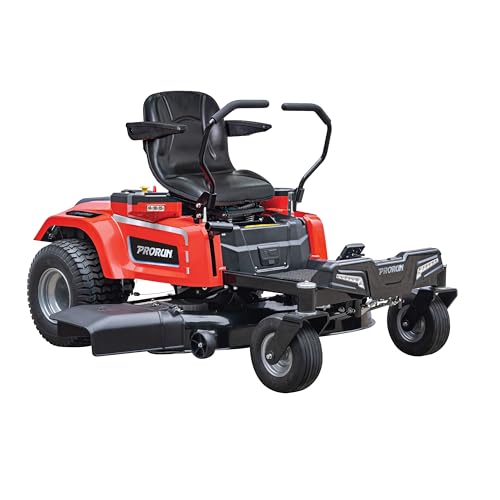
Pros
- High-efficiency brushless motors maximize power output and durability over traditional motors
- Up to 2 acres runtime with three included 10.0 Ah batteries supports substantial mowing sessions
- Zero-emission operation with gas-equivalent 20 HP power for quieter environmentally friendly use
- Six-port auto-switchover battery system provides flexible extended runtime options
- Durable 42-inch steel deck plus included mulch and towing kits add immediate functionality
Cons
- Runtime is limited to approximately 70 minutes or 2 acres which may require recharging for larger properties
- Fully battery-dependent design means performance relies on charge levels and spare battery availability
- 42-inch deck size may require more passes on expansive lawns compared to wider commercial models
The PRORUN PZT60V42 is a fully electric 60V zero-turn riding lawn mower built for residential and light commercial use. Its primary design centers on a robust 42-inch 14-gauge stamped steel twin blade deck powered by direct-drive brushless motors, giving an immediate impression of solid construction and modern battery-focused engineering. The mower arrives complete with three 10.0 Ah batteries, a charger, mulch kit, and towing kit for ready-to-work versatility.
In performance terms, four high-efficiency brushless motors deliver power equivalent to a 20 HP gas engine while producing zero emissions. The system supports up to 2.0 acres or 70 minutes of runtime, and six battery ports with auto switchover intelligently manage all PRORUN 60V battery sizes for continuous operation. A washout port on the steel deck further simplifies post-mow maintenance during real-world sessions.
Potential drawbacks include the finite 70-minute runtime window which can limit coverage on larger properties without spare batteries or recharge breaks. As a fully electric model, it also depends entirely on battery charge levels rather than continuous fuel refills, and the 42-inch deck width may demand extra passes compared with wider traditional options.
Overall the PRORUN PZT60V42 offers strong value for homeowners and small-property managers who want gas-like cutting power without emissions or noise. Those with medium-sized lawns seeking quiet efficient zero-turn performance and included accessories will benefit most from this electric mower.

Pros
- Strong 24HP FR730 engine power for demanding cutting conditions
- Wide 54-inch FAB deck reduces total mowing time
- Zero turn design delivers excellent maneuverability
- Fabricated deck supports durable everyday operation
Cons
- Sparse details beyond engine and deck leave other features unspecified
- Gas-powered FR730 engine needs regular fuel and maintenance
- Large 54-inch deck size may feel oversized on compact properties
The Husqvarna Z254F is a zero turn mower from the established Husqvarna brand in the riding lawn mowers category. It centers on a solid build that pairs a 24HP 726cc FR730 engine with a 54-inch FAB deck for straightforward residential grass care.
Performance stems directly from the listed specifications. The FR730 engine delivers the horsepower needed for steady operation across typical lawns while the wide FAB deck completes passes efficiently. Zero turn handling improves control in real yard layouts based on the model design.
Considerations arise from the limited data available. Secondary elements such as comfort features fuel capacity or extras receive no mention and the gas engine format involves routine upkeep. The large deck suits open areas better than confined spaces.
The Husqvarna Z254F provides the most value for owners of medium or large properties who want reliable engine power and a broad cutting width. Users with smaller lots or those seeking extensive accessory options should weigh the core specs carefully before purchase.
Quick-Reference Lawn Mowing Cost Table by Size

Lawn size is the single biggest driver of price. Professionals typically calculate quotes by square footage, acreage, or estimated time on site. Use this table as your baseline before requesting quotes.
| Lawn Size | Approximate Area | Average Cost per Visit (Pro) | Cost per Sq Ft (Approx.) |
|---|---|---|---|
| Small yard | Under 1,000 sq ft | $30–$45 | $0.03–$0.05 |
| Small-medium yard | 1,000–2,500 sq ft | $45–$55 | $0.02–$0.04 |
| Medium yard | 2,500–5,000 sq ft | $55–$65 | $0.01–$0.03 |
| Large yard | 5,000–10,000 sq ft | $65–$100 | $0.01–$0.02 |
| Quarter-acre lot | ~10,890 sq ft | $80–$110 | $0.007–$0.01 |
| Half-acre lot | ~21,780 sq ft | $100–$140 | $0.005–$0.007 |
| One acre | 43,560 sq ft | $130–$200 | $0.003–$0.005 |
| Two acres or more | 87,120 sq ft+ | $200–$350+ | $0.002–$0.004 |
Sources: Angi and Thumbtack regional pricing data; HomeAdvisor lawn care cost reports. Note that per-square-foot rates fall as lawn size increases — fixed mobilization costs (travel, equipment loading) are spread over more billable area. Readers comparing setup options can review our technical analysis on jbl partybox club 120 vs sony srs xv500.
Key Factors That Raise or Lower Your Mowing Cost
Averages only tell part of the story. Several variables push quotes above or below the baseline ranges above. Readers comparing setup options can review our technical analysis on jbl partybox club 120 vs sony srs xv500.
Grass Height and Overgrown Conditions
Overgrown or first-time mows require slower passes, double-cutting, or double-blade height adjustments. Most lawn care companies charge a first-mow surcharge of $25–$75 on top of the standard rate when grass exceeds 6 inches. Routine maintenance avoids this penalty entirely.
Terrain and Slope
Flat, open lawns take the least time and command the lowest quotes. Hilly or sloped yards slow the mower, increase fuel use, and raise safety considerations — expect a 10–30% price premium for properties with significant grade changes. Tight landscaping, narrow gates, or extensive obstacle navigation (tree roots, play equipment, garden beds) adds similar cost. For complementary field maintenance guidelines, examine our breakdown of z890 vs x870e motherboard.
Included Services: Edging, Blowing, and Bagging
“Mowing” means different things depending on the company. Confirm what is included before accepting a quote:
- Edging along sidewalks and driveways: $5–$15 extra per visit if not bundled
- Blowing clippings off hard surfaces: Usually included in full-service quotes; verify when comparing
- Bagging and hauling grass clippings: $10–$25 extra per visit — most standard services mulch clippings back into the lawn
- Weed whacking around obstacles: Often bundled, but confirm with your provider
Mowing Frequency
One-time or infrequent mows cost more per visit than recurring contracts. Grass that grows unchecked between sporadic visits is harder to cut, justifying the higher rate. Signing a seasonal contract locks in a lower per-visit price (see next section). To evaluate matched hardware tolerances, consult our detailed overview of marshall stanmore iii vs harman kardon onyx studio 8.
Lawn Condition and Obstacles
Dog waste, debris, rocks, and clutter require cleanup or manual removal before mowing, often billed as additional labor. Wet or waterlogged turf may cause rescheduling or surcharging due to equipment risk and lawn damage.
One-Time Mow vs. Recurring Lawn Care Contract: Cost Comparison
Hiring a professional once costs more per visit than committing to a schedule. Companies price recurring work lower because it guarantees steady revenue, reduces sales overhead, and keeps lawns at a manageable height — cutting labor time per session. When planning workspace deployment, consider the engineering criteria outlined in our dyson v8 cyclone vs bissell featherweight stick guide.
| Service Type | Typical Per-Visit Cost (Medium Yard) | Annual Cost Estimate (26 biweekly visits) |
|---|---|---|
| One-time mow | $75–$100 | N/A |
| Weekly contract | $40–$55 | $800–$1,100 (20-week season) |
| Bi-weekly contract | $50–$65 | $500–$650 (10 visits per season) |
| Monthly contract | $60–$80 | $300–$400 (5 visits per season) |
Recurring contract discount vs. one-time rate: 10–20% on average, per Angi lawn care pricing surveys. Some companies offer an additional discount for paying the full season upfront.
First-Time Mow Premium
Most providers charge a one-time setup or assessment fee ($25–$50) on the initial visit, even if you sign a contract. This covers the extra time needed to assess the property and bring an overgrown lawn to a maintainable height. Expect this line item in any legitimate first-visit invoice. For additional operational safety benchmarks, see our published testing notes on bissell crosswave hydrosteam vs shark stainforce.
Annual Mowing Cost Estimate
In a temperate U.S. climate with a 28–32 week mowing season, a medium residential yard on a bi-weekly schedule costs roughly $700–$1,000 per year in professional mowing fees. Year-round climates (Florida, Texas Gulf Coast, Southern California) can push annual costs to $1,200–$1,800 for weekly service across 40–52 weeks.
Lawn Mowing Costs by U.S. Region
Geography affects pricing through three levers: labor market wages, local cost of living, and mowing season length. Regional data from Thumbtack and Angi marketplace reports shows meaningful spread across the country.
| Region | Average Cost per Visit (Medium Yard) | Notes |
|---|---|---|
| Northeast (NY, MA, CT, NJ) | $60–$95 | High labor costs; shorter 20–24 week season |
| Midwest (OH, IN, IL, MI) | $40–$65 | Moderate labor costs; 22–26 week season |
| South (TX, GA, FL, NC) | $35–$60 | High competition; 32–52 week season in southern areas |
| Southwest (AZ, NV, NM) | $35–$65 | Desert landscapes reduce grass area; summer heat limits scheduling |
| Pacific Coast (CA, OR, WA) | $50–$85 | High minimum wages; varies sharply by metro vs. rural |
| Mountain West (CO, UT, ID) | $40–$70 | Shorter season at elevation; growing market competition |
Urban vs. Rural Pricing
Urban and dense suburban markets have higher overhead (fuel, drive time, parking, permit costs) but also higher competition, which moderates prices. Rural areas may see lower base rates but higher per-visit travel surcharges ($10–$25) if your property is outside a company’s standard service zone.
How Season Length Affects Annual Cost
A homeowner in Miami paying $45/visit on a weekly schedule for 50 weeks spends approximately $2,250/year. The same homeowner in Minneapolis paying $55/visit bi-weekly for 22 weeks spends approximately $605/year. Per-visit price and annual cost are separate calculations — always multiply by expected visits when comparing regional quotes.
DIY Lawn Mowing Cost: Equipment, Fuel, and Time Breakdown
DIY mowing eliminates labor cost but carries real expenses in equipment purchase, maintenance, fuel, and your own time. Run this calculation before deciding whether professional service is worth the price.
Equipment Purchase Cost
- Basic push mower (manual reel): $90–$180 upfront; no fuel cost
- Gas push mower: $200–$450 upfront; handles up to ~8,000 sq ft comfortably
- Self-propelled gas mower: $300–$700; suited for 5,000–15,000 sq ft
- Battery-powered push mower: $300–$700; zero fuel cost, higher upfront
- Riding mower / lawn tractor: $1,500–$3,500+; practical for half-acre and above
- Zero-turn mower: $3,000–$8,000+; professional efficiency for one acre and up
Annual Ownership and Maintenance Cost
Per Consumer Reports and manufacturer maintenance guides, annual gas push mower ownership costs break down as follows:
- Fuel: A standard 21-inch gas push mower consumes approximately 0.1–0.2 gallons per hour (per EPA small engine data). A 45-minute mow uses roughly 0.075–0.15 gallons — at $3.50/gallon, that equals $0.26–$0.53 per mow, or $7–$14 per season at 26 mows.
- Blade sharpening: $10–$20 per season (or DIY for ~$5 in supplies)
- Oil change: $5–$15 per season
- Air filter and spark plug: $10–$20 annually
- Equipment depreciation (10-year mower life): $30–$60/year on a $300–$600 mower
Total annual DIY operating cost (gas push mower): approximately $60–$120/year, or $2.30–$4.60 per mow on a 26-mow season — not counting your time.
Time Value Calculation
A 5,000 sq ft lawn takes 30–50 minutes to mow, edge, and blow per session. At 26 sessions per year, that equals 13–22 hours annually. Valued at the U.S. median hourly wage (~$23/hour per BLS data), DIY mowing costs $299–$506/year in time — comparable to or exceeding many professional service contracts for the same yard.
DIY vs. Pro: Break-Even Analysis
| Scenario | Annual DIY Cost (incl. time) | Annual Pro Cost (bi-weekly) | Verdict |
|---|---|---|---|
| Small yard, existing mower | $120–$200 | $390–$500 | DIY saves money |
| Medium yard, new mower purchase | $400–$700 (yr 1) | $650–$800 | Break even ~yr 1–2 |
| Large yard, need riding mower | $800–$1,200 (yr 1) | $900–$1,300 | Pro often competitive |
How to Get an Accurate Lawn Mowing Quote
A vague quote leads to surprise charges. Follow this process to get a number you can trust and compare.
Step 1: Measure Your Lawn Size
Use Google Earth (right-click your property → Measure) or a dedicated tool like the Lawn Love cost estimator to calculate total turf area in square feet. Exclude driveways, beds, patios, and structures. This number is the foundation of every legitimate professional quote.
Step 2: Request At Least Three Quotes
Contact local lawn care companies and national platforms (Angi, Thumbtack, LawnStarter, Lawn Love) for competing bids. Provide your square footage, mowing frequency preference, and any terrain details upfront — this prevents low-ball estimates that escalate after the first visit.
Step 3: Confirm What the Quote Includes
Every quote should explicitly state:
- Mowing (push or riding — relevant for slope and obstacle navigation)
- Edging along driveways, sidewalks, and beds (yes/no)
- Trimming / weed whacking around obstacles (yes/no)
- Blowing clippings from hard surfaces (yes/no)
- Clipping disposal — mulch, bag, or haul (specify)
- First-visit or setup fee (amount)
- Cancellation policy and contract length
Red Flags in Lawn Mowing Quotes
- Quote given without asking lawn size or seeing the property
- Price dramatically below regional averages (often signals unlicensed, uninsured operators)
- No written agreement or itemized service list
- Refusal to provide proof of liability insurance
Tools to Estimate Cost by ZIP Code
Platforms including LawnStarter, Lawn Love, and Angi offer instant online estimates when you enter your address and lawn size. These are useful benchmarks but not binding quotes — follow up with a provider walkthrough for properties with complex terrain or landscaping.
Buyer FAQs: How Much To Mow Lawn Solved
How much does it cost to mow a lawn per square foot?
Professional lawn mowing costs approximately $0.01–$0.05 per square foot, with the rate declining as lawn size increases. Small urban yards under 1,000 sq ft cost closer to $0.04–$0.05/sq ft due to minimum visit charges; properties of one acre or more drop to $0.003–$0.005/sq ft as fixed overhead is spread over larger area.
How much extra does an overgrown lawn cost to mow?
Most lawn care companies add a first-mow or overgrown-lawn surcharge of $25–$75 when grass exceeds 6 inches in height. Some charge a flat rate; others bill 1.5x the standard visit rate. The surcharge covers slower mowing speeds, potential double-cutting, and equipment wear from heavy grass loads.
Is it cheaper to mow your own lawn or hire a service?
For small yards (under 2,500 sq ft) with equipment already owned, DIY is almost always cheaper — operating costs run $2–$5 per mow versus $30–$55 for a professional. For large yards requiring a riding mower purchase, the break-even point is typically 2–3 seasons. Factor in your time: a medium-yard DIY mowing season consumes 13–22 hours annually, which has real opportunity cost at market wage rates.
How much does weekly lawn mowing service cost per month?
A weekly professional mowing service for a medium residential yard (2,500–5,000 sq ft) costs approximately $160–$260 per month (4 visits at $40–$65/visit on a recurring contract). Monthly costs are lower in the South and Midwest and higher in the Northeast and Pacific Coast metro areas. Some companies offer flat monthly billing that smooths seasonal variation.
For more hands-on benchmarks and buying recommendations, consult our guides on residential zero-turn lawn mower guide, as well as heavy-duty chainsaw buyer guide.
Mechanical safety standards, operational tolerances, and protective gear guidelines align with benchmark specifications established by the American National Standards Institute (ANSI).









