

Direct Answer: How to Fix a Lawn Mower That Won’t Start
A lawn mower that won’t start most commonly fails due to stale fuel, a fouled spark plug, a clogged air filter, or a gummed carburetor. Begin with the simplest checks: confirm fresh fuel is present, inspect the spark plug for fouling or wear, replace the air filter if dirty, then clean or rebuild the carburetor if the mower still won’t fire. For electric-start and battery-powered models, check charge level and battery terminals first. Work through causes in order of likelihood before escalating to professional repair.

Pros
- Large-size design named in product title
- Sharpening and balancing functions listed
- Listed as a new upgraded version

Pros
- Adjustable 15-to-45-degree range in title
- Sharpening and balancing functions listed

Pros
- Sharpener and balancer functions in title
- 15-to-45-degree adjustable setting listed
- Built for lawn mower blade maintenance
Pros
- Includes replacement gaskets and a 98079-55846 spark plug
- Matches Honda HRR216 and HRS216 lawn mower models
- Designed around the 16100-Z8B-901 carburetor specification
Cons
- Restricted to select Honda GCV160 mower applications
- Installation requires basic mechanical tools and skills
Why Your Lawn Mower Won’t Start: Most Common Causes at a Glance
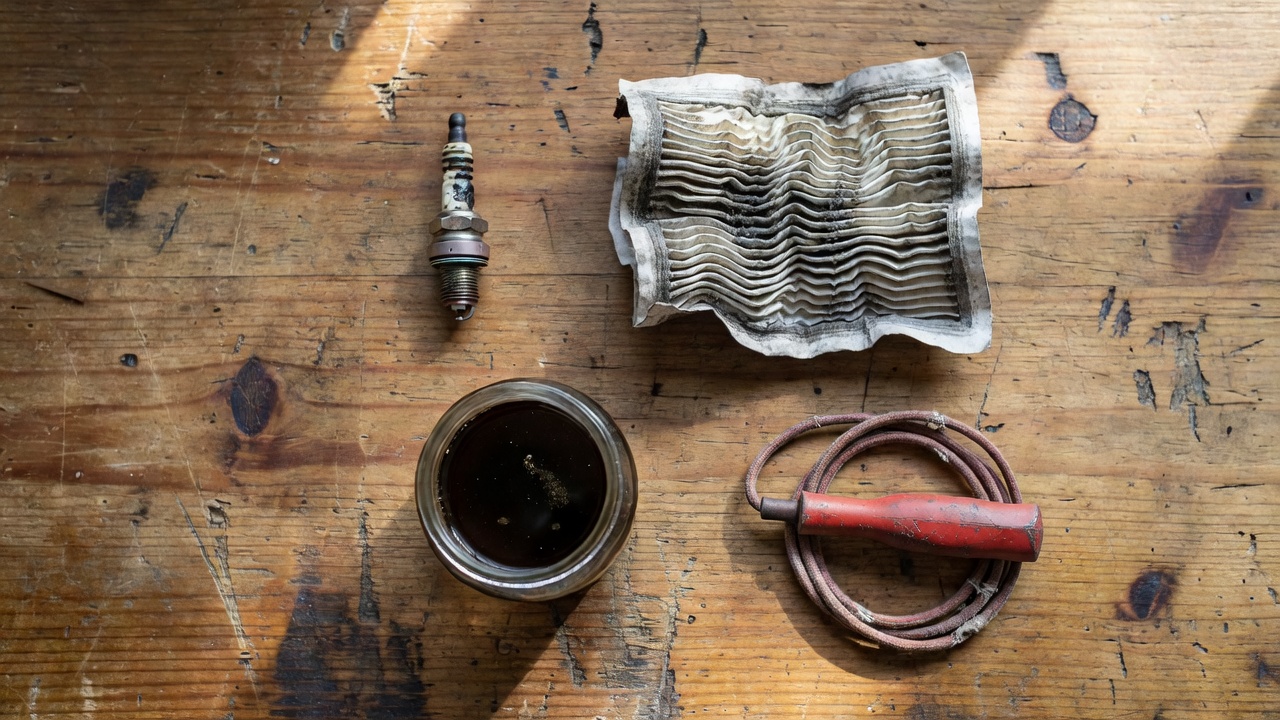
Before diving into step-by-step troubleshooting, here are the most frequent reasons a lawn mower fails to start, ranked by likelihood:
- Stale or old fuel — Ethanol-blend fuels degrade within 30 days in an unsealed tank, causing carburetor varnish deposits
- Fouled or worn spark plug — Carbon buildup, incorrect gap, or electrode wear prevents ignition
- Clogged air filter — Restricts airflow, making the fuel mixture too rich to ignite
- Gummed carburetor — Idle jets and needle valves clog from degraded fuel residue
- Weak or dead battery (electric-start and battery mowers) — Insufficient cranking power
- Safety switch engagement (riding mowers) — Seat, blade, or brake switches prevent starter activation
- Low oil level — Most modern engines include a low-oil sensor that prevents starting when oil is below safe level
- Pull cord or recoil starter failure — Broken spring or rope damage prevents engine cranking
Step 1 — Diagnose Your Symptom: No Crank, Cranks But Won’t Fire, or Starts Then Dies
The phrase “won’t start” covers several distinct failure modes. Identifying your exact symptom determines which troubleshooting path to follow: Before finalizing equipment decisions, refer to our comprehensive jbl partybox club 120 vs sony srs xv500 comparison. For complementary hardware performance, examine our breakdown on our comprehensive riding lawn mower guide.
No Crank (Starter Doesn’t Engage)
If you turn the key or pull the cord and nothing happens—no mechanical movement at all—the issue is electrical or mechanical but not engine-related. Check: Before finalizing equipment decisions, refer to our comprehensive jbl partybox club 120 vs sony srs xv500 comparison.
- Battery charge and terminal connections
- Safety interlock switches (riding mowers)
- Starter motor and solenoid
- Blown fuse
- Low oil shutoff sensor
Cranks But Won’t Fire
If the engine turns over but doesn’t ignite, the problem lies in the ignition, fuel, or air system: For broader ecosystem context, read through our operational guide on z890 vs x870e motherboard. For complementary hardware performance, examine our breakdown on weed eater.
- Fouled or incorrectly gapped spark plug
- Stale fuel or clogged fuel line
- Gummed carburetor not delivering fuel
- Clogged air filter restricting airflow
- Faulty ignition coil or module
Starts Then Dies
An engine that fires briefly then stalls indicates a fuel supply problem:
- Clogged carburetor bowl jet or needle valve
- Vent hole blockage in fuel cap
- Fuel line collapse or obstruction
- Choke not engaging properly for cold start
Gas Lawn Mower Won’t Start: Fuel System Checks
The fuel system is the most common culprit, especially for mowers that have been sitting. Ethanol-blend fuels (E10/E15) degrade and cause carburetor varnish deposits within 30 days in an unsealed tank. If your mower has been dormant for more than a few weeks, start here. For troubleshooting and reliability insights, consult our in-depth marshall stanmore iii vs harman kardon onyx studio 8 report. For complementary hardware performance, examine our breakdown on lawn tractor.
Checking and Replacing Stale Fuel
Old gasoline loses volatility and leaves gum deposits that clog fuel passages. Here’s how to address it: For broader ecosystem context, read through our operational guide on z890 vs x870e motherboard.
- Drain the existing fuel into an approved container (auto parts stores sell fuel-rated containers)
- Add fresh 87+ octane unleaded fuel—avoid ethanol-free if available, as it stores longer
- For storage longer than 30 days, add a fuel stabilizer like Sta-Bil (effective for up to 24 months per manufacturer data)
- If the carburetor is already gummed, proceed to the carburetor cleaning section below
Inspecting the Fuel Line
Cracked, brittle, or collapsed fuel lines prevent fuel flow. Inspect the line from the tank to the carburetor: Readers comparing setup options can review our technical analysis on dyson v8 cyclone vs bissell featherweight stick.
- Look for cracks, hardening, or discoloration
- Squeeze the line—collapsed sections won’t restore shape
- Replace with ethanol-resistant fuel line (typically 1/4″ inner diameter for most push mowers)
- Secure with spring-style fuel clamps to prevent leaks
Primer Bulb and Choke Operation
The primer bulb manually pumps fuel into the carburetor for starting. If it’s cracked or hard, replace it. The choke restricts air intake to enrich the fuel mixture for cold starts:
- Cold start: Move choke to “full” position
- Warm start: Choke should be open or in “partial” position
- If the choke plate is stuck, the engine won’t run once it fires
How to Inspect and Replace a Lawn Mower Spark Plug
The spark plug is responsible for igniting the fuel-air mixture. A fouled, worn, or incorrectly gapped plug is a leading cause of no-start conditions. Briggs & Stratton, Honda GCV, Kohler, and Kawasaki engines all follow similar inspection procedures. For troubleshooting and reliability insights, consult our in-depth marshall stanmore iii vs harman kardon onyx studio 8 report.
Spark Plug Inspection Steps
- Locate the spark plug — Near the top of the engine, with a rubber boot connecting the spark plug wire
- Remove the plug — Use a 13/16″ or 21mm socket, turn counterclockwise
- Read the condition:
| Condition | Appearance | Cause | Fix |
|---|---|---|---|
| Wet and black | Soaked in fuel, black soot | Over-rich fuel mixture (dirty air filter, flooded) | Clean, adjust mixture, replace air filter |
| Dry and black | Dry carbon buildup | Oil entering cylinder or weak ignition | Check valve cover gasket, replace plug |
| White or bladed | Light-colored, glazed | Lean mixture or overheating | Check for air leaks, ensure proper fuel delivery |
| Normal tan | Light brown deposits | Healthy operation | Reinstall with correct gap |
| Burned electrodes | Melting or pitting | Old age, overheating, pre-ignition | Replace immediately |
Correct Spark Plug Gap
Incorrect gap prevents reliable ignition. Check your engine’s specification:
- Briggs & Stratton: Typically 0.030″ (0.76mm)
- Honda GCV: Typically 0.028-0.031″ (0.7-0.8mm)
- General small engines: Usually 0.025-0.035″
Use a wire-type gap tool to set the side electrode. Never bend the center electrode. Readers comparing setup options can review our technical analysis on dyson v8 cyclone vs bissell featherweight stick.
When to Replace
Spark plug replacement interval is typically every 25 hours of operation or annually per engine manufacturer service schedules. Always replace if electrodes are worn, porcelain is cracked, or gap cannot be set correctly.
Checking and Replacing the Air Filter on a Lawn Mower
A clogged air filter restricts airflow, creating a fuel-rich mixture that won’t ignite. This is an often-overlooked cause that’s free and easy to fix. For complementary field maintenance guidelines, examine our breakdown of bissell crosswave hydrosteam vs shark stainforce.
Paper Air Filter
Most modern mowers use paper elements:
- Remove the filter cover (usually held by clips or screws)
- Tap gently to remove loose debris—do not wash paper filters
- Hold to light—if you can’t see through it, replace
- Replacement cost: $5-15 depending on engine model
Foam Air Filter
Older or some premium engines use foam:
- Remove and rinse in solvent
- Squeeze dry—never wring
- Saturate with clean engine oil
- Squeeze out excess oil until just damp
- Reinstall with oil side facing toward the engine
How to Clean a Lawn Mower Carburetor (Without Full Removal)
The carburetor mixes air and fuel for combustion. When varnish from stale fuel coats internal passages, fuel delivery stops. Start with spray cleaner before attempting disassembly.
Method 1: Spray Cleaner (No Removal)
- Locate the carburetor—mounted on top or side of the engine
- Remove the air filter and filter housing
- Spray carburetor cleaner into the carburetor throat while someone else pulls the starter cord
- This can force cleaner past stuck float needles and jets
- Allow 5 minutes to soak, then attempt start
Note: Starter fluid (ether) should be used only as a diagnostic tool, not as routine starting aid, as it can strip cylinder lubrication per small-engine repair authority warnings.
Method 2: Bowl and Jet Cleaning
- Turn fuel valve off (or drain tank)
- Remove the carburetor bowl (usually held by a single screw)
- Remove the float and needle valve assembly
- Spray all passages with carburetor cleaner
- Use compressed air to blow through jets and passages
- Reassemble with new bowl gasket if available
Full Rebuild vs. Replacement
If cleaning doesn’t restore operation, a full rebuild kit ($15-40) or carburetor replacement ($40-150) may be necessary. Professional carburetor cleaning typically costs $75-150 per small-engine repair industry data.
Riding Mower and Zero-Turn Won’t Start: Additional Checks
Riding mowers add electrical complexity and safety systems that push mowers don’t have.
Battery and Terminal Inspection
Riding mowers typically use 12V batteries (look for CCA rating on battery label):
- Check terminal corrosion—white/green buildup prevents conductivity
- Clean terminals with baking soda and water, then coat with terminal protector
- Verify cable connections are tight
- Test battery voltage—at least 12.4V for full charge
Safety Switch Bypass (For Diagnosis Only)
Safety switches prevent operation without an operator in the seat or with blades engaged:
- Seat switch: Usually under the seat
- Blade engagement switch: Must be disengaged (PTO off)
- Parking brake: Must be engaged on some models
To test if a safety switch is faulty, temporarily disconnect the wire harness connector. If the starter engages, the switch needs replacement.
Starter Solenoid and Solenoid
Clicking from the starter area usually indicates a faulty solenoid or low battery:
- Jump the solenoid terminals with a screwdriver (key off, key in “on”)
- If starter engages, solenoid is faulty
- Replace solenoid—typically $20-40
Battery-Powered and Corded Electric Lawn Mower Won’t Start
Electric mowers follow different troubleshooting paths—no fuel system, no spark plug, but battery and electrical systems still apply.
Battery-Powered Mowers
- Verify charge level — Battery indicator should show full charge
- Check battery seating — Remove and reinsert pack, ensure locking mechanism engages
- Inspect battery health — Capacity degrades over time (typically 3-5 year lifespan)
- Reset thermal cutoff — Some batteries have a reset button if overheated
- Check safety key — Most cordless mowers require the key inserted to operate
Corded Electric Mowers
- Verify outlet has power (test with another device)
- Inspect cord for damage—kinking, cuts, or exposed wires
- Check cord connection to mower body
- Test reset button on the cord or mower body
- Use a heavy-duty extension cord rated for the mower’s amperage draw
Oil Level and Engine Lockout: The Overlooked Starting Blocker
Most modern Briggs & Stratton, Honda, and Kohler engines include a low-oil sensor that prevents starting when oil is below the safe level. Many homeowners never connect low oil to a no-start condition.
How to Check Oil
- Set mower on level ground
- Locate oil dipstick (usually near the top, marked with “oil” or an oilcan icon)
- Remove, wipe clean, reinsert, then remove again to read level
- Oil should be between “add” and “full” marks
Oil Type
Most small engines use SAE 30 above 40°F or 10W-30 for varying temperatures. Check your owner’s manual—using wrong viscosity can trigger low-oil sensors on some models.
Faulty Oil Sensor
If oil level is correct but the sensor triggers, the sensor may be faulty. Some models allow bypassing the sensor temporarily for testing, but replace the sensor before regular use.
Pull Cord and Recoil Starter Problems
If the engine physically won’t turn over, the problem may be mechanical rather than fuel or ignition.
Hydrolocked Engine
Excess oil in the cylinder prevents the piston from completing its stroke. Signs:
- Pull cord is extremely hard to pull or won’t move at all
- Recently overfilled oil or mower was tipped over
Fix: Remove spark plug, pull cord several times to expel oil, reinstall plug and check oil level.
Broken Recoil Spring
If the pull cord won’t retract, the spring has likely broken or dislodged:
- Remove recoil starter cover
- Inspect spring for breaks or dislodged ends
- Replacement recoil assemblies cost $15-30
- Spring tension is critical—note orientation before disassembly
Lawn Mower Won’t Start After Winter: First-Start-of-Season Checklist
Spring start-up failures are the most common complaint. Proper storage prevents most issues.
Annual Tune-Up Components
- Fresh fuel — Drain old fuel or add stabilizer before storage
- New spark plug — Annual replacement prevents starting failures
- Clean air filter — Paper filters are inexpensive to replace annually
- Fresh oil — Oil degrades over storage; change before first use
- Clean under deck — Grass buildup under the deck can hide blade damage
Ethanol Fuel Damage
Ethanol-blend fuels absorb moisture and separate, causing:
- Phase separation in tanks over time
- Corrosion in fuel system components
- Carburetor jet clogging
Prevention: Use fuel stabilizer, run engine to warm fuel system before storage, or use ethanol-free fuel if available.
When to Stop DIY and Take the Mower to a Repair Shop
Know when a problem exceeds safe DIY scope:
- Seized engine — If pull cord won’t move after checking for hydrolock, the engine may be seized
- Bent crankshaft — Usually requires engine replacement or full rebuild
- Cracked engine block — Not repairable; replacement engine or mower needed
- Persistent no-start after all above steps — Electrical diagnosis requires multimeter and expertise
Professional repair costs vary: basic tune-up $75-150, carburetor repair $75-150, engine rebuild $300-600, engine replacement $250-500 plus labor.
Frequently Asked Questions About How To Fix A Lawn Mower That Won’t Start
Can old gas stop a lawn mower from starting?
Yes. Ethanol-blend fuels degrade within 30 days in unsealed tanks and leave varnish deposits in carburetors. Always use fresh fuel or add stabilizer before storage periods longer than 30 days.
How do I know if my lawn mower spark plug is bad?
Remove the plug and inspect: black soot (wet or dry) indicates fouling, white/bladed appearance suggests overheating or lean mixture, and burned or pitted electrodes require replacement. Always check and set the correct gap before reinstalling.
What choke position do I use to start a cold lawn mower?
For cold starts, set the choke to “full” or “closed” position. This restricts airflow and enriches the fuel mixture. Once the engine starts and warms for 10-15 seconds, move the choke to “open” or “run” position.
Why won’t my battery lawn mower start even with a charged battery?
Check that the safety key is inserted fully, the battery pack is properly seated and locked, and the thermal cutoff hasn’t triggered (allow battery to cool if recently used). If battery health is degraded after 3-5 years, replacement may be needed.
For more hands-on benchmarks and buying recommendations, consult our guides on heavy-duty chainsaw buyer guide, as well as high-CFM commercial leaf blower guide.
Mechanical safety standards, operational tolerances, and protective gear guidelines align with benchmark specifications established by the American National Standards Institute (ANSI).









