

Quick Answer: What Is A Recycler Lawn Mower?
A recycler lawn mower is a specialized grass-cutting machine designed to cut grass clippings into fine particles and deposit them back onto the lawn as natural fertilizer, eliminating the need for bagging or side-discharge. Unlike traditional mowers that collect clippings in a bag or scatter them to the side, recycler mowers continuously chop grass into tiny pieces and redistribute them…

Pros
- Powerful 80V brushless motor delivers 32HP gas-equivalent performance with quiet fume-free operation and no engine maintenance.
- Complete kit includes four 6.0Ah batteries and 600W charger for substantial runtime up to 1.5 acres.
- SmartCut technology and 42-inch heavy-duty steel deck ensure consistent cuts without bogging in tough conditions.
- Versatile towing up to 350 lbs and optional cargo hauling plus comfort features like high-back seat and LED lights.
- Strong 4-year limited warranty and full compatibility with the Greenworks 80V tool ecosystem.
Cons
- Rear utility cargo bed for 200 lb hauling is sold separately and not included in the kit.
- Runtime of up to 1.5 acres varies with conditions and may require recharging or battery swaps on larger properties.
- As a fully cordless model continuous operation depends on battery levels unlike gas engines with unlimited runtime.
The Greenworks 80V 42" CrossoverT Cordless Riding Lawn Tractor is a ready-to-mow zero-emission tractor designed for homeowners managing medium to large lawns. It features a reinforced 42-inch stamped steel deck of 12-gauge construction along with premium comfort elements such as a high-back padded seat with foldable armrests. The overall build emphasizes durability and user convenience right out of the box with the included battery and charger set.
Performance centers on the 80V TruBrushless motor that provides 32HP gas-equivalent power with instant torque and quiet fume-free operation. SmartCut technology senses grass conditions and automatically adjusts power to maintain a consistent cut even in tall thick or wet areas. The four 6.0Ah batteries support runtime for up to 1.5 acres depending on conditions while dual LED headlights and a 7-position deck height range from 1.5" to 4.5" add practicality. Front and rear attachments further allow towing up to 350 lbs for added yard utility.
Key considerations include that the rear utility storage bin capable of hauling 200 lbs is sold separately so full cargo functionality requires an extra purchase. Runtime remains condition-dependent and may fall short for properties significantly larger than 1.5 acres without using the 600W charger or swapping batteries. The cordless design prioritizes ease and low maintenance but trades off the continuous runtime of traditional gas models.
This tractor delivers strong value for eco-conscious owners of residential properties who want gas-like power without the emissions noise or upkeep. It suits those who already use or plan to expand into the Greenworks 80V family of tools and who appreciate the 4-year limited warranty. Users with exceptionally large or commercial-scale lawns should evaluate battery logistics carefully before purchase.

Pros
- Delivers strong 21 horsepower equivalent power comparable to gas riding mowers.
- Provides up to 1.5 acres of runtime on a full charge with the six included batteries.
- Features low-maintenance dual brushless motors without belts for greater durability.
- Offers versatile 12-position cutting height adjustment from 1.5 to 4.5 inches.
- Includes digital controls for blade settings, drive speeds, and cruise control.
Cons
- Limited to 1.5 acres of cutting per charge without purchasing additional batteries for bigger lawns.
- Requires recharging time for the six 56V batteries after each use session.
- Relies solely on battery power with no hybrid or gas backup option for extended operation.
The EGO Power+ TR4204 is a cordless electric riding lawn mower built as a modern tractor alternative for residential use. It features a robust 42-inch stamped steel deck and arrives ready to go with six 56V 6.0Ah batteries plus a charger, creating an immediate impression of convenience and solid construction free from gas engine complexity.
Performance shines through its equivalent 21 horsepower output and top speed of 6 MPH, allowing efficient coverage of up to 1.5 acres on a single charge. Dual brushless cutting motors operate without belts for added durability and less upkeep, while the digital display lets users select three blade settings, three drive speeds, and cruise control. The 12 adjustable heights ranging from 1.5 to 4.5 inches combined with anti-scalp wheels deliver precise results across varied terrain.
Drawbacks center on battery dependency, as larger properties beyond 1.5 acres require extra batteries and recharging intervals can interrupt workflow. The fully electric design eliminates fuel storage needs but demands access to power sources between sessions.
This mower suits homeowners with medium to large yards who value quiet, emission-free operation and reduced maintenance. Those seeking expandable battery capacity for bigger areas will find the EGO Power+ TR4204 a strong long-term investment in cordless lawn care.
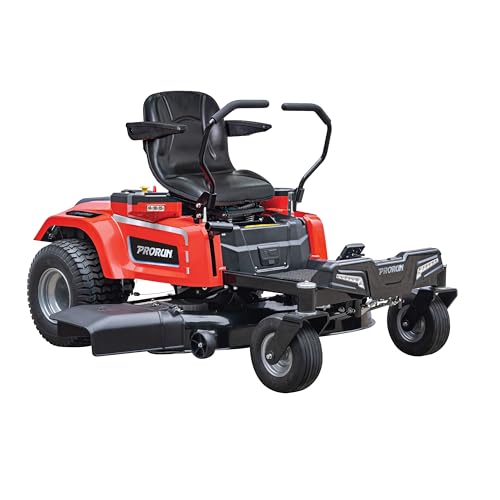
Pros
- High-efficiency brushless motors maximize power output and durability over traditional motors
- Up to 2 acres runtime with three included 10.0 Ah batteries supports substantial mowing sessions
- Zero-emission operation with gas-equivalent 20 HP power for quieter environmentally friendly use
- Six-port auto-switchover battery system provides flexible extended runtime options
- Durable 42-inch steel deck plus included mulch and towing kits add immediate functionality
Cons
- Runtime is limited to approximately 70 minutes or 2 acres which may require recharging for larger properties
- Fully battery-dependent design means performance relies on charge levels and spare battery availability
- 42-inch deck size may require more passes on expansive lawns compared to wider commercial models
The PRORUN PZT60V42 is a fully electric 60V zero-turn riding lawn mower built for residential and light commercial use. Its primary design centers on a robust 42-inch 14-gauge stamped steel twin blade deck powered by direct-drive brushless motors, giving an immediate impression of solid construction and modern battery-focused engineering. The mower arrives complete with three 10.0 Ah batteries, a charger, mulch kit, and towing kit for ready-to-work versatility.
In performance terms, four high-efficiency brushless motors deliver power equivalent to a 20 HP gas engine while producing zero emissions. The system supports up to 2.0 acres or 70 minutes of runtime, and six battery ports with auto switchover intelligently manage all PRORUN 60V battery sizes for continuous operation. A washout port on the steel deck further simplifies post-mow maintenance during real-world sessions.
Potential drawbacks include the finite 70-minute runtime window which can limit coverage on larger properties without spare batteries or recharge breaks. As a fully electric model, it also depends entirely on battery charge levels rather than continuous fuel refills, and the 42-inch deck width may demand extra passes compared with wider traditional options.
Overall the PRORUN PZT60V42 offers strong value for homeowners and small-property managers who want gas-like cutting power without emissions or noise. Those with medium-sized lawns seeking quiet efficient zero-turn performance and included accessories will benefit most from this electric mower.

Pros
- Strong 24HP FR730 engine power for demanding cutting conditions
- Wide 54-inch FAB deck reduces total mowing time
- Zero turn design delivers excellent maneuverability
- Fabricated deck supports durable everyday operation
Cons
- Sparse details beyond engine and deck leave other features unspecified
- Gas-powered FR730 engine needs regular fuel and maintenance
- Large 54-inch deck size may feel oversized on compact properties
The Husqvarna Z254F is a zero turn mower from the established Husqvarna brand in the riding lawn mowers category. It centers on a solid build that pairs a 24HP 726cc FR730 engine with a 54-inch FAB deck for straightforward residential grass care.
Performance stems directly from the listed specifications. The FR730 engine delivers the horsepower needed for steady operation across typical lawns while the wide FAB deck completes passes efficiently. Zero turn handling improves control in real yard layouts based on the model design.
Considerations arise from the limited data available. Secondary elements such as comfort features fuel capacity or extras receive no mention and the gas engine format involves routine upkeep. The large deck suits open areas better than confined spaces.
The Husqvarna Z254F provides the most value for owners of medium or large properties who want reliable engine power and a broad cutting width. Users with smaller lots or those seeking extensive accessory options should weigh the core specs carefully before purchase.
The term “recycler” is most commonly associated with Toro, which pioneered and trademarked the technology. However, the underlying concept—commonly called mulching—is used by many manufacturers under various brand names. Whether you encounter the term “recycler,” “mulching mower,” or “recycling deck,” these all refer to machines that transform grass clippings into a natural lawn treatment rather than disposing of them.
This article explores how recycler lawn mowers work, their benefits compared to standard mowers, and how to determine whether this technology suits your lawn care needs.
How Does a Recycler Lawn Mower Work?
The Cut-and-Drop Mulching Process
Recycler mowers employ a specialized cut-and-drop process that fundamentally differs from conventional mowing. The key lies in three interconnected design elements: blade configuration, deck architecture, and airflow management. To compare alternative configurations, check our hands-on review of jbl partybox club 120 vs sony srs xv500.
Specialized Blade Design: Unlike standard mowers that use a single flat blade, recycler mowers typically feature multiple cutting edges or specially curved blades that create a finer cut. These blades generate lift and suction, pulling grass blades upright before cutting them. The multiple cutting passes within the deck chamber reduce each clipping into progressively smaller pieces before releasing them downward. To compare alternative configurations, check our hands-on review of jbl partybox club 120 vs sony srs xv500.
Enclosed Deck Architecture: Recycler mower decks are designed with deeper chambers and curved undersides that keep grass clippings suspended longer inside the cutting area. This extended residence time allows the blades to make multiple cuts on each grass blade, producing finer mulch compared to single-pass cutting.
Optimized Airflow: The deck design creates a recirculating airflow pattern that: Users looking for related component recommendations can explore our z890 vs x870e motherboard breakdown.
- Lifts grass blades to uniform cutting height
- Circulates clippings for multiple cutting cycles
- Directs finished mulch downward through the grass canopy
- Prevents clumping or discharge buildup
Dedicated vs. Convertible Recycler Decks
Understanding the distinction between dedicated recycler decks and convertible deck options helps clarify your purchasing decisions.
Dedicated Recycler Decks: These mowers are engineered exclusively for recycling and mulching functions. The entire machine—engine power, blade design, deck construction, and airflow management—is optimized for producing fine clippings and redistributing them immediately. Dedicated recycler mowers typically deliver superior mulching performance but sacrifice bagging and side-discharge capabilities. Before finalizing equipment decisions, refer to our comprehensive marshall stanmore iii vs harman kardon onyx studio 8 comparison.
Convertible Deck Options: Many modern mowers offer switchable modes that allow operators to convert between bagging, side-discharge, and recycling modes. These versatile decks typically include:
- A removable bagger attachment
- A discharge chute that can be opened or closed
- A mulch plug that redirects airflow for recycling mode
While convertible options provide flexibility, dedicated recycler decks often achieve finer mulch particles due to their specialized engineering. If maximum mulching performance is your priority, a dedicated recycler deck may outperform convertible alternatives. For broader ecosystem context, read through our operational guide on dyson v8 cyclone vs bissell featherweight stick.
Benefits of Using a Recycler Lawn Mower
Natural Fertilization and Lawn Health
Perhaps the most significant advantage of recycler mowers is their ability to transform lawn maintenance into lawn enhancement. When grass clippings decompose on your lawn, they release essential nutrients back into the soil, creating a natural fertilizer cycle that supports healthy turf growth.
Nutrient Return: Grass clippings contain significant nitrogen content—approximately 4% nitrogen by weight—along with phosphorus, potassium, and trace minerals essential for lawn health. Studies from university extension services indicate that fine grass clippings can provide up to 25% of your lawn’s annual nitrogen requirements when consistently recycled. For troubleshooting and reliability insights, consult our in-depth bissell crosswave hydrosteam vs shark stainforce report.
Moisture Retention: Fine mulch clippings act as a natural mulch layer, helping soil retain moisture during hot summer months. This moisture regulation reduces water requirements and helps grass withstand drought conditions more effectively.
Soil Improvement: As clippings decompose, they add organic matter to the soil, improving soil structure, drainage, and microbial activity. Healthier soil supports stronger root systems and more resilient turfgrass.
Time and Effort Savings
Beyond environmental benefits, recycler mowers offer substantial practical advantages for homeowners:
Eliminated Bagging: Without the need to empty grass bags, you save significant time during each mowing session. There’s no stopping to swap full bags, no heavy lifting of clippings, and no trips to dispose of yard waste.
No Side-Discharge Cleanup: Recycler mowers eliminate the scattered grass clumps left by side-discharge mowers, requiring no additional raking or cleanup after mowing.
Continuous Mowing: Without interruptions for bag changes or discharge management, you can complete mowing sessions more quickly. Property owners typically report saving 15-30 minutes per mowing session compared to bagging methods, depending on lawn size.
Environmental Considerations
Choosing a recycler mower supports environmental sustainability in several ways:
- Reduced Landfill Waste: Grass clippings represent approximately 20% of residential yard waste entering landfills. Recycling clippings on-site eliminates this contribution to landfill volume.
- Lower Transportation Emissions: Without bagged clippings requiring disposal trips, you reduce vehicle emissions associated with yard waste transport.
- Chemical Fertilizer Reduction: Natural nutrient recycling may decrease reliance on synthetic fertilizers, reducing chemical runoff into waterways.
Recycler vs. Traditional Mowing Methods
Comparison with Bagging Mowers
Bagging mowers collect clippings in a rear bag or side-mounted container. While bagging produces a pristine cut appearance and removes clippings entirely, it comes with notable drawbacks:
| Factor | Recycler Mowers | Bagging Mowers |
|---|---|---|
| Post-Mowing Cleanup | None required | Raking may still be needed |
| Nutrient Return | Yes, natural fertilization | No, nutrients removed |
| Bag Emptying | Not applicable | Required multiple times per session |
| Disposal Responsibility | None | Bagged waste must be disposed |
| Cost Over Time | No disposal costs | Potential yard waste fees |
Comparison with Side-Discharge Mowers
Side-discharge mowers eject clippings sideways through an open chute. While efficient for large areas, side-discharge presents its own limitations:
- Clippings scatter across pathways, driveways, and landscaping beds
- Wind can carry discharge into unwanted areas
- Clumps may smother grass if not promptly redistributed
- Less effective nutrient retention since larger particles decompose slowly
Recycler mowers address these issues by confining clippings within the deck until they’re reduced to fine particles that filter through the grass canopy without clumping.
When a Recycler Mower Might Not Be Ideal
Despite their advantages, recycler mowers aren’t universally optimal. Consider these scenarios where alternative approaches may be preferable:
Very Long Grass: If grass has grown excessively tall (beyond one-third of desired height), recycler mowers may struggle to process the volume effectively. Traditional cutting followed by gradual height reduction works better for overgrown lawns.
Wet Conditions: Moist clippings tend to clump and resist the fine chopping process. Recycler mowers perform best during dry weather when grass is easier to cut and mulch.
Initial Spring Cleanup: After winter dormancy, lawns often accumulate debris, thatch, and accumulated organic matter. Some homeowners prefer bagging during the first few spring mows to remove this accumulation before transitioning to recycling.
Debris-Heavy Yards: Properties with significant fallen leaves, twigs, or other debris may benefit from bagging to remove these materials rather than attempting to mulch them into the lawn.
Choosing the Right Recycler Lawn Mower
Key Features to Evaluate
When selecting a recycler mower, consider these essential features:
Engine Power: Recycler decks require more engine power than standard cutting due to the additional chopping cycles. Look for adequate horsepower (typically 5-7 HP for residential walk-behind models) to maintain cutting performance without bogging down in dense grass.
Blade Quality: High-quality mulching blades with multiple cutting surfaces or curved profiles significantly impact mulch fineness. Some models include blade kits specifically optimized for recycling performance.
Deck Material: Steel decks offer durability and cost-effectiveness, while polypropylene decks provide rust resistance and lighter weight. Both can perform well for recycling when properly designed.
Cutting Width: Match deck width to your lawn size. Larger decks (21-22 inches for push mowers) cover more ground efficiently for medium-to-large lawns, while smaller widths offer maneuverability for complex landscapes.
Height Adjustment: Look for easy-to-adjust cutting height settings, ideally with a single-lever operation. Consistent cutting height helps maintain lawn health and optimizes recycling performance.
Dedicated vs. Convertible Decision Guide
Ask yourself these questions to determine which mower type best suits your needs:
- How often do you currently bag clippings? If rarely, a dedicated recycler maximizes performance. If frequently, convertible options preserve flexibility.
- Do you have diverse lawn care needs? Properties with mixed grass types, shade areas, and varying conditions benefit from convertible flexibility.
- Is mulch quality your top priority? Dedicated recycler decks typically produce finer particles than convertible modes.
- Do you frequently collect clippings for composting? If so, convertible decks that enable bagging serve dual purposes effectively.
Maintenance Tips for Recycler Mowers
Proper maintenance ensures optimal recycler mower performance and longevity:
Blade Sharpening: Sharp blades are essential for clean cuts and effective mulching. Dull blades tear grass rather than cutting it cleanly, resulting in ragged edges and poor recycling performance. Sharpen or replace blades at least annually, or more frequently with heavy use.
Regular Cleaning: Clean the underside of the deck after each few mowing sessions to prevent grass buildup. Accumulated clippings restrict airflow and reduce recycling efficiency. Many owners find that hosing the deck immediately after mowing, while residue is still fresh, works best.
Air Filter Maintenance: Recycler mowers often work harder than standard mowers due to increased resistance in enclosed decks. Maintain clean air filters to ensure adequate engine performance and longevity.
Oil Changes: Follow manufacturer recommendations for oil change intervals. Under heavy mulching workloads, some operators prefer more frequent changes to maintain engine protection.
Seasonal Storage: Before winter storage, thoroughly clean the mower, stabilize fuel, and consider removing the blade for inspection and sharpening before the next season.
Everything You Need to Know: Recycler Lawn Mower FAQ
Is “recycler” a specific brand, or can any mower recycle grass?
The term “recycler” is most commonly associated with Toro, which trademarked and popularized the technology. However, any mower designed with mulching capability can recycle grass clippings. Many manufacturers produce similar mowers under different names such as “mulching mower,” “recycling mower,” or “3-in-1 mower” that offers bagging, side-discharge, and recycling modes. The core technology—multiple cutting passes that reduce clippings to fine particles—can be found across multiple brands.
Do recycler mowers leave visible clippings on the lawn?
When properly maintained and operated correctly, recycler mowers produce clippings so fine that they’re virtually invisible on the lawn surface. These tiny particles filter through the grass canopy and decompose rapidly, typically within 24-48 hours. Visible clippings usually indicate either excessively long grass that needs multiple passes, dull blades that can’t cut cleanly, or wet conditions that prevent proper chopping. Regular mowing on appropriate schedules prevents visible residue accumulation.
Can I convert my existing mower to a recycler?
Many standard mowers can be converted to recycling capability with aftermarket mulch plugs and specialized blades. A mulch plug blocks the discharge chute to force clippings back into the cutting chamber for additional chopping cycles. Mulching blades feature curved profiles that generate the lift and recirculation needed for effective recycling. However, standard mower decks aren’t optimized for mulching, so performance may not match dedicated recycler designs. Convertible factory setups typically outperform aftermarket conversions.
How often should I mow to get the best results from a recycler mower?
For optimal recycler mower performance, mow frequently enough that you never remove more than one-third of the grass blade height at any single cutting. During peak growing seasons, this typically means mowing every 4-7 days. Frequent mowing produces shorter grass clippings that decompose quickly and provide maximum nutrient benefit. Waiting too long between cuts results in longer clippings that may not mulch as finely and can create temporary visibility on the lawn surface.
Conclusion
A recycler lawn mower offers an efficient, environmentally responsible approach to lawn maintenance that transforms ordinary grass clippings into natural fertilizer. By understanding the specialized cut-and-drop mechanism, evaluating the differences between dedicated and convertible designs, and following proper maintenance practices, you can determine whether this technology aligns with your lawn care goals.
The decision ultimately depends on your specific circumstances—lawn size, grass types, climate conditions, and personal preferences for yard work management. For many homeowners, the combination of time savings, natural fertilization benefits, and reduced environmental impact makes recycler mowers an excellent choice for maintaining healthy, attractive lawns with less effort.
For more detailed testing breakdowns and top recommendations, check our in-depth guide to residential zero-turn lawn mower guide.
For more hands-on benchmarks and buying recommendations, consult our guides on heavy-duty chainsaw buyer guide, as well as high-CFM commercial leaf blower guide, as well as automated robotic lawn mower guide.
Mechanical safety standards, operational tolerances, and protective gear guidelines align with benchmark specifications established by the American National Standards Institute (ANSI).









