

The Short Answer: It Depends on the Mower
Can a lawn mower be 2-stroke? Yes, it can. However, it is not the standard for modern machines. The vast majority of lawn mowers you’ll find today, from the walk-behind models in suburban garages to the large riding mowers used on estates, operate on 4-stroke engines.

Pros
- Powerful 80V brushless motor delivers 32HP gas-equivalent performance with quiet fume-free operation and no engine maintenance.
- Complete kit includes four 6.0Ah batteries and 600W charger for substantial runtime up to 1.5 acres.
- SmartCut technology and 42-inch heavy-duty steel deck ensure consistent cuts without bogging in tough conditions.
- Versatile towing up to 350 lbs and optional cargo hauling plus comfort features like high-back seat and LED lights.
- Strong 4-year limited warranty and full compatibility with the Greenworks 80V tool ecosystem.
Cons
- Rear utility cargo bed for 200 lb hauling is sold separately and not included in the kit.
- Runtime of up to 1.5 acres varies with conditions and may require recharging or battery swaps on larger properties.
- As a fully cordless model continuous operation depends on battery levels unlike gas engines with unlimited runtime.
The Greenworks 80V 42" CrossoverT Cordless Riding Lawn Tractor is a ready-to-mow zero-emission tractor designed for homeowners managing medium to large lawns. It features a reinforced 42-inch stamped steel deck of 12-gauge construction along with premium comfort elements such as a high-back padded seat with foldable armrests. The overall build emphasizes durability and user convenience right out of the box with the included battery and charger set.
Performance centers on the 80V TruBrushless motor that provides 32HP gas-equivalent power with instant torque and quiet fume-free operation. SmartCut technology senses grass conditions and automatically adjusts power to maintain a consistent cut even in tall thick or wet areas. The four 6.0Ah batteries support runtime for up to 1.5 acres depending on conditions while dual LED headlights and a 7-position deck height range from 1.5" to 4.5" add practicality. Front and rear attachments further allow towing up to 350 lbs for added yard utility.
Key considerations include that the rear utility storage bin capable of hauling 200 lbs is sold separately so full cargo functionality requires an extra purchase. Runtime remains condition-dependent and may fall short for properties significantly larger than 1.5 acres without using the 600W charger or swapping batteries. The cordless design prioritizes ease and low maintenance but trades off the continuous runtime of traditional gas models.
This tractor delivers strong value for eco-conscious owners of residential properties who want gas-like power without the emissions noise or upkeep. It suits those who already use or plan to expand into the Greenworks 80V family of tools and who appreciate the 4-year limited warranty. Users with exceptionally large or commercial-scale lawns should evaluate battery logistics carefully before purchase.

Pros
- Delivers strong 21 horsepower equivalent power comparable to gas riding mowers.
- Provides up to 1.5 acres of runtime on a full charge with the six included batteries.
- Features low-maintenance dual brushless motors without belts for greater durability.
- Offers versatile 12-position cutting height adjustment from 1.5 to 4.5 inches.
- Includes digital controls for blade settings, drive speeds, and cruise control.
Cons
- Limited to 1.5 acres of cutting per charge without purchasing additional batteries for bigger lawns.
- Requires recharging time for the six 56V batteries after each use session.
- Relies solely on battery power with no hybrid or gas backup option for extended operation.
The EGO Power+ TR4204 is a cordless electric riding lawn mower built as a modern tractor alternative for residential use. It features a robust 42-inch stamped steel deck and arrives ready to go with six 56V 6.0Ah batteries plus a charger, creating an immediate impression of convenience and solid construction free from gas engine complexity.
Performance shines through its equivalent 21 horsepower output and top speed of 6 MPH, allowing efficient coverage of up to 1.5 acres on a single charge. Dual brushless cutting motors operate without belts for added durability and less upkeep, while the digital display lets users select three blade settings, three drive speeds, and cruise control. The 12 adjustable heights ranging from 1.5 to 4.5 inches combined with anti-scalp wheels deliver precise results across varied terrain.
Drawbacks center on battery dependency, as larger properties beyond 1.5 acres require extra batteries and recharging intervals can interrupt workflow. The fully electric design eliminates fuel storage needs but demands access to power sources between sessions.
This mower suits homeowners with medium to large yards who value quiet, emission-free operation and reduced maintenance. Those seeking expandable battery capacity for bigger areas will find the EGO Power+ TR4204 a strong long-term investment in cordless lawn care.
Pros
- High-efficiency brushless motors maximize power output and durability over traditional motors
- Up to 2 acres runtime with three included 10.0 Ah batteries supports substantial mowing sessions
- Zero-emission operation with gas-equivalent 20 HP power for quieter environmentally friendly use
- Six-port auto-switchover battery system provides flexible extended runtime options
- Durable 42-inch steel deck plus included mulch and towing kits add immediate functionality
Cons
- Runtime is limited to approximately 70 minutes or 2 acres which may require recharging for larger properties
- Fully battery-dependent design means performance relies on charge levels and spare battery availability
- 42-inch deck size may require more passes on expansive lawns compared to wider commercial models
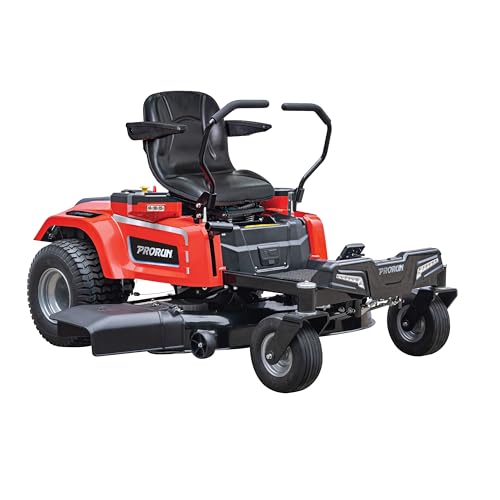
The PRORUN PZT60V42 is a fully electric 60V zero-turn riding lawn mower built for residential and light commercial use. Its primary design centers on a robust 42-inch 14-gauge stamped steel twin blade deck powered by direct-drive brushless motors, giving an immediate impression of solid construction and modern battery-focused engineering. The mower arrives complete with three 10.0 Ah batteries, a charger, mulch kit, and towing kit for ready-to-work versatility.
In performance terms, four high-efficiency brushless motors deliver power equivalent to a 20 HP gas engine while producing zero emissions. The system supports up to 2.0 acres or 70 minutes of runtime, and six battery ports with auto switchover intelligently manage all PRORUN 60V battery sizes for continuous operation. A washout port on the steel deck further simplifies post-mow maintenance during real-world sessions.
Potential drawbacks include the finite 70-minute runtime window which can limit coverage on larger properties without spare batteries or recharge breaks. As a fully electric model, it also depends entirely on battery charge levels rather than continuous fuel refills, and the 42-inch deck width may demand extra passes compared with wider traditional options.
Overall the PRORUN PZT60V42 offers strong value for homeowners and small-property managers who want gas-like cutting power without emissions or noise. Those with medium-sized lawns seeking quiet efficient zero-turn performance and included accessories will benefit most from this electric mower.

Pros
- Strong 24HP FR730 engine power for demanding cutting conditions
- Wide 54-inch FAB deck reduces total mowing time
- Zero turn design delivers excellent maneuverability
- Fabricated deck supports durable everyday operation
Cons
- Sparse details beyond engine and deck leave other features unspecified
- Gas-powered FR730 engine needs regular fuel and maintenance
- Large 54-inch deck size may feel oversized on compact properties
The Husqvarna Z254F is a zero turn mower from the established Husqvarna brand in the riding lawn mowers category. It centers on a solid build that pairs a 24HP 726cc FR730 engine with a 54-inch FAB deck for straightforward residential grass care.
Performance stems directly from the listed specifications. The FR730 engine delivers the horsepower needed for steady operation across typical lawns while the wide FAB deck completes passes efficiently. Zero turn handling improves control in real yard layouts based on the model design.
Considerations arise from the limited data available. Secondary elements such as comfort features fuel capacity or extras receive no mention and the gas engine format involves routine upkeep. The large deck suits open areas better than confined spaces.
The Husqvarna Z254F provides the most value for owners of medium or large properties who want reliable engine power and a broad cutting width. Users with smaller lots or those seeking extensive accessory options should weigh the core specs carefully before purchase.
The confusion often arises because 2-stroke engines are very common in other types of outdoor power equipment. If you have a string trimmer (also called a weed eater or weed whacker), a leaf blower, or a chainsaw, there’s a good chance it uses a 2-stroke engine. People sometimes mentally group all this equipment together as “lawn mowers,” but the mower itself is typically a different beast.
So, while you might encounter a 2-stroke lawn mower, especially if you’re looking at older models or very specific specialty types, it’s the exception rather than the rule in today’s market.
2-Stroke vs. 4-Stroke Engines: The Basic Difference
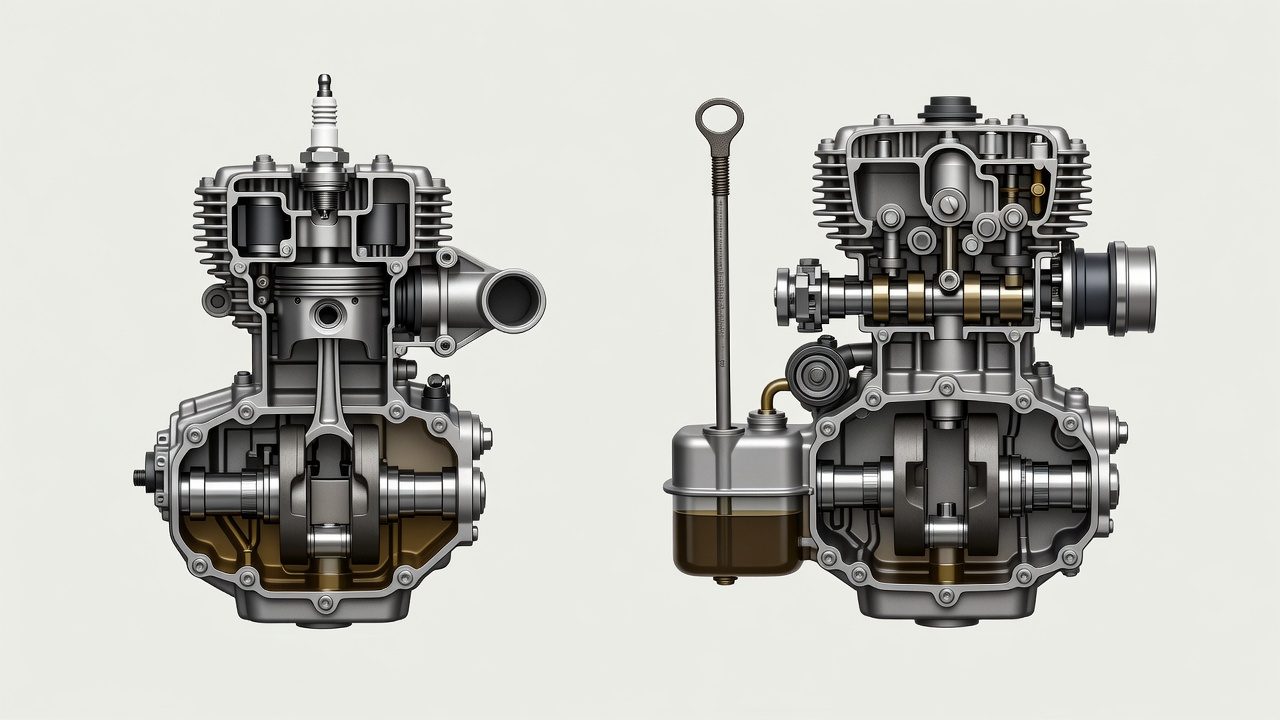
To understand why this distinction matters, it helps to know what “2-stroke” and “4-stroke” actually mean. These terms refer to the engine’s combustion cycle, how it converts fuel into power.
The Power Cycle
- 2-Stroke Engine: Completes a power cycle with two strokes of the piston (one up, one down) and one revolution of the crankshaft. This means it fires (creates power) on every single revolution, which can give it a higher power-to-weight ratio.
- 4-Stroke Engine: Completes a power cycle with four strokes of the piston (intake, compression, power, exhaust) and two revolutions of the crankshaft. It fires only on every other revolution.
For the average homeowner, the most important practical difference isn’t the number of strokes, it’s lubrication.
The Critical Lubrication Difference
A 2-stroke engine has no separate oil reservoir. Instead, the engine oil must be pre-mixed with the gasoline in the correct ratio (often something like 50:1 or 40:1, meaning 50 or 40 parts gasoline to one part oil). This oil-gas mixture lubricates the internal engine parts as it passes through.
A 4-stroke engine has a separate oil reservoir (like a car engine) with its own fill port and often a dipstick. You put only unleaded gasoline in the fuel tank. The engine draws oil from its reservoir to lubricate itself.
This difference dictates how you fuel and maintain each type of mower, and using the wrong fuel in the wrong engine can cause catastrophic damage. For broader ecosystem context, read through our operational guide on z890 vs x870e motherboard.
Which Mower Types Use Which Engine?
Engine type is closely tied to the category of lawn mower.
Walk-Behind Mowers
The standard walk-behind mower, whether it’s a basic push mower or a self-propelled model, almost universally uses a 4-stroke engine in modern production. Major manufacturers have shifted to 4-stroke designs for these machines due to their efficiency, lower emissions, and user convenience (no mixing required). For troubleshooting and reliability insights, consult our in-depth marshall stanmore iii vs harman kardon onyx studio 8 report.
You might find 2-stroke engines in some very old, lightweight walk-behind mowers, perhaps from the 1970s or earlier, or in some extremely compact, specialty reel mowers with small engines. But if you buy a new walk-behind mower today, it will be 4-stroke.
Ride-On Mowers and Lawn Tractors
All standard riding mowers, lawn tractors, and zero-turn mowers use 4-stroke engines. These are larger, more powerful machines that require the sustained operation and lubrication system that a 4-stroke engine provides. You will not find a 2-stroke engine in a modern riding mower.
Handheld Equipment (Often Confused with Mowers)
This is where 2-stroke engines remain prevalent. String trimmers, edgers, leaf blowers, and chainsaws often use 2-stroke engines because they need to be lightweight, portable, and capable of high RPMs. When people ask “are lawn mowers 2-stroke?” they are sometimes thinking of this equipment.
How to Identify Your Mower’s Engine Type
If you’re not sure what engine your mower has, here are the most reliable ways to check. Getting this right is crucial for proper operation.
1. Check the Fuel Cap and Owner’s Manual
The fuel cap is your first and best clue.
- A 2-stroke engine cap will often have labels mentioning “mixed fuel,” “pre-mix,” or a specific oil-to-gas ratio (e.g., “50:1”).
- A 4-stroke engine cap will typically say “unleaded gasoline only” or “regular unleaded fuel.”
The owner’s manual is the definitive source. It will specify the exact fuel type and, for 2-strokes, the correct oil ratio.
2. Look for a Separate Oil Fill Port
This is a nearly foolproof test. Walk around the engine and look for a second cap or port, usually with a dipstick, located on the engine block itself (not on the fuel tank).
- If you find a separate oil fill port and dipstick, you have a 4-stroke engine. You fill this with engine oil separately from the gasoline.
- If there is no separate oil fill port, and only one place to add fuel, it is almost certainly a 2-stroke engine that requires a fuel-oil mixture.
3. Check the Engine Model Number
If the labels are faded or unclear, find the engine model number stamped on the engine (often on a metal tag or directly on the housing). A quick online search for that model number will tell you the engine type and its specifications.
Why 4-Stroke Engines Dominate Modern Mowers
The industry shift to 4-stroke engines for lawn mowers isn’t accidental. It’s driven by several practical and regulatory factors.
Convenience and Simplicity
For the homeowner, a 4-stroke mower is simpler to operate. You go to the gas station, fill a can with regular unleaded gasoline, and pour it in the tank. There’s no need to measure and mix oil, which eliminates a step where mistakes can happen.
Emissions and Regulations
2-stroke engines burn oil along with gasoline, which results in higher emissions of unburned hydrocarbons and particulate matter. As environmental regulations for small engines have tightened in many regions, manufacturers have moved toward cleaner-burning 4-stroke designs to comply.
Fuel Efficiency and Longevity
Generally, 4-stroke engines are more fuel-efficient and tend to have a longer operational life for the sustained, steady work of mowing a lawn. They run cooler and the separate lubrication system provides more consistent protection for engine components.
Important Safety and Maintenance Notes
Understanding your engine type is critical to avoiding expensive damage.
The Wrong Fuel Can Destroy Your Engine
- Running a 2-stroke engine on unmixed fuel (straight gas) is disastrous. Without oil in the fuel, there is no lubrication for the piston and bearings. The engine will overheat and seize within minutes, requiring a complete rebuild or replacement.
- Running a 4-stroke engine on fuel mixed with oil is also harmful. The extra oil will cause excessive smoke, fouled spark plugs, carbon buildup, and poor performance. It can damage the catalytic converter (if equipped) and lead to long-term engine issues.
Safe Fuel Handling
Whether your mower is 2-stroke or 4-stroke, follow these general safety practices:
- Use fresh gasoline. Fuel older than 30 days can degrade and cause starting and running problems.
- Store fuel in an approved container, away from heat sources and out of direct sunlight.
- For 2-stroke engines, use the specific type of two-cycle oil recommended for air-cooled engines and mix it thoroughly in the correct ratio.
- Always consult your owner’s manual for the exact fuel type and any specific maintenance procedures.
If you’re unsure about your mower’s engine type or how to properly fuel it, consult the manual or contact a qualified small engine repair professional before operating it.
Related Maintenance and Operating Guides
To keep your equipment running at peak operating efficiency, explore our related technical walkthroughs and maintenance tutorials:
- Consult our detailed breakdown on lawn.
Technical Standards and Compliance
Mechanical safety standards, operational tolerances, and protective gear guidelines align with benchmark specifications established by the American National Standards Institute (ANSI).









