

Quick Answer: Are Mower Blades Universal?
When it’s time to replace a worn or damaged mower blade, it’s tempting to think any blade of a similar length will do the job. However, mower blades are generally not universal. They are precision components designed to work as part of a system with your mower’s deck, spindle, and drive mechanism. Using the wrong blade can lead to poor…

Pros
- Large-size design named in product title
- Sharpening and balancing functions listed
- Listed as a new upgraded version

Pros
- Adjustable 15-to-45-degree range in title
- Sharpening and balancing functions listed
Pros
- Includes replacement gaskets and a 98079-55846 spark plug
- Matches Honda HRR216 and HRS216 lawn mower models
- Designed around the 16100-Z8B-901 carburetor specification
Cons
- Restricted to select Honda GCV160 mower applications
- Installation requires basic mechanical tools and skills
This article explains why mower blades are model-specific, details the critical factors that determine compatibility, and provides a step-by-step guide to finding the exact replacement blade your mower requires.
Why Mower Blades Are Not Universal
The fundamental reason mower blades are not interchangeable across all models is that they are engineered as part of a complete cutting system. A blade’s design is intrinsically linked to the geometry of the mower deck it operates within. The deck’s shape, the spindle’s position, and the intended airflow for grass discharge or mulching all dictate the blade’s required specifications.
Even blades that appear visually similar can have critical differences in their mounting hardware or aerodynamic properties. A blade designed for one brand’s 42-inch deck will likely not fit the spindle of another brand’s 42-inch deck due to a different bolt hole pattern. Furthermore, blades are balanced for specific rotational speeds and mower weights; an incorrect blade can throw the entire system out of balance, leading to premature wear on the spindle bearings and engine.
Key Factors That Determine Blade Compatibility
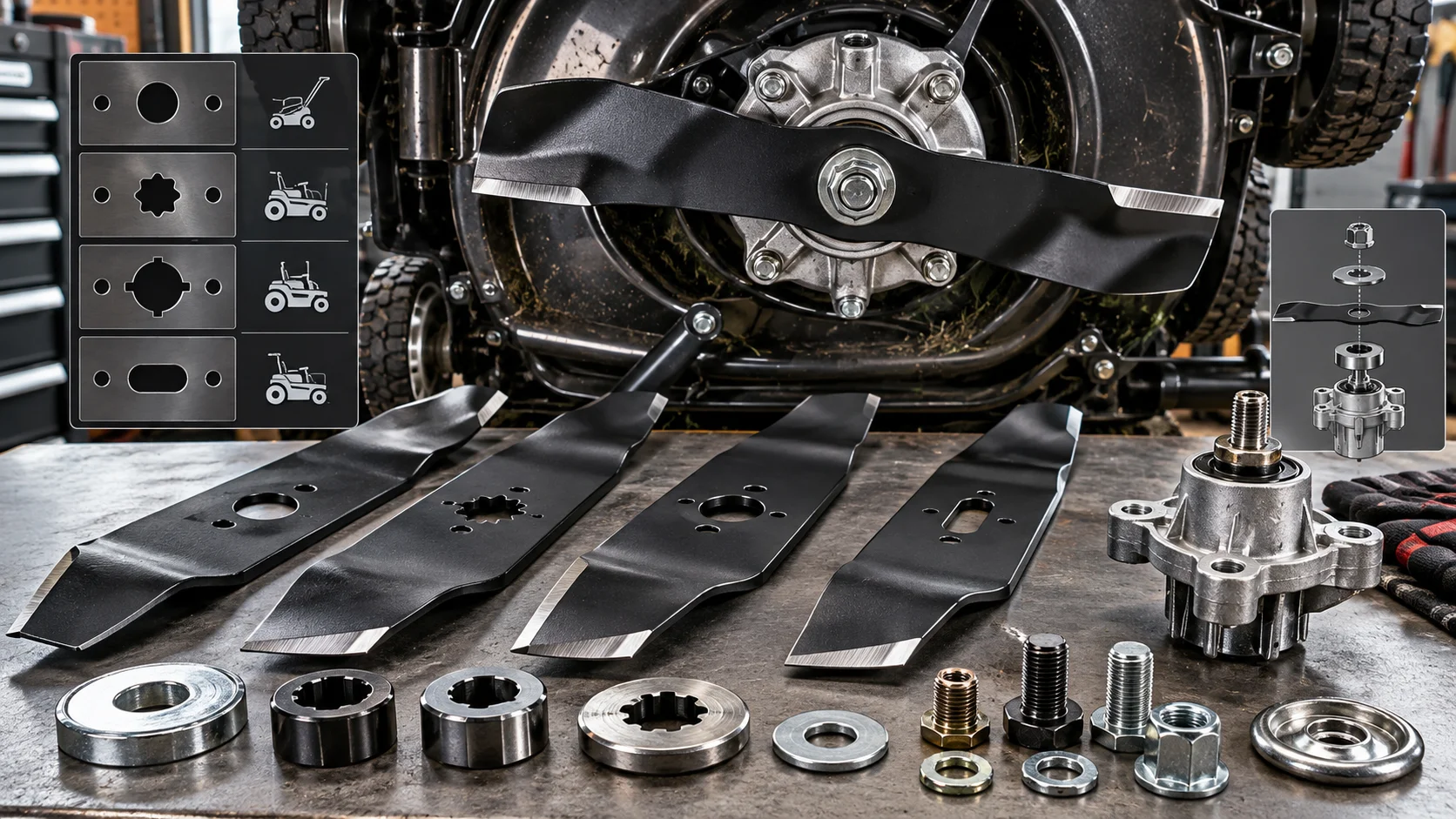
To ensure a blade fits and functions correctly, you must match several key specifications. These are the primary factors that separate one blade from another.
1. Blade Length and Width
This is the most obvious measurement. The blade must fit within the mower deck without striking the sides. While deck size (e.g., 42 inches, 48 inches) gives a general idea, the actual blade length is a precise measurement from tip to tip. Similarly, blade width affects the cutting path and must be compatible with the deck’s internal clearance. To evaluate matched hardware tolerances, consult our detailed overview of z890 vs x870e motherboard.
2. Mounting Hole Pattern
This is often the most critical compatibility factor. The hole in the center of the blade must match the shape and size of the mower’s spindle bolt or adapter. Common patterns include:
- Round Hole: A simple circular hole, often with a specific diameter.
- Star or Spline Pattern: A star-shaped or multi-toothed pattern that locks onto a matching spindle for a secure, non-slip fit.
- Bowtie or Hex Pattern: A shaped hole that corresponds to a specific spindle design.
Using a blade with the wrong mounting pattern is impossible without modification, which is strongly discouraged as it compromises safety and balance. When planning workspace deployment, consider the engineering criteria outlined in our marshall stanmore iii vs harman kardon onyx studio 8 guide.
3. Blade Thickness
Blade thickness is crucial for durability and balance. A blade that is too thin may flex or bend during operation, while one that is too thick may not fit properly within the spindle assembly or could place undue stress on the drive components.
4. Lift Type and Aerodynamics
Blades are designed to create specific airflow patterns within the deck. This “lift” is what stands grass upright for a clean cut and either discharges clippings from the side or recirculates them for mulching. The main types include: For additional operational safety benchmarks, see our published testing notes on dyson v8 cyclone vs bissell featherweight stick.
- Standard/Low-Lift Blades: Have a slight curve on the ends, designed for basic side-discharge cutting in dry conditions.
- High-Lift Blades: Have a more pronounced curve, creating stronger upward airflow. This is ideal for bagging clippings and handling thicker or wet grass.
- Mulching Blades: Often have a more complex shape with additional cutting edges or “wings” designed to cut clippings into finer pieces and recirculate them back into the lawn.
- Gator-Style Blades: A hybrid type with teeth or serrations on the back edge, intended to further chop clippings for enhanced mulching.
While you can sometimes switch between blade types (e.g., from a standard to a mulching blade), you must ensure the replacement blade is compatible with your mower’s deck design and intended function.
How to Find the Correct Replacement Blade for Your Mower
The most reliable method to find the right blade is to use your mower’s model number. This unique identifier is the key to accessing the manufacturer’s parts catalog and ensuring a perfect match. To compare alternative configurations, check our hands-on review of bissell crosswave hydrosteam vs shark stainforce.
Step 1: Locate Your Mower’s Model Number
The model number is typically found on a sticker or plate attached to the mower. Common locations include:
- The mower deck itself (often near the rear or side discharge chute).
- The frame or chassis, under the seat, or on the steering column.
- The engine shroud (for the engine model, which is different from the mower model).
Look for a label that includes the brand name, a model number (often starting with letters like “LT” for lawn tractor or “Z” for zero-turn), and a serial number.
Step 2: Use the Model Number for Parts Lookup
With the model number in hand, you have several options:
- Manufacturer’s Website: Most major brands have an online parts lookup tool on their official website. Enter your model number to find diagrams and lists of compatible parts, including blades.
- Authorized Dealers: A local dealer for your mower’s brand can look up the correct OEM (Original Equipment Manufacturer) blade for you.
- Reputable Online Parts Retailers: Many websites specialize in outdoor power equipment parts and have search functions based on mower model.
The parts listing will specify the exact OEM part number for the blade. You can then purchase that exact part or find an aftermarket blade that explicitly lists compatibility with your mower’s model number.
Step 3: Measure the Old Blade as a Backup
If the model number is missing or illegible, you can measure the old blade. Measure the total length from tip to tip, the width, and the thickness. Also, carefully examine the mounting hole shape and size. While this method can help narrow down options, it is less precise than using the model number, as it doesn’t account for subtle differences in lift or balance. Always try to find the model number first.
Consequences of Using an Incorrect Blade
Installing a blade that is not designed for your mower is not just a matter of poor performance; it poses significant risks.
- Poor Cut Quality: The most immediate effect is an uneven, ragged, or torn cut, which can stress the grass and make it more susceptible to disease.
- Excessive Vibration: An unbalanced or improperly fitted blade will cause severe vibration. This vibration is uncomfortable for the operator and accelerates wear on the spindle bearings, deck, and other components.
- Increased Strain: A blade with the wrong aerodynamic properties can force the engine and drive system to work harder, potentially leading to overheating or premature failure.
- Safety Hazard: The most serious risk is the blade becoming detached during operation. A spinning blade that breaks free can cause catastrophic injury or property damage. This is why using the correct mounting hardware and ensuring a proper fit is non-negotiable.
Special Considerations and Common Confusions
What Does “Universal Fit” Actually Mean?
You will often see blades marketed as “universal fit.” This term can be misleading. In most cases, it means the blade is compatible with a specific list of mower models from one or more brands, not that it fits every mower ever made. Always check the compatibility list provided by the seller to confirm your mower’s model is included.
Can I Switch to a Different Blade Type?
Yes, it is often possible to switch from a standard blade to a mulching or high-lift blade, provided you purchase a blade that is designed for your specific mower model in that configuration. For example, if your mower originally came with a standard blade, the manufacturer likely offers a compatible mulching blade as an accessory. Do not assume any mulching blade will work; it must match all the other compatibility factors (length, mounting, etc.).
What If I Can’t Find My Model Number?
If the model number plate is missing, gather all the information you can: the brand, the approximate deck size (measured across the top of the deck), the year of manufacture (if known), and the engine model. Take this information to an authorized dealer for your mower’s brand. They can often identify the correct parts based on these details.
Conclusion
Choosing the right mower blade is essential for achieving a clean, healthy cut and operating your equipment safely. By understanding that blades are not universal and learning to identify the key compatibility factors, especially the mounting pattern and using your mower’s model number, you can confidently select the correct replacement. Taking the time to find the right part will protect your investment in your mower and ensure it performs reliably for seasons to come.
Technical Standards and Compliance
Mechanical safety standards, operational tolerances, and protective gear guidelines align with benchmark specifications established by the American National Standards Institute (ANSI).









