

Quick Answer: How Often Should You Replace Lawn Mower Blades?
There is no single calendar date that fits every lawn. For a typical homeowner rotary mower, inspect the blade regularly, sharpen it when it is merely dull and intact, and replace it when it is bent, cracked, chipped, badly worn, or too thin to sharpen safely. Many blades last more than one season if they stay undamaged, but sandy soil,…

Pros
- Large-size design named in product title
- Sharpening and balancing functions listed
- Listed as a new upgraded version

Pros
- Adjustable 15-to-45-degree range in title
- Sharpening and balancing functions listed

Pros
- Sharpener and balancer functions in title
- 15-to-45-degree adjustable setting listed
- Built for lawn mower blade maintenance
Pros
- Includes replacement gaskets and a 98079-55846 spark plug
- Matches Honda HRR216 and HRS216 lawn mower models
- Designed around the 16100-Z8B-901 carburetor specification
Cons
- Restricted to select Honda GCV160 mower applications
- Installation requires basic mechanical tools and skills
A Practical Replacement Interval, Not a Calendar Rule
Homeowners often want a date they can circle: replace the blade every spring, every other year, or after a set number of hours. That kind of rule is tidy, and it is also incomplete. Lawn mower blades on a typical homeowner rotary mower wear according to what they hit, how often they run, and what they cut through, not according to the calendar on the garage wall.
A useful habit is inspect first, then decide. Look at the blade at the start of the season, after any hard impact, and whenever the lawn starts looking torn or uneven. If the steel is still straight, uncracked, and thick enough to take a new edge, blade sharpening is usually the next step, not blade replacement. Sharpening is the frequent job in ordinary mower maintenance. Replacement is the less common one.
Many homeowner blades last more than one mowing season when they stay sharp and undamaged. Some last several seasons of light, clean cutting. Others fail in a single afternoon after a rock, a hidden stake, or a concrete edge. That is why hours of use and visible wear matter more than a published anniversary. A single impact can end a blade’s life immediately, no matter how new it is. For additional operational safety benchmarks, see our published testing notes on jbl partybox club 120 vs sony srs xv500. For complementary hardware performance, examine our breakdown on riding lawn mower specifications.
Walk-behind and riding rotary mowers follow the same basic logic. A riding mower may cover more ground in a session, so its blades may see more abrasive wear in a week, but the decision is still based on condition. A walk-behind mower used on a small, clean lawn may keep a serviceable blade much longer. Neither type has a universal hour count that applies to every yard, brand, or deck size.
This guidance is for standard rotary decks. Reel mowers use a cylinder and bedknife. Many robotic mowers use small blades that are swapped on a much shorter cycle. Commercial machines may follow published hour-based service that belongs in the equipment manual, not in a one-size homeowner rule. For additional operational safety benchmarks, see our published testing notes on jbl partybox club 120 vs sony srs xv500.
Sharpen Versus Replace
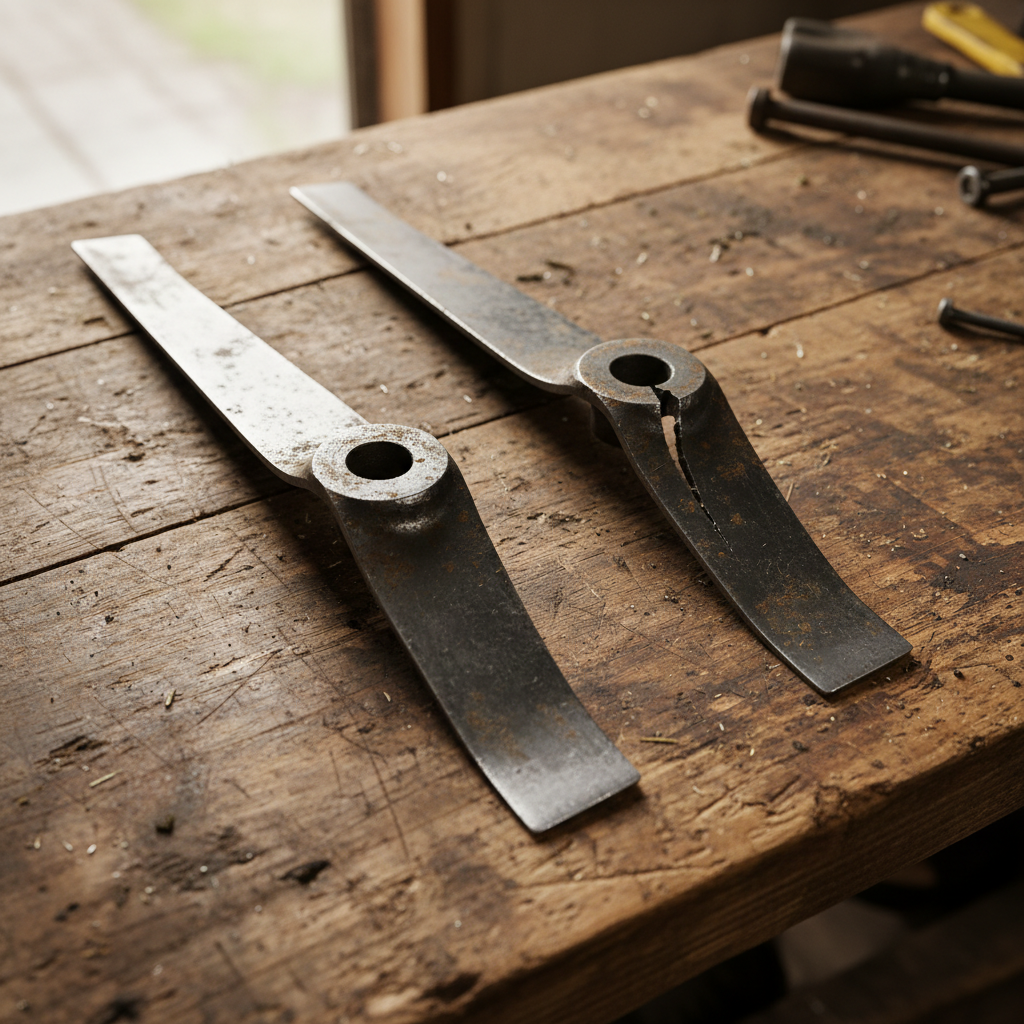
A dull cutting edge and a ruined blade are not the same problem. Confusing the two is how people either throw away a perfectly serviceable blade or keep spinning a cracked one. To compare alternative configurations, check our hands-on review of z890 vs x870e motherboard.
When sharpening is enough
Sharpening is enough when the blade is straight, the center hole is still round and undamaged, there are no cracks, and the edge is merely rounded, lightly nicked, or no longer slicing cleanly. Restoring that edge can return a clean shear if the rest of the steel is sound. A blade that has only lost its keenness is a maintenance item, not scrap.
Light dressing of a slightly nicked edge is often reasonable during sharpening, as long as the nick is shallow and the blade is otherwise intact. The goal is an even, keen edge on both wings and a blade that can still be balanced. If you cannot get there without removing a lot of metal from one side only, stop and reassess. Users looking for related component recommendations can explore our marshall stanmore iii vs harman kardon onyx studio 8 breakdown.
When the blade should come off for good
Replace instead of resharpening when you find structural damage, severe wear, or an edge that can no longer be sharpened safely. Typical replace-now problems include: To compare alternative configurations, check our hands-on review of z890 vs x870e motherboard.
- A bend, twist, or warp in the blade
- A crack anywhere, including near the center hole or along the cutting area
- Missing chunks or a deeply notched, rolled edge
- Severe pitting at the cutting area
- A blade that has been ground so far it looks thin, shortened, or hard to balance
- A deformed mounting hole or hardware that no longer seats cleanly
Repeated grinding removes metal. Even a blade that has never cracked can become unsafe or ineffective if so much steel is gone that the blade is hard to balance, the lift or sail area is compromised, or the remaining edge is too thin. There is no single remaining-width or hardness number that applies to every original and aftermarket blade. If the maker of your mower or blade publishes a limit, follow that. If you cannot restore a keen, even edge without leaving the blade obviously undersized or lopsided, take it out of service.
A deep gouge, a folded lip, or a chip that reaches well into the body of the blade is not a “dress it and go” nick. Do not weld a cracked blade or try to hammer a badly bent blade back into service. Straightening and welding can hide a weakness that fails at speed. A compromised blade belongs in the scrap pile, not back on the spindle. Users looking for related component recommendations can explore our marshall stanmore iii vs harman kardon onyx studio 8 breakdown.
Signs Your Blade Is Worn, Damaged, or Unsafe
The lawn often tells you before you flip the deck. A sharp rotary blade shears grass. A dull or damaged blade tends to tear it. Torn grass looks ragged. Tips may brown, especially in heat or drought. The cut can look fuzzy rather than crisp. You may see uncut strips, extra clumping, or a lawn that seems to fray a day after mowing. Tip browning is a useful clue. It is not proof of a single cause.
What to look for on the blade
On the steel itself, replace-now defects include a bent blade, a cracked blade, a nicked or chipped edge that has removed a chunk of metal, a wavy or twisted profile, and rust pits that undercut the cutting area. Look at both ends and both faces. Rotary blades spin at high speed. A defect on one wing is enough. Before finalizing equipment decisions, refer to our comprehensive dyson v8 cyclone vs bissell featherweight stick comparison.
Compare the two cutting ends. If one side is much more rounded, shorter, or more chewed than the other, the blade may already be hard to balance. Check the area around the center hole for cracks, elongation, or burrs. Damage there is easy to miss if you only glance at the tips.
Vibration, noise, and a wandering cut
Unusual vibration after hitting something, new rattling, or a wandering, uneven cut should stop the job. Power down and inspect the blade, the mounting hardware, and the area around the spindle. Vibration does not automatically mean the blade is finished. Packed deck debris, a bent baffle, loose hardware, or an unbalanced resharpened blade can mimic wear. Still, vibration after an impact is never something to ignore and keep mowing through. For broader ecosystem context, read through our operational guide on bissell crosswave hydrosteam vs shark stainforce.
When the lawn looks bad for other reasons
Poor cut quality can also come from the wrong cutting height, mowing too fast, wet heavy grass, a dirty mower deck, or a clogged discharge path. Check those before you assume the steel is spent. If the lawn looks torn and the edge is rounded or damaged, treat the blade as the first fix. If a freshly sharpened or new, correctly installed blade still leaves a bad cut, look at deck cleanliness, height, speed, and the rest of the machine.
How Hours, Soil, Debris, and Impacts Change Blade Life
Calendar time is a weak predictor because yards are not interchangeable. Two neighbors can buy the same walk-behind mower and get very different blade life from the same season of mower maintenance.
Hours and inspection, not a hidden hour chart
Frequent mowing and longer weekly run time mean more contact between steel and grass, grit, and the occasional hidden object. Higher use generally means more frequent inspection, not a guaranteed shorter life measured in months. A blade that never hits anything on clean turf can stay structurally fine for a long time even if it needs regular sharpening. Trying to convert homeowner use into a commercial-style hour-to-replacement table invents a precision the job does not have.
Sandy soil, grit, and splash
Sandy soil, grit, and irrigation splash act like sandpaper. Dusty conditions and soil thrown up from a low cut dull an edge faster than a higher cut on moist, grit-free turf. Lawns on sandy ground, recently graded soil, or paths that kick up dust often need more frequent edge work. That extra dulling still does not automatically mean replacement. It means you will sharpen sooner, and you should inspect more often for thinning and chips.
Impacts end a blade on the spot
Roots, rocks, sprinkler heads, landscape edging, wire, toys, and buried debris can bend a blade, chip the edge, or crack the steel in one pass. After a hard hit, inspect even if the mower still “cuts something.” A slightly marked edge can hide a bend you only notice later as vibration or an uneven strip. Hitting an object is the most common reason a blade that should have lasted the season does not.
Mulching, bagging, side-discharge, and tough grass
Mulching versus bagging versus side-discharge does not give each setup a secret lifespan, but it does change how the blade works. Mulching recirculates clippings and can keep the edge in contact with more dry, gritty material. Bagging and side-discharge still wear the edge; they just move clippings out of the deck differently. Cutting very tall, wet, or debris-filled grass loads the blade and the deck and raises the chance of hitting hidden objects. Light, frequent mowing on a clean lawn is easier on the edge than knocking down overgrown, sandy turf in one pass.
Why Dull or Damaged Blades Matter
The cutting edge is what the turf feels. Dull blades tear grass rather than slicing it. Torn tissue dries out at the tip, looks brown or gray, and can add stress when the lawn is already dealing with heat or drought. A ragged cut is also slower to look tidy. “It still cuts something” is a low standard. If the mower is chewing instead of shearing, you are trading a few extra uses of an old edge for a worse lawn and more cleanup later.
A torn cut is not the same thing as a named lawn disease, and a new blade is not a guaranteed health treatment. It is still a real quality and stress issue. Grass that is shredded at the tip loses moisture faster and looks tired sooner, especially in midsummer.
A bent or unbalanced blade does not only spoil the cut. It can increase vibration and stress the spindle, belt, bearings, and deck. Loose or damaged hardware adds to that risk. Vibration you treat as normal noise can become a repair that costs more than a blade. The machine is designed to spin a balanced piece of steel. It is not designed to absorb a wobbling, cracked, or lopsided one all season.
Safety is the hard stop. Cracked or badly bent blades are unsafe to keep in service. They can fail, throw debris more unpredictably, or come loose. Dull or damaged blades also tend to tear and slap rather than cut cleanly, which can make thrown material less predictable. You do not need an injury statistic to take that seriously. If the steel is compromised, replace it. If you cannot inspect or install the blade safely, stop and get help.
How to Inspect a Blade Before You Decide
Inspection is simple. Getting to the blade safely is the part people rush. Wait for all motion to stop. Isolate power before you put a hand near the deck.
Power isolation comes first
For a gasoline walk-behind mower, a spark-plug disconnect is standard general practice so the engine cannot start while you work. Pull the boot off the plug and keep it away from the terminal. For battery, corded electric, and riding mowers, remove the key, remove or disconnect the battery if that is how the machine is disabled, or follow the owner’s manual’s power isolation steps. Do not rely on the throttle, a power button, or a wall switch alone if the manual tells you to do more.
Wear sturdy gloves. Treat the blade as sharp even when it looks dull. Stabilize the mower so it cannot roll or fall. Use the owner’s manual for tipping, blocking, and lift guidance. Do not reach under a deck that is only held by a jack, a stack of boards, or a propped handle. If you cannot secure the machine, stop and take it to a shop.
What to examine
Look at both sides of the blade, both cutting ends, the sail or lift area, the center hole, and the mounting hardware. Work through a short checklist:
- A rounded, rolled, or uneven cutting edge
- Nicks, chips, and missing metal
- Bends, twists, or wings that no longer match
- Cracks, including hairline cracks near the hole
- Deep rust pits at the edge
- A stretched, egg-shaped, or burred center hole
- Worn, rounded, or damaged bolts, nuts, and washers
- Grass packed so tightly it hides damage
Inspection becomes a replace-or-shop decision as soon as you find a crack, a clear bend, a chunked edge, damaged mounting hardware, or a blade you cannot balance after sharpening. If anything about the spindle, deck, or hardware looks bent, cracked, or unable to clamp cleanly, that is also beyond a simple backyard edge touch-up.
This is not a full shop sharpening guide. Grinding angles, bench setups, and torque values belong in the manual or with a technician who has the right tools. A blade that needs more than a careful inspection and a decision should go to someone set up to sharpen, balance, and reinstall it correctly.
Replacing a Blade Without Guessing Compatibility
A replacement blade has to match the mower and the deck, not a marketing label. Take information from the old blade, any deck stamp, and the owner’s manual. What matters most is length, the center hole shape and size, the mounting pattern, and the intended rotation and orientation. Thickness and the presence of a mulching or high-lift profile also need to be compatible with how you use the mower, but the first filter is physical fit.
A blade that is too long can strike the deck or the ground. A wrong center hole will not clamp correctly. Installing a blade upside down ruins the cut and can be unsafe. Arrows, cutting-edge location, and the curve of the sail tell you which way the steel is supposed to face. If those cues and the manual disagree with a guess, follow the manual.
Multi-blade decks and mixed wear
On a multi-blade deck, mixed old and new blades can leave an uneven cut or a balance problem. If one blade is badly worn or damaged, replacing them as a set is often the more even, balanced choice. If only one was bent by an impact and the others are still in good shape and well matched, some owners replace the damaged blade alone and recheck the cut. When wear is uneven or you cannot tell how much metal the others have lost, a set is the prudent path.
Balance, direction, and hardware
A new or resharpened blade must be balanced and installed in the correct direction. An unbalanced blade is a vibration problem waiting to happen. Follow the orientation and hardware stack shown in the manual. Replace damaged bolts, nuts, or washers rather than reusing hardware that is rounded, stretched, or cracked. Torque belongs to the manual. Guessing a number is not a substitute.
Do not choose a blade by a brand story or a claim that one steel lasts twice as long. Fit, condition, balance, and correct installation determine whether the cut is clean and the machine stays intact. After installation, do a short test in an open area and listen for vibration before you settle into the rest of the lawn.
Exceptions, Limits, and When to Stop
Not every mower uses a large rotary blade you sharpen a few times a season. Reel mowers are a cylinder-and-bedknife system. Their service logic is about keeping the reel and bedknife in contact and correctly adjusted, not about swapping a single stamped blade on a homeowner interval. Robotic mowers often use small blades on a much shorter inspect-and-swap cycle. Those blades are typically replaced rather than repeatedly sharpened, and the maker’s interval—if you have it—is the right reference. Commercial rotary equipment may follow hour-based service that this article cannot invent.
A dealer or shop is the safer option when you cannot stabilize the mower, the spindle or deck looks cracked or bent, hardware will not clamp or turn cleanly, severe vibration remains after a correct, balanced new blade, or you are not comfortable removing and reinstalling the blade. Leftover symptoms after a new blade usually mean something else is wrong: a dirty or damaged deck, incorrect height, a bent baffle, belt or spindle trouble, or an operator setting such as speed.
After a hard impact, inspect even if the edge still looks only slightly marked. A bend can be subtle. A cracked blade can look almost intact until it fails. There is no universal legal or warranty rule that can be stated here. Use the manual that came with your machine, and do not put a cracked or badly bent blade back into service.
Buyer FAQs: How Often Should You Replace Lawn Mower Blades Solved
Can I just replace the blade every spring and skip inspections?
A spring swap can be convenient, but it is not a substitute for inspection. A new blade can be ruined in one impact in April. An older blade can still be sound in October if it was kept sharp and never bent. Inspect at the start of the season, after hits, and whenever the cut looks torn.
How many times can I sharpen a rotary blade?
There is no universal count. Sharpen as long as the blade stays straight, uncracked, and thick enough to take an even, balanceable edge. When grinding would leave the blade thin, shortened, or lopsided, replace it. If your blade or mower maker publishes a limit, use that.
Is a nicked blade always unsafe?
A shallow nick on an otherwise sound blade can often be dressed during sharpening. A deep notch, a missing chunk, a rolled lip, or any crack is a reason to replace the blade rather than keep using it.
Do riding mowers need new blades more often than walk-behinds?
Not automatically. A riding mower may accumulate more cutting time in a week, which can dull edges faster and raise the chance of hitting debris. The replacement decision is still based on damage, remaining metal, balance, and cut quality, not on the fact that the mower has a seat.
Mechanical safety standards, operational tolerances, and protective gear guidelines align with benchmark specifications established by the American National Standards Institute (ANSI).
Should I keep mowing if the blade still cuts after I hit a rock?
No. Stop, isolate power, and inspect. A blade can still tear grass after it is bent or cracked. Continuing after an impact risks a worse cut, more vibration, and a blade that fails while spinning.
For more hands-on benchmarks and buying recommendations, consult our guides on heavy-duty chainsaw buyer guide, as well as high-CFM commercial leaf blower guide.









