

For more hands-on benchmarks and buying recommendations, consult our guides on heavy-duty chainsaw buyer guide, as well as high-CFM commercial leaf blower guide.
Mechanical safety standards, operational tolerances, and protective gear guidelines align with benchmark specifications established by the American National Standards Institute (ANSI).
Quick Answer: Where To Finance A Lawn Mower?
You can usually finance a lawn mower through the retailer or dealer where you buy it, a manufacturer program, a bank or credit union, an online personal loan, or existing credit. The right channel depends on where you buy, whether the mower is new or used, your credit and budget, and total borrowing cost—not just the monthly payment. Compare APR,…

Pros
- Powerful 80V brushless motor delivers 32HP gas-equivalent performance with quiet fume-free operation and no engine maintenance.
- Complete kit includes four 6.0Ah batteries and 600W charger for substantial runtime up to 1.5 acres.
- SmartCut technology and 42-inch heavy-duty steel deck ensure consistent cuts without bogging in tough conditions.
- Versatile towing up to 350 lbs and optional cargo hauling plus comfort features like high-back seat and LED lights.
- Strong 4-year limited warranty and full compatibility with the Greenworks 80V tool ecosystem.
Cons
- Rear utility cargo bed for 200 lb hauling is sold separately and not included in the kit.
- Runtime of up to 1.5 acres varies with conditions and may require recharging or battery swaps on larger properties.
- As a fully cordless model continuous operation depends on battery levels unlike gas engines with unlimited runtime.
The Greenworks 80V 42" CrossoverT Cordless Riding Lawn Tractor is a ready-to-mow zero-emission tractor designed for homeowners managing medium to large lawns. It features a reinforced 42-inch stamped steel deck of 12-gauge construction along with premium comfort elements such as a high-back padded seat with foldable armrests. The overall build emphasizes durability and user convenience right out of the box with the included battery and charger set.
Performance centers on the 80V TruBrushless motor that provides 32HP gas-equivalent power with instant torque and quiet fume-free operation. SmartCut technology senses grass conditions and automatically adjusts power to maintain a consistent cut even in tall thick or wet areas. The four 6.0Ah batteries support runtime for up to 1.5 acres depending on conditions while dual LED headlights and a 7-position deck height range from 1.5" to 4.5" add practicality. Front and rear attachments further allow towing up to 350 lbs for added yard utility.
Key considerations include that the rear utility storage bin capable of hauling 200 lbs is sold separately so full cargo functionality requires an extra purchase. Runtime remains condition-dependent and may fall short for properties significantly larger than 1.5 acres without using the 600W charger or swapping batteries. The cordless design prioritizes ease and low maintenance but trades off the continuous runtime of traditional gas models.
This tractor delivers strong value for eco-conscious owners of residential properties who want gas-like power without the emissions noise or upkeep. It suits those who already use or plan to expand into the Greenworks 80V family of tools and who appreciate the 4-year limited warranty. Users with exceptionally large or commercial-scale lawns should evaluate battery logistics carefully before purchase.

Pros
- Delivers strong 21 horsepower equivalent power comparable to gas riding mowers.
- Provides up to 1.5 acres of runtime on a full charge with the six included batteries.
- Features low-maintenance dual brushless motors without belts for greater durability.
- Offers versatile 12-position cutting height adjustment from 1.5 to 4.5 inches.
- Includes digital controls for blade settings, drive speeds, and cruise control.
Cons
- Limited to 1.5 acres of cutting per charge without purchasing additional batteries for bigger lawns.
- Requires recharging time for the six 56V batteries after each use session.
- Relies solely on battery power with no hybrid or gas backup option for extended operation.
The EGO Power+ TR4204 is a cordless electric riding lawn mower built as a modern tractor alternative for residential use. It features a robust 42-inch stamped steel deck and arrives ready to go with six 56V 6.0Ah batteries plus a charger, creating an immediate impression of convenience and solid construction free from gas engine complexity.
Performance shines through its equivalent 21 horsepower output and top speed of 6 MPH, allowing efficient coverage of up to 1.5 acres on a single charge. Dual brushless cutting motors operate without belts for added durability and less upkeep, while the digital display lets users select three blade settings, three drive speeds, and cruise control. The 12 adjustable heights ranging from 1.5 to 4.5 inches combined with anti-scalp wheels deliver precise results across varied terrain.
Drawbacks center on battery dependency, as larger properties beyond 1.5 acres require extra batteries and recharging intervals can interrupt workflow. The fully electric design eliminates fuel storage needs but demands access to power sources between sessions.
This mower suits homeowners with medium to large yards who value quiet, emission-free operation and reduced maintenance. Those seeking expandable battery capacity for bigger areas will find the EGO Power+ TR4204 a strong long-term investment in cordless lawn care.

Pros
- High-efficiency brushless motors maximize power output and durability over traditional motors
- Up to 2 acres runtime with three included 10.0 Ah batteries supports substantial mowing sessions
- Zero-emission operation with gas-equivalent 20 HP power for quieter environmentally friendly use
- Six-port auto-switchover battery system provides flexible extended runtime options
- Durable 42-inch steel deck plus included mulch and towing kits add immediate functionality
Cons
- Runtime is limited to approximately 70 minutes or 2 acres which may require recharging for larger properties
- Fully battery-dependent design means performance relies on charge levels and spare battery availability
- 42-inch deck size may require more passes on expansive lawns compared to wider commercial models
The PRORUN PZT60V42 is a fully electric 60V zero-turn riding lawn mower built for residential and light commercial use. Its primary design centers on a robust 42-inch 14-gauge stamped steel twin blade deck powered by direct-drive brushless motors, giving an immediate impression of solid construction and modern battery-focused engineering. The mower arrives complete with three 10.0 Ah batteries, a charger, mulch kit, and towing kit for ready-to-work versatility.
In performance terms, four high-efficiency brushless motors deliver power equivalent to a 20 HP gas engine while producing zero emissions. The system supports up to 2.0 acres or 70 minutes of runtime, and six battery ports with auto switchover intelligently manage all PRORUN 60V battery sizes for continuous operation. A washout port on the steel deck further simplifies post-mow maintenance during real-world sessions.
Potential drawbacks include the finite 70-minute runtime window which can limit coverage on larger properties without spare batteries or recharge breaks. As a fully electric model, it also depends entirely on battery charge levels rather than continuous fuel refills, and the 42-inch deck width may demand extra passes compared with wider traditional options.
Overall the PRORUN PZT60V42 offers strong value for homeowners and small-property managers who want gas-like cutting power without emissions or noise. Those with medium-sized lawns seeking quiet efficient zero-turn performance and included accessories will benefit most from this electric mower.

Pros
- Strong 24HP FR730 engine power for demanding cutting conditions
- Wide 54-inch FAB deck reduces total mowing time
- Zero turn design delivers excellent maneuverability
- Fabricated deck supports durable everyday operation
Cons
- Sparse details beyond engine and deck leave other features unspecified
- Gas-powered FR730 engine needs regular fuel and maintenance
- Large 54-inch deck size may feel oversized on compact properties
The Husqvarna Z254F is a zero turn mower from the established Husqvarna brand in the riding lawn mowers category. It centers on a solid build that pairs a 24HP 726cc FR730 engine with a 54-inch FAB deck for straightforward residential grass care.
Performance stems directly from the listed specifications. The FR730 engine delivers the horsepower needed for steady operation across typical lawns while the wide FAB deck completes passes efficiently. Zero turn handling improves control in real yard layouts based on the model design.
Considerations arise from the limited data available. Secondary elements such as comfort features fuel capacity or extras receive no mention and the gas engine format involves routine upkeep. The large deck suits open areas better than confined spaces.
The Husqvarna Z254F provides the most value for owners of medium or large properties who want reliable engine power and a broad cutting width. Users with smaller lots or those seeking extensive accessory options should weigh the core specs carefully before purchase.
The main places to finance a lawn mower
Lawn mower financing is not a single product. It is a set of credit channels that open or close depending on the seller, the machine, and the buyer. People commonly apply in five places: at a home-improvement, farm-and-garden, or outdoor-power retailer; at an independent equipment dealer; through a manufacturer-linked lending partner; at a bank or credit union, including many online personal-loan applications; or on credit they already have, such as a credit card or line of credit.
Not every store offers financing, and no channel is automatically available in every country or for every credit profile. Point-of-sale plans are usually tied to buying that seller’s in-stock or ordered machine. A personal loan, bank loan, or existing revolving credit is more portable and is often the realistic path for a used lawn mower or a private sale. Manufacturer programs, when they exist, tend to sit on top of a participating dealer or retailer rather than replacing a bank entirely.
Treat the list below as a map, not a ranking. Availability, underwriting, and promotions vary by location, seller, price of the mower, new versus used condition, and the buyer’s credit and existing debt. The rest of this article explains how each channel works, what the purchase setting changes, and how to compare offers without committing to the first monthly payment you see. Before finalizing equipment decisions, refer to our comprehensive jbl partybox club 120 vs sony srs xv500 comparison. For complementary hardware performance, examine our breakdown on our comprehensive riding lawn mower guide.
Retailer and dealer financing
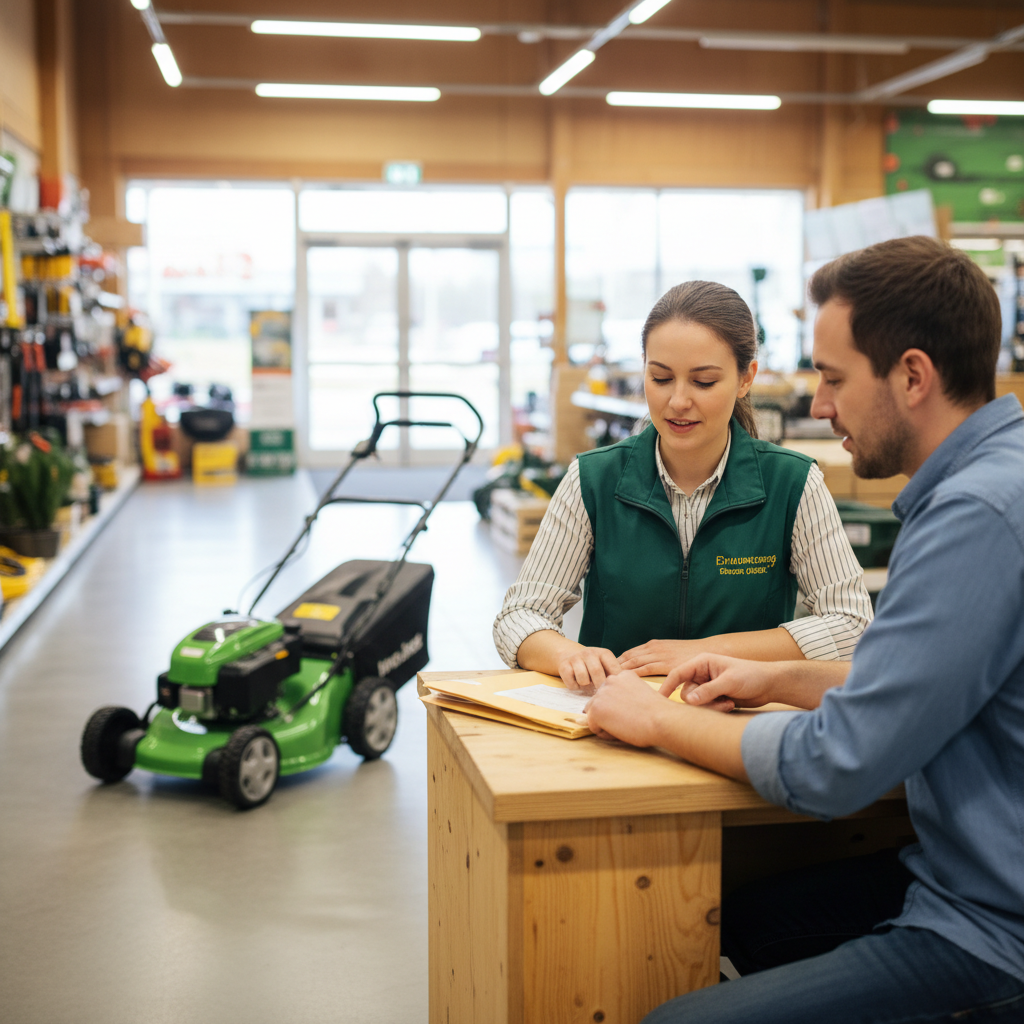
Retailer financing happens at checkout or a customer-service desk in a large store. Dealer financing happens at an outdoor power equipment, farm, or lawn-and-garden dealership, often at a finance desk rather than a self-serve kiosk. In both cases the seller typically introduces a partner lender. You complete an application with identity, income, and housing information; the lender decides whether to approve an installment loan, a store credit card, or a promotional plan; and the financed amount is applied to that purchase if you accept the contract.
These products are easy to confuse because they are sold in the same aisle. A store credit card is revolving credit: you can reuse the account later, the minimum payment can be small, and interest usually continues until the balance is gone. A closed-end installment plan is a fixed loan for that mower: you borrow a set amount, repay it over a stated loan term, and the account is meant to end when the last payment posts. Same-as-cash and other promotional financing sit on top of either structure. They advertise a period during which you may pay no interest if you follow the contract exactly. Deferred interest is the version that can charge a large back-dated interest bill if any qualifying balance remains when the promotion ends. The sales pitch does not control that outcome. The written contract does.
Dealer financing is more common on riding mowers and other higher-priced outdoor equipment than on inexpensive walk-behind machines. A dealer may also be the place where a manufacturer program is offered, or where you can finance attachments bought with the mower. The financed item is almost always the machine you buy from that seller. That makes retailer and dealer plans a poor fit for a neighbor’s used mower or a marketplace listing. If you walk away from the store, you generally walk away from that particular offer as well.
Ask for the full disclosure before you sign: APR, whether interest is deferred or truly waived, when the promotional period ends, what happens if a payment is late or short, any down payment, documentation or origination charges, and whether extra products were added to the ticket to “qualify” the deal. If the numbers only work on a whiteboard and not on paper, treat that as a reason to pause.
Manufacturer financing programs
Manufacturer financing is credit arranged by a brand or its lending partner, usually for new equipment sold through participating dealers or retailers. It can look like a store offer at the desk, but the eligible models, promotional language, and underwriting may be set by the brand program rather than by the store’s generic card. Some outdoor-power brands periodically run these programs. Others do not, or they run them only in certain regions and seasons.
Do not assume a brand program exists because you recognize the logo on the hood. Confirm three things with the selling dealer or the official brand or lender materials: whether financing is actually available at that location, which machines and packages qualify, and what the contract says about rate, term, and any promotion. Offers are time-sensitive and location-specific. A flyer, a verbal “we can get you approved,” or a social post is not a commitment.
Manufacturer programs still require a credit decision. They are not a guarantee, and they rarely apply to a private-party used lawn mower. If the only way to unlock the advertised promotion is to add insurance, an extended plan, or accessories you do not want, price the whole package against a bank or credit-union installment loan for the machine you actually need.
Banks, credit unions, and personal loans
A personal loan is an installment loan you can usually spend with any legitimate seller. That flexibility is the main reason people use a bank loan or credit-union loan for lawn mower financing when the machine is used, the seller is a private individual, or the store’s promotion is a poor fit. You receive funds (or the lender pays an agreed party), then repay a fixed amount over a set term. Some banks also offer a personal line of credit. That is revolving credit, more like a card than a closed loan, and it can cost more if the balance lingers.
Banks and credit unions typically differ from store financing in where you apply and how you use the money. You apply with the institution, not at the mower display. Approval is based on the lender’s own rules, your relationship with that institution, and your credit and income, not on whether you buy a particular brand that day. Credit unions generally serve members rather than the open public. Membership may require living or working in an area, belonging to a group, or opening a share account. Requirements differ, so ask the credit union what membership involves before you treat it as a walk-in option. Readers comparing setup options can review our technical analysis on dyson v8 cyclone vs bissell featherweight stick.
Online personal-loan applications follow the same idea: an installment loan that is not tied to one dealer. Prequalification, when a lender offers it, can help you compare estimated APR, term, and payment before a full application. Practices vary. A completed application may involve a hard credit inquiry. None of this makes one type of lender universally cheaper or faster. Compare written estimates for the same amount and a realistic payoff date.
Lenders commonly ask for identity, income, and housing information. Some will want account history if you already bank there. There is no universal document checklist. If a “specialist” who contacted you first demands ID images, a fee to unlock approval, or payment by gift card, stop and use the official bank, credit-union, retailer, or manufacturer channel instead. For complementary field maintenance guidelines, examine our breakdown of bissell crosswave hydrosteam vs shark stainforce.
Credit cards and money you already have available
Existing revolving credit is sometimes the simplest way to pay, especially for a lower-priced walk-behind mower, an online order, or a short gap between purchase and payday. A general-purpose credit card, a store credit card you already hold, or a personal line of credit can close the sale without a new installment application. Convenience is the benefit. Cost is the risk.
If you pay the statement balance in full by the due date, you may avoid interest on ordinary purchases, depending on the account terms. If you carry a balance, you usually pay that account’s APR plus any late or cash-advance fees that apply. Revolving credit does not give you a single payoff date the way an installment loan does. The minimum payment can stretch the debt and raise the total cost. Opening a new store card to get a same-day discount or promotion still involves a credit inquiry and, after any promotional period, can leave you with a high ongoing rate.
Use a card or line of credit when the mower fits a budget you can clear quickly and you already understand the account. Prefer a dedicated installment loan when you need a known end date, a structured payment, or funds for a seller who will not take a card—common in a private sale. Do not treat rewards or a temporary promotion as a reason to finance more machine than you need.
How the purchase setting changes your options
Where you buy the mower often decides which financing channels exist at all.
Big-box and farm-and-garden stores
Large retailers may offer a store card, a partner installment plan, or a checkout pay-over-time product. Staff can start an application while the machine is in the cart. You are financing that store’s sale. If the store does not offer credit, you still can bring a personal loan or a card you already have.
Independent outdoor-power dealers
Dealers are where riding-mower installment plans and manufacturer programs cluster. You may discuss down payment, delivery, and setup in the same conversation as credit. Used machines on a dealer lot are sometimes financeable through that dealer’s lender, but that is not guaranteed and is different from buying a used lawn mower from a private owner.
Online retailers
Online checkout may present the retailer’s own plan or a third-party pay-over-time option. Read whether you are opening revolving credit or an installment loan, and whether the offer is limited to that website. Shipping, assembly, and return rules are separate from the credit contract; a financing approval does not fix a machine that is wrong for your yard.
Private sale and marketplace listings
A private seller almost never offers retailer financing, dealer financing, or manufacturer financing. Buyers typically pay with cash, a bank transfer arranged in a safe way, a personal loan they already closed, or another form of funds they control. Do not assume a classifieds site or neighborhood listing includes a finance department. A seller who steers you to an unusual payment app, gift cards, or a “financing agent” who is not a known bank, credit union, or retailer partner is a red flag. Meet in a safe public place if you exchange a machine in person, and never send ID documents to someone who contacted you out of the blue.
What to compare across every offer
The monthly payment is a scheduling number, not a measure of whether the credit is affordable. Two offers can share a similar payment and differ sharply in total cost. Compare the same purchase amount and a payoff date you actually intend to meet.
- APR. Annual percentage rate expresses the yearly cost of credit, including certain fees, so you can compare offers more fairly than by interest rate alone. A lower advertised payment with a higher APR and a longer term can cost more overall.
- Loan term. Stretching payments over more months can shrink each bill and raise the interest you pay if the rate is not zero. Match the term to how long you reasonably want the debt, not only to the smallest payment the desk can print.
- Down payment. Cash up front reduces the amount financed and can change approval or promotional eligibility. It also means that money is no longer available for repairs, fuel, or an emergency.
- Fees. Origination, documentation, late, and returned-payment charges add cost. Ask what is deducted from the amount you receive and what is added to the balance.
- Promotional fine print. Same-as-cash and deferred-interest deals can be inexpensive if you retire the balance on time and as the contract requires. They can become expensive if a remaining balance triggers interest for the whole promotional period. Note the end date, the required payment pattern, and whether a late payment cancels the promotion.
- Installment versus revolving credit. An installment loan has a planned end. Revolving credit can be reused and can last as long as you carry a balance.
- Prequalification versus a full application. Prequalification, when offered, is often used to estimate options and may rely on a softer check. A full application may be a hard credit inquiry. Ask which one you are starting.
- Prepayment. Some contracts let you pay extra or pay off early without a penalty; others restrict it. If you plan to throw extra money at the balance after a bonus or tax refund, confirm the rules in writing.
Also ask who the actual lender is, how payments are made, and what happens if the mower is defective, delayed, or returned. Credit approval does not replace the sales contract, warranty paperwork, or your right to inspect a used machine.
New versus used, walk-behind versus riding, and personal versus business use
The machine and the use case change which channel is realistic. Larger-ticket riding mowers are more often offered with dealer installment plans and manufacturer programs than small walk-behind mowers. A compact electric or basic gas walk-behind is frequently paid with a card, cash, or a modest personal loan because many stores will not open a long installment file for a low-priced unit.
New equipment at a retailer or dealer is where promotional financing clusters. A used lawn mower on a dealer lot may still go through that dealer’s lender, subject to the lender’s rules about age and condition. A private-party used machine rarely qualifies for store or manufacturer promotions. For those purchases, plan on cash, existing credit, or a personal loan you arrange yourself.
If the mower is for a landscaping trade, a farm, or another business—not a typical residential yard—the cleaner fit may be a business loan, equipment loan, or commercial account rather than a consumer store card. That is a different underwriting path and a different set of documents. It is not a shortcut around credit review, and it is not tax or legal advice. Deductibility and bookkeeping depend on your situation and local rules; ask a qualified tax professional if business use is the reason you are borrowing. For most homeowners, consumer retailer, dealer, bank, credit-union, or card options remain the default path.
Practical next steps before you apply
You can check eligibility this week without locking in a loan. Work in an order that gathers facts first and hard applications last.
- Set a cash budget and a monthly ceiling you can keep if income dips or the mower needs a repair. If the only way the payment works is if nothing else goes wrong, wait, choose a cheaper machine, or pay cash.
- Decide new versus used, walk-behind versus riding, and where you will actually buy. Financing that exists only at a dealer does not help a private sale.
- Ask the seller what financing, if any, they offer. Get the written terms: APR, term, fees, down payment, promotional end date, and the legal name of the lender.
- Check your own bank and, if you can join one, a credit union. If you still need another option, look at online personal-loan prequalification from institutions you recognize. Use official sites. Do not send ID to unsolicited messages.
- Compare total cost and payoff date for the same amount, not just the smallest payment. Include promotions that fail if you miss the fine print.
- Apply to one well-understood offer. Multiple hard applications in a short window can show up on a credit report and may affect later decisions.
Prequalification can reduce guesswork, but it is not a promise that credit will be untouched. Ask whether the step you are taking is a soft estimate or a hard credit inquiry. Keep copies of every disclosure you are asked to sign, and do not let anyone rush you through screens you have not read.
Costs, credit impact, and red flags
Financing a mower can help if you need the machine now, the payment fits a durable budget, and you understand the lender. It is a poor fit when interest and fees erase the benefit of buying today, when you cannot name the real lender, or when the contract only works on optimistic assumptions.
On-time installment or card payments may support a positive credit history over time. Missed payments can damage a credit report and may lead to collection activity. A hard credit inquiry from a completed application can appear on your file. Several hard applications close together can be visible to other lenders. None of that means credit is “unaffected” because a salesperson said the check was soft—verify the type of check before you submit.
Walk away from guaranteed approval in exchange for an upfront fee, pressure to add extra products to get a rate, requests to wire money or pay with gift cards, and contracts that do not match the verbal pitch. Sharing ID or bank details with an unsolicited third party is a warning sign. So is a seller who will not put the lender’s name, APR, and payoff rules on paper.
Paying cash or waiting is a practical choice when every offer is poorly disclosed high-cost credit, when a used machine’s condition is uncertain, or when the payment would crowd out necessities. Lawn mower financing is a tool for matching a purchase to cash flow. It is not a requirement, and it is not free money even when the monthly number looks small.
Everything You Need to Know: Where To Finance A Lawn Mower FAQ
Can you finance a used lawn mower?
Sometimes. A dealer may finance a used unit on its lot through its partner lender. A private sale usually requires cash, a personal loan, or credit you already have. Store and manufacturer promotions are generally built for new equipment from that seller.
Is dealer financing only for riding mowers?
No, but higher-priced riding mowers and similar equipment are more often offered with dealer installment plans than inexpensive walk-behind mowers. Always ask what that dealer’s lender will actually consider.
Does prequalification mean I am approved?
No. Prequalification, when a lender offers it, is an estimate. A full application can still be declined and may involve a harder credit check. Read what you are authorizing before you click submit.
Should I use a credit card or an installment loan?
A card can be reasonable for a smaller purchase you can pay off quickly. An installment loan is usually clearer when you want a fixed term and a known payoff date, or when the seller will not accept a card.









