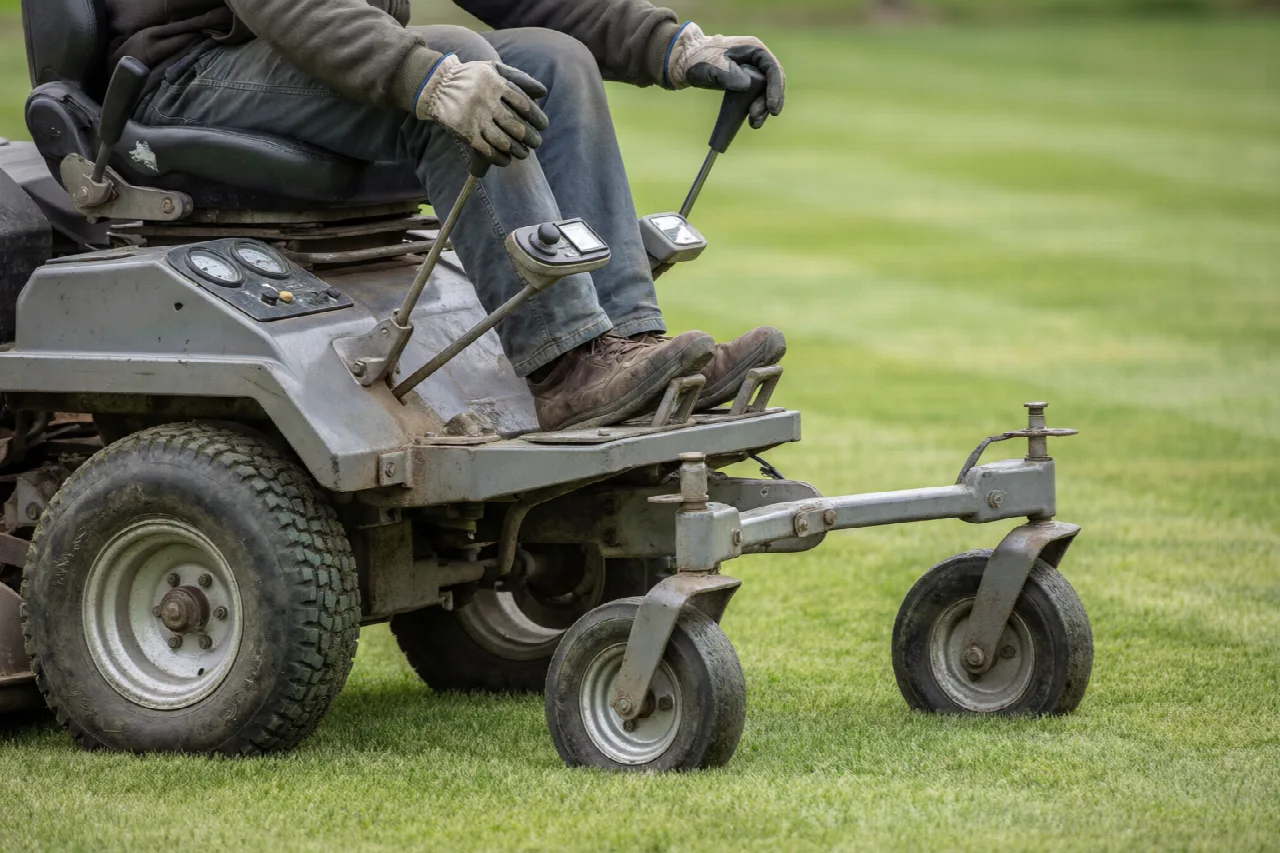
No single person is universally accepted as the inventor of the zero-turn mower. Industry histories usually credit U.S. commercial turf-equipment companies, especially Excel Industries—later known for the Hustler brand—for an early commercially successful rider that could turn in place. Dixon is often named for popularizing the machines and the “ZTR” label. “First” depends on whether the claim means a prototype, a patent, a sale, or the familiar later design.

What a Zero-Turn Mower Is—and Why That Definition Matters

A zero-turn mower, also written as a zero turn mower or called a ZTR mower, is generally a riding mower that can change direction with a near-zero turning radius. The feature that defines the class is not the deck, the seat, or the fact that the operator rides. It is independent control of the drive wheels. Each drive wheel can be sped up, slowed, stopped, or reversed without forcing the other wheel to do the same thing. When one wheel rolls forward and the other rolls backward at a similar rate, the machine can pivot with little or no forward travel.

That independent-wheel idea is why dual-lever steering became the historically typical layout. One lever governs one drive wheel; the other lever governs the other. Push both forward and the mower travels ahead. Pull both back and it travels in reverse. Move the levers unequally and the machine arcs. Move them in opposite directions and it can spin in place. Later machines have used other control hardware, including a steering-wheel or joystick layout that still commands two independent drives. Those later interfaces are not the original invention. They are different ways of asking the same mechanical question: how fast, and in which direction, should each drive wheel turn?

A conventional riding mower or garden tractor works on a different logic. The operator usually steers the front wheels with a steering wheel. Power is sent through a driveline and differential that is not meant to run one rear wheel forward while the other runs backward. The machine can turn tightly for its size, but it still needs a turning radius. It traces a curve instead of pivoting on a point. That difference is easy to miss in casual speech, because both machines are riding mowers and both cut grass. For an invention question, the difference is the whole subject. If “zero-turn” is stretched to mean any rider that turns more tightly than a farm tractor, the origin story dissolves into the much older history of riding mowers, garden tractors, and agricultural dual-drive ideas.

A stricter definition also excludes some machines that look related. An articulated mower bends in the middle. An out-front mower places the deck ahead of the operator and can feel very maneuverable around beds and buildings. Those designs can turn tightly without independently reversing the drive wheels. They are part of the broader story of commercial turf equipment, but they are not automatically zero-turn mowers. The same caution applies to walk-behind machines with dual drives. Independent wheel control existed in more than one form. The everyday question “who invented the zero-turn mower” usually means the riding machine that became familiar on commercial properties: a rider whose drive wheels can be commanded separately so the turning radius approaches zero.

Definition matters because it changes the cast of candidates. A loose definition invites every tight-turning ancestor. A strict definition focuses on independent drive-wheel control on a riding mower offered as a practical tool. Most commonly repeated industry accounts use something closer to that stricter sense. They are not looking for the first person who ever made two wheels turn opposite ways. They are looking for the company that put a usable, commercially recognizable version of that idea into the hands of people who mowed for a living.

The Short Answer: Company Credit, Not One Famous Inventor

Credit is usually given to companies, not to one household-name inventor. That is the most important correction to the way the question is often asked. The zero-turn mower did not enter public memory the way a light bulb or an airplane sometimes does, with a single celebrity attached to a single eureka moment. It emerged inside the U.S. commercial mowing industry, among firms already thinking about turf, landscaping, and outdoor power equipment. The surviving stories are company stories.

The company most often named in those accounts is Excel Industries, associated with the Hustler brand. Industry histories repeatedly attach that name to an early commercially successful riding mower that could turn in place. The usual claim is not that Excel invented every later comfort feature, consumer model, or control variation. It is that the firm is the attribution people reach for when they want the first practical commercial machine in the form later buyers would recognize as a zero-turn rider.

Dixon is the other name that appears again and again. Dixon is widely associated with early popularization and with public use of the ZTR label. In ordinary conversation, “ZTR mower” and “zero-turn mower” now travel as near synonyms. That is a branding and recognition story as much as an engineering story. A company that made the category familiar can be remembered as if it created the category, even when another firm is more often credited with an earlier commercial machine.

Other established mower and turf-equipment makers later offered their own zero-turn machines. Their later presence in the market is not evidence that they originated the idea. It is evidence that the idea worked. Once landscapers and grounds crews saw the value of pivoting around trees, beds, and building corners, larger outdoor-power brands had a reason to follow. Those later entries belong to the adoption chapter, not the invention chapter.

A lone-genius story is a poor fit here for several reasons. The useful machine depended on a combination of chassis layout, independent drive control, and a commercial reason to build it. Those pieces do not have to arrive in one notebook on one afternoon. They can be assembled by a shop, a small manufacturer, or a product team that already knew how conventional riders failed on landscaped ground. Company histories also tend to celebrate the brand, not a single designer. When a later writer wants a tidy answer, the company name is what remains. That is why a responsible short answer names firms and still refuses to say that one person, or even one company, “definitely invented” the entire class.

Why There Is More Than One Origin Story

Search results disagree because “invented” is not one event. It is a family of claims that get collapsed into a single verb. An experimental dual-drive machine can exist in a shop long before anyone offers it for sale. A patented control or drive arrangement can protect one mechanism without covering every later zero-turn mower. A first machine sold to customers can be crude, local, or short-lived and still be first in a commercial sense. A later design can become the one people remember because it was marketed widely, labeled clearly, or copied until it looked inevitable.

Those stages are easy to mix up. Marketing histories often treat them as the same story. An anniversary article may say a company invented the zero-turn mower when the supporting detail, if any, is that the company sold an early model, used a memorable name, or helped the design become common. None of those achievements is trivial. None of them is automatically the same as being first in every sense. A prototype can precede a sale by years. A sale can precede mass recognition by years. A popular product name can arrive after the mechanical idea is already in circulation.

Trademarks and brand language make the confusion worse. ZTR is a compact label. It sounds like a technical category, and in everyday use it functions as one. It can also be a marketing handle closely tied to a particular company in public memory. When a brand name becomes the nickname for a whole class of machines, later readers may assume the brand created the class. That is a common pattern in industrial history, not a special failing of mower companies. The word people use for a thing often comes from the firm that popularized it, not from the first shop that built a working example.

Manufacturer timelines disagree for ordinary reasons as well. Companies remember their own firsts. They date a product from a prototype, a public demonstration, a catalog listing, a first shipment, or a later model that finally looked like the modern machine. They may count a related tight-turning rider as a zero-turn ancestor. A rival may use a stricter definition and start the clock later. Without a shared rule for what counts, two honest timelines can name different “firsts.”

That is why this article does not award a winner among competing origin stories. It is safe to say that Excel/Hustler is the attribution most often used for an early commercially successful zero-turn riding mower, and that Dixon is commonly named for early popularization and for helping make ZTR a familiar label. It is not safe, on general knowledge alone, to treat either claim as courtroom-proof priority, or to treat a commonly repeated industry date as a documented invention year. If a specific year appears in a company history, it should be read as that company’s claim and checked against a primary source before anyone treats it as settled fact.

The Mid-Century Setting Behind the Design

The commercially recognizable zero-turn riding mower belongs to the mid-twentieth-century United States. Ordinary riding mowers and garden tractors already existed by then. So did agricultural machines that used dual drives or otherwise treated the two sides of a vehicle as separately controllable. What changed was the job. Commercial turf work around homes, campuses, parks, and business parks created a demand that a conventional rider met awkwardly. The grass was not an open field. It was a sequence of obstacles: trees, flower beds, fences, light poles, sidewalks, and building corners. A machine that had to loop and back up around every obstacle wasted travel. A machine that could pivot used less unproductive motion.

That demand does not require a romantic origin story. Landscapers and grounds crews already knew where time disappeared. They trimmed edges, recut missed strips, and spent a surprising share of the day getting the deck back into position after a wide turn. A riding mower that could turn in place promised a simpler path: cut closer to the obstacle, spin, and continue. The payoff was maneuverability on finished landscapes, not a new theory of grass. The design makes the most sense when it is placed among makers of commercial turf and outdoor power equipment, not among backyard novelty inventors.

Practical independent control also depended on drive systems that could vary wheel speed and direction smoothly. A zero-turn maneuver is not a single locked setting. The operator is constantly changing the relationship between the two drives: a little more on one side to arc, opposite rotation to pivot, both forward to leave the turn. If those changes are abrupt, the machine is hard to place. If they cannot reverse a wheel independently, the machine cannot complete the signature spin. Hydrostatic drives are commonly described as central to later commercial designs because they give the operator continuous control over speed and direction at each wheel. They were not the only conceivable method. They were a practical way to make independent-drive control usable all day.

The mechanical picture can stay conceptual. Two drive wheels. Separate command of speed and direction. Opposite rotation when a pivot is wanted. A chassis and deck arranged so the operator can use that pivot around real landscape features. That is the mid-century design problem. It does not require a named city, a workshop anecdote, or a precise invention year. Those details are exactly the kind of color that company histories supply and that a careful article should not invent. The high-level setting is enough: after ordinary riders existed, and among commercial turf-equipment makers serving people who needed to mow around obstacles rather than across open ground.

It is also useful to remember what the setting was not. It was not a sudden replacement of all other mowers. Walk-behind machines, conventional riders, and agricultural equipment continued to do the jobs they already did well. Zero-turn machines occupied a specific niche first: commercial or institutional properties where tight trimming justified a different control scheme. Consumer versions and later comfort features came after the category had a reason to exist. Dating the invention to those later homeowner machines would start the story too late and credit the wrong kind of change.

Companies Most Often Named in Early Accounts

Once the question is limited to historical credit, two company names do most of the work, and they do different work.

Excel Industries, remembered through the Hustler brand, is the attribution most often used for an early commercially successful zero-turn riding mower. In that telling, the important achievement is not a later suspension seat or a later consumer paint scheme. It is a riding machine that could be sold as a working tool and could turn in place by independently driving its wheels. Readers will see that claim repeated in industry overviews because it answers the practical version of the invention question: who put a usable commercial example into the world?

Dixon is commonly credited with early popularization and with a close public tie to the ZTR label. That is a different kind of first. A company can help customers recognize a new class of machine, give the class a short name, and spread the idea through sales and marketing without being the only, or even the earliest, builder of a dual-drive rider. If the reader’s real question is “why do people say ZTR?”, Dixon is the name that usually appears. If the reader’s real question is “who is most often credited with an early commercial machine?”, Excel/Hustler is the name that usually appears. Those answers can both be useful. They are not the same answer.

Later, larger outdoor-power brands entered with their own zero-turn machines. That pattern is what successful equipment categories look like. A specialized commercial idea is proven on job sites. Demand becomes visible. Broader manufacturers add the configuration to their lineups. Those later machines matter to anyone studying how the market grew. They do not rewrite the origin question. A brand that became prominent decades after the mid-century emergence of the class is a later adopter unless a specific, well-supported claim says otherwise. This article does not build a model-year timeline of those later entries, because first-model dates are exactly the kind of precise claim that needs a source and is often inflated in brand histories.

Later innovations should be separated from the original invention question with equal care. Operator comfort, suspension, refined decks, quieter operation, and homeowner-oriented versions all changed how zero-turn mowers are used and who buys them. None of those improvements is the same thing as independently driven wheels that let a rider pivot. A company can be important in the comfort era and still be a latecomer to the steering idea. A company can be important in the commercial-origin era and still have little to do with later consumer features. Mixing those chapters produces fake inventors: whoever made the familiar modern machine is treated as if they made the first machine that could turn in place.

None of this is a ranking of current brands. Surviving names are not automatically more authentic than names that changed, merged, or faded. Excel/Hustler and Dixon appear here because they dominate the origin stories a reader will actually encounter, not because a modern product line is being endorsed. The historical question stops at credit for the early independent-drive rider and for the popularization of the category. It does not continue into warranties, dealers, or which present-day machine is “the real” zero-turn mower.

How Early Zero-Turn Machines Differed From Ordinary Riders

The historical novelty was control logic. On a conventional rider or garden tractor, direction is mostly a steering-wheel problem. The front wheels point, the machine follows an arc, and the driveline keeps the powered wheels working together. On a zero-turn machine, direction is a drive problem. The operator changes the relative speed and direction of the drive wheels. The front end, often a pair of casters, follows that change instead of initiating it. The machine does not need the front wheels to carve the turn. It needs the drive wheels to disagree in a controlled way.

Opposite rotation is the clearest expression of that disagreement. If the left drive wheel moves forward and the right drive wheel moves backward, the chassis rotates between them. If the speeds are similar, the rotation happens with little forward progress. That is the near-zero turning radius in mechanical form. Partial disagreement produces a wider arc: one wheel faster than the other, or one wheel driving while the other slows. The operator is not choosing among a few locked turning radii. The operator is continuously writing the path with two drives.

That is why dual-lever steering felt native to the design even though it is not the only possible interface. Each hand already maps onto one wheel. The skill is coordination, not a new theory of mowing. Early commercial users were not buying a party trick. They were buying a way to keep the deck working through a property that was full of things a wide loop would miss or force them to recut. Trees, beds, and buildings made the pivot valuable enough to commercialize. Open-acre farm mowing did not create the same pressure. A wide agricultural turn is often acceptable. A wide turn on a landscaped lot leaves uncut crescents and extra travel.

What should not be lumped in as a zero-turn ancestor is every machine that turned more tightly than a wagon. Articulated frames, compact garden tractors, out-front decks, and various dual-drive work machines can all be part of a family tree of maneuverability. They are not, by themselves, the invention of the zero-turn riding mower. The ancestor that matters to this question is the one that puts independent drive-wheel control under a riding operator so the machine can pivot. Stretch the definition further and the inventor becomes whoever first built a vehicle with two driven sides. That is a different, older, and much blurrier history.

It is fair to say the commercial payoff was faster trimming and less unproductive travel on landscaped properties. It is not fair, without evidence this article does not have, to attach percentages, fuel savings, or safety superiority to that payoff. Early zero-turn machines were a different tool, not a proven upgrade on every measure. They also introduced their own handling character. A machine that can spin is not steered like a garden tractor. That difference is part of why the design took time to become familiar and part of why popularization, not only invention, belongs in the origin story.

How to Read Competing “We Invented It” Claims

Company histories, museum blurbs, and anniversary articles are useful clues. They are not independent proof. The red flags are familiar once the stages of “invented” are kept separate. A page that uses a single exact year for invention, first sale, first demonstration, and trademark success is compressing a messy process into a slogan. A page that names one person as the undisputed creator of the entire category is doing the same compression with a biography. A page that treats a popular product name as legal ownership of the generic idea is mixing branding with engineering. A page that calls every later improvement part of the original invention is stretching credit forward until it becomes advertising.

It is often fairer to say a company commercialized or popularized the design than to say it invented the idea in an exclusive sense. Commercialized means customers could buy a working machine. Popularized means enough people saw, used, or heard the name that the category became ordinary language. Invented, in the strongest sense, would need a clearer chain: what was built, how it controlled the wheels, when it was shown or sold, and why earlier dual-drive or tight-turning machines do not already count. A patent can support one piece of that chain. It cannot, by itself, prove that one document covers every later zero-turn mower. A model name can mark a commercial beginning. It cannot, by itself, erase rival prototypes.

A stronger historical claim would show its work. It would define the machine tightly enough that a conventional rider or an articulated mower could not sneak in. It would distinguish demonstration from sale and sale from mass adoption. It would treat manufacturer timelines as claims. It would not need invented diary entries, workshop legends, or a courtroom-style verdict against every other firm. This article cannot supply that archival case, and it should not pretend to. The responsible public wording is more modest: Excel/Hustler is commonly credited with an early commercial machine; Dixon is commonly credited with early popularization and ZTR branding; the broader idea of independently driven wheels has more than one possible ancestor.

This subject is a history-of-equipment question. It is not a reason to rank current mowers, declare a surviving brand the authentic original, or tell a reader which machine to buy. Later consumer models, comfort features, and deck refinements are real developments. They are not the invention of zero-radius independent-drive steering. Manufacturer anniversary stories can overstate exclusivity. Treat them as claims. The everyday question still has an answer, just not a single-person answer. Credit is shared, company-level, and sensitive to how “first” is defined.

Frequently Asked Questions

Who is commonly credited with inventing the zero-turn mower?

There is no universally agreed individual inventor. Common accounts credit U.S. commercial turf-equipment companies. Excel Industries, associated with the Hustler brand, is the company most often named for an early commercially successful rider that could turn in place. Dixon is commonly named for popularizing the machines and the ZTR label.

Is a ZTR mower the same thing as a zero-turn mower?

In everyday use, yes. ZTR is widely used as shorthand for a zero-turn or zero-turning-radius mower. The label is also part of the popularization story. A familiar abbreviation can make one company look like the originator even when the mechanical idea has more than one claimed beginning.

When did zero-turn mowers appear?

Recognizable commercial zero-turn riding mowers emerged in the mid-twentieth century, after ordinary riding mowers already existed. Exact invention years, first-sale years, and trademark dates are the kind of precise claims that should be checked against primary sources rather than treated as settled from company timelines.

Why do different companies say they were first?

They may be talking about different events: a prototype, a patented mechanism, a first machine offered for sale, or the design that later became familiar. Brand names and marketing histories often collapse those stages. A company that popularized the category can be remembered as the inventor without being the only early builder.

Are garden tractors and articulated mowers zero-turn mowers?

Not by a useful definition. A conventional garden tractor typically steers the front wheels and does not independently reverse its drive wheels to pivot. An articulated machine can turn tightly by bending in the middle. A zero-turn mower changes direction by independently controlling the speed and direction of its drive wheels.