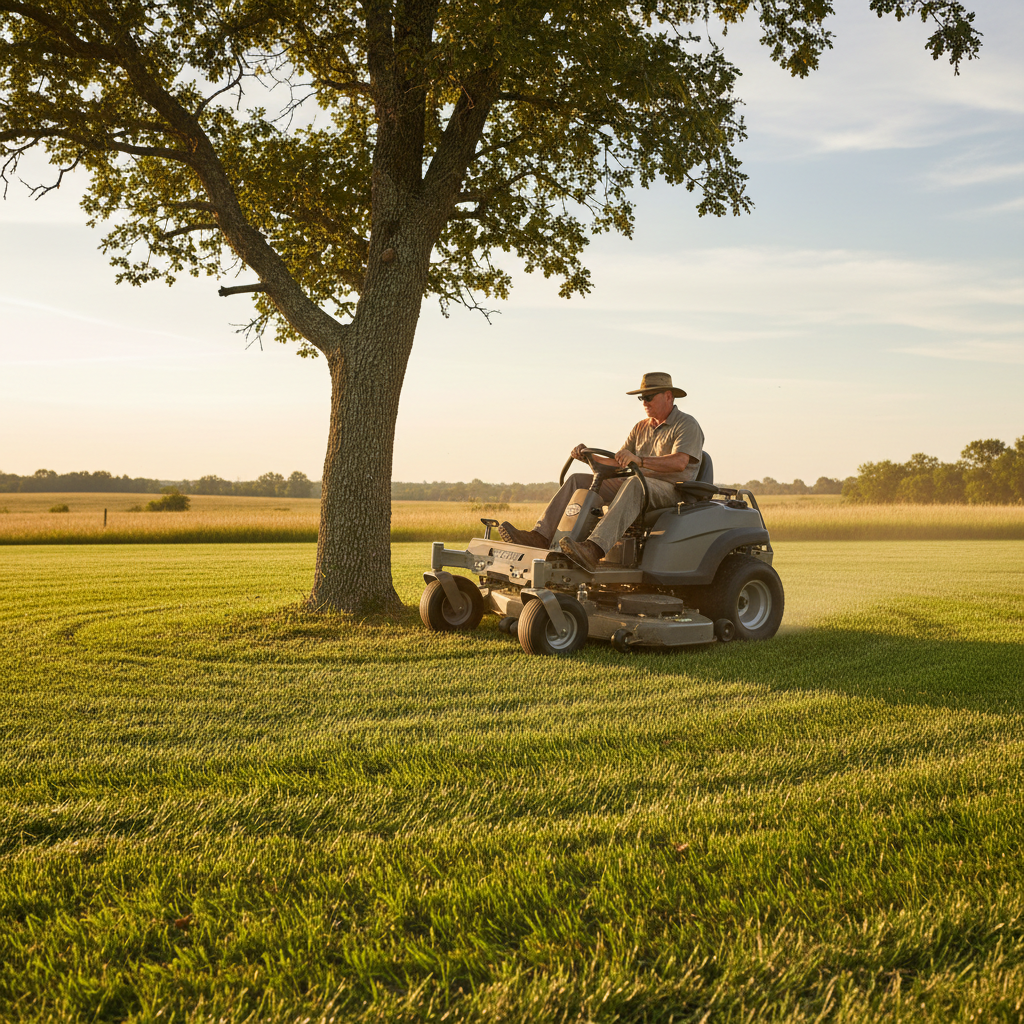
Most U.S. outdoor-power and turf-equipment histories credit Excel Industries with the first widely recognized commercial zero-turn riding mower, sold as the Hustler. That credit refers to an early production machine that drove its left and right wheels independently and could turn in a near-zero radius. It is not a claim that nobody ever built a homemade dual-drive mower earlier, and it is separate from later brands that helped make the design common.
Who Is Usually Credited With the First Zero-Turn Mower
When people ask who made the first zero-turn lawn mower, they usually want a name they can use, not a museum catalog of every shop-built experiment. In that practical sense, the standard answer in U.S. commercial-equipment history is Excel Industries and the Hustler riding mower. The usual credit is attached to a manufacturer and a named production machine, not to a single inventor whose workshop story can be verified from public knowledge alone.
That distinction matters. “Made the first” can sound like one person invented independently driven mower wheels out of nowhere. The better reading is narrower: Excel put a riding mower into commercial production that steered by driving the left and right wheels separately, giving the machine a turning radius close enough to zero that the category later took the name zero-turn, or ZTR. Later companies sold many more machines and made the layout familiar to homeowners. Those later roles are real, but they are not the same as the early commercial-history credit.
It is also important not to treat the usual answer as a courtroom finding. Mechanical ideas travel through sketches, farm repairs, patents, prototypes, and products at different times. Similar dual-drive or skid-steer thinking already existed on other vehicles. What outdoor-power histories most often mark is the first widely recognized production zero-turn riding mower, not an unknowable claim that no one else ever welded two independently driven wheels onto a cutting deck.
Do not read the credit as a current brand “owning” the invention. Company names change, product lines expand, and many manufacturers later offered zero-turn models. The historical point is simpler: among commonly repeated U.S. turf-equipment accounts, Excel’s Hustler is the machine most often named as the first commercial example of the type.
Secondary write-ups sometimes attach a mid-1960s date to that machine. Those dates circulate widely, but they belong with other details that need a primary source before anyone should treat them as settled. For a reader trying to understand the origin, the useful fact is the manufacturer-and-machine pairing, not an unsourced calendar year.
What Counted as a Zero-Turn Mower
A historical claim about the “first” machine only makes sense if the machine type is defined. In this context, a zero-turn riding mower is a sit-down mower whose propulsion system can drive the left and right drive wheels independently. Slow one side, stop one side, or reverse one side, and the machine pivots instead of swinging through a wide front-wheel arc. With the wheels driven in opposite directions, it can effectively spin about its own axis. That is what people mean by a zero-turn radius: not that the mower occupies no space, but that the turning circle can collapse to roughly the width of the machine.
A conventional riding lawn mower, lawn tractor, or garden tractor usually steers the other way. The operator turns a steering wheel or tiller, the front wheels pivot, and the rear wheels follow. That layout is familiar, stable at modest speeds, and well suited to open lawns. It also needs room. Trees, flower beds, monuments, fence corners, and building walls force extra looping because the machine cannot fold its path as tightly as a dual-drive mower.
Independent wheel drive is the mechanical heart of the idea. Dual-lever steering later became the familiar control layout: one hand lever for each drive wheel, so the operator can speed up, slow, stop, or reverse each side. It is safe to say that this two-lever arrangement became the category’s common language. It is not safe, from general knowledge alone, to describe the exact lever shape, hydrostatic brand, horsepower, deck width, or travel speed of the first production unit. Those details are specifications, and specifications need a source.
Hydraulic or hydrostatic drive later became a typical way to give each wheel smooth, independent control. That does not mean the first commercial machine must be described as “the first hydrostatic zero-turn,” and it does not mean every early dual-drive experiment used the same transmission hardware. The historical definition is the steering concept applied to a riding mower: independent left and right drive, a very tight turning radius, and a machine sold to cut grass rather than to load dirt or pull implements as its main job.
The contrast with a garden tractor is especially useful. A garden tractor is built around versatility and front-wheel steering. A zero-turn riding mower is built around maneuvering a cutting deck through obstacles. Both are riding machines. They are not the same steering family.
Prototype, Patent, and Commercial Firsts Are Not the Same Thing
The hardest part of the question is the word “first.” A homemade dual-drive mower could have existed in a shop before any named production model. A patent could describe independently driven wheels without proving that a finished mower was sold. A prototype can demonstrate an idea and still never become a product. A machine offered for sale can define a market category even if someone else sketched the same layout earlier.
Those events are not interchangeable. The honest public answer is usually the first widely recognized production zero-turn riding mower. That is a commercial-history answer. It is easier to name a manufacturer than a single inventor because companies leave product names, sales channels, and later industry memory, while individual shop experiments often leave none of those traces in sources a general reader can check.
Similar independent-drive steering already existed on other vehicles. Skid-steer loaders and other dual-drive machines use the same basic idea: change the speed or direction of one side relative to the other and the vehicle turns in a tight space. The early commercial zero-turn mower is best described as a turf application of a known vehicle idea, not as the sudden invention of independent wheel drive itself. That framing avoids two common errors. One is inflating a mower company into the inventor of all dual-drive vehicles. The other is dismissing the mower’s importance because the steering concept had cousins in other industries.
Patents are especially easy to over-read. A patent can protect a mechanism, a control layout, or a refinement without proving commercial firstness. It can also arrive after a machine is already being built, or describe something that never reached customers. Without a specific patent document in hand, it is better not to treat any one filing as the birth certificate of the category. The same caution applies to “lost” prototypes and unnamed farmers. Those stories may be true in some local case, but they are not a substitute for the production machine that later writers can still point to by brand and model family.
So the usual credit to Excel and the Hustler should be held in that middle position: stronger than folklore, weaker than an absolute claim that no earlier experiment existed, and different from a patent race.
Why the Design Mattered to Early Users
The design solved a real mowing problem. Large turf is full of things a machine must go around: trees, beds, monuments, playground equipment, lamp posts, and the corners of buildings. A lawn tractor can do that work, but each obstacle costs extra looping. A rider who can stop one wheel and swing the deck around a trunk spends less time recrossing ground already cut and less time making a second pass to clean up uncut crescents.
That advantage showed up first where the lawn was a job, not a Saturday chore. Parks, schools, cemeteries, campuses, and similar grounds have enough area and enough obstacles for tight turning to matter all day. Early demand was therefore more commercial and institutional than typical suburban homeowner use. A small rectangular yard can be mowed with a walk-behind or a conventional rider without the operator feeling the turning-radius penalty as sharply. A cemetery full of markers is a different problem.
None of that requires invented productivity numbers. There is no need to say the first machine cut mowing time in half, covered a fixed number of acres per hour, or paid for itself in a set number of seasons. The qualitative point is enough: reducing wasted motion around obstacles is valuable on large, interrupted turf, and that is the job a zero-turn riding mower was trying to do better than a lawn tractor.
The operator experience also changed. Dual-lever control asks for a different kind of coordination than a steering wheel. Early users were often people who already thought of mowing as equipment work. That helps explain why the idea could catch on among commercial crews before it became a common homeowner machine. The category did not have to win the suburban driveway first in order to be historically important.
How Zero-Turn Mowers Spread After the First Commercial Machines
Once an early commercial design existed, the story is no longer about a single maker. Other manufacturers entered the category, copied and varied the dual-drive idea, and helped make zero-turn mowers a normal part of the outdoor-power market. Excel and the Hustler should not be overstated as the whole history. They are the usual commercial starting point, not the entire later industry.
Dixon is often mentioned in secondary accounts as an important later popularizer, especially as more machines reached users outside professional crews. That is commonly reported later history. It is not, on the evidence available here, a rival claim that Dixon built the first commercial zero-turn riding mower. Later popularization and original commercial recognition are different achievements. A company can matter enormously to how familiar a machine becomes without being the first to offer the type for sale.
Over time, major outdoor-power brands added zero-turn models. The market split into branches that still share independent wheel drive: residential sit-down machines for larger home lawns, heavier commercial sit-down mowers for all-day turf work, and later stand-on mowers that put the operator on a platform instead of in a seat. Those branches are descendants of the same steering idea. They are not evidence of who built the first production unit, and they should not be read backward into the origin story as if today’s product families were present at the start.
Homeowner or residential zero-turn mowers became familiar well after the commercial pattern was established. The timing is easy to overstate with unsourced “first consumer ZTR” claims, so the cautious statement is enough: the design moved from a specialized commercial tool toward a broader riding-mower option as more makers offered it and as larger home properties made tight turning attractive. Today’s residential machine is usually quieter in marketing tone, more comfort-oriented, and surrounded by features the earliest production units are not known, from public knowledge alone, to have carried. The kinship is the dual-drive layout, not a claim that the first Hustler was a suburban lawn tractor in disguise.
Hydrostatic or hydraulic independent drive became a typical later feature because it fits the control problem so well. Smooth, variable speed to each wheel makes dual-lever steering practical for long days. That technical habit of the mature category should not be used to rewrite the first-machine definition around one transmission type.
Machines and Brands People Often Mix Into the Origin Story
Famous tractor and lawn-equipment brands later sold zero-turn mowers. They are not usually credited with the original commercial machine. Seeing a well-known name on a modern ZTR is evidence of how thoroughly the idea spread, not evidence that the brand invented the category. The same is true of companies that built conventional riders for decades and then added a zero-turn line. Continuity of a brand is not continuity of a first.
A skid-steer loader can share the steering concept without being a lawn mower. Dual-drive vehicles turn by changing wheel or track speeds; that does not make every skid-steer a missing chapter in mower history. Likewise, a garden tractor with a mower deck is still a front-steer tractor. Putting a cutting deck under a conventional rider does not create a zero-turn radius. The deck is not the definition. The independent drive and the resulting turning radius are.
Stand-on mowers, wide-area commercial mowers, and robotic mowers do not belong in the “first machine” story except as later or separate developments. A stand-on is a later operator position on a dual-drive chassis. A wide-area mower is about coverage and deck arrangement. A robotic mower navigates by sensors and programs, not by a rider using independent wheel levers. Backdating any of those into the first commercial zero-turn riding mower confuses a family resemblance with a birth date.
Geography needs the same restraint. The usual credit is a U.S. commercial-equipment story. Local firsts elsewhere may exist and may not be documented in the same English-language industry accounts. That is not a survey of every country, and it is not a “world’s first” claim. It is a statement about which origin story a reader is most likely to meet, and how far that story can honestly be pushed.
People also mix prototype and production language when they see an old machine in a photo or a collection. A surviving example can illustrate the type. It cannot, without documentation, be declared the original unit. Appearance, a brand decal, or a later restoration is not a chain of custody.
How to Read Conflicting Claims About the First Zero-Turn Mower
Origin claims online often disagree because they are answering different questions with the same word. Ask what “first” is supposed to mean. First prototype? First patent? First machine offered for sale? First design that became widely known? First machine aimed at homeowners? Those are different events. An article that never says which one it means is usually repeating a slogan, not tracing a product.
Prefer accounts that name a manufacturer and a production machine over stories that only say “invented by” with no product. Excel and the Hustler meet that test in the usual U.S. commercial telling. A claim that names only a person, with no machine, no maker, and no sense of whether the unit was sold, is weaker for a general reader even if the person was involved in some real workshop. Individual inventors, exact dates, and any “world’s first” wording should stay uncertain unless a primary source is available.
When two articles name different firsts, look at the scope each writer chose. One may be talking about the first widely recognized commercial rider. Another may be talking about a later consumer model, a control-layout patent, or a regional shop machine. Those can all be “first” in a narrow sense and still not contradict the standard commercial-history answer. Conflict is real when two sources claim the same kind of first for different makers without explaining the evidence. In that case, the careful move is not to pick a winner from blog confidence. It is to keep the production-machine credit and treat the rest as unverified.
Unsourced dates are a special case. Many pages repeat a year as if it were a serial number stamped on the first frame. Those dates are not automatically false. They are unverified from the information a general article can responsibly use. The same is true of founding stories, factory towns presented as must-know facts, sales milestones, and quoted advertising lines. Leave them out rather than decorate the origin with details that cannot be checked here.
Marketing language has tells. “We invented zero-turn,” “the original,” and “the only real first” are claims of ownership more than they are historical method. A careful origin statement sounds more like this: a named manufacturer offered a production riding mower with independent wheel drive and a near-zero turning radius, and later writers treat that machine as the start of the commercial category. That sentence can be true alongside later popularizers, alongside earlier experiments that left no catalog, and alongside modern brands that now sell most of the machines people see at dealers.
What remains uncertain, even after the usual credit is given, is exactly the list a skeptical reader should keep in mind. Who personally designed the first production layout? What year, to the month, a customer could buy one? Whether some undocumented dual-drive mower ran earlier on a private property? Whether a particular patent, if one exists in the background, matches the machine people remember? Those questions need documents. They do not need to block the usable answer.
The usable answer stays stable. A zero-turn lawn mower, in the historical sense that matters to this question, is a riding mower that steers by independent left and right wheel drive and can turn in a very tight circle. U.S. industry memory most often credits Excel Industries’ Hustler as the first widely recognized commercial machine of that type. Prototype, patent, and “world’s first” claims are a different kind of statement. Later makers, including Dixon and eventually many major outdoor-power brands, spread the idea into commercial fleets and then into residential yards. The dual-drive concept had relatives on other vehicles, and today’s sit-down, stand-on, and robotic machines should not be collapsed into that first production credit. Read any sharper claim as a reminder to ask which kind of first is being sold.