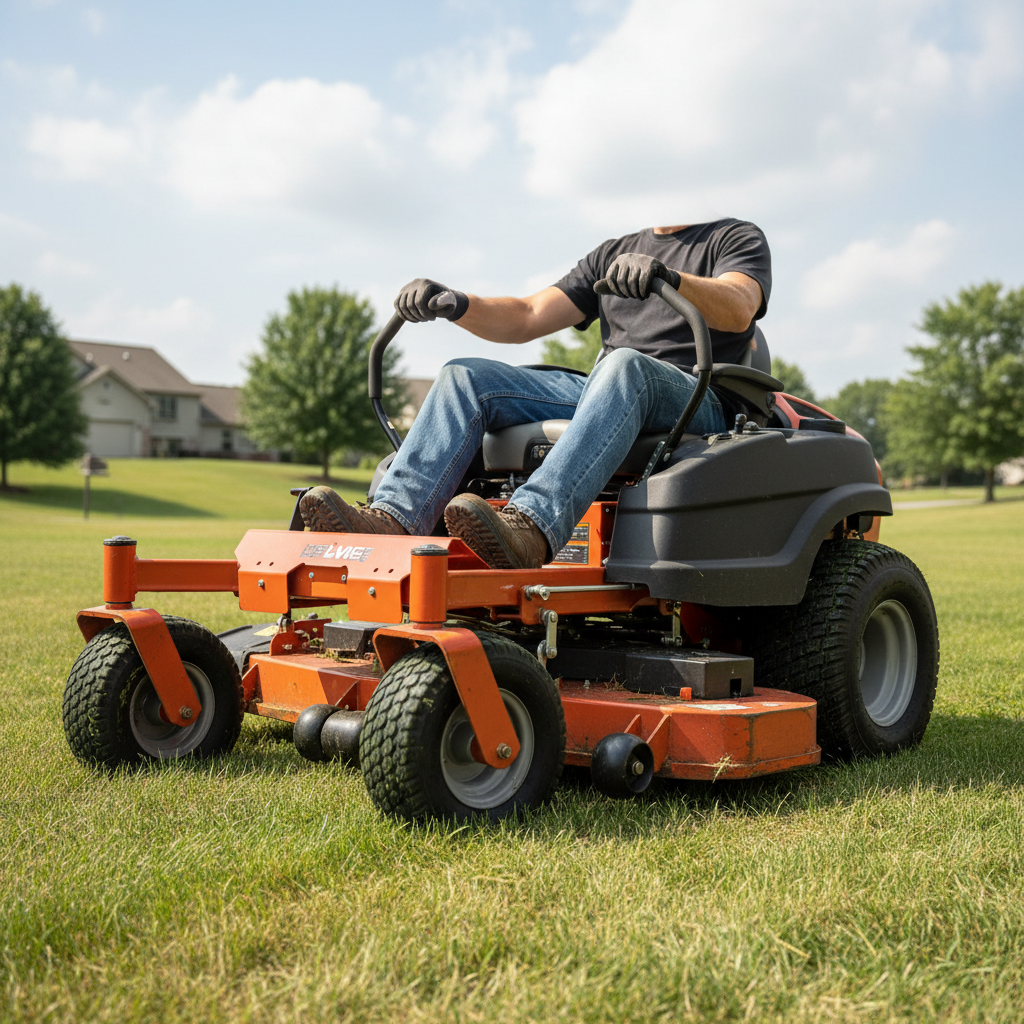
The first commercially successful zero-turn lawn mower is most often credited to Excel Industries of Hesston, Kansas, which introduced a Hustler riding mower in the mid-1960s. That credit usually refers to a commercial machine whose independently driven wheels could spin the mower in place, not to a single uncontested personal inventor or the only early prototype. Dixon later helped popularize residential zero-turn mowers in the 1970s. Earlier riding mowers already existed, but they generally steered like small tractors and could not make a true zero-radius turn.
What Makes a Lawn Mower a Zero-Turn Mower
A zero-turn lawn mower is a riding mower built so its two drive wheels can be commanded independently. One wheel can roll forward while the other slows, stops, or rolls backward. That independent wheel drive lets the machine pivot about a point between the drive wheels. In ordinary language, it can spin in place, or come close enough that the leftover turning radius is negligible. The phrase zero turning radius, often shortened to ZTR, names that steering behavior. It is not a brand, a deck style, or a promise that every historic machine used the same transmission.
What zero turning radius means
Turning radius is the space a vehicle needs to complete a change of direction. A conventional lawn tractor traces an arc. Its front wheels steer, its wheelbase stays long, and the rear wheels generally drive together, so the machine needs room to swing. A zero-turn mower is designed so that arc can collapse. When the drive wheels rotate at different speeds, the path curves tightly. When they rotate in opposite directions, the mower yaws around its own center instead of traveling through a wide U-turn.
That is the distinctive claim of the category. The operator is not asking a steered front axle to lead a long vehicle around an obstacle. The operator is asking the drive wheels to rotate the whole platform. Caster-style front wheels, common on this layout, follow that motion rather than initiating it. They swivel as the rear of the machine dictates the path. The result looks dramatic from the sidewalk—a rider that can face a tree, pivot, and leave—but the underlying idea is simple differential control of two wheels.
How the drive wheels and controls create the turn
Most zero-turn mowers replace the steering wheel with a pair of lap bars or steering levers, one for each drive wheel. Push both levers forward and both wheels drive forward. Pull both back and the machine reverses. Advance one lever farther than the other and the mower curves. Push one and pull the other and the machine rotates. Small hand movements produce small heading changes; opposite lever positions produce the tight pivot people mean by zero turning radius.
The controls are only the human interface. The mechanical fact that matters historically is that each drive wheel can receive its own speed and direction command. Later machines often use hydrostatic transmissions to deliver that control smoothly, and many operators now treat hydrostats and lap bars as the definition of a ZTR. That association is modern shorthand, not a complete history. Early commercial designs were not all built the same way. What placed a machine in this family was the ability to drive the wheels independently enough to pivot in a tight space, not a single pump-and-motor recipe, engine brand, or deck width.
How this differs from a lawn tractor or ordinary riding mower
A conventional lawn tractor is a small, steered vehicle that also cuts grass. The operator turns a wheel. The front tires change direction. The rear tires supply traction and usually act together. Around a bed, mailbox, or building corner, the machine still has to complete an arc or a three-point turn. An ordinary riding mower that uses the same geometry is not a zero-turn mower, even if it is a rider and even if it is powerful.
The contrast is easiest to see as a set of roles, not as a scorecard of which machine is “better.”
| Feature | Conventional lawn tractor | Zero-turn mower |
|---|---|---|
| Primary steering | Steering wheel and front wheels | Lap bars or levers commanding the drive wheels |
| Drive wheels | Generally driven together | Independently controlled |
| Front wheels | Steered | Usually casters that follow the turn |
| Typical turn | An arc that needs room | A tight pivot about the machine’s center |
| Familiar feel | Like a small tractor | Unlike a tractor until the levers become habit |
Calling a machine a zero-turn mower is therefore a claim about steering geometry and wheel control. It is not a claim that every modern ZTR works identically, and it is not a claim that earlier riders were somehow not real riding mowers.
Who Is Commonly Credited With Inventing It
When people ask who invented the zero-turn lawn mower, secondary historical accounts most often name a company and a commercial product, not a lone inventor with a single sketch. Excel Industries of Hesston, Kansas, and its Hustler riding mower are the names that appear again and again as the first commercially successful zero-turn machine.
A company-and-product attribution, not a courtroom finding
That credit is best understood as a commercial-introduction story. A firm put a riding mower on the market whose independently driven wheels could turn the machine in place, and later writers treated that product as the origin of the category now called a ZTR. The attribution attaches to Excel and to the Hustler name, which became closely associated with professional and commercial mowing. In popular telling, “invented the zero-turn lawn mower” usually means “introduced a marketable rider that could spin in place for paid turf work,” not “was the first person to imagine two wheels moving in opposite directions.”
Repeating a common attribution is not the same as proving a legal conclusion. It does not establish that one company owns the idea of independent wheel drive, that no homemade machine existed earlier, or that a court has declared a sole inventor. Company histories, trade lore, and later marketing copy tend to compress a messy process—shop experiments, existing vehicle ideas, fabrication, and a product launch—into a clean origin sentence. For a reader, the honest version is narrower and more useful: Excel’s Hustler is the machine most often credited as the first commercially successful zero-turn riding mower.
Why a single personal inventor is hard to name responsibly
The surviving public story is a firm-and-brand story. Teams design machines. Shop practice, existing industrial ideas, and later sales language all get mixed into anniversary retellings. Without a sourced contemporary record in front of the reader, attaching one personal name as “the inventor” pretends to a precision the commonly repeated account does not actually give. The cautious answer to the primary question is therefore institutional and commercial: Excel Industries, Hustler, mid-1960s commercial success—not a lone genius and not an uncontested legal title.
That caution is not a dodge. It is how invention credit works in a product that sits at the intersection of farm-adjacent machinery, small engines, and landscaping. The distinctive contribution, as the story is usually told, was packaging independent wheel drive as a practical riding mower that customers could buy and use. Credit for that package is what most historical summaries are trying to assign when they name Excel and Hustler.
When It Appeared, and What “Invented” Can Mean
The usual origin story places a commercial Hustler machine in the mid-1960s. That dating is widely repeated, and it is the safest general timeframe when the question is who invented the zero-turn lawn mower. A more specific calendar year, model code, serial-number anecdote, or “first in the world” claim is a different kind of statement. Those details circulate in company timelines and enthusiast retellings. They should be treated as commonly reported only when a reader can check a primary source. They are not required to answer the basic historical question.
Three different meanings of invented
Part of the confusion comes from the word itself. In this category, invented can mean at least three things, and they are not interchangeable.
- A working prototype. Someone in a shop built a rider that could pivot and used it to cut grass. Homemade and experimental machines are difficult to rule out. Independent wheel control is a mechanical idea that can occur to more than one fabricator, and local shops do not always leave a paper trail. Saying a commercial product appeared in the mid-1960s is not the same as saying no one had ever bolted a similar drive together earlier.
- A patent. A government office granted rights in a particular design, control layout, or drive arrangement as written in an application. Patents answer a legal question about a claimed invention. They do not automatically identify the first machine that worked, the first machine sold, or the design that later defined the consumer category. Different patents can cover different pieces of a mower. Later patents can improve an already commercial idea. Without a specific filing in view, it is not responsible to declare who held “the first valid zero-turn mower patent.”
- A commercial product. A company offered a riding mower for sale whose independently controlled drive wheels produced a near-zero turning radius, and customers could buy that capability as a finished machine. This is the sense in which Excel and Hustler are usually credited. It is also the sense that matters most to the later industry, because a product that can be manufactured, serviced, and sold is what turns a shop idea into a category.
Why sources disagree
Sources disagree about who invented the machine because they are often answering different versions of the question. One writer is talking about a commercial launch. Another is talking about a consumer model a decade later. A third is talking about a patent, a local prototype, or a later technical refinement. Marketing language then flattens those distinctions into “we were first.” The disagreement is less mysterious once invented is unpacked.
A cautious timeline therefore looks like this: powered mowing and riding mowers already existed; a commercially successful zero-turn rider is generally dated to the mid-1960s and associated with Excel’s Hustler; residential popularization is generally associated with the 1970s and with Dixon; later decades brought refinements rather than a second invention of the basic idea. Anything more precise—an exact year presented as settled fact, a claim that no earlier experimental machine existed—goes beyond what a general historical summary should assert.
How Zero-Turn Mowers Differed From Earlier Riding Mowers
Powered walk-behind lawn mowers and powered riding mowers both predated zero-turn machines by decades. The zero-turn layout did not invent the idea of sitting down to cut grass, and it did not invent the gasoline-powered lawn mower. Readers who picture a world of only push mowers until the 1960s are mixing up categories. What earlier riding mowers generally did not do was spin in place.
Why older riders could not make the same turn
A conventional lawn tractor, and many older riding mowers, steer mainly with the front wheels. The rear wheels supply traction and usually drive together. When the operator turns the wheel, the machine follows a curved path whose tightness is limited by wheelbase, steering angle, and the fact that both drive wheels want to travel in the same direction at related speeds. Around a tree, a mailbox, or a flower bed, the operator has to swing wide or make a multi-point turn. Uncut patches and extra passes are a normal result of that geometry, not a failure of effort.
The zero-turn layout changed the job by changing which wheels decide the path. Independent wheel drive lets one drive wheel slow, stop, or reverse while the other continues. The machine can yaw about a point between those wheels. Combined with castering front wheels, that produces the tight pivot people mean by zero turning radius. The operator is no longer asking a front axle to lead a long vehicle through an arc.
What was distinctive—and what was not brand-new to all vehicles
That mechanical idea is distinctive in lawn-mower history. It is not a claim that independently driven wheels had never appeared on any other kind of vehicle. Tracked machines, some industrial equipment, and various experimental vehicles have used differential or opposite-side drive for a long time. What was new in the mower story, as commonly told, was applying that control scheme to a riding lawn mower and selling it as a practical way to cut turf around obstacles.
It is also easy to confuse zero-turn riders with other special-purpose mowers that are not the same invention. Articulated machines, out-front deck riders that still steer like tractors, and wide-area mowers can all look professional without being ZTRs. The test is not how aggressive the machine looks. The test is whether the drive wheels can be commanded independently enough for the machine to pivot about its own center. If they cannot, the machine may still be an important riding mower. It is not the invention this question is asking about.
Competing Claims and Later Popularizers
Excel’s commercial Hustler is the name most often attached to the origin of the professional zero-turn rider. A second name appears just as often when the story shifts from invention to everyday use: Dixon. Dixon is widely associated with popularizing zero-turn mowers for homeowners in the 1970s. In that telling, the design moves from commercial property work into residential yards, and a broader public learns what lap bars and a spinning rider can do.
Inventors, popularizers, and improvers are not the same role
Those are different kinds of credit. Popularizing a machine for homeowners is not the same as introducing the first commercially successful commercial unit, and neither is the same as holding a particular patent. Later manufacturers then refined transmissions, operator platforms, controls, and suspension. Stand-on mowers, more sophisticated hydrostatic systems, and comfort or traction improvements belong in that later chapter. They are developments of the zero-turn idea, not a second invention of independent wheel drive for turf.
The commercial-versus-residential split also explains why two honest summaries can sound as if they disagree. A landscaping-centered history starts with a professional rider in the mid-1960s and treats later homeowner machines as the design’s afterlife. A consumer-centered history may start when ordinary households could buy a ZTR and treat the earlier commercial machine as background. Both can be describing the same mechanical idea at different points on the path from shop floor to suburban garage.
Why several companies can claim an early first
More than one company may claim an early design, a first consumer model, or a key patent. That is normal in a product category that matured over decades. A firm can be first to a regional market, first to a particular customer group, or first to a later technical feature without being the inventor of the category. Readers should expect overlapping origin stories, especially in advertising and anniversary pages. Those stories are evidence of how companies want to be remembered. They are not automatically evidence that the earlier commercial attribution is wrong, and they are not a reason to declare a living manufacturer the true inventor.
It is also a mistake to turn the history into a brand ranking. Which current line cuts more cleanly, which dealer network is larger, or which machine suits a particular yard are buying questions. They do not settle who introduced the steering idea as a commercial riding mower. The historical question stops at attribution, dating, and the difference between inventors, popularizers, and improvers.
Why the Design Caught On
The design caught on because it changed the geometry of everyday mowing. The invention is easier to understand once the job, not only the patent-or-product debate, is in view.
Where the layout is most useful
Around trees, beds, buildings, fences, and playground equipment, a conventional rider spends time making three-point turns and leaving slivers of uncut grass. A zero-turn mower can face the obstacle, pivot, and leave with fewer extra passes. In a large open lawn that still has many obstacles, that tighter maneuvering can mean less time spent repositioning and less leftover fringe to clean up with a trimmer. Commercial crews adopted the machines because time around obstacles is expensive. Homeowners adopted them later because the same geometry is satisfying on a yard full of trees—once the levers make sense.
The benefit is qualitative, not a promise of a particular work rate or fuel saving. An experienced operator on open turf with scattered obstacles can keep the machine moving instead of stopping to reset a wide turning arc. A new operator may spend the first hours learning not to scalp, not to over-correct the levers, and not to back into objects. The same independent drive that makes the machine nimble also makes it sensitive to small hand movements. The learning curve is part of the design’s afterlife, not a footnote.
Where it is less suitable
The layout is most useful where the work is mowing turf among obstacles and the ground is reasonably open and not steep. Large commercial properties, campuses, and sprawling residential lawns are the settings people usually have in mind. The layout is less suitable when the operator wants a garden tractor’s personality: towing, ground-engaging tools, and a steering wheel that behaves like a small farm tractor. Zero-turn mowers can have hitches and accessories, but they were not conceived as general-purpose tractors that also happen to cut grass.
Slope is a practical limit as well. Independently driven rear wheels and castering front wheels do not automatically make a machine sure-footed on a bank. Many riders find other machine types more comfortable or more appropriate on steep ground, and operator manuals treat slope work as a serious hazard. Nothing in the origin story is a safety guarantee. A zero-turn mower can tip, slide, or get away from an unpracticed operator. Anyone using one should follow the machine’s manual and labels, wear appropriate protection, and treat unfamiliar slopes as a reason to stop and reconsider rather than as a place to test the turning radius. If the ground, attachments, or repairs are beyond ordinary homeowner work, a qualified technician or a professional landscaping service is the safer next step.
The invention’s staying power is that combination of a clear mechanical trick and a common landscaping problem. It is not a claim that zero-turn mowers replaced every other mower type, or that they are the right machine for every yard.
How to Read Invention and “First Mower” Claims
Company timelines, advertising language, and patents answer different questions. A timeline may record when a firm sold a machine it now calls its first zero-turn model. Advertising may call that machine the first of its kind. A patent may protect a linkage, a control, or a drive detail that is only one piece of the mower. All three documents can be accurate in their own terms and still disagree about who invented it.
A short checklist for first-mower language
A useful way to read a first-mower claim is to ask three smaller questions:
- Was there a dated commercial product that customers could buy, or only a shop prototype and a later memory of it?
- Did that product actually have independently controlled drive wheels and a near-zero turning radius, or was it a conventional rider with aggressive styling?
- Is the claim about professional machines, homeowner machines, or a later feature such as a new transmission, control layout, or operator platform?
Claims that skip those distinctions are usually doing brand work, not historical work. Two companies can tell different origin stories without either one fabricating a machine out of nothing. One may have sold an early commercial rider. Another may have reached homeowners first in a particular decade or region. A third may have patented a refinement that later became common. Each story can be locally true. The reader’s job is to notice which milestone is being celebrated.
None of those stories should be treated as courtroom truth unless the reader is looking at an actual legal decision. This article does not offer one. The responsible public answer remains an attribution: secondary accounts most often credit Excel Industries and its Hustler mower with the first commercially successful zero-turn riding mower in the mid-1960s; Dixon is widely associated with bringing the idea to more residential users in the 1970s; later firms improved transmissions, platforms, and comfort. That is enough to answer who invented the zero-turn lawn mower in the sense most people mean, and it leaves room for the quieter truth that a prototype, a patent, and a product launch are not the same event.