

The Short Answer Depends on Product Type and Lawn Condition
“After fertilizing” is not one situation. It can mean you just set the spreader down, you treated the lawn earlier today, or you fed the grass yesterday and are back on a normal mowing day. Those moments are not interchangeable, and a single yes or no does not cover them.

Pros
- Powerful 80V brushless motor delivers 32HP gas-equivalent performance with quiet fume-free operation and no engine maintenance.
- Complete kit includes four 6.0Ah batteries and 600W charger for substantial runtime up to 1.5 acres.
- SmartCut technology and 42-inch heavy-duty steel deck ensure consistent cuts without bogging in tough conditions.
- Versatile towing up to 350 lbs and optional cargo hauling plus comfort features like high-back seat and LED lights.
- Strong 4-year limited warranty and full compatibility with the Greenworks 80V tool ecosystem.
Cons
- Rear utility cargo bed for 200 lb hauling is sold separately and not included in the kit.
- Runtime of up to 1.5 acres varies with conditions and may require recharging or battery swaps on larger properties.
- As a fully cordless model continuous operation depends on battery levels unlike gas engines with unlimited runtime.
The Greenworks 80V 42" CrossoverT Cordless Riding Lawn Tractor is a ready-to-mow zero-emission tractor designed for homeowners managing medium to large lawns. It features a reinforced 42-inch stamped steel deck of 12-gauge construction along with premium comfort elements such as a high-back padded seat with foldable armrests. The overall build emphasizes durability and user convenience right out of the box with the included battery and charger set.
Performance centers on the 80V TruBrushless motor that provides 32HP gas-equivalent power with instant torque and quiet fume-free operation. SmartCut technology senses grass conditions and automatically adjusts power to maintain a consistent cut even in tall thick or wet areas. The four 6.0Ah batteries support runtime for up to 1.5 acres depending on conditions while dual LED headlights and a 7-position deck height range from 1.5" to 4.5" add practicality. Front and rear attachments further allow towing up to 350 lbs for added yard utility.
Key considerations include that the rear utility storage bin capable of hauling 200 lbs is sold separately so full cargo functionality requires an extra purchase. Runtime remains condition-dependent and may fall short for properties significantly larger than 1.5 acres without using the 600W charger or swapping batteries. The cordless design prioritizes ease and low maintenance but trades off the continuous runtime of traditional gas models.
This tractor delivers strong value for eco-conscious owners of residential properties who want gas-like power without the emissions noise or upkeep. It suits those who already use or plan to expand into the Greenworks 80V family of tools and who appreciate the 4-year limited warranty. Users with exceptionally large or commercial-scale lawns should evaluate battery logistics carefully before purchase.

Pros
- Delivers strong 21 horsepower equivalent power comparable to gas riding mowers.
- Provides up to 1.5 acres of runtime on a full charge with the six included batteries.
- Features low-maintenance dual brushless motors without belts for greater durability.
- Offers versatile 12-position cutting height adjustment from 1.5 to 4.5 inches.
- Includes digital controls for blade settings, drive speeds, and cruise control.
Cons
- Limited to 1.5 acres of cutting per charge without purchasing additional batteries for bigger lawns.
- Requires recharging time for the six 56V batteries after each use session.
- Relies solely on battery power with no hybrid or gas backup option for extended operation.
The EGO Power+ TR4204 is a cordless electric riding lawn mower built as a modern tractor alternative for residential use. It features a robust 42-inch stamped steel deck and arrives ready to go with six 56V 6.0Ah batteries plus a charger, creating an immediate impression of convenience and solid construction free from gas engine complexity.
Performance shines through its equivalent 21 horsepower output and top speed of 6 MPH, allowing efficient coverage of up to 1.5 acres on a single charge. Dual brushless cutting motors operate without belts for added durability and less upkeep, while the digital display lets users select three blade settings, three drive speeds, and cruise control. The 12 adjustable heights ranging from 1.5 to 4.5 inches combined with anti-scalp wheels deliver precise results across varied terrain.
Drawbacks center on battery dependency, as larger properties beyond 1.5 acres require extra batteries and recharging intervals can interrupt workflow. The fully electric design eliminates fuel storage needs but demands access to power sources between sessions.
This mower suits homeowners with medium to large yards who value quiet, emission-free operation and reduced maintenance. Those seeking expandable battery capacity for bigger areas will find the EGO Power+ TR4204 a strong long-term investment in cordless lawn care.

Pros
- High-efficiency brushless motors maximize power output and durability over traditional motors
- Up to 2 acres runtime with three included 10.0 Ah batteries supports substantial mowing sessions
- Zero-emission operation with gas-equivalent 20 HP power for quieter environmentally friendly use
- Six-port auto-switchover battery system provides flexible extended runtime options
- Durable 42-inch steel deck plus included mulch and towing kits add immediate functionality
Cons
- Runtime is limited to approximately 70 minutes or 2 acres which may require recharging for larger properties
- Fully battery-dependent design means performance relies on charge levels and spare battery availability
- 42-inch deck size may require more passes on expansive lawns compared to wider commercial models
The PRORUN PZT60V42 is a fully electric 60V zero-turn riding lawn mower built for residential and light commercial use. Its primary design centers on a robust 42-inch 14-gauge stamped steel twin blade deck powered by direct-drive brushless motors, giving an immediate impression of solid construction and modern battery-focused engineering. The mower arrives complete with three 10.0 Ah batteries, a charger, mulch kit, and towing kit for ready-to-work versatility.
In performance terms, four high-efficiency brushless motors deliver power equivalent to a 20 HP gas engine while producing zero emissions. The system supports up to 2.0 acres or 70 minutes of runtime, and six battery ports with auto switchover intelligently manage all PRORUN 60V battery sizes for continuous operation. A washout port on the steel deck further simplifies post-mow maintenance during real-world sessions.
Potential drawbacks include the finite 70-minute runtime window which can limit coverage on larger properties without spare batteries or recharge breaks. As a fully electric model, it also depends entirely on battery charge levels rather than continuous fuel refills, and the 42-inch deck width may demand extra passes compared with wider traditional options.
Overall the PRORUN PZT60V42 offers strong value for homeowners and small-property managers who want gas-like cutting power without emissions or noise. Those with medium-sized lawns seeking quiet efficient zero-turn performance and included accessories will benefit most from this electric mower.

Pros
- Strong 24HP FR730 engine power for demanding cutting conditions
- Wide 54-inch FAB deck reduces total mowing time
- Zero turn design delivers excellent maneuverability
- Fabricated deck supports durable everyday operation
Cons
- Sparse details beyond engine and deck leave other features unspecified
- Gas-powered FR730 engine needs regular fuel and maintenance
- Large 54-inch deck size may feel oversized on compact properties
The Husqvarna Z254F is a zero turn mower from the established Husqvarna brand in the riding lawn mowers category. It centers on a solid build that pairs a 24HP 726cc FR730 engine with a 54-inch FAB deck for straightforward residential grass care.
Performance stems directly from the listed specifications. The FR730 engine delivers the horsepower needed for steady operation across typical lawns while the wide FAB deck completes passes efficiently. Zero turn handling improves control in real yard layouts based on the model design.
Considerations arise from the limited data available. Secondary elements such as comfort features fuel capacity or extras receive no mention and the gas engine format involves routine upkeep. The large deck suits open areas better than confined spaces.
The Husqvarna Z254F provides the most value for owners of medium or large properties who want reliable engine power and a broad cutting width. Users with smaller lots or those seeking extensive accessory options should weigh the core specs carefully before purchase.
Mowing immediately after application is usually a poor idea. The fertilizer has not had time to leave the leaf blades, dry on the foliage, or move toward the soil. Later the same day can be reasonable if the product was applied evenly, watered in when the label required it, and the turf is dry enough for a clean cut. A later regular mowing, after the product has already settled, is typically a question of lawn health rather than fertilizer placement.
Clock time is a weak guide. Two yards treated on the same morning can be ready at different points in the afternoon. What matters more is the form of lawn fertilizer you used, whether the label told you to water it in, whether particles or residue are still sitting on the grass, and whether the surface is dry. Visible granules on leaf blades, a wet sheen, or residue on your shoes are stronger signals to wait than any remembered hour count.
If the lawn was already tall and due for a cut, the cleaner plan is often to mow first on a dry day, then fertilize. That sequence keeps the mower from becoming a second spreader. If you already applied the product, do not cut just to finish the chore. Wait until the turf and the fertilizer are both ready.
Why Mowing Too Soon Can Waste Fertilizer
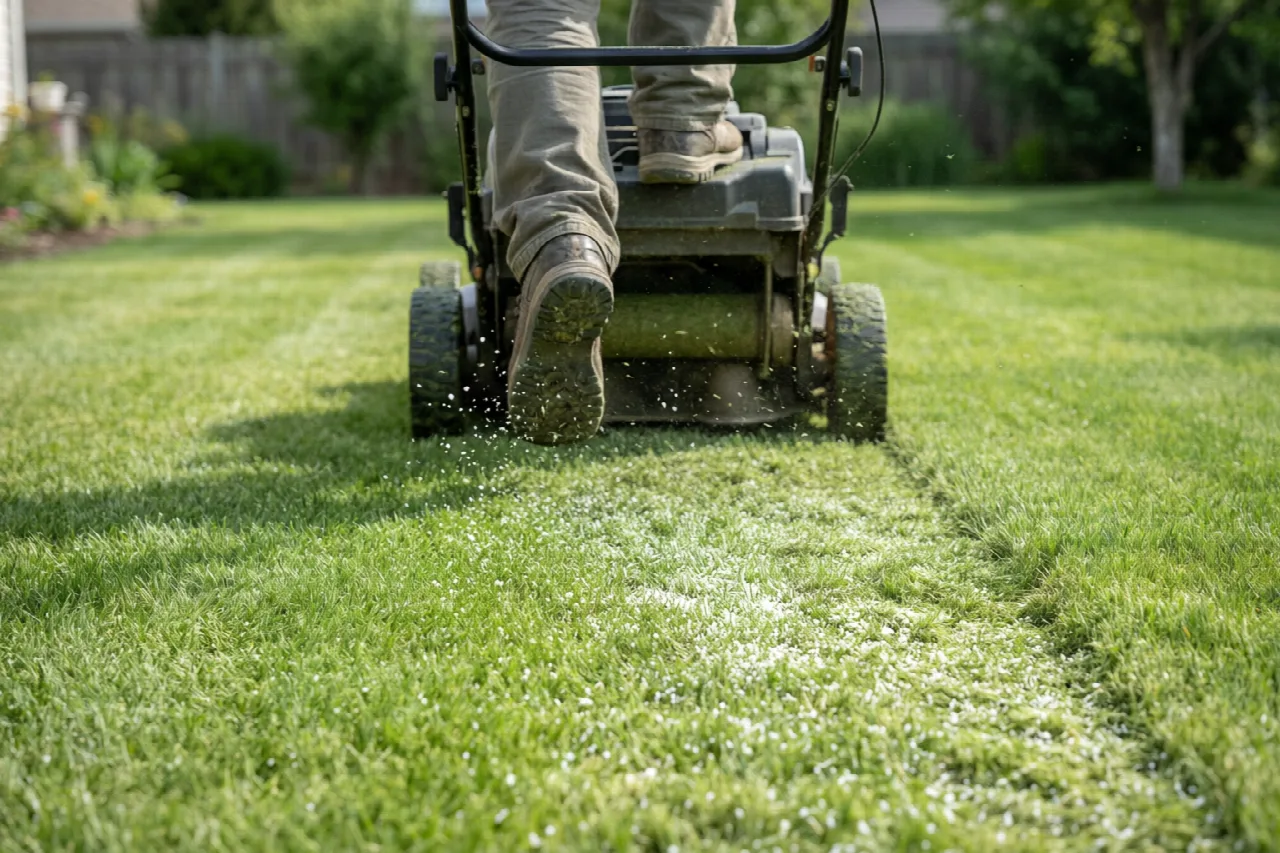
A mower does more than slice leaves. The deck lifts grass, the blade creates airflow, and clippings move toward a side chute, mulching chamber, or bagger. Loose fertilizer sitting in the canopy takes the same path.
If the mower hits dry granules, several things can happen at once. Particles get thrown sideways, so one strip receives extra product and the next strip receives less. The bagger or discharge stream collects fertilizer with the grass clippings. Wheels and the underside of the deck pick up material and drop it later, sometimes in clumps. Those clumps can land in low spots, along edges, or on already-treated turf. If concentrated granules sit on wet foliage, they can contribute to lawn burn in small patches. Burn is not guaranteed, but piled product on damp leaves is a common way tip scorch starts. For troubleshooting and reliability insights, consult our in-depth z890 vs x870e motherboard report.
Uneven coverage matters because grass responds to what actually reached the root zone. A careful pass with the spreader can still look streaky weeks later if the mower rearranged the feeding. You may see darker green stripes beside paler ones, or a ring of extra growth where the deck dumped material when you turned.
Liquid fertilizer does not rattle around as pellets, but it is not immune. A wet spray film can be wiped, smeared across the deck, or vacuumed off the leaf if you cut before the product has done its job. Some liquids are meant to remain on foliage for a time. Others are meant to reach the soil. Mowing too soon can interrupt either path and leave residue on shoes, toys, and hard surfaces. Readers comparing setup options can review our technical analysis on marshall stanmore iii vs harman kardon onyx studio 8.
There is no reliable percentage for how much nutrient you lose by cutting early. Loss depends on how much product was still loose, how wet the turf was, whether you bagged, and where the discharge pointed. The practical rule is simpler: do not give the mower a chance to move fertilizer that has not yet settled.
Granular Fertilizer vs. Liquid Fertilizer
Dry granules and liquid feeds do not stay on grass the same way, so mowing advice is not identical for both. Neither form is automatically safe to cut over, and neither is automatically off-limits later the same day. For complementary field maintenance guidelines, examine our breakdown of dyson v8 cyclone vs bissell featherweight stick.
Granular fertilizer rests on leaves, thatch, and soil until particles dissolve, fall into the canopy, or are watered in. While those particles are still perched on the blades, mowing can move or collect them. A useful field check is visual: if you can still see pellets on the grass, it is too early. After a watering-in step that the label calls for, granules should be off the foliage and heading toward the soil. Some slow-release products are designed to remain in the canopy and release over time. Even then, you want them settled, not bouncing through a discharge chute.
Liquid fertilizer is applied as a spray or hose-end solution. Some products dry on the leaf. Others are watered into the soil. The safe moment to mow is after that intended step is finished and the surface is dry enough that you will not smear, vacuum, or track the treatment away. A still-wet lawn can clump, transfer residue onto the deck, and leave footprints of product across sidewalks. To evaluate matched hardware tolerances, consult our detailed overview of bissell crosswave hydrosteam vs shark stainforce.
Do not assume one form never interacts with mowing. Always read the product directions for watering-in, drying, re-entry, and any note about disturbing the turf. The label overrides general timing advice, including the sequence in this article.
| What to check | Granular fertilizer | Liquid fertilizer |
|---|---|---|
| Visible product | Wait until pellets are off the leaf blades | Wait until the spray has dried or been watered in as directed |
| Watering in | Often intended to move nutrients toward the root zone | Depends on whether the product is foliar or soil-directed |
| Bagging too soon | Can collect granules with the clippings | Can remove treated leaf tissue or smear residue |
| Surface before cutting | Dry enough for a clean cut after any required watering | Dry enough that residue is not wet or sticky |
Combination products, including some weed-and-feed formulas, still follow this same logic, with one extra caution: their labels are often stricter about watering, mowing, and household contact. If the bag or bottle gives a specific sequence, use that sequence.
Water the Fertilizer In, Then Wait Until the Grass Is Dry
For many granular lawn fertilizers, the usual safe order is apply, water in if the label says to, let the surface dry, then mow. Watering in helps granules leave the leaf, begin dissolving, and move nutrients toward the root zone. It also reduces the chance that a mower will pick the product up or that concentrated particles will sit on wet foliage.
A dry surface matters for the fertilizer and for cut quality. Wet grass tears instead of slicing. Clippings clump and can smother patches. The deck smears residue. Wheels sink and leave tracks on soft ground. You are more likely to track fertilizer or muddy clippings onto hard surfaces. Tender, water-heavy tissue also bruises more easily under the mower.
Some labels say not to water immediately. Certain liquids and specialty products need time on the leaf or a dry period first. In that case, watering before mowing would be the wrong move. Follow the product directions, then wait until the lawn is dry enough to cut cleanly.
Do not replace the label with a household timetable or a set watering depth. Those details vary by product, soil, and weather. If the label gives a watering instruction, use it. If it does not, the usual goal for soil-directed granules is enough water to move particles off the blades without sending them down the driveway. Treat that as a description of purpose, not a measured recipe.
Rain can stand in for watering in when it is gentle enough to settle granules without washing them off the yard. A hard downpour can cause runoff and leave patchy feeding. If a storm is clearly coming, delaying the application is often better than applying and hoping. After any rain, wait until the surface is no longer wet and the ground is not saturated before you mow.
How to Mow Once the Lawn Is Ready
Mow only when the turf is dry enough for a clean cut and the fertilizer is no longer sitting loosely on the blades or wet on the surface. Also ask a simpler question: does the lawn actually need cutting? A feeding is not a reason to scalp, bag, or traffic a yard that should be left alone.
Bagging versus mulching is mostly about whether product is still on the surface. Bagging soon after a granular application can remove fertilizer that never reached the soil. If you waited properly, bagging becomes an ordinary clipping choice, not a fertilizer rescue. Mulching returns grass clippings and some nutrients to the lawn, which is often useful. Mulching too early can also redistribute leftover granules. If you can still see product on the turf, do not try to “clean it up” with the bagger. Sweep visible granules back onto the grass and wait.
Keep mowing height conservative. A widely used lawn-care guideline is to remove no more than about one-third of the leaf in a single cutting. That is a general principle, not a fertilizer-specific rule, and it is safer than scalping after a feeding. Do not drop the deck just because you applied fertilizer. A sudden short cut stresses turf that is already being asked to grow. Match height to the grass you have and the season you are in rather than to a generic number from an article that cannot see your yard.
A sharp blade matters more after a feeding than it does on an ordinary week. A dull blade shreds tips and can make a recently fed lawn look brown at the ends even when the product itself did no harm. Alternate mowing direction when you can so wheels do not keep packing the same tracks.
Pay attention to edges and discharge. Point the chute away from streets, storm drains, water features, and garden beds. Do not blow clippings or leftover fertilizer into the gutter. After the last pass, walk sidewalks, driveways, and patios. Sweep stray granules back onto the lawn. Avoid parking a loaded deck on a treated area and then rolling across hardscape, which is an easy way to start tracking product off the yard.
Same-Day Mowing: When It Can Be Reasonable
You can fertilize and mow on the same day when the product is already where it belongs and the grass is dry. Same-day work is a convenience, not a requirement, and it is not automatically safe.
A reasonable same-day sequence looks like this: the lawn was not already so tall that it needed a severe cut; the fertilizer was applied evenly; you watered it in when the label required that step; granules are no longer sitting on leaf blades; the surface is dry to the touch; and the label’s drying or re-entry guidance has been met. At that point, mowing is mostly about cut quality.
Visible pellets, damp residue, wet footprints, or clippings that would clump are signs to wait. Soft, spongy ground is another. If water is still moving across the yard after irrigation or rain, you can relocate fertilizer and create runoff by driving through it.
Do not treat any particular number of hours as enough. Heat, shade, product form, and whether you watered all change how fast the surface is truly ready. If the lawn was overdue for a cut before you fertilized, accept that this may not be a same-day job. Mow on a later dry day, or, next time, cut first and feed after the clippings have been managed.
People, Pets, Hard Surfaces, and Water
People and pets should stay off a freshly treated lawn until the label’s re-entry or drying guidance is met. Shoes, paws, and play transfer residue indoors, and some products should not be contacted while wet. Do not substitute a neighbor’s habit for the bag or bottle you used.
If a person or pet contacts a treated area too soon, follow the precaution and first-aid statements on that product label. This article cannot give medical or veterinary treatment advice.
Hard surfaces deserve a short cleanup every time you fertilize, whether you mow or not. Sweep granules off sidewalks, driveways, patios, and street edges back onto the lawn. Do not hose them into the gutter. That path leads to storm drains and wastes product. Liquid overspray should be handled the way the label describes; do not create a stream of fertilizer toward the street.
Mowing can send fertilizer and nutrient-rich clippings toward pavement. Nutrients that leave the yard do not feed the lawn and can move into lakes, streams, and storm systems. Keep the discharge pointed inward. Avoid mowing when water is already flowing off the property. These are practical household and environmental cautions, not legal findings. Local fertilizer or stormwater rules may add requirements where you live.
Lawn-Health Caveats Before You Cut
A stressed, soggy, or newly seeded lawn is a poor candidate for mowing even if it was just fertilized. Fertilizer does not cancel the usual reasons to leave turf alone.
Skip or delay the cut if the grass is wilted from drought, saturated, frost-covered, newly seeded with seedlings too small for a regular pass, or recently sodded and not yet ready for traffic. Thin or already scalped turf also needs leaf area more than it needs another cut. The plant uses energy to recover from mowing. Adding wheel marks and leaf loss on the same day as a feeding can work against the growth you wanted.
Weather and grass type change recovery in general ways. Hot, bright afternoons increase cutting stress. Dense shade slows drying. Cool-season and warm-season grasses have different active growing periods, so a feeding-and-mowing day that makes sense in peak growth may be a poor idea when the grass is barely moving. That is not a climate-zone calendar. If the lawn is not actively growing, both fertilizer and mowing deserve more caution, and local guidance for your grass type is a better source than a single national timetable.
Height still comes first. If the lawn is already very short, wait. If it is extremely tall, take off only a portion of the leaf on a separate visit, manage the clippings, then fertilize when the surface is clean and dry.
If You Already Mowed Too Soon
If the bagger collected a lot of granules, do not dump that bag back onto a small area. A concentrated pile raises the chance of lawn burn. Do not automatically put down another full application either. Plenty of product may still be in the turf. If the bag is mostly grass with only a little fertilizer mixed in, treat it as ordinary clippings and keep it out of storm drains. A light watering, if the label allows it, can help remaining granules leave the leaf surfaces and move toward the soil.
Streaky color later on can mean the mower reduced even coverage or moved product into stripes. Watch the lawn through the normal response of that feeding instead of rushing to correct it. Spotty dark green beside paler green may even out as remaining nutrients become available, or it may persist if product was removed from some strips. A later feeding on your regular schedule is usually wiser than an emergency extra rate.
Scorched tips or small brown patches can follow concentrated granules that sat on wet foliage or clumps dropped by the deck. Water according to the label and ordinary lawn needs if the soil is dry and runoff is not a risk. Do not stack more fertilizer on the browned spots. Minor tip burn is often a leaf-end problem; the crown may still be alive. A few tan tips are not proof of permanent damage.
You cannot perfectly rebuild a disrupted application. Stop relocating more product, water remaining granules in if appropriate, keep people and pets off until the label allows contact, and return to a normal mowing height once the surface is dry and the turf is actually ready to cut.
Quick Checks Before You Start the Mower
- Read the fertilizer label for watering-in, drying, re-entry, and any note about mowing or disturbing the turf.
- Look down at the canopy. Visible granules on leaf blades mean wait.
- Check for a wet sheen, sticky residue, or footprints. A dry surface cuts more cleanly and is less likely to smear product.
- Decide whether bagging would remove fertilizer that never reached the soil. If you are unsure, wait rather than bag.
- Plan the discharge path away from streets, storm drains, beds, and water.
- Sweep sidewalks and driveways after you finish so tracking and runoff are less likely.
- Skip the cut entirely if the lawn is wilted, soggy, frost-covered, newly seeded, or already too short.
Common Questions on Can You Mow Lawn After Fertilizing Answered
Is it better to mow before you fertilize?
Often, yes, if the lawn is already due for a cut. Mowing first on a dry day removes excess leaf, reduces the chance you will later bag up granules, and leaves a clearer surface for the application. Fertilize after that, then follow the watering and drying steps before the next mowing.
Can you mow if it rained after you fertilized?
A gentle rain that watered granular fertilizer in without causing runoff can put the product where it belongs. Wait until the surface is dry enough to cut cleanly and the ground is not saturated. If rain washed material onto hard surfaces or left puddles, sweep granules back onto the lawn and delay mowing.
Do grass clippings after fertilizing hurt the lawn?
Dry clippings that disperse are not a problem and return some nutrients. Trouble starts when wet clumps smother grass or when bagging removes granules that never reached the soil. Mulching is reasonable once the fertilizer has settled and the turf is dry.
What if you used a hose-end liquid feed?
Wait until the lawn is dry and you will not wipe the treatment off. Check whether that product needed to stay on the leaf or be watered into the soil. After that step is done, mow as you would on any other dry day, keeping discharge away from hard surfaces and water.
Should people and pets stay off the lawn until after you mow?
Re-entry is a label question, not a mowing question. Stay off until the product’s drying or re-entry guidance is met, even if you do not plan to cut. Mowing does not make a freshly treated surface safe for play, and it can spread residue if the lawn is still wet.
Related Maintenance and Operating Guides
To keep your equipment running at peak operating efficiency, explore our related technical walkthroughs and maintenance tutorials:
- Consult our detailed breakdown on Mowing.
Technical Standards and Compliance
Mechanical safety standards, operational tolerances, and protective gear guidelines align with benchmark specifications established by the American National Standards Institute (ANSI).









