

Quick Answer: How Fast Does A Lawn Mower Blade Spin?
A lawn mower blade typically spins at several thousand revolutions per minute. On many walk-behind gas mowers the blade is driven at roughly the same speed as the engine, which is commonly governed somewhere around 2,800 to 3,600 RPM. Riding mowers, electric mowers, and different deck designs can land outside that band because belts, pulleys, gearboxes, or electronic motor control…

Pros
- Large-size design named in product title
- Sharpening and balancing functions listed
- Listed as a new upgraded version

Pros
- Adjustable 15-to-45-degree range in title
- Sharpening and balancing functions listed

Pros
- Sharpener and balancer functions in title
- 15-to-45-degree adjustable setting listed
- Built for lawn mower blade maintenance
Pros
- Includes replacement gaskets and a 98079-55846 spark plug
- Matches Honda HRR216 and HRS216 lawn mower models
- Designed around the 16100-Z8B-901 carburetor specification
Cons
- Restricted to select Honda GCV160 mower applications
- Installation requires basic mechanical tools and skills
How Fast Lawn Mower Blades Spin on Different Mower Types
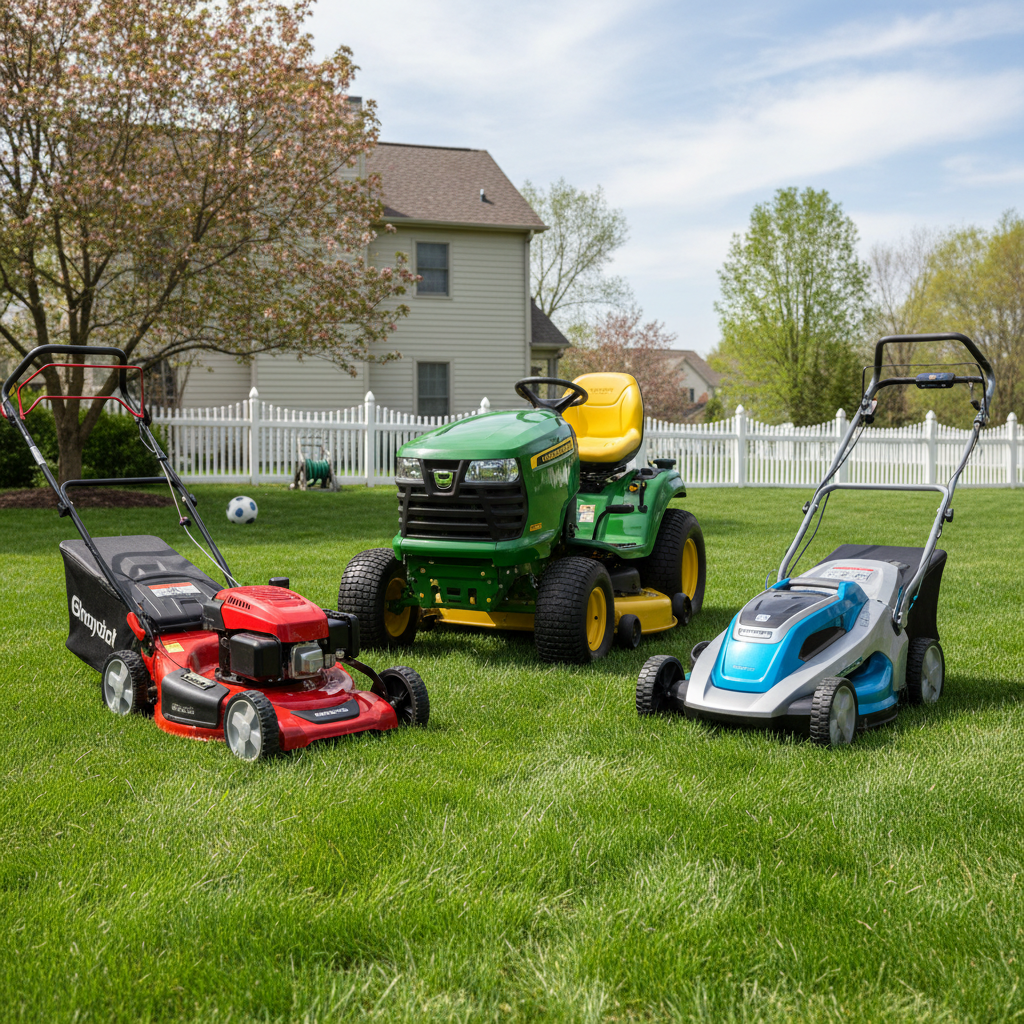
People searching how fast a lawn mower blade spins are usually hoping for one number. There is no single universal RPM for every lawn mower blade. Push mowers, riding mowers, gas lawn mowers, and electric lawn mowers are built around different engines, motors, and decks. The blade still has to move fast enough to cut cleanly, but the path from power source to blade is not identical. Treating “lawn mower” as one category hides those differences and makes manufacturer specs harder to interpret.
What is the typical RPM for a walk-behind gas mower?
On a typical walk-behind gas lawn mower, the blade is often mounted on the engine crankshaft or driven in a way that keeps blade RPM close to engine speed. Small gasoline engines used on push mowers are commonly designed to run under a governor in a high-idle range of a few thousand RPM rather than at the much higher speeds associated with some power tools. In practical terms, many walk-behind gas mowers therefore spin the blade on the order of about 3,000 RPM, with published or commonly discussed ranges often falling roughly between the high 2,000s and the mid 3,000s. That is an order-of-magnitude picture, not a guarantee for every brand, deck width, or engine family.
Engine speed and blade RPM are easy to confuse because they can be nearly the same on a direct-drive push mower and quite different on a machine with belts. A governor is meant to keep engine speed from racing when the load drops and from falling too far when the blade hits thick grass. If the engine is lugging, the blade is also slowing. If the engine is screaming because a governor is misadjusted or missing, the blade is spinning faster than the machine was intended to run. For a walk-behind gas mower, the useful answer is therefore: look for engine rated speed or blade speed in the manual, expect a few thousand RPM, and do not assume a figure copied from another model will match yours. To compare alternative configurations, check our hands-on review of jbl partybox club 120 vs sony srs xv500. For complementary hardware performance, examine our breakdown on riding lawn mower specifications.
How does blade speed differ on riding mowers?
Riding mowers and lawn tractors usually do not put the blade on the crankshaft in the same simple way as a small push mower. The engine still runs at several thousand RPM, but power typically travels through belts and spindle pulleys to one or more blades under a wider deck. Pulley diameters can increase or decrease spindle speed relative to the engine. A rider can therefore have an engine speed that looks familiar while the blades turn somewhat faster or slower than that engine figure. To compare alternative configurations, check our hands-on review of jbl partybox club 120 vs sony srs xv500.
Multiple blades add another wrinkle. A 42-inch or 54-inch deck may use two or three blades that overlap. Each blade still rotates at spindle speed, but the effective cutting action is the combined path of those tips. Operators sometimes assume a bigger riding mower must spin its blades much faster than a push mower. Deck size does not automatically mean higher RPM. Designers often keep rotational speed in a similar several-thousand-RPM neighborhood and change blade length, overlap, and tip speed instead. Belt slip, worn pulleys, or a loose idler can drop blade RPM even when the engine sounds normal, which is one reason a rider may tear grass rather than cut it even though “the engine is fine.” Users looking for related component recommendations can explore our z890 vs x870e motherboard breakdown.
Do battery-powered electric mowers spin blades at different speeds?
Battery-powered electric lawn mowers do not use a small gasoline engine’s governor. A brushed or brushless motor, a controller, and sometimes a gearbox set blade speed. Some electric mowers are designed to hold a fairly steady RPM under load; others allow speed to fall as grass resistance rises or as the battery voltage sags. Because electric motors can be built for a wide RPM range, it is not accurate to say every electric lawn mower blade spins slower or faster than every gas lawn mower blade.
What often differs is how that speed is delivered. An electric mower may reach cutting speed almost immediately, without a choke or throttle-up sequence. Some models offer more than one cutting-speed setting, which changes motor RPM on purpose. Corded electric mowers are constrained by motor design and household power rather than by a fuel-air governor, but they still target a blade speed high enough to slice grass rather than knock it over. If a listing or manual gives only motor RPM, check whether that is the motor shaft or the blade after any reduction. The honest comparison between electric and gas models is not a single published chart; it is whether each machine’s blade RPM and tip speed are in a range that cuts cleanly for that blade length. When a manufacturer does not publish RPM, treating “electric” as automatically slower is a guess, not a specification.
Understanding RPM Versus Blade Tip Speed
Searches for how fast a lawn mower blade spins mix two measurements. Revolutions per minute describe how many times the blade turns. Blade tip speed describes how fast the cutting edge is moving through the air and the grass. Both matter, and they are related by geometry rather than by marketing language. Reading only RPM, or only a tip-speed claim, leaves half the picture out. Before finalizing equipment decisions, refer to our comprehensive marshall stanmore iii vs harman kardon onyx studio 8 comparison.
What does RPM mean for a lawn mower blade?
RPM means revolutions per minute: complete turns of the blade in sixty seconds. If a blade is spinning at 3,000 RPM, it completes 3,000 full rotations each minute, or 50 rotations each second. That figure is a rotational speed. It does not by itself say how fast any point on the blade is traveling in miles per hour or feet per minute. The center of the blade is barely moving laterally; the tips are racing. RPM is still the number most people can compare to engine speed, tachometer readings, or a motor rating, which is why it dominates casual discussion of lawn mower blade speed. Users looking for related component recommendations can explore our z890 vs x870e motherboard breakdown.
RPM is also what changes when a governor, throttle, worn belt, or motor controller changes. A dull blade does not automatically lower RPM, but extra load from dull edges, low cutting height, or wet grass can pull engine or motor speed down, and then RPM falls. When someone says a mower “isn’t spinning fast enough,” they may mean the engine is below governed speed, the belt is slipping, or the motor is current-limiting. In all of those cases the useful diagnostic idea is rotational speed at the blade, not a vague sense that the mower sounds busy.
How is blade tip speed different from rotational speed?
Blade tip speed is linear speed at the outermost cutting edge. Each revolution, the tip travels the circumference of a circle whose diameter is the blade length (for a single blade spanning the deck) or twice the radius from the spindle center to the tip. In simple form, tip speed increases with both RPM and blade length. Two mowers can share the same RPM while the longer blade has a faster tip. Two mowers can share the same tip speed while the shorter blade must spin at a higher RPM to keep up. Before finalizing equipment decisions, refer to our comprehensive marshall stanmore iii vs harman kardon onyx studio 8 comparison.
A workable relationship, using consistent units, is that tip speed is proportional to π times diameter times rotational speed. If diameter is in feet and rotational speed is in RPM, the result is in feet per minute before any unit conversion. That is why a modest change in blade length has a large effect at the tip, and why swapping a longer aftermarket blade onto a spindle designed for a shorter one is not a harmless way to “cut more lawn.” The metal at the tip is already traveling extremely fast at normal RPM. Increasing radius without reducing RPM raises tip speed, kinetic energy, and the distance debris can be thrown.
Tip speed is what actually shears grass against the sharp edge. If the edge is moving too slowly relative to how fast you push the mower, the blade tends to tear or fold the leaf blade instead of slicing it. If the edge is moving very fast, cutting can look cleaner—until the blade is dull, bent, or out of balance, at which point that same speed becomes a hazard rather than a benefit. RPM tells you how the hub is turning; tip speed tells you what the grass and anything in the discharge path actually experience. For broader ecosystem context, read through our operational guide on dyson v8 cyclone vs bissell featherweight stick.
Why might both RPM and tip speed be listed?
Manufacturers, standards documents, and technical discussions may list both because they answer different questions. RPM is convenient for matching engines, motors, pulleys, and replacement spindles. Tip speed is convenient for talking about cutting performance and for comparing machines with different blade lengths. Safety-related design practice for consumer walk-behind mowers has long paid attention to maximum blade tip speed, not only to raw RPM, because injury risk from thrown objects and blade fragments scales with how fast the tip is moving.
A figure often cited in U.S. consumer lawn-mower safety discussion is a maximum blade tip speed on the order of 19,000 feet per minute. That kind of limit, where it applies, is about the tip, not a single RPM cap for every deck. A shorter blade could legally or practically run at a higher RPM than a longer blade while staying under the same tip-speed ceiling. If a spec sheet lists only RPM, you can estimate tip speed only if you also know the effective blade diameter. If it lists only tip speed, you cannot recover RPM without that same length. Listing both reduces that ambiguity. When neither is listed, the manual’s engine speed, plus the knowledge of whether the blade is direct-drive or belt-driven, is the remaining clue—still an estimate unless the manufacturer states blade RPM outright. For troubleshooting and reliability insights, consult our in-depth bissell crosswave hydrosteam vs shark stainforce report.
What Determines a Lawn Mower Blade’s Spin Speed
Blade spin speed is a design result, not an accident of how loud the mower is. Engine or motor characteristics, the drive ratio, blade length, load from the grass, and class-specific engineering limits all feed into the RPM you would measure at the spindle. Understanding those factors explains why two mowers that “feel” similar can still differ, and why maintenance that looks unrelated to the blade can change cutting speed.
How does engine or motor speed relate to blade RPM?
On many push-style gas lawn mowers, the relationship is nearly one to one: the blade is fixed to the crankshaft, so engine RPM is blade RPM aside from any tiny losses that do not matter for this discussion. Set the throttle to the intended operating position and the governor tries to hold that engine speed. Idle is a different, lower RPM used when you are not cutting. Measuring or quoting idle speed as if it were cutting speed will understate how fast the lawn mower blade spins in use.
On belt-driven decks, engine speed is multiplied or reduced by pulley ratio. A smaller pulley on the spindle than on the engine crank will spin the blade faster than the engine; the opposite ratio slows it down. Riding mowers, some wide-deck walk-behinds, and many zero-turn designs live in this category. Electric mowers insert a motor curve and a controller instead of a carburetor and governor. Some motors drive the blade directly; others use reduction. In every case, blade RPM is downstream of the power source. A strong-sounding engine with a glazed belt can still deliver a slow blade. A quiet electric motor at high RPM can still deliver a fast blade. Sound is a poor tachometer.
Does blade length affect how fast the blade spins?
Blade length does not magically set RPM. The engine, motor, and drive ratio set rotational speed. Length does set how fast the tip is moving at that RPM and how much work each revolution can do. A longer blade has more mass outboard, more air-moving capacity if it is a lift-style blade, and a higher tip speed at the same RPM. Designers choosing a longer blade for a wider cut often keep RPM in a familiar range rather than scaling RPM up with width, in part because tip speed and structural loads climb quickly with radius.
Length also changes load. More blade in contact with thick grass demands more torque. If the power source cannot hold speed, RPM drops even though the “design RPM” is unchanged. That is why a mower may spin its blade at the intended speed in thin turf and well below that speed in wet, tall grass. The blade did not become longer mid-pass; the drive could not maintain rotational speed under the extra load. Replacing a blade with a different length or a much heavier aftermarket profile can therefore alter both tip speed and the RPM the engine or motor can sustain, even if the spindle is turning the same hardware interface.
Are there common speed ranges or limits by mower class?
Across consumer classes, it is reasonable to think in thousands of RPM, not hundreds and not tens of thousands, for the blade itself. Walk-behind gas mowers often cluster near typical small-engine governed speeds. Riding mowers often keep spindle speeds in a similar several-thousand-RPM band even when the engine is a larger single-cylinder or V-twin unit. Electric lawn mowers vary more because motor RPM is a free design choice, but they still need enough tip speed to cut. Commercial mowers may use different engines, decks, and duty cycles; they should not be assumed to share a consumer push-mower’s exact RPM, even if the blade still turns thousands of times per minute.
Limits show up more clearly in tip speed than in a universal RPM law. Safety standards and manufacturer design targets constrain how fast the tip may travel, which indirectly caps RPM for a given blade diameter. That is a major reason you do not see ordinary lawn mower blades spinning at the tens of thousands of RPM common in some routers or trimmers with much smaller cutting radii. Class differences also include whether the blade stops within a required time after you release a handle bail, whether a blade-brake clutch allows the engine to keep running, and whether an electric controller ramps the motor down. Those features affect how long the blade stays at speed, not only how fast it is while cutting. For any class, the defensible “typical range” is still the range the maker specifies for that machine. Public discussion can sketch the neighborhood; it cannot replace the plate, the manual, or a service tachometer reading taken as the manufacturer directs.
Safety Considerations Related to Blade Speed
A lawn mower blade at operating RPM is a high-energy rotating tool, not a slow garden implement. The same speed that cuts grass can throw debris, shatter a damaged blade, or cause severe injury on contact. Safety here is about respecting that energy, keeping the blade in spec, and using the machine’s guards and controls as designed—not about modifying a mower to spin faster.
Why is blade speed a safety concern?
At several thousand RPM, the tip is moving fast enough that stones, sticks, and wire can leave the deck with serious force. Discharge openings, missing guards, or lifting the deck toward people and pets put those projectiles on a line toward someone. Contact with a spinning blade is likewise not a “nick” scenario; rotational speed and edge sharpness combine to cut extremely quickly. That is why walk-behind mowers use operator-presence controls that are meant to stop or disengage the blade when you leave the handle, and why riding mowers use seat and interlock systems meant to prevent the blades from running in unsafe conditions.
Speed also shortens the time you have to react. Fifty revolutions per second, as a round illustration at 3,000 RPM, means a blade has already completed many cutting passes in the time it takes to notice that a foot, hand, or jammed stick is in the wrong place. Clearing a clog, reaching under the deck, or disabling an interlock “just for a second” while the blade can still be at speed is how many injuries occur. Wait for the blade to stop completely. Disconnect the spark plug wire on a gas lawn mower, or remove the battery / key on an electric mower, before inspecting the deck. Do not rely on sound alone to decide that rotation has ended, especially on electric models that can be quiet while still live.
Mechanical safety standards, operational tolerances, and protective gear guidelines align with benchmark specifications established by the American National Standards Institute (ANSI).
What can happen if a blade is damaged or unbalanced at operating speed?
A bent, cracked, heavily worn, or badly unbalanced blade is dangerous specifically because operating speed is so high. Unbalance produces vibration that grows with RPM. That vibration stresses the crankshaft or spindle, loosens hardware, damages bearings, and can fatigue the blade until a piece separates. A fragment leaving a deck at tip speed is a thrown object with no useful “safe direction.” Nicks from rocks can become crack starters. Overheating a blade while grinding it thin, or running a blade worn far below its original profile, reduces the margin the designer assumed at normal spin speed.
The practical response is inspection and replacement, not an attempt to out-run the problem by keeping RPM high. Replace a blade that is cracked, missing large chunks, bent, or too worn to balance and sharpen within its remaining metal. Tighten mounting hardware to the manufacturer’s specified method. After hitting a hidden obstacle, stop and check the blade and crank or spindle before returning to full speed. Sharpen evenly and keep both ends of a typical two-sided blade in similar condition so mass stays balanced. Never “straighten” a severely bent blade and return it to service as if speed will not find the weak point.
Blade speed is also the reason homemade or poorly matched replacement blades are a poor idea. A blade that is longer, heavier, or weaker than the deck was designed for changes tip speed, load, and the chance of failure at the same engine or motor RPM. Use the replacement blade specified for that mower, install it in the correct orientation, and keep the deck and chute in place so the energy at the tip is directed into the grass, not into bystanders. The useful takeaway is simple: a lawn mower blade spins fast enough to cut well only when it is intact, balanced, properly mounted, and used behind the guards and controls that were built around that speed.
For more hands-on benchmarks and buying recommendations, consult our guides on high-CFM commercial leaf blower guide.









