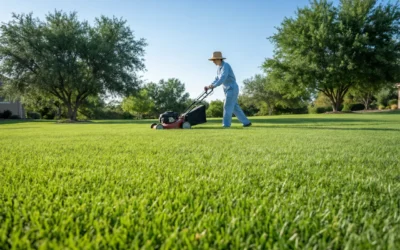
In Texas, the short answer is that you should mow warm-season grasses like Bermuda and St. Augustine every 5–7 days during the peak growing months of late spring and summer. However, this baseline shifts with rainfall, temperature, grass type, and your specific region within the state. The most reliable guide is the one-third rule: never remove more than one-third of the grass blade in a single mowing. If your grass grows faster than your scheduled cut allows, you need to mow more frequently.
Texas Climate and Grass Types
Texas spans multiple climate zones, from the humid, subtropical conditions of the Gulf Coast and East Texas to the semi-arid and arid environments of West Texas. This diversity directly influences which grasses thrive and how quickly they grow. The majority of Texas lawns are planted with warm-season grasses, which are adapted to the state’s hot summers and mild winters. These grasses grow most actively when soil temperatures are between 80°F and 95°F, which in Texas typically means a long growing season that begins in late spring and extends into early fall.
The most common warm-season grasses in Texas include Bermuda grass, St. Augustine grass, Zoysia grass, and Buffalo grass. Bermuda grass is the most widely used across the state because of its durability, drought tolerance, and aggressive growth habit. St. Augustine is favored in the humid eastern and coastal regions, where it thrives in the shade and moisture. Zoysia offers a dense, medium-textured lawn that performs well in transitional areas. Buffalo grass is a native option that requires minimal water and is best suited for the drier western parts of the state.
Because warm-season grasses grow rapidly in Texas heat, they demand more frequent mowing than cool-season grasses found in northern states. Understanding your grass type is the first step in determining a realistic mowing schedule, as each species has its own growth rate and preferred height.
Recommended Mowing Frequency in Texas
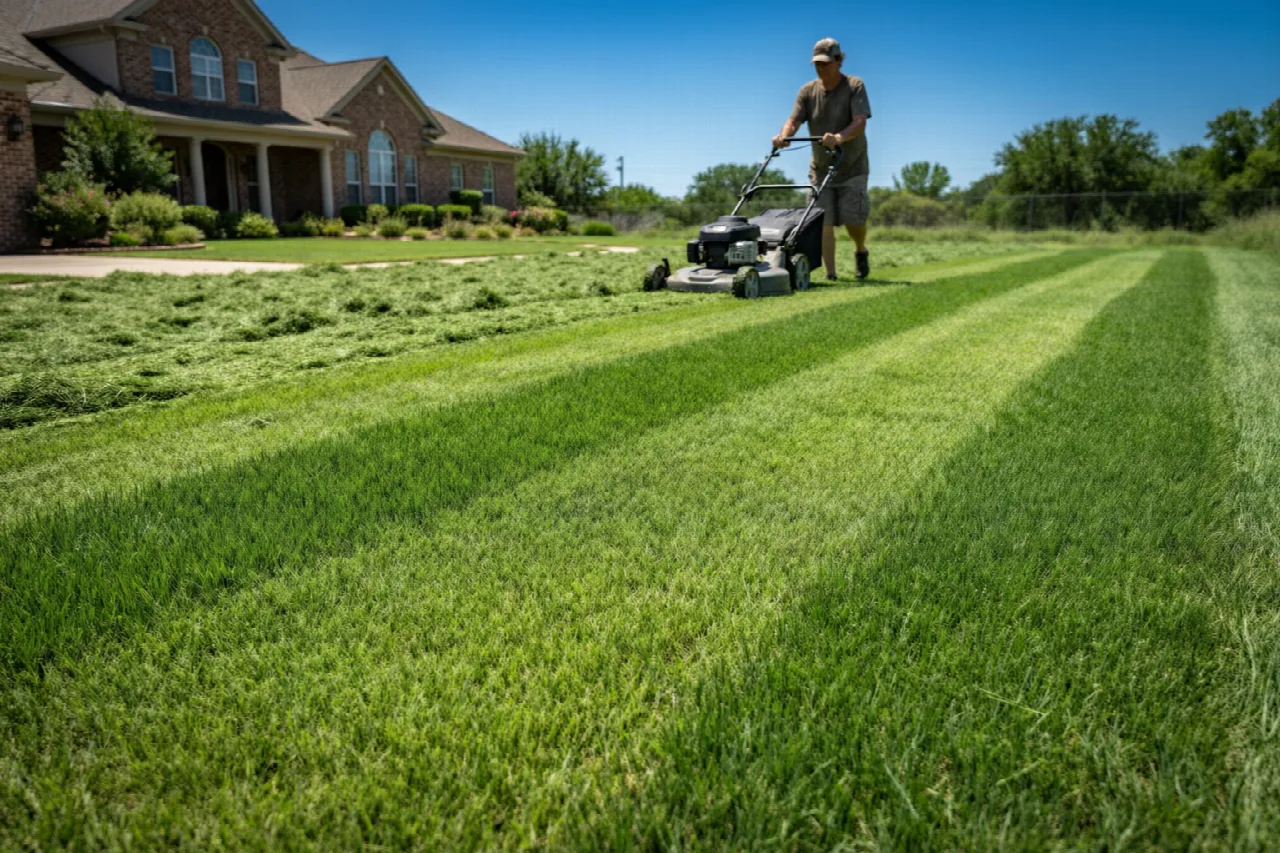
During the peak growing season, which generally runs from May through September, most Texas lawns need to be mowed every 5 to 7 days. This frequency keeps growth in check and prevents the grass from becoming too tall, which can stress the plant and encourage pests or disease. Mowing on a consistent weekly schedule is a practical starting point for most homeowners, but you should be prepared to cut more often during periods of rapid growth.
Bermuda grass, the most common turf in Texas, grows aggressively in full sun and can easily require mowing every 5 days during the height of summer. It responds well to frequent cutting and actually becomes denser and healthier when maintained at a lower height. St. Augustine grass, by contrast, grows somewhat more slowly and is often mowed every 5 to 7 days during peak season. Because St. Augustine has a coarser blade and prefers a taller cut, it does not need to be mowed as frequently as Bermuda, but it still benefits from a weekly schedule during active growth.
Zoysia grass falls between the two, typically requiring mowing every 7 days during peak growth. Buffalo grass, being a slower-growing native, may only need mowing every 10 to 14 days, even in summer. The key is to observe your lawn’s growth rate and adjust your schedule so that you are never removing more than one-third of the blade at a time.
Seasonal Adjustments
Mowing frequency in Texas changes significantly with the seasons. In the summer, when temperatures regularly exceed 90°F and daylight is abundant, warm-season grasses grow at their fastest rate. This is when you will mow most often, typically every 5 to 7 days. During heat waves or periods of heavy rainfall, growth can accelerate even further, and you may need to mow every 4 to 5 days to keep up.
In the spring and fall, growth slows as temperatures moderate. During these shoulder seasons, mowing every 7 to 10 days is usually sufficient. You should also adjust your mowing height seasonally. In the spring, you can gradually lower the blade to encourage a denser lawn. In the fall, as growth slows, you may raise the cutting height slightly to help the grass store energy for the winter.
Winter is the major exception. Most warm-season grasses in Texas go dormant when soil temperatures drop below about 55°F, which typically occurs from December through February. During dormancy, the grass stops growing and does not need to be mowed at all, or at most only once or twice to clean up debris. In milder winters, particularly in South Texas, you may see occasional growth spurts that require a light mowing, but the frequency drops dramatically compared to summer.
Regional Differences Across Texas
Texas is large enough that mowing practices vary considerably from one region to another. In humid East Texas and along the Gulf Coast, frequent rainfall and high humidity keep the soil consistently moist, which promotes rapid grass growth. Lawns in these areas often need mowing on the shorter end of the 5-to-7-day range, and sometimes more frequently during rainy spells. The abundant moisture also favors St. Augustine grass, which thrives in these conditions but can become lush and fast-growing.
In contrast, arid West Texas receives far less rainfall, and lawns there are often irrigated or planted with drought-tolerant grasses like Bermuda or Buffalo. Growth is slower in dry conditions, so mowing every 7 to 10 days is often sufficient. During drought periods, grass growth may slow dramatically, and you may be able to extend the interval between mowings to 10 to 14 days. However, it is important not to let the grass become too tall, as taller grass can help shade the soil and reduce water loss.
Central Texas, including the Austin and San Antonio areas, sits in a transitional zone with hot summers and variable rainfall. Mowing frequency here typically falls between the eastern and western extremes, usually every 6 to 7 days during peak season. The key is to monitor your local rainfall and adjust your schedule accordingly, as a week of heavy rain can quickly produce a growth surge that demands more frequent cutting.
The One-Third Rule in Texas
The one-third rule is the most important guideline for mowing any Texas lawn. It states that you should never remove more than one-third of the grass blade’s height in a single mowing. This rule protects the grass from stress, encourages deeper root growth, and prevents scalping, which can expose the soil to weeds and erosion. If you cut too much at once, the grass loses too much leaf area to photosynthesize effectively, and it may turn brown or become vulnerable to disease.
Applying the one-third rule in Texas means setting your mowing height based on your grass type and then mowing frequently enough to keep growth within that limit. For Bermuda grass, the recommended mowing height is typically 1 to 1.5 inches, so you should mow when the grass reaches about 1.5 to 2 inches. For St. Augustine, the recommended height is 2.5 to 3.5 inches, meaning you should mow when it reaches roughly 3.5 to 4.5 inches. Zoysia is usually mowed at 1 to 2 inches, while Buffalo grass is best kept at 3 to 4 inches.
The one-third rule also tells you when to mow. Rather than sticking to a rigid calendar schedule, you should mow based on growth. If your grass reaches the one-third threshold before your scheduled mowing day, you should cut it sooner. This approach is more responsive to weather and ensures your lawn stays healthy throughout the Texas growing season.
Adjusting for Weather and Rainfall
Texas weather is notoriously variable, and your mowing schedule should adapt to it. After a period of heavy rain, grass growth accelerates rapidly, often requiring more frequent mowing. If your lawn receives several inches of rain in a week, you may need to mow every 4 to 5 days to keep growth under control. Conversely, during drought conditions, grass growth slows, and you can extend the interval between mowings to reduce stress on the lawn.
Temperature also plays a role. During extreme heat waves, when temperatures exceed 100°F, grass growth may slow as the plant conserves water, even if it is irrigated. In these conditions, you may be able to mow less frequently, but you should still monitor growth and avoid letting the grass become too tall. During mild spells in the spring or fall, growth can pick up, and you may need to mow more often than you expected.
It is also important to adjust your mowing practices during wet or dry periods. After rain, wait until the grass has dried before mowing to avoid clumping and to prevent the mower from tearing the blades. During drought, raise your mowing height slightly to provide more shade to the soil and reduce water evaporation. By staying flexible and responding to weather conditions, you can keep your Texas lawn healthy and well-maintained throughout the year.