Quick Answer: Intel Arc B570 vs Intel Arc B580 — Which Should You Buy in 2026?
Buy the Intel Arc B580 if the price gap is about $30, because it is typically 10–20% faster, has 12GB of VRAM instead of 10GB, and provides 20% more memory bandwidth. Choose the Intel Arc B570 for a tightly controlled 1080p build when it is available near $210–$220 and at least $40–$50 cheaper than the B580. At similar prices, the B580 is the better long-term gaming and creator card.
Winner by Category
| Category | Winner | Margin / Evidence |
|---|---|---|
| 1080p | Arc B580 | Approximately 15–18% faster on average; CPU and driver overhead can narrow the gap in some games. |
| 1440p | Arc B580 | Approximately 13–18% faster; Final Fantasy XIV measured 86 FPS versus 75 FPS. |
| 4K | Arc B580 | Approximately 15–30% faster in aggregate comparisons, helped by 12GB VRAM and 456GB/s bandwidth. |
| Ray tracing | Arc B580 | Usually 15–20% faster; Resident Evil 4 measured 43 FPS versus 37 FPS at 4K with RT and FSR. |
| Upscaling | Tie | Both support XeSS 2, XeSS Super Resolution, XeSS Frame Generation, Xe Low Latency, and game-dependent FSR. Neither supports NVIDIA DLSS. |
| VRAM | Arc B580 | 12GB GDDR6 versus 10GB, with a 192-bit bus versus 160-bit. |
| Power | Arc B570 | 150W TBP versus 190W, a 40W reduction. |
| Value | Depends on the price gap | The B570 wins only when it is approximately $40–$50 cheaper. A $30 gap generally favors the B580. |
Pros
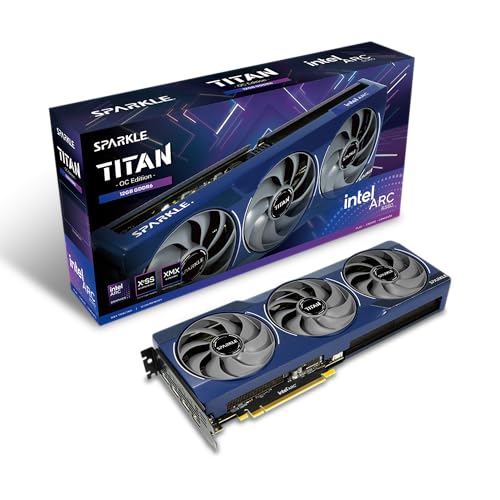
- Factory-overclocked to 2760MHz for higher stock performance than non-OC models.
- 12GB GDDR6 memory is a useful spec for modern gaming and texture-heavy workloads.
- Metal backplate and sag bracket suggest a more stable, better-supported physical design.
- Cooling-focused design includes TORN Cooling 2.0 and an axial fan.
Cons
- The listing does not provide full specifications such as dimensions, power connector requirements, or display outputs.
- There are no user reviews in the provided data, so long-term real-world feedback is limited.
- Only basic cooling details are listed, so noise levels and thermal performance cannot be confirmed from the data provided.
Overview: The Sparkle Intel Arc B580 Titan OC is a desktop graphics card built around Intel Arc hardware, 12GB of GDDR6 memory, and a factory-overclocked 2760MHz boost clock. It presents as a practical, visually refined option with a metal backplate, blue breathing light, and included sag bracket.
Performance & Features: On paper, the main strengths are its 12GB memory buffer and tuned boost clock, which should appeal to gamers and creators who want a modern GPU with extra headroom. TORN Cooling 2.0 and the axial fan are meant to support stable operation under load, while the backplate and bracket add physical reinforcement.
Drawbacks & Considerations: The listing leaves out several important details, including power requirements, port layout, size, and detailed thermal or acoustic data. There is also no user review history in the provided data, so buyers do not have much community feedback to rely on yet.
Verdict: This model makes the most sense for PC builders who want a Sparkle Intel Arc B580 with a factory OC, 12GB GDDR6, and included support hardware. It is best suited to buyers who value the listed specs and design features, while accepting that some practical details are not fully documented here.

Pros
- Factory overclocked for immediate out-of-box performance.
- Quiet operation at idle thanks to 0dB Silent Cooling.
- Modern display connectivity with three DisplayPort 2.0 outputs.
- Reinforced build quality with a metal backplate and Super Alloy parts.
Cons
- Requires two 8-pin PCIe power connectors and a recommended 650W power supply.
- The 2.4-slot, 271 mm length may be difficult to fit in smaller cases.
- 8GB of VRAM may be limiting for some heavy 4K or pro-level workloads.
Overview: The ASRock Intel Arc A580 Challenger 8GB OC is a factory-overclocked graphics card based on Intel Xe HPG architecture. It uses a dual-fan cooler, a metal backplate, and ASRock Super Alloy components, giving it a solid and practical design for mainstream gaming PCs.
Performance & Features: With 8GB of GDDR6 memory, a 256-bit interface, and a 2000 MHz engine clock, this card is aimed at 1440p gaming and everyday creative workloads. It also supports Intel XeSS, DirectX 12 Ultimate, PCIe 4.0, and up to four displays through three DisplayPort 2.0 outputs and one HDMI 2.0b port.
Drawbacks & Considerations: This model is not the best fit for compact systems because it needs a 2.4-slot layout, two 8-pin PCIe power connectors, and a recommended 650W power supply. Users planning heavier high-resolution workloads should also consider that 8GB of VRAM can be a practical limit in some demanding scenarios.
Verdict: The ASRock Intel Arc A580 Challenger 8GB OC is a good option for buyers who want modern Intel graphics features, quiet idle operation, and strong display support at a midrange level. It is best suited to PC builders who have enough case space and adequate power delivery.
Specifications Side-by-Side
The Arc B570 and Arc B580 are not different generations. Both use Intel’s Xe2-HPG Battlemage architecture, the BMG-G21 GPU, and TSMC’s N5 process. The B580 is the larger configuration, adding shader resources, Xe2 cores, XMX engines, memory capacity, bandwidth, and board power.
| Specification | Intel Arc B570 | Intel Arc B580 |
|---|---|---|
| Architecture | Intel Xe2-HPG / Battlemage | Intel Xe2-HPG / Battlemage |
| GPU / process | BMG-G21 / TSMC N5 | BMG-G21 / TSMC N5 |
| Shader/vector cores | 2,304 | 2,560 |
| Xe2 cores | 18 | 20 |
| XMX AI engines | 144 | 160 |
| Ray-tracing units | 18 second-generation RT units | 20 second-generation RT units |
| VRAM | 10GB GDDR6 | 12GB GDDR6 |
| Memory bus | 160-bit | 192-bit |
| Memory speed | 19Gbps | 19Gbps |
| Memory bandwidth | 380GB/s | 456GB/s |
| Graphics clock | 2,500MHz | 2,670MHz |
| Approximate boost | Up to 2,750MHz, depending on board model | Up to approximately 2,850MHz, depending on board model |
| PCIe interface | PCIe 4.0 x8 | PCIe 4.0 x8 |
| Total board power | 150W | 190W |
| Launch MSRP | $219 | $249 |
| Typical U.S. street price in 2026 | Approximately $210–$260 new | Approximately $240–$310 new |
Gaming Performance
1080p
The Arc B580 is generally about 15–18% faster than the B570 at 1080p. The B570 remains suitable for a budget 1080p system, but the smaller card can lose proportionally more performance when CPU limits and driver overhead become significant. The exact difference varies by game, settings, and driver version, so the B580’s advantage should be treated as a typical range rather than a fixed result.
1440p
1440p is where the B580’s extra resources become easier to justify. Aggregate results place it approximately 13–18% ahead, while Final Fantasy XIV measured 86 FPS on the B580 versus 75 FPS on the B570, an advantage of roughly 15%. In Cyberpunk 2077 at 1440p Ultra, one comparison recorded approximately 56 FPS for the B580 and 45–50 FPS for the B570. Black Myth: Wukong at 1440p Cinematic with 50% upscaling measured 31 FPS versus 26 FPS. Before finalizing equipment decisions, refer to our comprehensive how to clean gpu dust comparison.
4K
Neither card should be treated as a universal 4K high-refresh solution, but the B580 is the stronger 4K option. Aggregate comparisons report an approximate 15–30% lead, with the upper end varying substantially by game. Its 12GB memory buffer and 456GB/s bandwidth give it more room than the B570’s 10GB and 380GB/s when texture demand and resolution increase. Before finalizing equipment decisions, refer to our comprehensive how to clean gpu dust comparison.
Ray Tracing & Upscaling
The B580 is typically 15–20% faster in ray-traced workloads because it has 20 second-generation RT units, compared with 18 on the B570, plus more shader cores, a higher graphics clock, and greater bandwidth. In Resident Evil 4 at 4K with ray tracing and FSR, the B580 reached 43 FPS versus 37 FPS. Dragon’s Dogma 2 at 1440p with ray tracing measured 36 FPS versus 31 FPS, also approximately a 16% advantage. For broader ecosystem context, read through our operational guide on vertical gpu mount airflow.
Features & Ecosystem
Both cards support Intel XeSS 2, including XeSS Super Resolution, XeSS Frame Generation, and Xe Low Latency. Intel reports XeSS support in more than 150 games and up to 3.9× output in selected XeSS 2 demonstrations. Both cards can also use AMD FSR 2 or FSR 3 where a game implements those technologies. FSR does not require AMD hardware, but its frame-generation availability remains title-dependent.
Neither Arc card supports NVIDIA DLSS, which is exclusive to GeForce RTX hardware. The practical comparison is therefore XeSS 2 against the FSR version available in a particular game, rather than DLSS against XeSS. In Intel’s F1 24 demonstration, the B580 increased output from 48 FPS natively to 93 FPS with XeSS Balanced and 152 FPS with XeSS 2 frame generation. Those figures are an Intel demonstration, not an independent average for all games. For broader ecosystem context, read through our operational guide on vertical gpu mount airflow.
For streaming and video work, both cards include dual Intel MFX media engines with AV1, H.264, HEVC/H.265, and VP9 support. They also support HEVC 4:2:2 10-bit decoding and encoding paths where the software supports them. This makes both unusually interesting for AV1 streaming and video export at their respective prices. The B580 has more XMX engines—160 versus 144—and more VRAM, which gives it an advantage for selected local-AI, video-editing, Unreal Engine, and GPU-effects workloads.
The software ecosystem is more capable than Intel’s first-generation Arc launch, but it is not as plug-and-play as CUDA. Intel’s native compute routes include oneAPI, OpenCL, Level Zero, OpenVINO, SYCL, and IPEX. Neither card runs CUDA natively, and neither is a ROCm GPU. Application support therefore needs to be checked individually, particularly for AI packages, plug-ins, Blender, and production workflows. NVIDIA remains preferable for CUDA-dependent software, RAW-heavy editing, some Fusion work, and certain Blender workloads. For troubleshooting and reliability insights, consult our in-depth weak psu cause gpu stutter report.
Battlemage launched with a substantially more mature software stack than first-generation Alchemist. Nevertheless, game-specific bugs, inconsistent frame-time behavior, and creator-application issues can still occur. Intel’s 2026 driver listings continue to include Arc B-series support, so current drivers and firmware matter. On Linux, Xe2 support requires a relatively recent kernel and Mesa stack; Linux 6.12 was reported as the minimum mainline kernel at launch, with newer versions recommended for better support.
Power, Thermals & Build Compatibility
The B570 has the easier power profile, with a 150W total board power rating compared with 190W for the B580. That 40W difference can be useful in a smaller or efficiency-focused system. The B580’s higher power target supports its additional cores, faster clock, extra RT unit, larger memory configuration, and 20% higher memory bandwidth, but the specific cooler, fan profile, and boost behavior depend on the board model. Readers comparing setup options can review our technical analysis on black screen gpu drivers.
- Check the power supply: account for the card’s 150W B570 or 190W B580 TBP and the rest of the system.
- Check physical clearance: board dimensions and cooler designs vary by manufacturer, so verify case compatibility for the exact model.
- Check PCIe support: both cards use PCIe 4.0 x8.
- Update software: install current Intel graphics drivers and keep motherboard firmware current when troubleshooting Arc compatibility.
- Check Linux versions: Xe2 needs a recent kernel and Mesa stack for the best support.
Neither card’s TBP alone determines the ideal system PSU, because CPU choice, storage, cooling, and other components also affect total demand. The B570 is the better fit when minimizing GPU power is a priority; the B580 is the better fit when the system can accommodate its higher power and the additional gaming headroom matters more.
Price & Value Analysis
At launch, the B570 was priced at $219 and the B580 at $249, a $30 difference. In typical U.S. 2026 listings, the B570 is approximately $210–$260 new, with some used listings around $220. The B580 is approximately $240–$310 new, although model and availability variation is substantial and some listings exceed $300. For complementary field maintenance guidelines, examine our breakdown of daisy chain pcie cables.
The B580’s value case comes from more than its frame-rate lead. For roughly $30 more at launch, it adds 256 shader/vector cores, two Xe2 cores, 16 XMX engines, one additional RT unit, 2GB of VRAM, 76GB/s of memory bandwidth, and a higher clock configuration. Its 456GB/s bandwidth is 20% greater than the B570’s 380GB/s. Those advantages make the B580 the better purchase when the current gap is close to $30.
The B570 becomes the value choice when it is approximately $40–$50 cheaper than the B580. A B570 near $210–$220 can deliver most of the same Battlemage feature set while using 40W less power. However, the savings should be weighed against its smaller 10GB memory capacity and weaker performance in demanding 1440p, 4K, and ray-traced games. If a B570 costs $250 while a B580 is available near $250–$280, the B580 is usually the more sensible purchase.
Which Should You Buy?
Choose Intel Arc B580 if…
- You want the faster card for modern 1080p or 1440p gaming, with a typical 10–20% raster advantage.
- You play at 1440p or use high texture settings and want 12GB rather than 10GB of VRAM.
- You want the stronger option for ray tracing, where the B580 is commonly 15–20% faster.
- You want 456GB/s of memory bandwidth instead of 380GB/s for more demanding resolutions and workloads.
- You edit video, stream with AV1, use GPU effects, or experiment with selected local-AI workloads.
- The B580 is only about $30 more than the B570, or is available near the lower end of its $240–$310 street-price range.
Choose Intel Arc B570 if…
- Your budget is tightly constrained and the card is available near $210–$220.
- You primarily play at 1080p and can accept lower performance in demanding modern titles.
- You find it at least approximately $40–$50 cheaper than a comparable B580.
- You want the lower 150W TBP for a power-conscious system.
- You use the same XeSS 2, FSR, AV1, H.264, HEVC, and VP9 feature support but do not need the B580’s extra VRAM and performance.
Consider a different card if…
Consider an NVIDIA GeForce RTX card if your workload depends on CUDA, DLSS, or production-critical software where broad application compatibility is more important than Arc’s media value. Consider an AMD Radeon card if your preferred software and games benefit from AMD’s ecosystem or if a competing model offers a better price in your market. The supplied research does not identify specific alternative models or prices.
Frequently Asked Questions About Arc B570 Vs Arc B580
Is the Intel Arc B580 worth $30 more than the B570?
Usually, yes. At a $30 difference, the B580’s typical 10–20% gaming advantage, 2GB of additional VRAM, 20% greater memory bandwidth, and extra RT, shader, Xe2, and XMX resources generally justify the premium. The B570 becomes more compelling when the price difference reaches approximately $40–$50.
Is 10GB of VRAM enough on the Arc B570?
It can be suitable for a budget 1080p card, but the B570 is less comfortable than the B580 for demanding 1440p and 4K games, high texture settings, and future workloads. The B580’s 12GB capacity provides more headroom, while its 456GB/s bandwidth is also higher than the B570’s 380GB/s.
Do the Arc B570 and B580 support DLSS?
No. NVIDIA DLSS is exclusive to GeForce RTX hardware. Both Arc cards support Intel XeSS 2, including Super Resolution, Frame Generation, and Xe Low Latency, and both can use AMD FSR features when implemented by the game. FSR and frame generation support vary by title.
Are the Arc B570 and B580 good for video editing and AI?
Both cards have dual Intel MFX media engines with AV1, H.264, HEVC/H.265, and VP9 support, making them attractive for supported streaming and video-export workflows. The B580 is the stronger choice because it has 12GB of VRAM and 160 XMX engines versus 10GB and 144 XMX engines on the B570. However, neither card runs CUDA natively, and NVIDIA remains preferable for CUDA-dependent applications, RAW-heavy workflows, some Fusion work, and certain Blender workloads.
Mechanical safety standards, operational tolerances, and protective gear guidelines align with benchmark specifications established by the American National Standards Institute (ANSI).
Related Posts
- Rx 7700 Xt Vs Rx 9060 Xt 16Gb
- Rtx 5050 Vs Arc A770 16Gb
- Rtx 4070 Super Vs Rtx 5070