Direct Answer: The best cordless chainsaw for you depends on intended use, budget, and priorities. Homeowners doing light trimming benefit from lightweight 18-20V models with good battery systems, while those tackling larger projects need higher voltage (40-60V) with extended runtime and longer bar lengths. Evaluate battery life, cutting power, weight, and total cost of ownership—including batteries and chargers—before deciding.
Understanding Cordless Chainsaw Technology
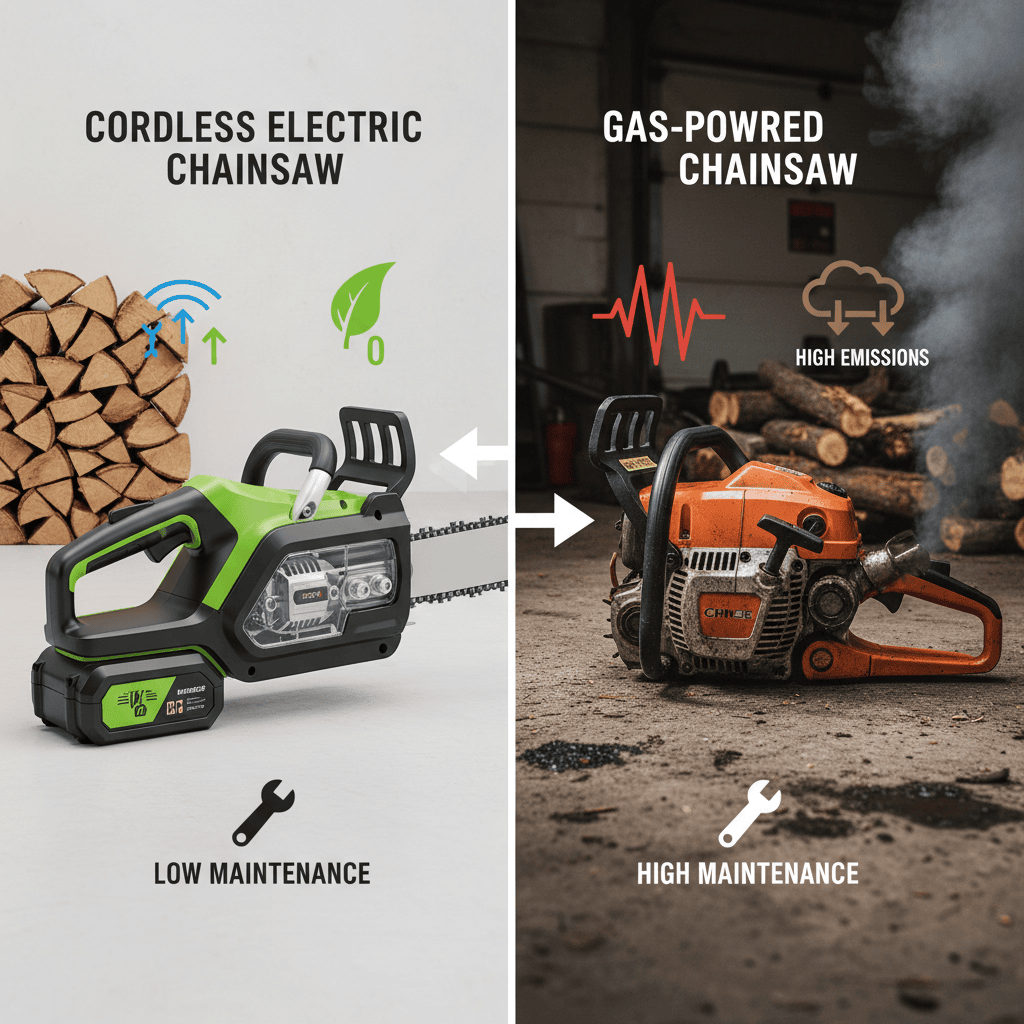
Battery-powered chainsaws have transformed the consumer and professional landscaping market by eliminating the need for gas mixing, maintenance, and fuel storage. Unlike gas-powered models that rely on two-stroke engines, cordless chainsaws use rechargeable lithium-ion batteries to power an electric motor that drives the chain at high speeds.
The primary advantage of cordless technology is convenience: no pull cords, no emission concerns, significantly lower noise levels (typically 80-90 decibels versus 100+ for gas models), and minimal maintenance. The motor engages instantly and requires no warm-up period. Battery-powered chainsaws are ideal for residential users who value ease of operation and environmental responsibility.
However, cordless chainsaws do have limitations. Battery runtime typically ranges from 15 minutes to 45 minutes per charge depending on voltage, battery capacity, and cutting conditions. Cutting power generally lags behind high-end gas models, making very heavy-duty professional work more challenging. Battery replacement costs can add significantly to long-term ownership expenses, typically $80–$300 per battery depending on capacity and brand.
Key Performance Factors to Evaluate
Battery Voltage and Cutting Power
Battery voltage directly correlates with cutting power and motor performance. Cordless chainsaws typically range from 18V to 80V:
- 18-20V: Entry-level option for light trimming, small branch removal, and basic yard maintenance. Best for occasional users with minimal cutting demands.
- 40-60V: Mid-range performance suitable for regular homeowners. Handles moderate cutting tasks, longer bar lengths (12–16 inches), and sustained use without frequent battery swaps.
- 80V and above: Professional-grade performance for frequent, heavy-duty use. Supports longer bars (18+ inches) and maintains consistent cutting power through demanding applications.
Higher voltage models draw more power, enabling faster chain speeds and deeper cuts, but also drain batteries more quickly. The relationship is not linear—a 40V model isn’t necessarily twice as powerful as a 20V, but it typically delivers noticeably better performance for demanding tasks.
Battery Capacity and Runtime
Battery capacity, measured in amp-hours (Ah), determines how long a chainsaw runs per charge. A 2.0Ah battery will deliver roughly half the runtime of a 4.0Ah battery at the same voltage. Typical runtime expectations:
- 20V with 2.0Ah: 15–25 minutes of moderate cutting
- 40V with 4.0Ah: 25–40 minutes of moderate cutting
- 60V with 6.0Ah: 35–50 minutes of moderate cutting
Real-world runtime varies based on wood density, cutting depth, and chain sharpness. Harder woods and deeper cuts consume battery charge faster. Consider purchasing a second battery if you anticipate cutting sessions longer than 30 minutes, enabling continuous work while one battery charges.
Bar Length and Cutting Capacity
Bar length—the exposed cutting edge of the chainsaw—ranges from 6 inches on compact models to 20+ inches on professional equipment. Longer bars cut deeper and handle larger diameter wood, but increase weight and reduce maneuverability:
- 6–8 inches: Pruning, thin branches, light trimming tasks
- 10–12 inches: General homeowner use, moderate firewood preparation, branch removal up to 6–8 inches diameter
- 14–16 inches: Serious homeowner and semi-professional use, handles logs up to 10–12 inches diameter
- 18+ inches: Professional-grade cutting, large tree work, felling applications
Match bar length to your primary use case. A 16-inch bar on a 40V chainsaw is versatile for most residential tasks without excessive weight, but overkill for basic yard maintenance where a 10-inch bar suffices.
Weight and Ergonomic Design
Cordless chainsaws typically weigh 7–12 pounds depending on battery and bar length. Weight matters significantly during extended use—fatigue reduces control and increases injury risk. Consider:
- Total weight including battery (batteries add 1–3 pounds)
- Weight distribution and balance point
- Grip design and comfort during sustained operation
- Vibration levels and shock absorption
A well-balanced, lighter model reduces user fatigue and improves accuracy during overhead cutting or extended sessions. Premium models often feature ergonomic handles, vibration dampening, and anti-vibration technology that professional users value.
Safety Features
Essential safety features in quality cordless chainsaws include:
- Automatic chain brake: Stops the chain within milliseconds if the saw kicks back, preventing serious injury
- Chain tensioning: Automatic or tool-free adjustment keeps the chain at optimal tightness without frequent manual adjustments
- Throttle interlock: Prevents accidental acceleration
- Hand guards: Protect hands from the moving chain
- Low-fuel/low-battery warning: Alerts users when battery is depleted, preventing mid-cut power loss
Matching Chainsaws to Use Cases
Light Residential Use
For occasional pruning, small branch removal, and basic yard cleanup a few times per year, an 18-20V model with a 6–10 inch bar and 2.0–2.5Ah battery is sufficient. These models are lightweight, easy to handle, and cost $150–$300. Runtime of 15–25 minutes covers typical tasks without battery concerns.
Regular Homeowner Maintenance
Homeowners maintaining 1–2 acres with regular branch removal, small tree cutting, and firewood preparation benefit from 40V chainsaws with 10–14 inch bars and 3.0–4.0Ah batteries. This tier ($400–$700) balances power, runtime, and maneuverability. Most users find one battery sufficient for typical weekend work, though a second battery ($100–$200) enables continuous cutting without downtime.
Demanding or Frequent Use
Property maintenance professionals, frequent firewood processors, or homeowners managing larger wooded properties should consider 60V or higher models with 14–18 inch bars. These ($800–$1,500+) deliver sustained cutting power, longer runtimes, and handle extended use without performance degradation. Multiple batteries become essential, and total system cost approaches or exceeds entry-level gas models.
Battery Systems and Cost of Ownership
One often-overlooked factor in cordless chainsaw selection is the broader battery ecosystem. Major manufacturers like DeWalt, Makita, Milwaukee, and Ryobi each use proprietary battery platforms. Choosing a brand you already own tools for can significantly reduce total cost—you may use existing batteries rather than purchasing new ones.
Battery lifespan typically ranges from 3–5 years of regular use before significant capacity loss occurs. Replacement batteries cost $80–$300 depending on voltage and capacity. A homeowner who purchases a $500 40V chainsaw may spend an additional $150–$300 every 4 years on battery replacement, affecting long-term value calculations.
Consider total system cost: chainsaw + multiple batteries + charger. A complete cordless system often costs $700–$1,200 for residential-grade equipment. This compares favorably to gas models ($600–$1,200), with the advantage of lower operating costs (electricity versus fuel) and reduced maintenance.
Frequently Asked Questions
How long does a cordless chainsaw battery last on a single charge?
Runtime depends on voltage, battery capacity, and cutting conditions. A 40V chainsaw with a 4.0Ah battery typically runs 25–40 minutes during moderate cutting of standard wood. Cutting harder woods, using maximum throttle continuously, or operating in cold weather reduces runtime by 20–30%. Most homeowners find 20–30 minutes adequate for typical weekend tasks, though serious users benefit from a second battery.
Can cordless chainsaws match the power of gas models?
High-end cordless models (60V+) deliver comparable cutting power to consumer-grade gas chainsaws for most tasks. However, professional-grade gas models with larger displacements still offer superior sustained power and reliability for full-time commercial use. For homeowner and semi-professional work, modern cordless technology is competitive and often preferable due to convenience and lower noise.
What’s the difference between battery voltage and amp-hour rating?
Voltage (measured in volts) determines power and cutting performance—higher voltage means more power. Amp-hour rating (Ah) determines capacity and runtime—higher capacity means longer runtime per charge. A 40V 2.0Ah battery runs shorter than a 40V 4.0Ah, but both deliver the same cutting power. A 20V 4.0Ah and 40V 2.0Ah deliver different power levels despite similar total watt-hours.
Should I buy a cordless chainsaw if I already own a gas model?
Cordless chainsaws excel for convenience, low noise, and minimal maintenance—ideal for frequent light to moderate use. Keep a gas model if you perform heavy-duty professional work or need unlimited runtime. Many homeowners benefit from owning both: cordless for quick yard maintenance, gas for demanding felling or commercial work. The decision depends on your use frequency and cutting demands.