What Are the Best Snow Blowers for Your Situation?
The best snow blower isn’t a single product—it’s the machine that matches your specific needs. Single-stage models excel for light, frequent snowfall on small properties and cost $300–$800. Two-stage models handle moderate to heavy snow on driveways and larger areas, ranging from $800–$3,000. Three-stage models offer maximum clearing power for heavy, wet snow and commercial applications, typically costing $3,000–$10,000+. Your decision should be based on climate patterns, property size, snow characteristics in your region, and realistic maintenance commitments—not brand popularity alone.
Understanding Snow Blower Types and How They Work
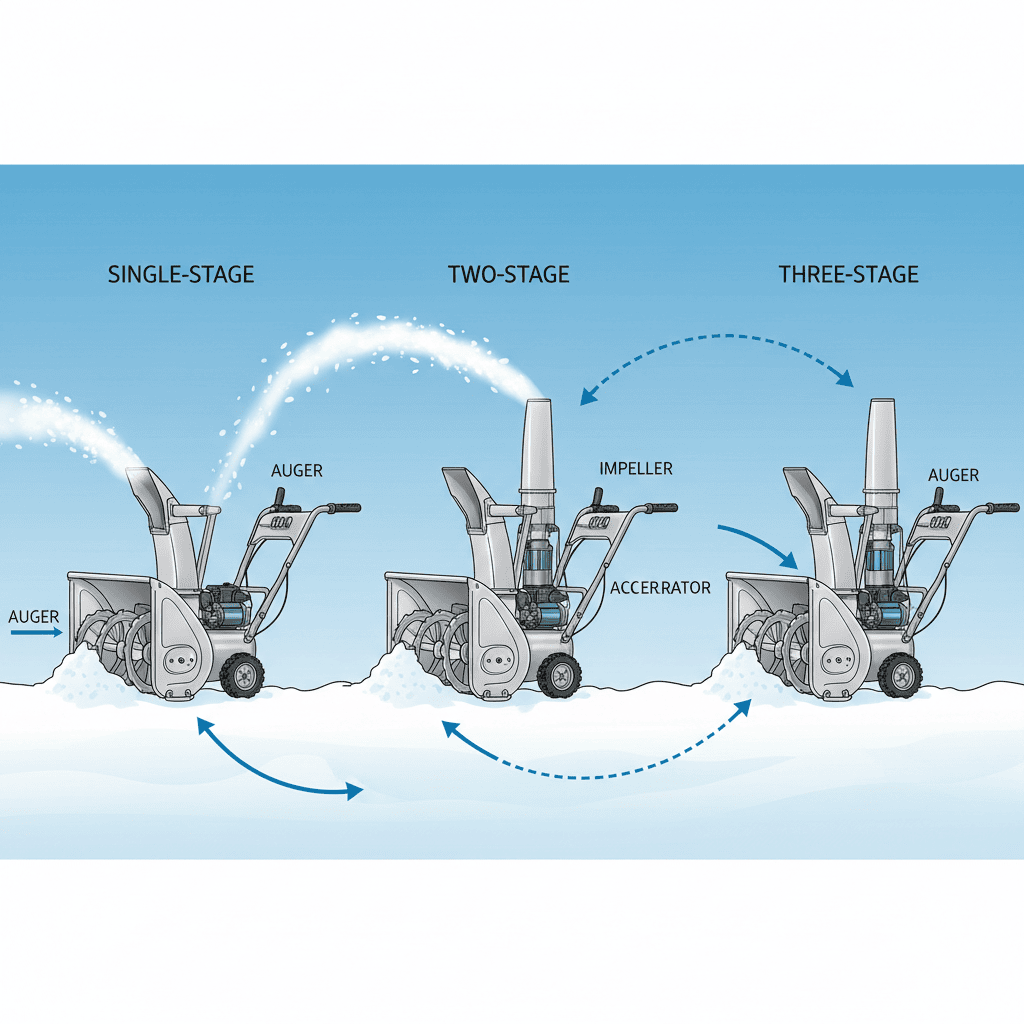
Snow blower design directly determines what conditions it handles and how efficiently it clears snow. Each type uses different mechanisms to move and discharge snow, making them suited to different scenarios.
Single-Stage Snow Blowers: Speed and Simplicity
Single-stage models use one rotating auger that both pulls snow into the machine and propels it out through the chute. This design is compact, lightweight (typically 40–100 lbs), and fast to deploy.
- Clearing width: 16–24 inches
- Best for: Light snowfall (under 6 inches), sidewalks, small driveways, frequent clearing after each snow event
- Snow types: Wet, light, or powdery snow; struggles with packed or icy conditions
- Advantages: Affordable, minimal storage space, easy to start and operate, low maintenance
- Disadvantages: Limited power, poor performance in heavy or wet snow, can clog with dense snow
Two-Stage Snow Blowers: The Versatile Standard
Two-stage machines use a separate auger to gather snow and an impeller (fan-like mechanism) to accelerate it through the discharge chute. This design provides substantially more clearing force and handles tougher conditions.
- Clearing width: 24–32 inches
- Best for: Moderate to heavy snowfall (6–12+ inches), larger driveways, mixed residential/light commercial use
- Snow types: Wet, packed, or heavy snow; handles icy conditions better than single-stage
- Advantages: Reliable power across varied snow conditions, faster clearing, longer chute discharge distance (30–40 feet), self-propelled options available
- Disadvantages: Higher initial cost, requires more storage space, regular maintenance (spark plugs, oil changes, fuel stabilizer)
Three-Stage Snow Blowers: Maximum Clearing Power
Three-stage models add an accelerator stage after the initial auger and impeller, further increasing throwing distance and clearing speed. These machines are designed for extreme conditions and heavy-duty use.
- Clearing width: 28–36 inches (sometimes wider)
- Best for: Heavy snowfall (12+ inches), wet or dense snow, large properties, commercial driveways, gravel or rough terrain
- Snow types: Extremely heavy, wet, or packed snow; can handle partially frozen or crusted conditions
- Advantages: Maximum throwing distance (50+ feet), fastest clearing, handles worst-case scenarios, often equipped with power steering and heated cabins
- Disadvantages: Highest cost, largest storage footprint, significant maintenance requirements, may require commercial fuel grade
Key Factors to Consider Before Buying a Snow Blower
Property Size and Driveway Characteristics
Your property’s dimensions directly determine required clearing width and engine power. A 20-foot-long residential driveway typically needs a 22–24 inch clearing width, while a 50-foot commercial lot benefits from 28–32 inches. Consider whether your terrain includes:
- Gravel or unpaved surfaces (requires higher ground clearance and sturdier construction)
- Hills or slopes (affects self-propulsion requirements)
- Obstacles like parked cars, planters, or tight corners (narrower models may be preferable)
- Proximity to vegetation or structures that could be damaged by thrown snow
Climate and Snow Patterns in Your Region
Different regions experience different snow challenges. Wet, heavy snow common in maritime climates requires more power than light, dry snow in continental climates. Ask yourself:
- How many significant snowfall events occur annually in your area? (Fewer than 3 events may not justify owning a machine versus renting)
- What’s the typical depth per snowfall event? (Light = under 4 inches; moderate = 4–8 inches; heavy = 8+ inches)
- Does your region experience freezing rain, ice crust, or packed snow conditions?
- Are storms frequent enough to require same-day clearing, or can you wait for accumulation?
Fuel Type Trade-offs: Gas vs. Electric vs. Cordless
Gas-powered models (most common) offer maximum power and runtime. They require fuel storage, regular maintenance, and seasonal tune-ups. Typical fuel cost for a winter season: $50–$150.
Electric corded models produce zero emissions, require minimal maintenance, and cost less to operate ($10–$30/season). The trade-off: limited by cord length (typically 50–100 feet) and unsuitable for commercial applications.
Cordless electric models combine convenience with clean operation but have limited battery runtime (typically 30–60 minutes) and reduced power compared to gas equivalents. Battery replacement costs $200–$500. These work well for small properties in areas with frequent light snowfall.
Self-Propulsion vs. Manual Push
Most single-stage models are manual push (you provide the forward motion). Most two-stage and all three-stage models include self-propulsion. For users over 60, those with mobility limitations, or properties over 100 feet long, self-propulsion becomes essential rather than optional. Self-propelled models add $200–$800 to the price but significantly reduce physical strain.
Matching Snow Blower Type to Your Use Case
Light Residential Use (Small Properties, Infrequent Snow)
If you live in a region with 1–3 snowfall events annually totaling less than 15 inches, or if you maintain a small property (under 30 feet of driveway), a single-stage or small two-stage model is appropriate. These machines prioritize affordability and storage efficiency. Expected investment: $300–$800.
Recommendation: Consider a cordless electric single-stage model if your property is very small and snow is light. Otherwise, a gas-powered single-stage provides better value and reliability.
Mid-Range Homeowner (Moderate Climate, Typical Suburban Property)
Most homeowners in northern U.S. states (Ohio, Pennsylvania, New York, Michigan, Wisconsin, Minnesota) and southern Canada fall into this category. You likely experience 5–10 snowfall events annually with typical depths of 4–12 inches and a mix of snow types. A standard two-stage model matches these conditions and typically serves 15–20 years with routine maintenance. Expected investment: $1,200–$2,200.
Recommendation: Prioritize a two-stage model with 26–28 inch clearing width and 7–9 horsepower. Self-propulsion is advisable for properties over 50 feet of driveway or users with limited upper-body strength.
Heavy-Duty Residential or Commercial Use
If you experience heavy snowfall (12+ inches per event), frequent storms (8+ events annually), or operate on rough terrain, or if you clear for neighbors or operate a small commercial service, a three-stage or heavy-duty two-stage model is warranted. These machines prioritize power and durability over cost. Expected investment: $2,500–$6,000.
Recommendation: Three-stage models with 10–13+ horsepower and 32–36 inch clearing width offer the best long-term value for heavy use. Consider commercial-grade models designed for year-round operation.
Essential Specifications and Features Explained
Clearing Width and Snow Removal Efficiency
Clearing width directly impacts time spent snow blowing. Each additional inch of width reduces clearing time by roughly 4–5% on the same property. However, wider machines require more storage space and may be difficult to maneuver in tight areas.
| Clearing Width | Best Property Size | Typical Driveway Time (6-inch snow) |
|---|---|---|
| 18–20 inches | Small driveways, sidewalks only | 30–45 minutes |
| 22–24 inches | Small to medium residential (to 50 feet) | 20–30 minutes |
| 26–28 inches | Medium residential (50–100 feet) | 15–25 minutes |
| 30–36 inches | Large residential or commercial | 10–20 minutes |
Engine Power: Horsepower and Displacement
Engine power determines how quickly a snow blower can clear heavy, wet, or packed snow. Horsepower ratings can be misleading; engine displacement (measured in cubic centimeters or cc) provides a more reliable indicator of actual power.
- Single-stage: 2–5 hp typical; 100–200cc displacement
- Two-stage: 6–11 hp typical; 200–300cc displacement
- Three-stage: 11–20+ hp; 300–500cc+ displacement
As a general rule: add 1 hp for every additional inch of clearing width beyond your base model. Wet snow demands 20–30% more power than light snow.
Chute Design and Discharge Distance
The discharge chute directs snow away from your cleared area. Quality matters significantly for usability:
- Chute angle: Should adjust 45–180 degrees to direct snow where needed without repositioning the machine
- Discharge distance: Single-stage models typically throw 15–25 feet; two-stage models 30–50 feet; three-stage models 50+ feet. Longer discharge reduces the need to clear windrows multiple times
- Deflector design: Prevents snow from blowing back onto already-cleared areas; essential for windy conditions
Auger and Impeller Construction
These internal components determine snow handling capability and durability. Cast-iron or steel augers resist damage from rocks and gravel better than plastic. Sealed bearings reduce maintenance compared to open designs. Rubber-lined chutes protect against ice buildup and reduce noise.
Wheels, Tires, and Traction
Proper traction prevents slipping on icy or sloped surfaces. Look for:
- Lug-pattern tires (not smooth tread) for snow and ice grip
- Pneumatic (air-filled) tires for comfort on rough terrain; solid tires require less maintenance
- Adjustable weight distribution or ballast options for slopes
- Power steering on larger models to reduce operator fatigue
Seasonal Availability, Storage, and Maintenance Considerations
When to Purchase: Timing and Availability
Snow blower availability and pricing fluctuate dramatically by season. Purchasing in September–October (before winter) offers the widest selection and best pricing. By December, inventory depletes and prices may increase 10–25%. January–February often features clearance pricing but limited selection. If you haven’t purchased by November, consider renting for immediate needs while shopping for next season.
Storage Requirements
Snow blowers require dry, climate-controlled storage to prevent rust and corrosion. Single-stage models fit in most garage corners or garden sheds (space requirement: roughly 3 feet × 2 feet). Two-stage models need 4–6 feet of space. Three-stage models often require dedicated 8+ foot storage areas. Insufficient storage shouldn’t prevent purchase of the right machine for your climate, but it’s a legitimate planning consideration.
Maintenance Commitments and Costs
Gas-powered models require seasonal maintenance:
- Pre-season tune-up (spark plug replacement, oil change, fuel stabilizer): $50–$100 DIY, $100–$200 professional
- Mid-season inspection and cleaning: 30–45 minutes
- Post-season storage preparation (drain fuel or run with stabilizer): 20–30 minutes
- Belt and spark plug replacement every 2–3 seasons: $30–$80
- Auger or impeller bearing replacement as needed (5–10 year intervals): $100–$300
Electric models require minimal maintenance:
- Annual cleaning and inspection: 15 minutes
- Battery charging (cordless models): time varies, cost included in initial purchase
- Cord inspection (corded models): visual check, cost negligible
Total cost of ownership over 10 years: Gas models typically cost $150–$400 more in maintenance than electric models, but offer superior power and versatility.
Winterization and Storage Procedures
Proper storage extends machine lifespan by 5+ years and prevents costly repairs:
- Drain fuel or use stabilizer: Prevents carburetor gum buildup and starting problems next season
- Change oil: Fresh oil prevents engine sludge during off-season
- Clean thoroughly: Remove packed snow and salt spray to prevent rust
- Protect exposed metal: Apply light oil coating to unpainted metal parts
- Store in controlled environment: Garage or shed prevents freezing damage and theft
Frequently Asked Questions
How do I know if I should buy or rent a snow blower?
Buy if you experience 4+ snowfall events annually in your area; rent if you face fewer than 2 events. Consider regional averages over 5 years, not just last winter. Rental costs typically run $40–$80 per day or $150–$300 per season, making purchase financially sensible when you’ll use the machine 3+ times per season. Also factor personal preference: some people prefer hassle-free rentals despite higher long-term costs.
What’s the difference between engine displacement and horsepower ratings?
Engine displacement (measured in cc) is the total volume of air and fuel an engine processes per cycle—a consistent measurement. Horsepower varies by RPM, load, and manufacturer testing methods. A 208cc two-stage engine will consistently outperform a 5 hp single-stage engine regardless of marketing claims. Always compare displacement or look for independent performance tests rather than relying on horsepower numbers alone.
Can I use a residential snow blower commercially?
Technically, yes, but residentially-rated machines (typically designed for 30–50 hours of annual use) will wear faster under commercial demands (100–200+ hours annually). Commercial-grade machines use heavier-duty components, reinforced frames, and sealed engine designs built for continuous operation. If you plan to clear for multiple properties or operate a snow removal service, invest in commercial equipment to avoid premature failure and liability issues.
How much noise do snow blowers produce, and does it matter?
Gas single-stage models produce 80–85 decibels (similar to a lawn mower). Two-stage models: 85–90 decibels. Three-stage machines: 90–95 decibels. Electric models are significantly quieter at 65–75 decibels. Local ordinances may restrict noise before 8 AM or after 6 PM. If you live in a densely populated area or plan early-morning clearing, cordless electric or corded electric models are preferable despite lower power.