
Direct Answer: Can You Use Car Engine Oil in a Lawn Mower?
Yes—with conditions. Car engine oil works in most 4-stroke lawn mower engines provided the viscosity grade and API service rating match the manufacturer’s specification. SAE 30 and 10W-30 are the grades most widely accepted by major OEMs including Briggs & Stratton and Honda. 2-stroke mower engines are a hard exception: they require dedicated 2-stroke oil pre-mixed with fuel at a precise ratio—pouring straight car oil into a 2-stroke engine causes rapid, irreversible damage.

Pros
- Large-size design named in product title
- Sharpening and balancing functions listed
- Listed as a new upgraded version

Pros
- Adjustable 15-to-45-degree range in title
- Sharpening and balancing functions listed

Pros
- Sharpener and balancer functions in title
- 15-to-45-degree adjustable setting listed
- Built for lawn mower blade maintenance
Pros
- Includes replacement gaskets and a 98079-55846 spark plug
- Matches Honda HRR216 and HRS216 lawn mower models
- Designed around the 16100-Z8B-901 carburetor specification
Cons
- Restricted to select Honda GCV160 mower applications
- Installation requires basic mechanical tools and skills
4-Stroke vs. 2-Stroke Lawn Mower Engines: Identify Your Engine First
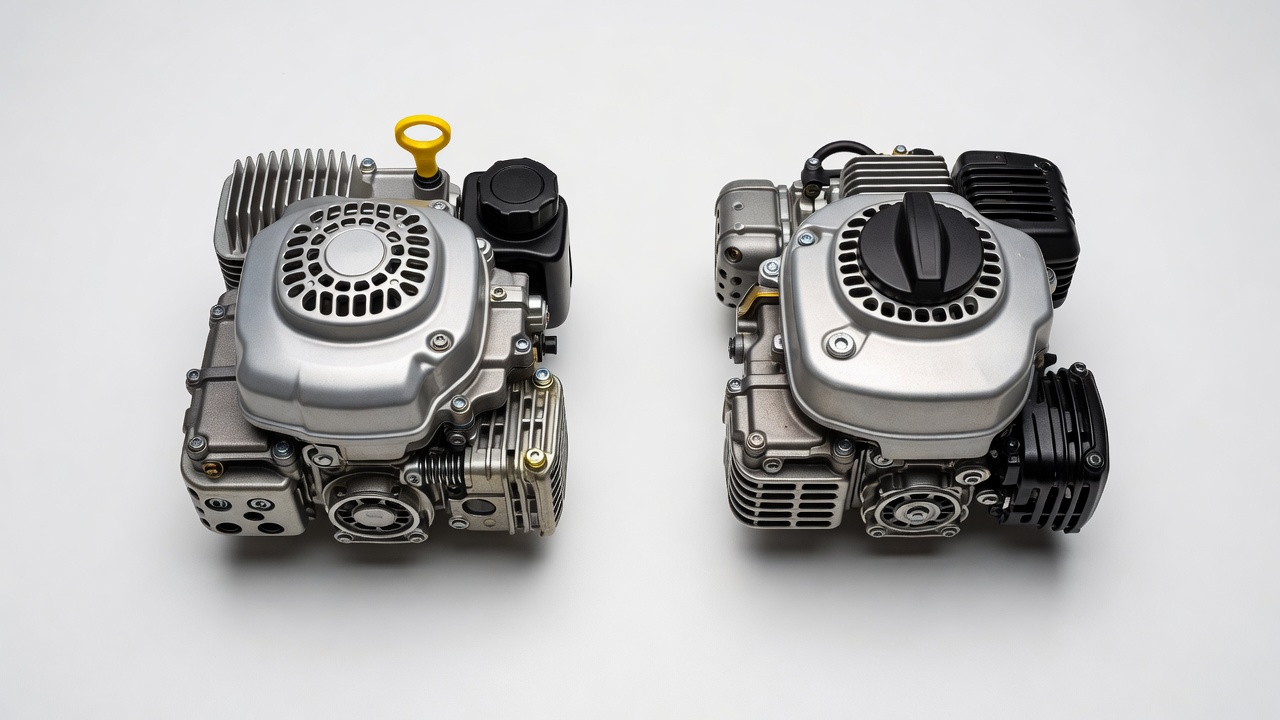
The answer to this question splits completely depending on engine type. Identify yours before doing anything else.
How to Tell Which Engine Type You Have
- 4-stroke (4-cycle): Has a separate oil fill cap and dipstick. Fuel goes in the fuel tank undiluted. The vast majority of modern push mowers and all riding mowers use 4-stroke engines. Common examples: Briggs & Stratton 500 series, Honda GCV160, Kohler XT series.
- 2-stroke (2-cycle): Has no separate oil reservoir. Oil and fuel are mixed together before filling the tank, or a combined fuel/oil cap is present. Common on older push mowers, handheld trimmers, and some lightweight walk-behind mowers.
Why Car Oil Is Categorically Unsafe in a 2-Stroke Engine
A 2-stroke engine lubricates its crankshaft, bearings, and cylinder walls through oil carried in the fuel mixture itself. Dedicated 2-stroke oil is formulated to burn cleanly alongside fuel. Car engine oil does not burn cleanly—it leaves carbon deposits, fouls the spark plug, and starves critical components of lubrication within minutes of operation. The result is seized pistons and destroyed bearings. No exceptions apply here. Users looking for related component recommendations can explore our jbl partybox club 120 vs sony srs xv500 breakdown.
The standard 2-stroke oil-to-fuel mix ratio is typically 50:1 (2.6 oz oil per 1 gallon of gas) but always confirm against your engine’s owner’s manual—some older engines specify 32:1. Users looking for related component recommendations can explore our jbl partybox club 120 vs sony srs xv500 breakdown.
Do Modern Mowers Still Use 2-Stroke Engines?
Increasingly rare but not extinct. Most mowers sold after 2000 are 4-stroke. If your mower is older, lightweight, or lacks a dipstick, check the manual or look for a single-cap fuel/oil system before adding anything.
Which Car Engine Oil Grades Work in a 4-Stroke Lawn Mower?
For 4-stroke mowers, the viscosity grade is the primary compatibility variable. Small air-cooled engines lack the liquid cooling systems of car engines, so they run at higher sustained operating temperatures—viscosity selection is more consequential than it is in an automobile. Before finalizing equipment decisions, refer to our comprehensive z890 vs x870e motherboard comparison.
| Oil Grade | Best Operating Temperature Range | 4-Stroke Mower Compatible? | Notes |
|---|---|---|---|
| SAE 30 | Above 40°F (4°C) | ✅ Yes | Standard grade for warm-climate mowing; most common OEM recommendation |
| 10W-30 | 0°F to 100°F (-18°C to 38°C) | ✅ Yes | Wider temperature range; accepted by Briggs & Stratton and Honda GCV |
| 5W-30 | Below 40°F (4°C) | ✅ Yes (cold climates) | Better cold-start protection; acceptable per most OEM manuals in cold conditions |
| 10W-40 | Above 40°F (4°C) | ⚠️ Conditional | Some OEMs accept it; check your specific manual—may increase oil consumption |
| High-mileage blends | Varies | ⚠️ Use with caution | Seal-conditioning additives and friction modifiers may be incompatible with small engine tolerances |
| 2-stroke oil | N/A | ❌ No (in 4-stroke) | Wrong formulation entirely |
Synthetic vs. Conventional Car Oil in a Lawn Mower
Full synthetic car oil (e.g., Mobil 1 5W-30) meeting the correct viscosity and API rating is acceptable in most 4-stroke mower engines and can extend oil life. Briggs & Stratton explicitly states that synthetic oils meeting API SJ or higher and the correct viscosity grade can be used in their engines. Switching from conventional to synthetic mid-season is fine—you do not need to flush between types. High-mileage synthetic blends are the exception: the friction modifiers and seal-swelling agents added for worn car engines can cause issues in the tighter tolerances of small air-cooled engines, so avoid these unless your OEM manual explicitly permits them.
API Service Rating: The Specification Most People Skip
Viscosity grade gets most of the attention, but the API (American Petroleum Institute) service rating printed on the oil bottle’s donut label is equally important. It tells you whether the oil’s additive package is appropriate for the engine’s demands. For broader ecosystem context, read through our operational guide on marshall stanmore iii vs harman kardon onyx studio 8.
What API Rating Does a Lawn Mower Engine Require?
Most small 4-stroke engine manufacturers specify API SJ or higher (SL, SM, SN, SP). These ratings indicate the oil meets performance standards for oxidation resistance, deposit control, and wear protection under the thermal stress conditions of a small air-cooled engine. API SJ is the minimum; current car oils typically carry SN or SP, which exceed that threshold and are acceptable.
Why Additives in Car Oil Can Be Problematic
Car engines are liquid-cooled and operate at lower sustained temperatures relative to their displacement than air-cooled small engines. Additive packages optimized for car engines—particularly friction modifiers (like molybdenum disulfide compounds in some high-mileage and performance oils) and viscosity index improvers—can shear down under the higher RPM and thermal load of a small mower engine faster than in an automobile. The result is effective viscosity dropping below the safe range mid-operation. Standard conventional or full-synthetic oils at the correct grade without high-mileage additives avoid this risk. For troubleshooting and reliability insights, consult our in-depth dyson v8 cyclone vs bissell featherweight stick report.
What Briggs & Stratton, Honda, Kohler, and Other OEMs Actually Specify
Manufacturer specifications are the authoritative source. Here is what the three dominant small-engine OEMs state in their published owner’s manuals:
Briggs & Stratton
Briggs & Stratton specifies SAE 30 for temperatures above 40°F and 10W-30 for varying temperature conditions. They explicitly state that standard automotive motor oil meeting API SJ or higher is acceptable—branded small-engine oil is not required. Full synthetic is permitted. Capacity varies by engine model but typically falls between 20 oz and 48 oz (0.6–1.5 liters). Consult the model-specific manual for exact fill volume. Readers comparing setup options can review our technical analysis on bissell crosswave hydrosteam vs shark stainforce.
Honda GCV Series (GCV160, GCV190)
Honda GCV owner’s manuals specify SAE 30 for temperatures above 50°F and 10W-30 as acceptable across a wider range. Honda also accepts API SJ or later classification. The GCV160 holds approximately 0.58 liters (19.6 oz) of oil. Honda’s warranty language requires oil meeting its published viscosity and API spec—deviation can provide grounds to deny warranty claims on engine-related failures.
Kohler (XT Series, Command Pro)
Kohler specifies 10W-30 or SAE 30 for most operating conditions, with 5W-20 or 5W-30 recommended for temperatures below 32°F. Kohler mandates API SF or higher (current SN/SP oils exceed this). Kohler’s warranty explicitly states that engine damage resulting from use of non-specification oil is not covered.
Where to Find Your Mower’s Oil Specification
- Owner’s manual (physical copy or PDF on the manufacturer’s website—search by engine model number)
- Engine model number label on the engine block itself
- Oil fill cap—some OEMs print the grade directly on it
- Manufacturer’s online parts/support lookup tool (Briggs & Stratton, Honda Power Equipment, Kohler Engines all provide this)
How Operating Temperature and Climate Affect Your Oil Choice
Small air-cooled engines have no radiator, no coolant, and no thermostat. Engine temperature tracks ambient temperature and workload far more directly than a car engine. This makes ambient operating temperature the primary driver of correct viscosity selection—not just a secondary consideration.
Temperature-to-Grade Reference
- Above 40°F (4°C): SAE 30 is the standard recommendation. Provides correct viscosity at operating temperature in warm conditions.
- 0°F to 100°F (-18°C to 38°C): 10W-30 is the versatile all-season choice. The lower cold-flow rating (10W) aids starting; the 30 weight maintains film strength at operating temperature.
- Below 40°F (4°C): 5W-30 or 5W-20 (per OEM). Thin enough to flow immediately on cold start, preventing dry-running wear during the first seconds of operation.
- Extreme heat (sustained above 95°F / 35°C ambient): Some OEMs recommend SAE 30 over 10W-30 in very high ambient temperatures because the multigrade viscosity improvers in 10W-30 can shear more readily under sustained thermal load.
Using an oil that is too thin in hot conditions reduces the lubricant film between moving parts. Using one that is too thick in cold conditions causes hard starting and delayed lubrication on startup. Either scenario accelerates wear.
How to Check and Change Your Lawn Mower Oil Correctly
Checking Oil Level
- Park the mower on a flat, level surface. Tilt on a slope will give a false reading.
- Clean around the dipstick or oil fill cap before removing to prevent debris entering the crankcase.
- Remove the dipstick, wipe clean, reinsert fully, then remove again and read the level.
- Oil should sit between the MIN and MAX marks. Add oil in small increments if low—overfilling causes foaming and blown gaskets.
Changing the Oil
- Run the mower for 2–3 minutes to warm the oil—warm oil drains more completely than cold oil.
- Disconnect the spark plug wire before any maintenance.
- Position a drain pan. Remove the drain plug (bottom of engine) or tilt the mower toward the oil fill side to drain through the fill port—check your manual for the correct tilt direction to avoid fuel or oil entering the air filter.
- Allow full drainage (3–5 minutes).
- Replace drain plug and torque to spec (typically 140–180 in-lb for most small engines—check your manual).
- Refill with the correct grade to the MAX mark on the dipstick. Do not overfill.
- Reconnect the spark plug wire, start the engine, and check for leaks.
Oil Change Interval
- New engine break-in: Change after the first 5 hours of operation. Metal particles from initial wear contaminate the oil rapidly during break-in.
- Ongoing interval: Every 50 hours of operation or once per mowing season, whichever comes first—per Briggs & Stratton and Honda GCV guidance.
- Heavy-use or commercial mowing: Every 25 hours.
Disposing of Used Oil
Used motor oil is a regulated waste product. Take it to an auto parts retailer (AutoZone, O’Reilly, Advance Auto Parts) or municipal recycling center—most accept used oil at no charge. Do not pour down drains or onto the ground.
When to Use Dedicated Small Engine Oil Instead of Car Oil
Car oil substitution is a legitimate short-term solution in specific situations. It is not always the optimal long-term choice.
Car Oil Is Acceptable When:
- You are performing an emergency top-up mid-season and the correct viscosity and API-rated car oil is what you have available.
- The car oil grade exactly matches the OEM specification for your engine.
- You plan to do a full oil change at the next scheduled interval with the proper product.
Opt for Dedicated Small Engine Oil When:
- The mower is new and under warranty—document that you used OEM-specified or purpose-formulated small engine oil to protect warranty claims.
- You run the mower in extreme heat or for extended commercial hours—small engine oils are formulated specifically for the thermal profile of air-cooled engines and provide more appropriate additive packages for sustained high-temperature operation.
- You want to extend oil life between changes—some small-engine-specific synthetic oils are tuned for longer intervals under air-cooled conditions.
- You are uncertain which car oil additive package is present in the bottle you have—dedicated small engine oil removes that ambiguity.
Mixing small engine oil and car oil of the same viscosity grade mid-season is acceptable. Different base stocks and additive packages are compatible at the molecular level provided viscosity grades match. This is not the preferred approach but causes no immediate harm.
Common Questions on Can You Put Car Engine Oil In A Lawn Mower Answered
Can I use 10W-30 car oil in a lawn mower?
Yes. 10W-30 automotive motor oil meeting API SJ or higher is explicitly accepted by Briggs & Stratton, Honda GCV, and Kohler for their 4-stroke engines. It is the most versatile grade for variable operating temperatures. Confirm your specific engine model’s manual to be certain.
What happens if you put car engine oil in a 2-stroke lawn mower?
Serious engine damage occurs rapidly. A 2-stroke engine requires oil mixed into the fuel to lubricate internal components during combustion. Car engine oil does not atomize or burn cleanly with fuel—it starves the engine of proper lubrication, fouls the spark plug with carbon deposits, and leads to seized pistons and bearing failure. Always use dedicated 2-stroke oil at the manufacturer-specified mix ratio.
Will using car oil void my lawn mower warranty?
It can. Briggs & Stratton, Honda, and Kohler all specify that oil must meet defined viscosity and API ratings. If you use a car oil that meets those specs (correct grade, API SJ or higher, no incompatible additives), the substitution is within the published parameters and does not constitute grounds for warranty denial. Using the wrong grade, a 2-stroke oil, or a high-mileage blend with unapproved additives in a 4-stroke engine provides the manufacturer grounds to deny engine-related warranty claims.
Is small engine oil actually different from car engine oil?
In terms of base chemistry, no—both are petroleum or synthetic lubricants refined to a viscosity grade. The differences lie in the additive package. Small engine oils are formulated for air-cooled, high-temperature, high-RPM operation with additive profiles matched to those conditions. Car oils optimized for liquid-cooled engines—particularly high-mileage and performance variants—carry friction modifiers and viscosity index improvers that can be suboptimal in small engines. A standard conventional or full-synthetic car oil at the correct grade and API rating is functionally appropriate for 4-stroke mower use.
For more hands-on benchmarks and buying recommendations, consult our guides on heavy-duty chainsaw buyer guide, as well as high-CFM commercial leaf blower guide, as well as durable ride-on lawn tractor guide, as well as automated robotic lawn mower guide.
Mechanical safety standards, operational tolerances, and protective gear guidelines align with benchmark specifications established by the American National Standards Institute (ANSI).