

Quick Answer: How Much Is A Lawn Mower At Home Depot?
There is no single Home Depot lawn mower price. Cost depends on mower type (push, self-propelled, riding, zero-turn, or robotic), power source, deck size and features, brand and model, season, and your store or ZIP code. Walk-behind mowers are usually the least expensive category; larger, powered, and automated machines typically cost more. Extra batteries, delivery, assembly, tax, and supplies can…

Pros
- Powerful 80V brushless motor delivers 32HP gas-equivalent performance with quiet fume-free operation and no engine maintenance.
- Complete kit includes four 6.0Ah batteries and 600W charger for substantial runtime up to 1.5 acres.
- SmartCut technology and 42-inch heavy-duty steel deck ensure consistent cuts without bogging in tough conditions.
- Versatile towing up to 350 lbs and optional cargo hauling plus comfort features like high-back seat and LED lights.
- Strong 4-year limited warranty and full compatibility with the Greenworks 80V tool ecosystem.
Cons
- Rear utility cargo bed for 200 lb hauling is sold separately and not included in the kit.
- Runtime of up to 1.5 acres varies with conditions and may require recharging or battery swaps on larger properties.
- As a fully cordless model continuous operation depends on battery levels unlike gas engines with unlimited runtime.
The Greenworks 80V 42" CrossoverT Cordless Riding Lawn Tractor is a ready-to-mow zero-emission tractor designed for homeowners managing medium to large lawns. It features a reinforced 42-inch stamped steel deck of 12-gauge construction along with premium comfort elements such as a high-back padded seat with foldable armrests. The overall build emphasizes durability and user convenience right out of the box with the included battery and charger set.
Performance centers on the 80V TruBrushless motor that provides 32HP gas-equivalent power with instant torque and quiet fume-free operation. SmartCut technology senses grass conditions and automatically adjusts power to maintain a consistent cut even in tall thick or wet areas. The four 6.0Ah batteries support runtime for up to 1.5 acres depending on conditions while dual LED headlights and a 7-position deck height range from 1.5" to 4.5" add practicality. Front and rear attachments further allow towing up to 350 lbs for added yard utility.
Key considerations include that the rear utility storage bin capable of hauling 200 lbs is sold separately so full cargo functionality requires an extra purchase. Runtime remains condition-dependent and may fall short for properties significantly larger than 1.5 acres without using the 600W charger or swapping batteries. The cordless design prioritizes ease and low maintenance but trades off the continuous runtime of traditional gas models.
This tractor delivers strong value for eco-conscious owners of residential properties who want gas-like power without the emissions noise or upkeep. It suits those who already use or plan to expand into the Greenworks 80V family of tools and who appreciate the 4-year limited warranty. Users with exceptionally large or commercial-scale lawns should evaluate battery logistics carefully before purchase.

Pros
- Delivers strong 21 horsepower equivalent power comparable to gas riding mowers.
- Provides up to 1.5 acres of runtime on a full charge with the six included batteries.
- Features low-maintenance dual brushless motors without belts for greater durability.
- Offers versatile 12-position cutting height adjustment from 1.5 to 4.5 inches.
- Includes digital controls for blade settings, drive speeds, and cruise control.
Cons
- Limited to 1.5 acres of cutting per charge without purchasing additional batteries for bigger lawns.
- Requires recharging time for the six 56V batteries after each use session.
- Relies solely on battery power with no hybrid or gas backup option for extended operation.
The EGO Power+ TR4204 is a cordless electric riding lawn mower built as a modern tractor alternative for residential use. It features a robust 42-inch stamped steel deck and arrives ready to go with six 56V 6.0Ah batteries plus a charger, creating an immediate impression of convenience and solid construction free from gas engine complexity.
Performance shines through its equivalent 21 horsepower output and top speed of 6 MPH, allowing efficient coverage of up to 1.5 acres on a single charge. Dual brushless cutting motors operate without belts for added durability and less upkeep, while the digital display lets users select three blade settings, three drive speeds, and cruise control. The 12 adjustable heights ranging from 1.5 to 4.5 inches combined with anti-scalp wheels deliver precise results across varied terrain.
Drawbacks center on battery dependency, as larger properties beyond 1.5 acres require extra batteries and recharging intervals can interrupt workflow. The fully electric design eliminates fuel storage needs but demands access to power sources between sessions.
This mower suits homeowners with medium to large yards who value quiet, emission-free operation and reduced maintenance. Those seeking expandable battery capacity for bigger areas will find the EGO Power+ TR4204 a strong long-term investment in cordless lawn care.
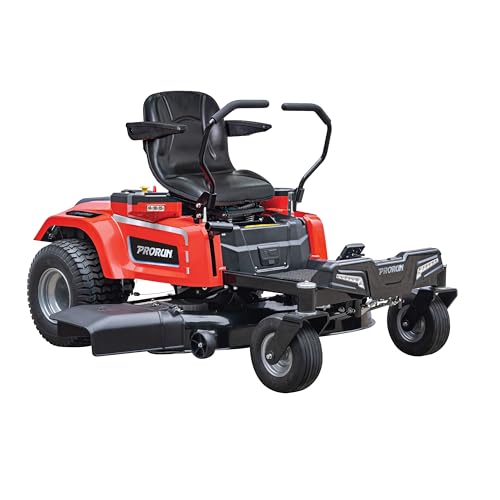
Pros
- High-efficiency brushless motors maximize power output and durability over traditional motors
- Up to 2 acres runtime with three included 10.0 Ah batteries supports substantial mowing sessions
- Zero-emission operation with gas-equivalent 20 HP power for quieter environmentally friendly use
- Six-port auto-switchover battery system provides flexible extended runtime options
- Durable 42-inch steel deck plus included mulch and towing kits add immediate functionality
Cons
- Runtime is limited to approximately 70 minutes or 2 acres which may require recharging for larger properties
- Fully battery-dependent design means performance relies on charge levels and spare battery availability
- 42-inch deck size may require more passes on expansive lawns compared to wider commercial models
The PRORUN PZT60V42 is a fully electric 60V zero-turn riding lawn mower built for residential and light commercial use. Its primary design centers on a robust 42-inch 14-gauge stamped steel twin blade deck powered by direct-drive brushless motors, giving an immediate impression of solid construction and modern battery-focused engineering. The mower arrives complete with three 10.0 Ah batteries, a charger, mulch kit, and towing kit for ready-to-work versatility.
In performance terms, four high-efficiency brushless motors deliver power equivalent to a 20 HP gas engine while producing zero emissions. The system supports up to 2.0 acres or 70 minutes of runtime, and six battery ports with auto switchover intelligently manage all PRORUN 60V battery sizes for continuous operation. A washout port on the steel deck further simplifies post-mow maintenance during real-world sessions.
Potential drawbacks include the finite 70-minute runtime window which can limit coverage on larger properties without spare batteries or recharge breaks. As a fully electric model, it also depends entirely on battery charge levels rather than continuous fuel refills, and the 42-inch deck width may demand extra passes compared with wider traditional options.
Overall the PRORUN PZT60V42 offers strong value for homeowners and small-property managers who want gas-like cutting power without emissions or noise. Those with medium-sized lawns seeking quiet efficient zero-turn performance and included accessories will benefit most from this electric mower.

Pros
- Strong 24HP FR730 engine power for demanding cutting conditions
- Wide 54-inch FAB deck reduces total mowing time
- Zero turn design delivers excellent maneuverability
- Fabricated deck supports durable everyday operation
Cons
- Sparse details beyond engine and deck leave other features unspecified
- Gas-powered FR730 engine needs regular fuel and maintenance
- Large 54-inch deck size may feel oversized on compact properties
The Husqvarna Z254F is a zero turn mower from the established Husqvarna brand in the riding lawn mowers category. It centers on a solid build that pairs a 24HP 726cc FR730 engine with a 54-inch FAB deck for straightforward residential grass care.
Performance stems directly from the listed specifications. The FR730 engine delivers the horsepower needed for steady operation across typical lawns while the wide FAB deck completes passes efficiently. Zero turn handling improves control in real yard layouts based on the model design.
Considerations arise from the limited data available. Secondary elements such as comfort features fuel capacity or extras receive no mention and the gas engine format involves routine upkeep. The large deck suits open areas better than confined spaces.
The Husqvarna Z254F provides the most value for owners of medium or large properties who want reliable engine power and a broad cutting width. Users with smaller lots or those seeking extensive accessory options should weigh the core specs carefully before purchase.
There Is No Single Home Depot Lawn Mower Price
Shoppers often type a simple question and expect one number. Home Depot does not sell one lawn mower. It sells several families of machines that do related work at very different scales. A compact walk-behind unit and a large riding mower both cut grass, but they are not interchangeable products, and they are not priced as if they were.
The number on a tag moves for several independent reasons at once. Type is the first split: a push mower, a self-propelled walk-behind, a riding mower or lawn tractor, a zero-turn mower, and a robotic mower occupy different parts of the assortment. Power source is the second split: gas-powered, corded electric, and cordless battery designs are built, stocked, and accessorized differently. After that come cutting-deck width, drive and start features, brand, included attachments, and whether the listing is a complete kit or a bare tool.
Location and channel matter as well. Home Depot sets prices in a live retail system, not as a single nationwide sticker that never changes. Two stores can show different inventory. An online-only SKU may not exist on a local shelf. A seasonal promotion, a clearance markdown, or a display unit can sit next to a regular-price boxed model that looks similar from ten feet away. Timing matters because outdoor power equipment demand usually rises when grass starts growing and eases when the season winds down, and assortment often shifts with that cycle.
Treat this article as orientation, not a checkout quote. It can explain why two tags differ and how to read a listing. It cannot publish a trustworthy current price, an average, or a low-to-high dollar band that will still be accurate when you shop. The only reliable current price for a given machine is Home Depot’s live website or app listing for a chosen ZIP code or store, or the in-store tag for that exact SKU and model number. To compare alternative configurations, check our hands-on review of jbl partybox club 120 vs sony srs xv500.
Mower Types You Will Usually See and How Type Affects Cost

Comparing prices is only meaningful across similar types and similar included equipment. A cheaper robotic mower is not a bargain against a basic push mower if you needed something you can store in a small shed and push for twenty minutes. Start by naming the category, then compare tags inside that category. Home Depot’s mix of types can differ by store and season, so a format you saw online may not be on every sales floor.
Walk-behind and push mowers
A walk-behind mower is a machine you walk behind while it cuts. A push mower is the simplest version of that idea: you supply the forward motion. These units usually have a smaller cutting deck than riders, fewer convenience systems, and a smaller storage footprint. Because the product is physically simpler and aimed at smaller or less demanding yards, walk-behind and especially basic push mowers are typically the lowest-priced major category you will see. To compare alternative configurations, check our hands-on review of jbl partybox club 120 vs sony srs xv500.
Self-propelled walk-behind mowers
A self-propelled walk-behind still requires you to walk the lawn, but the drive system helps move the mower forward. That assistance is useful on slopes, in thick grass, or for anyone who does not want to push the full weight of the machine. Drive hardware, speed controls, and sometimes all-wheel or variable-pace systems add parts and complexity, so self-propelled models typically cost more than a comparable push mower in the same power family.
Riding mowers and lawn tractors
A riding mower or lawn tractor is a sit-down machine with a larger cutting deck and a chassis built to cover more ground. These are generally intended for larger properties where walking the entire lawn is impractical. You are buying an engine or motor system, a transmission, a seat and steering setup, a wider deck, and often the ability to accept attachments. That is why riders generally cost more than walk-behinds. Lawn tractor styling and feature packages vary; some are closer to a dedicated mower, while others are presented as more utility-oriented. Either way, compare them with other riders, not with push mowers. Users looking for related component recommendations can explore our z890 vs x870e motherboard breakdown.
Zero-turn mowers
A zero-turn mower is a riding format designed to pivot tightly, which can reduce the time spent turning around trees, beds, and buildings. The steering system, deck design, and performance positioning of many zero-turn models place them at the higher end of the riding category. That is a relative statement about typical assortment, not a promise that every zero-turn listing will outprice every lawn tractor. Read the deck size, power type, and included equipment before you assume two riders are peers.
Robotic mowers
A robotic mower is designed to cut with little or no hands-on operation after setup. Automation, sensors, boundary or mapping hardware, and a docking or charging setup change both the purchase price and the installation burden. Some properties also need extra wire, extra docking considerations, or more careful layout around obstacles. Those needs can push cost up even when the mower itself looks compact. Installation complexity is part of the real price, whether you do the work yourself according to the manufacturer’s instructions or hire a qualified installer. Before finalizing equipment decisions, refer to our comprehensive marshall stanmore iii vs harman kardon onyx studio 8 comparison.
Use type as a filter, not as a ranking. Home Depot is not presenting one “correct” mower. It is stocking several answers to several yards. If two listings are not the same type, a lower tag does not automatically mean a better deal.
Gas, Corded Electric, and Battery Power
Power source is one of the largest drivers of both the purchase price and the cost of owning the machine. It also changes what “the price” even includes, because battery products are often sold as kits or as tool-only items. For broader ecosystem context, read through our operational guide on dyson v8 cyclone vs bissell featherweight stick.
How the three common power types differ on the tag
Corded electric walk-behind mowers are usually the simplest electric option: they draw power from an outdoor-rated extension setup rather than from onboard fuel or a removable pack. That simplicity can keep the machine itself relatively inexpensive, but the cord limits range and can be impractical on large or obstacle-filled lawns.
Cordless battery mowers remove the cord and the gas can. The advertised price may cover a mower, one battery, and a charger; it may cover a mower only; or it may include more than one pack. A larger yard may need a second battery or a higher-capacity pack to finish without a long pause. If the listing is a bare tool, the real price to start mowing includes at least one compatible battery and charger, and those accessories are not optional extras in any practical sense. For troubleshooting and reliability insights, consult our in-depth bissell crosswave hydrosteam vs shark stainforce report.
Gas-powered walk-behind and riding options typically include an engine that runs on fuel and requires oil and periodic service. The base SKU often looks “complete” in a way a tool-only battery listing does not, but first-use fluids, a fuel can, and later maintenance still sit outside the headline number. Across the whole Home Depot wall, you should not assume gas is always higher or always lower than battery. Compare complete, ready-to-use configurations of the same type.
Ownership cost is not the same as purchase price
Gas mowers generally require fuel, oil, thoughtful storage, and periodic service. Electric models shift cost toward electricity. Cordless units add battery wear and eventual pack replacement. None of those streams can be turned into a reliable annual number from an article, because yards, grass, climate, and how often you mow differ. Treat ownership-cost talk as a checklist of categories, not a calculated total cost of ownership.
A shopper might accept a higher upfront battery price for quieter operation, no fuel storage, and easier starting. Another shopper might accept fuel and maintenance in exchange for a familiar platform or a particular riding format. Those are preference and property questions. They are not proof that one power type always saves money.
Read runtime, voltage, and power claims as manufacturer-stated
Listings often highlight voltage, amp-hours, horsepower-style language, or runtime. Those figures come from the manufacturer’s marketing and specification sheet. They are not independently verified here, and they are easy to misuse when two brands describe power differently. Use them to compare similar products in the same family, then confirm what is actually in the box. Kit contents change the real price more reliably than a headline power number does.
Features and Specs That Usually Raise or Lower the Price
Two mowers can share a type and still sit far apart on the shelf. The gap is usually a stack of deck, drive, convenience, and accessory choices rather than a mystery surcharge.
Cutting deck and build
The cutting deck is the housing that holds the blade or blades and determines how wide a strip you cut on each pass. A wider deck typically costs more because it is a larger fabricated part and it is usually paired with a more capable machine. Build also matters. Steel decks, reinforced structures, and multi-blade setups on larger riders generally sit above lighter, simpler decks. Width is not a quality score by itself. A deck that is wider than your gates, storage path, or tight side yards can be an expensive mismatch.
Convenience and control features
Features that reduce effort usually raise the purchase price. On walk-behinds, that often means electric start instead of a pull start, personal-pace or variable-speed drive, and sometimes all-wheel drive. On riders, headlights, cruise-style speed control, tighter turning aids, and a more comfortable seat package are common step-ups. None of these is automatically necessary. They are reasons two similar photos can hide different tags.
Mulch, bag, and side-discharge
Most walk-behind and many riding designs handle clippings in more than one way: mulch them back into the lawn, collect them in a bag, or throw them out a side-discharge chute. A machine that includes more than one mode, plus the bag, mulch plug, or other accessories in the box, can justify a higher price than a unit that ships as a single-mode cutter. Check whether those accessories are included, sold separately, or incompatible with the exact SKU you are viewing. Included attachments change value even when the mower body looks the same.
Brand, warranty presentation, and easy-to-misread listing details
Brand and how the warranty is presented on the listing affect what people are willing to pay, but warranty length and exclusions are brand- and product-specific. Read the current coverage language on the listing and in the manufacturer materials rather than assuming two logos mean the same protection.
Several listing details are easy to misread and will distort any price comparison:
- Kit versus bare tool, especially on cordless battery mowers.
- Assembled versus some assembly required, which can hide time or a paid assembly fee.
- Online-only versus available for store pickup or on a local shelf.
- Color, deck size, or battery count that differs from a similarly named sibling model.
- A floor model or open-box unit that is not the same condition as a sealed carton.
Follow the manufacturer’s manual for operation, blade service, fuel or battery handling, and any safety interlocks. Feature lists are not a substitute for those instructions, and no convenience option should be treated as a required safety device unless the manufacturer says so for that machine.
Match the Mower to Your Yard Before You Compare Price Tags
A low price on the wrong type is not a savings. A high price on more machine than the property needs is not automatically “better.” Fit the category to the yard, then shop tags.
Lawn size is the obvious starting point, but it is not the only one. Slope, tight gates, trees, play equipment, and storage space often decide the format before budget does. A small, flat yard with a shed just large enough for a walk-behind points toward a push or self-propelled unit. A large open lawn with a garage bay may make a riding mower or lawn tractor feel proportionate. Complex landscaping and a desire to stop walking the property every week is what leads some households to look at robotic options, with the understanding that setup is part of the project.
Personal constraints matter as much as acreage folklore. Physical ability can make self-propelled drive or a rider more sensible even on a modest lot. Noise sensitivity, apartment-adjacent rules, HOA guidelines, or a preference to avoid storing gasoline can steer someone toward electric or battery equipment. Local rules and the manufacturer’s manual still govern where and how you can operate any machine.
Buying larger or more automated than the yard needs inflates the price without improving the result. You may pay for a wider deck you cannot store, a rider you cannot trailer through a side gate, or robotic hardware you do not want to install. Buying too small creates a different waste: extra time, extra battery swaps, unfinished sessions, or a second purchase later. Those outcomes are why complete-to-use cost and category fit belong in the same conversation.
People sometimes repeat rough heuristics about which type “is enough” for a given lot size. Treat any such rule of thumb as a personal fit check, not a manufacturer standard and not an official Home Depot cutoff. Grass height, growth rate, obstacles, and how often you can mow change the answer. Confirm capacity language on the product listing and walk your own property before you treat a category as settled.
New Regular Price Versus Sale, Clearance, and Display Stock
The same kind of mower can show different prices in the same week because the ticket is not always a regular-price boxed unit.
Regular price is the ordinary current tag for a new item in the active assortment. A promotional price is a temporary reduction tied to an offer that will have its own dates and conditions on the listing or in the store. Clearance usually means the retailer is trying to move a specific leftover, last-year, or discontinued configuration. Open-box or display models are units that have been handled, assembled, or used as a floor sample. Those four situations are not equivalent bargains even when the machine looks identical in a photo.
Outdoor power equipment typically draws more attention in spring and early summer, when people return to lawn care. Off-season tags and leftover assortment can look different because demand, inventory, and display space have changed. That is a general seasonal pattern, not a promise of a particular holiday event, percent-off schedule, or month when Home Depot “always” discounts mowers. Read the current offer details rather than shopping from a remembered circular.
An online price, an advertised flyer, and a local shelf tag may not match. Causes include local inventory, online-only SKUs, a promotion that has not updated everywhere, or a different model number that shares a marketing name. If you are considering clearance or display stock, verify condition, completeness, and return terms before treating the low tag as a simple bargain. Confirm whether the unit includes the same battery, bag, keys, manuals, and guards as a new boxed SKU. Do not assume clearance or display units automatically carry the same return window or warranty handling as a sealed new item; check the current store policy and the manufacturer’s coverage for that serial or model.
Costs Beyond the Number on the Mower
The headline price is the start of the ticket, not always the amount you pay to put a working mower on the lawn. Out-the-door cost includes add-ons, services, tax, and first-use supplies.
Common add-ons at checkout
Depending on type, shoppers often add extra batteries and chargers, collection bags, mulch plugs, covers, spare blades, oil, fuel stabilizer, or basic safety gear such as eye and hearing protection. Some of those items are required to use the mower as intended. Others are optional comfort or longevity purchases. Either way, they change the comparison if one listing already includes them and another does not.
Delivery, freight, assembly, and haul-away
A walk-behind may fit in a vehicle. A riding mower or zero-turn often does not. Delivery or freight, paid assembly, and haul-away of an old machine can each add a line to the total. Availability and pricing of those services vary by item and location. This article cannot quote Home Depot’s current fee table. If the listing offers delivery or assembly, read the estimate for your ZIP code before you treat the mower-only number as the final cost.
Tax, parts access, and first-use supplies
Sales tax depends on where you buy and take delivery. Local access to service parts and a place that will work on the brand can affect long-term cost even when it does not change today’s tag. A gas mower typically needs the correct fuel and oil before first use, plus a plan for storage and periodic maintenance. A battery mower typically needs charged packs and a charger; if those are missing from the carton, they are first-use costs. A corded electric mower needs a suitable outdoor cord and a workable route around the yard. Compare complete-to-use cost, not only the base SKU price.
How to Check the Current Home Depot Price
The practical way to finish this question is to pull a live number for a specific model in a specific place. You do not need a saved shopping list from an article to do that.
- Open Home Depot’s website or app and search by mower type, then narrow by power source and cutting-deck size if those filters are available.
- Set a store or ZIP code before you trust availability or the fulfillment method.
- Open a listing and read the model number or SKU, kit contents, fulfillment method, store stock note, delivery estimate, and any exclusions or “sold separately” callouts.
- If you prefer to buy in person, take that model number to the local store, check the aisle tag, and ask customer service or the special-order desk to confirm the same SKU.
- Ask whether a floor model matches the boxed model in deck size, battery count, and included accessories.
- If the item is online-only, out of stock nearby, or priced differently in another market, decide whether to change fulfillment, wait, special-order, or switch to a nearby store rather than mixing unlike SKUs.
Note the model number, not just the marketing name. Brands reuse names across years, deck widths, and kit configurations. A screenshot or written SKU makes it possible to compare two options without accidentally pairing a tool-only listing with a kit, or a pickup SKU with a freight-only rider.
Read current published policies on the site or in the store for returns, protection plans, and any price-adjustment language. Those rules change and are not something an article should recite as if they were permanent.
If the Website Price and the Store Price Do Not Match
Mismatches are common enough that they deserve a process, not a guess about what the retailer “has to” do. Local inventory, online-only SKUs, shipping versus pickup, and a promotion that has not finished updating can all produce two different numbers for what looks like the same mower.
Compare more than the dollar figure. Line up model number, included battery or bag, color, deck size, and fulfillment method. If any of those differ, you are not looking at one price for one product. You are looking at two products or two ways of getting a product.
In the store, a sales associate or the desk that handles large outdoor equipment can confirm a tag and check whether the floor sample is the boxed SKU. Ask for the final total, including tax and any delivery or assembly you actually want, before you pay. If the numbers still disagree, waiting, special-ordering the exact SKU, or choosing a nearby store with stock is often cleaner than trying to force a mismatch at the register. This page cannot promise that Home Depot will honor a particular price-match outcome. The useful move is to ask, document the model number, and get the total in writing on the current transaction screen or receipt path.
Mechanical safety standards, operational tolerances, and protective gear guidelines align with benchmark specifications established by the American National Standards Institute (ANSI).
For further specifications and verified tests, explore our breakdown of battery weed eater.
Why Any Price You Read in an Article Goes Stale Quickly
Assortment changes. Regional pricing changes. Promotions start and end. A leftover configuration disappears and a new kit takes its place. Yesterday’s number, even if someone typed it carefully, is not a catalog you can check out against. That is why this page does not publish starter prices, averages, or a numeric range “for context.” Those figures would pretend to be current the moment they were written.
What this article can responsibly tell you is structural. Home Depot sells more than one category of lawn mower, and the mix can differ by store and season. There is no single nationwide price. Type, power source, features, brand, location, and timing all influence the tag. Basic walk-behind mowers are typically less expensive than self-propelled, riding, zero-turn, or robotic mowers. A larger cutting deck and more convenience or automation usually increase purchase price. Battery listings may be tool-only or kit. Gas mowers generally require fuel and periodic maintenance; electric models shift cost toward electricity and, for cordless units, batteries. Online assortment, local stock, and shelf tags can disagree. Delivery, assembly, tax, and accessories can make the amount paid higher than the base mower price. Spring and early growing season are typically high-demand periods for lawn equipment.
What only a live listing can tell you is the number you will actually pay for a specific SKU in your ZIP code today, whether that SKU is in stock, and what the carton includes. When you open current Home Depot results, use the type-and-feature framework first: pick the category that fits the yard, match power source and kit contents, then compare tags among true peers. That is how the question “lawn-mower/”>how much is a lawn mower at Home Depot” turns into an answer you can use at checkout instead of a figure that aged out before you finished reading.









