

Direct Answer: How to Make a Lawn Mower Go 30 MPH
Stock lawn mowers are governed to 3,500 to 6,000 RPM for safety and durability. To reach 30 mph, you must remove or disable the governor, tune the carburetor and ignition timing for higher output, modify the drivetrain by changing pulley ratios or swapping the transmission, reduce weight, and optimize fuel. Most modifications require intermediate to advanced mechanical skill and void manufacturer warranties. A 30 mph lawn mower poses serious safety risks including blade disconnect, loss of control, and structural failure.
Understanding the Governor: Why Lawn Mowers Are Slow by Design
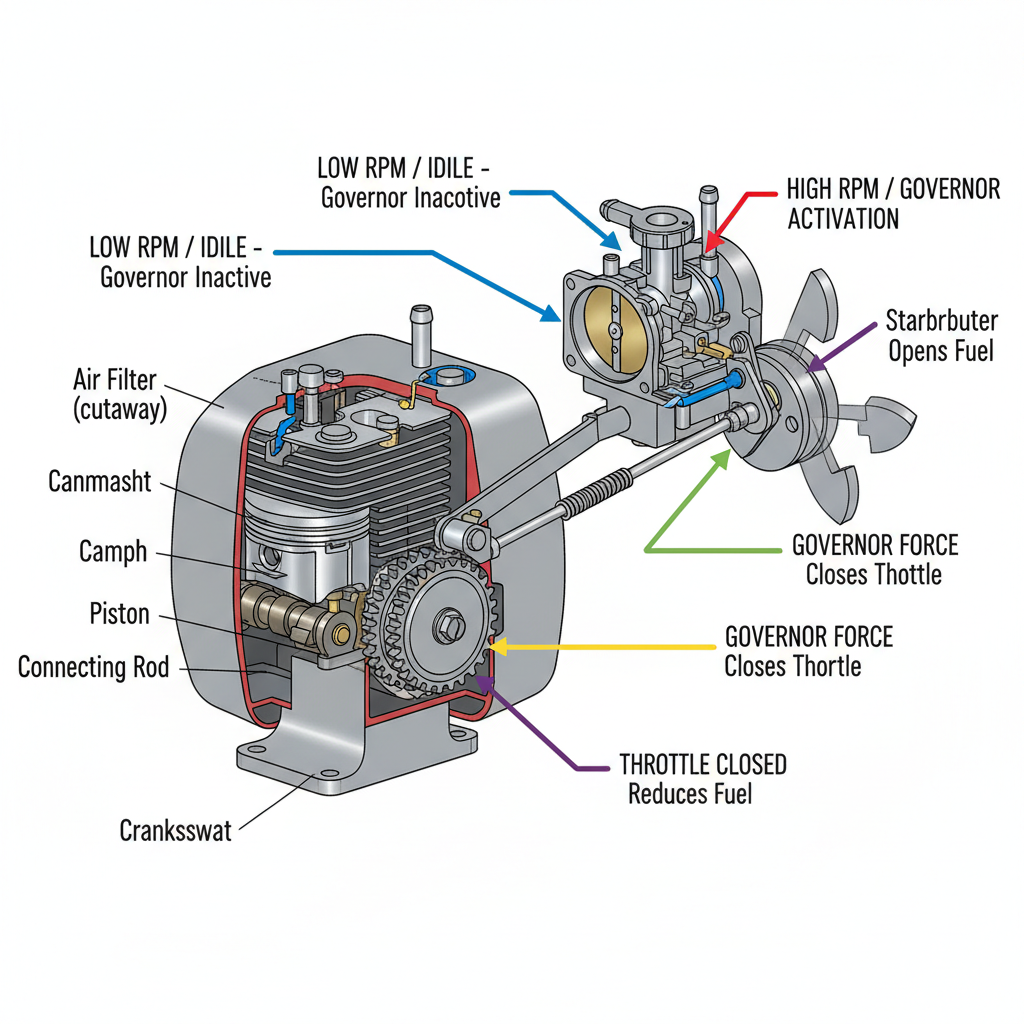
The governor is a mechanical or electronic device that automatically limits engine RPM to protect the mower and operator. Stock residential lawn mowers typically run at 3,000 to 6,000 RPM, producing 5 to 15 horsepower. This conservative design ensures blade stability, reduces vibration, and prevents engine damage from sustained high-speed operation.
How the governor works: A centrifugal or electronic governor detects engine speed and restricts throttle input once a set RPM threshold is reached. Removing the governor eliminates this limiter, allowing the engine to run at full throttle without automatic restriction.
Speed formula: Top speed depends on engine RPM, pulley diameter ratios, and final drive gearing. A typical push mower with a 6-inch drive pulley and 3-inch engine pulley at 6,000 RPM reaches roughly 9 to 12 mph. Removing the governor alone can increase speed by 40 to 60%, but reaching 30 mph requires additional drivetrain modifications.
Engine Modifications: Extracting More Power and RPM
Removing or Disabling the Governor
The most direct modification is physically removing the governor linkage or replacing it with a fixed throttle cable. This immediately allows higher RPM operation. On small gasoline engines, the governor shaft or spring-loaded arm can be disconnected from the carburetor throttle plate, letting you control throttle manually.
- Mechanical governors: Disconnect the spring-loaded arm that restricts throttle; replace with a direct cable to the throttle plate.
- Electronic governors: More complex; may require rewiring the kill switch or installing an aftermarket ignition module.
- Risk: Without governor control, the engine can over-rev, damage internal components, and reduce engine lifespan significantly.
Carburetor Tuning
The carburetor controls the fuel-air mixture. Stock carburetors are jet-limited to prevent over-fueling at high RPM. Tuning involves: To evaluate matched hardware tolerances, consult our detailed overview of z890 vs x870e motherboard.
- Main jet upsizing: Increase the main jet diameter (measured in thousandths of an inch) to allow more fuel at high RPM. A typical upgrade from a 0.078″ to 0.090″ jet increases fuel flow by roughly 15%.
- Needle position: Raising the needle clip enriches the mid-range mixture, improving throttle response and power delivery.
- Air filter removal: Removing or replacing the air filter with a high-flow unit reduces intake restriction, allowing more air and fuel into the cylinder.
- Carburetor bore polishing: Smoothing internal passages reduces turbulence and improves flow efficiency.
Ignition Timing Adjustment
Advancing ignition timing causes the spark plug to fire earlier in the engine cycle, allowing more complete combustion and increased power output. Most stock lawn mower ignition systems use a fixed-advance or minimal-advance design. Upgrading to an aftermarket electronic ignition with adjustable timing can add 10 to 15% horsepower.
- Typical advance range: 20 to 30 degrees before top dead center (BTDC).
- Risk: Over-advancing causes detonation (engine knock), which damages pistons and valves.
Fuel Optimization
Use higher-octane fuel (91 to 93 octane instead of regular 87 octane) to resist detonation and allow more aggressive timing advance. Some builders add small quantities of nitrous oxide, but this significantly increases mechanical stress.
Drivetrain Upgrades: Changing Gearing and Belt Ratios
Engine modifications alone cannot reach 30 mph; you must change how engine power is transmitted to the wheels. This involves altering pulley ratios or transmission gearing. When planning workspace deployment, consider the engineering criteria outlined in our marshall stanmore iii vs harman kardon onyx studio 8 guide.
Pulley Ratio Modification
Belt-drive lawn mowers use engine pulleys and drive pulleys connected by a belt. The ratio between pulley diameters determines final drive speed:
- Example: A 2-inch engine pulley and 6-inch drive pulley = 0.33 ratio (2÷6). This is an overdrive that increases speed.
- Swapping a 6-inch drive pulley for a 3-inch pulley doubles the gear ratio and approximately doubles top speed.
- Increasing the engine pulley from 2 inches to 3 inches also increases the ratio.
Practical steps: Replace stock pulleys with aftermarket units. Smaller drive pulleys and larger engine pulleys increase speed but reduce torque and acceleration. For a 30 mph target, you may need a 3:1 or higher ratio combined with sufficient engine power.
Belt and Chain Upgrades
Use a wider, higher-grip belt rated for higher speeds and power transfer. Automotive-grade belts withstand greater stress than stock lawn mower belts and reduce slippage at high RPM. To compare alternative configurations, check our hands-on review of bissell crosswave hydrosteam vs shark stainforce.
Transmission Swaps
Some builders replace the stock transmission with a go-kart or mini-bike transmission, which offers multiple gears and higher top-speed ratings. This is a complex modification requiring custom mounting and welding but provides superior performance and controllability compared to fixed-ratio belt drives.
Weight Reduction and Aerodynamic Optimization
Lighter mowers accelerate faster and require less power to reach a given speed. Removing the mower deck, fuel tank cover, and grass catcher can reduce weight by 20 to 40 pounds. Welding aluminum subframes and using lightweight fasteners further reduce mass.
Aerodynamic drag increases exponentially with speed. At 30 mph, streamlining the deck, adding a lower-profile cowl, and reducing blade height clearance measurably improve efficiency and reduce power requirements. Some high-speed mower projects use full fairings inspired by racing motorcycles.
Safety, Reliability, and Legal Considerations
Safety Hazards
- Blade disconnect: High-speed vibration and stress can loosen or shear the blade shaft, creating a projectile hazard.
- Loss of control: Steering becomes difficult at 30 mph on a vehicle designed for 5 to 10 mph. Turning radius increases dramatically.
- Structural failure: Frame welds and fasteners designed for low speed may fail under high-speed stress.
- Brake inadequacy: Stock brakes (often none on push mowers) cannot stop a 30 mph vehicle safely.
- Operator injury: Ejection risk, inability to bail out safely, and exposure to spinning blades are significantly elevated.
Reliability Trade-offs
Modified lawn mower engines typically experience 30 to 50% reduction in service life. Continuous high-RPM operation accelerates wear on piston rings, valve seats, and bearings. Frequent oil changes and inspection are mandatory.
Legal Restrictions
Modified lawn mowers may be illegal on public roads depending on local regulations. Most jurisdictions classify lawn mowers as off-road vehicles with specific speed and safety requirements. Check local laws before building or operating a high-speed mower. Homeowner’s association rules and insurance policies may also prohibit modified mowers.
Step-by-Step Modification Roadmap
Phase 1: Engine Foundation (Est. Cost: $150 to 300)
- Remove or disable the governor.
- Upgrade spark plug to a hotter range (e.g., NGK BR8ES to BR7ES).
- Install an aftermarket electronic ignition coil if the engine supports it.
- Test run and baseline the current speed.
Phase 2: Carburetor Optimization (Est. Cost: $50 to 150)
- Remove the air filter and inspect the carburetor jets.
- Upsize the main jet by one size (typically 0.005 to 0.010 inch increase).
- Install a high-flow air filter or open-intake design.
- Adjust needle position and idle screw for smooth throttle response.
- Test for detonation (engine knock) and adjust timing if needed.
Phase 3: Drivetrain Modification (Est. Cost: $200 to 500)
- Measure current pulley diameters and calculate existing gear ratio.
- Order aftermarket pulleys sized for a 2.5:1 to 3.5:1 overdrive ratio.
- Replace drive belt with a automotive-grade high-grip belt.
- Install new pulleys and adjust belt tension.
- Test speed incrementally, starting at 25% throttle.
Phase 4: Safety and Control (Est. Cost: $300 to 800)
- Install hydraulic disc brakes (sourced from ATV or motorcycle suppliers).
- Reinforce frame with additional welds or gussets.
- Secure blade shaft with a secondary bolt or lock washer.
- Add a roll cage or safety bumper.
- Test in an open area away from obstacles or bystanders.
Required Tools and Mechanical Knowledge
Modifying a lawn mower to reach 30 mph requires intermediate to advanced mechanical skill. Essential tools include: wrench set, socket set, carburetor cleaning kit, pulley puller, belt adjustment tool, welding equipment (for frame reinforcement), and torque wrench. Familiarity with small engine maintenance, welding, and basic physics (gear ratios, force calculations) is highly recommended.
Alternative Approaches: Racing Mower Platforms
Instead of modifying a residential mower, consider starting with a racing mower platform or go-kart frame. Racing lawn mower communities (particularly in the USA) have developed purpose-built designs with integrated safety features, higher-RPM engines, and proven drivetrain configurations. These platforms often reach 40 to 50 mph safely and legally in sanctioned racing events.
Frequently Asked Questions About How To Make A Lawn Mower Go 30 Mph
What’s the minimum horsepower needed for a 30 mph lawn mower?
A 30 mph lawn mower typically requires 15 to 25 horsepower, depending on weight and aerodynamic efficiency. A lightweight mower (under 300 pounds) with aerodynamic optimization may reach 30 mph with 15 hp; a heavier deck-equipped mower may need 25 hp or more. Stock lawn mower engines produce 5 to 15 hp, so expect to need an engine upgrade or high-RPM tuning to achieve the required power output.
Can you just remove the governor and reach 30 mph?
No. Removing the governor typically increases top speed by 40 to 60%, which on a stock mower might increase speed from 8 mph to 12 to 13 mph. Reaching 30 mph requires a combination of engine tuning, drivetrain gearing changes, weight reduction, and aerodynamic optimization. All three areas must be addressed simultaneously for the best results.
Is it legal to modify a lawn mower to go 30 mph?
It depends on local regulations. Most jurisdictions classify lawn mowers as off-road vehicles with specific speed and safety standards. Modified lawn mowers are typically illegal on public roads but may be permitted on private property or in organized racing events. Check your local Department of Motor Vehicles or county regulations before building a high-speed mower. Homeowner’s insurance may also be voided if you operate a modified mower on your property.
What’s the biggest safety risk of a 30 mph lawn mower?
Loss of control and inability to stop safely. Stock lawn mowers have minimal braking systems designed for 5 to 10 mph operation. At 30 mph, turning radius increases dramatically, steering becomes sluggish, and brakes (if present) cannot dissipate enough energy to stop quickly. Blade structural failure and operator ejection are also significant risks. Any 30 mph lawn mower project must include heavy-duty brakes, a reinforced frame, and extensive testing in a controlled environment.
Related Maintenance and Operating Guides
To keep your equipment running at peak operating efficiency, explore our related technical walkthroughs and maintenance tutorials:
- Consult our detailed breakdown on dyson v8 cyclone vs bissell featherweight stick.
Technical Standards and Compliance
Mechanical safety standards, operational tolerances, and protective gear guidelines align with benchmark specifications established by the American National Standards Institute (ANSI).









