Quick Answer: How to Turn On a Lawn Mower
Gas push mower: Engage the safety bail bar, set the choke to closed (cold start), press the primer bulb 3 times, move the throttle to Fast/Run, then pull the recoil cord in one firm, smooth stroke. Riding mower: Sit in the seat, set the parking brake, disengage the blade engagement lever, then turn the ignition key to Start. Battery or corded electric mower: Insert a charged battery (or plug in the extension cord), press and hold the safety interlock button, and squeeze the handle bail. Exact steps vary by mower type and engine brand — full procedures for each type follow below.
What You Need to Know Before Starting Any Lawn Mower (Safety Checks)
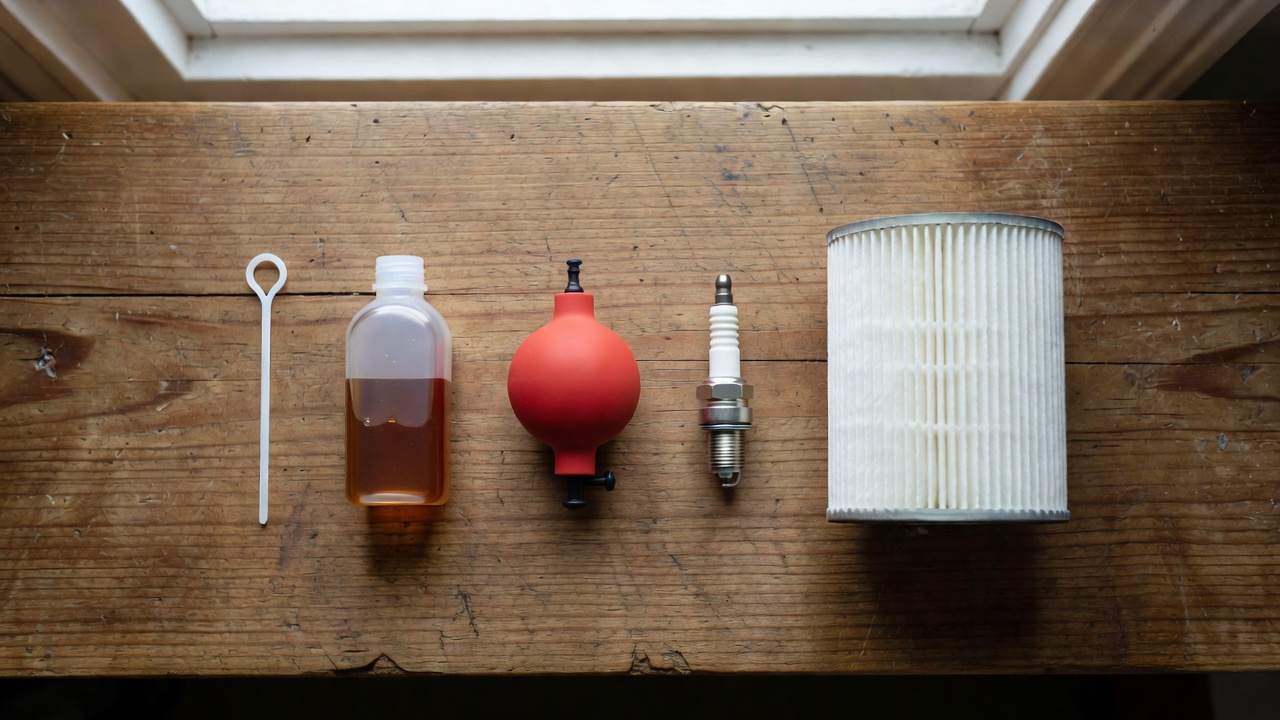
Skipping pre-start checks is the leading cause of equipment damage and operator injury. Complete every item on this list before touching a start control — regardless of mower type.
Check Oil Level
Pull the dipstick, wipe it clean, reinsert fully, then pull again. Oil should sit between the MIN and MAX marks. Running a gas engine low on oil causes irreversible cylinder damage within minutes. Use the viscosity grade stamped on the engine shroud (commonly SAE 30 or 10W-30).
Check Fuel Level and Fuel Quality
Ethanol-blended gasoline (E10) begins degrading in as little as 30 days without a fuel stabilizer, forming varnish deposits that clog carburetor jets. If fuel has sat in the tank over winter or longer than 30 days, drain it and refill with fresh gasoline before attempting a start. Most consumer gas mowers require regular unleaded (87 octane) with no more than 10% ethanol; consult your engine manual before using E15 or E85.
Inspect the Cutting Area
Walk the mowing area and remove rocks, sticks, toys, hoses, and any debris. A mower blade spinning at 3,000 RPM converts a small stone into a high-velocity projectile.
Personal Protective Equipment (PPE)
- Closed-toe shoes — mandatory; no sandals or bare feet near any mower
- Eye protection — safety glasses or goggles protect against ejected debris
- Hearing protection — gas mowers typically operate at 85–95 dB; prolonged exposure causes hearing loss
- Long pants — reduces laceration risk from debris discharge
Carbon Monoxide Warning
Never start or run a gas-powered mower indoors, in a garage, or in any enclosed or partially enclosed space. According to the U.S. Consumer Product Safety Commission (CPSC), gas-powered lawn equipment is a leading source of non-fire carbon monoxide poisoning. CO is odorless and colorless; incapacitation can occur within minutes at high concentrations. Start and operate gas mowers exclusively in open outdoor areas.
Inspect the Air Filter and Spark Plug (Quick Visual)
A clogged air filter starves the engine of oxygen; a fouled spark plug fails to ignite the fuel-air mixture. Before the first start of the season, pull the air filter and tap it clean (paper element) or wash it (foam element). Visually inspect the spark plug for cracked porcelain, heavy carbon buildup, or a worn electrode — replace if in doubt. Briggs & Stratton and Honda both recommend spark plug replacement every 100 operating hours or once per season, whichever comes first.
How to Turn On a Gas Push Mower (Step-by-Step)
Gas push mowers are the most common type. Most use either a Briggs & Stratton or Honda engine; the start sequence below applies to both with minor label differences.
Cold Start Procedure (Engine Has Not Run Recently)
- Position the mower on a flat, open surface. Ensure the discharge chute faces away from people and structures.
- Set the choke lever to CLOSED (or CHOKE). Closing the choke restricts airflow into the carburetor, enriching the fuel-air mixture — necessary to fire a cold engine. The lever is typically located on the engine shroud and labeled with a choke symbol or Open/Close text.
- Move the throttle to FAST or RUN. On most engines this is a separate lever or integrated into the choke/throttle panel. Starting at a fast throttle setting delivers adequate RPM to keep a cold engine running.
- Press the primer bulb 3 times. The primer bulb is a small rubber dome (usually red or black) on the carburetor body. Each press purges air from the fuel line and delivers a metered shot of gasoline directly to the carburetor bowl. Three presses is the standard recommendation from both Briggs & Stratton and Honda for a cold engine at normal temperatures; press up to 5 times in cold weather below 50°F (10°C). Do not over-prime — excessive fuel floods the engine.
- Engage the safety bail bar. The bail bar (also called the operator presence control or dead-man lever) is the U-shaped handle bar you squeeze against the main handle. Federal blade-control safety standards require this switch; the engine will not start unless the bail is held firmly. Keep it held throughout operation — releasing it stops the engine and, on blade-brake models, halts the blade within 3 seconds.
- Pull the recoil starter cord. Grip the handle firmly, pull straight out in one smooth, rapid stroke — do not yank at an angle or let the cord snap back uncontrolled. A controlled recoil prevents cord fraying and hand strain. The engine should fire within 2–3 pulls on a properly primed, well-maintained mower.
- Open the choke after the engine warms up. Once the engine runs steadily (typically 30–60 seconds), move the choke lever back to OPEN or RUN. Leaving the choke closed on a warm engine causes rough running and excessive fuel consumption.
Warm Start Procedure (Engine Ran Within the Last Hour)
- Set the choke to OPEN — the engine is already warm and does not need an enriched mixture.
- Set the throttle to FAST.
- Press the primer bulb 1–2 times (some engines need none when warm).
- Engage the bail bar and pull the recoil cord.
How to Turn On a Riding Lawn Mower (Step-by-Step)
Riding mowers use ignition-key starts and incorporate multiple safety interlock switches that must all be satisfied before the engine cranks. Attempting to bypass these switches is dangerous and voids most warranties.
- Sit fully in the operator seat. The seat safety switch is a pressure sensor beneath the seat cushion. It prevents the engine from cranking — or cuts the engine — if the operator leaves the seat while the blades are engaged. The seat must be occupied throughout operation.
- Set the parking brake. Engage the parking brake lever or pedal (location varies by brand; consult your operator manual). Most ignition interlocks on riding mowers require the parking brake to be set before the engine will crank.
- Disengage the blade engagement lever (PTO). The blade engagement lever or Power Take-Off (PTO) switch must be in the OFF or DISENGAGED position before starting. Attempting to start with blades engaged overloads the starter motor and is a safety hazard.
- Set the throttle to the START or HALF position. Some riding mowers have a dedicated choke control (especially older carbureted models); set it to CHOKE for a cold start. Many modern riding mowers with automatic choke systems (including most Husqvarna and John Deere models with Briggs & Stratton Intek engines) handle choke automatically — check your manual.
- Insert the ignition key and turn to START. Turn the key clockwise to the START position and hold it until the engine fires — do not hold for more than 5 seconds continuously to avoid overheating the starter motor. If the engine does not start within 5 seconds, release the key to the OFF position, wait 10 seconds, then try again.
- Release the key to the RUN position once the engine starts. Open the choke (if manually controlled) after 30–60 seconds of warm-up.
- Allow a brief warm-up period (1–2 minutes at low throttle) before engaging the blades and beginning to mow.
Why won’t the riding mower crank when I turn the key? The most common cause is an unsatisfied safety interlock: the seat switch is not depressed, the parking brake is off, or the blade engagement lever is in the ON position. Verify all three before suspecting a dead battery or faulty starter.
How to Turn On a Battery-Powered (Cordless Electric) Lawn Mower
Cordless electric mowers have no choke, no primer bulb, and no pull cord. The start process is simpler but has its own safety interlocks.
- Verify battery charge level. Most major OEMs (EGO, Greenworks, Ryobi) recommend charging the battery to full (100%) before the first use of the season. A battery below approximately 20% charge may not deliver sufficient amperage to engage the blade motor under load — the mower will power on but stall in thick grass. Check the battery’s LED charge indicator before inserting it.
- Insert the battery pack into the mower’s battery compartment until it clicks and locks. Using a partially seated battery causes intermittent power loss and can damage the battery contacts.
- Press and hold the safety interlock button. This is typically a small button on the handle or top deck that must be held simultaneously with the bail bar to prevent accidental starts. The button location varies by brand — EGO places it on the handle; Ryobi places it on the top of the deck near the handle.
- Squeeze the handle bail while continuing to hold the safety interlock button. The blade engages and the mower is now operating.
- Release either control to stop. Releasing the handle bail or the interlock button cuts power to the blade immediately.
Battery storage note: Lithium-ion batteries stored at 0% charge for extended periods suffer capacity loss. Store batteries at 40–80% charge in a cool, dry location when the mower is not in use for more than a few weeks.
How to Turn On a Corded Electric Lawn Mower
Corded electric mowers are the simplest type to start but require attention to extension cord specifications to avoid voltage drop, overheating, or tripped breakers.
Extension Cord Requirements
| Cord Length | Minimum Wire Gauge | Required Rating |
|---|---|---|
| Up to 50 ft (15 m) | 14 AWG | Outdoor-rated (SJTW or SJTOW) |
| 50–100 ft (15–30 m) | 12 AWG | Outdoor-rated (SJTW or SJTOW) |
| Over 100 ft (30 m) | Not recommended | Excessive voltage drop damages motor |
Always use an outdoor-rated three-prong grounded extension cord. Using an indoor or two-prong cord with a corded electric mower is a shock and fire hazard.
Start Procedure
- Connect the mower cord to the extension cord and the extension cord to a grounded outdoor outlet. Lay the cord behind you and away from the cutting path to avoid running it over.
- Locate the power switch or key (some models have a removable safety key that must be inserted before the mower can start — store this key when the mower is unattended).
- Press and hold the safety interlock button on the handle.
- Squeeze the handle bail lever. The motor engages. Release either control to stop.
Corded electric mowers have no choke, no primer, no oil to check (no engine), and no fuel. The only pre-start checks are cord condition (no cuts, fraying, or exposed wiring) and blade condition.
Cold Start vs. Warm Start: Key Differences to Know
The single most common reason a gas mower fails to start correctly is using the wrong choke position for engine temperature. Understanding the difference prevents a flooded engine and wasted effort.
Cold Start (First Start of the Day or After Sitting)
A cold engine has no residual fuel vapor in the carburetor. Choke CLOSED restricts incoming air, forcing a richer (more fuel-heavy) fuel-air mixture that a cold engine needs to combust reliably. Use full choke, prime 3 times, and expect to pull 2–4 times before ignition.
Warm Start (Engine Ran Within the Past Hour)
A warm engine has residual heat and fuel vapor present. Closing the choke delivers excess fuel, flooding the engine. Choke OPEN, reduced or no priming, and the engine should start on the first or second pull.
Flooded Engine Recovery
A flooded engine has too much raw gasoline in the cylinder, preventing ignition. Symptoms: strong fuel smell from the exhaust, engine cranks but won’t fire, black smoke on brief starts.
- Set the choke to OPEN (fully open, no choke).
- Move the throttle to FAST.
- Do not press the primer bulb again.
- Pull the recoil cord 6–10 times to purge excess fuel through the cylinder.
- Wait 10–15 minutes for fuel to evaporate, then attempt a normal warm-start sequence.
For first-start-of-season guidance after winter storage — including fuel draining, carburetor cleaning, and battery conditioning — see our dedicated article: How to Start a Lawn Mower After Winter.
Lawn Mower Won’t Start? Quick Troubleshooting Checklist
Work through this checklist in order before assuming a major mechanical failure. Most no-start conditions have a simple cause.
| Symptom | Likely Cause | Quick Fix |
|---|---|---|
| Engine cranks, won’t fire | Stale fuel or flooded engine | Drain old fuel; use flooded engine recovery procedure above |
| No crank, no sound (gas mower) | Unsatisfied safety interlock (bail bar, seat switch, brake) | Verify all operator controls are correctly positioned |
| Weak/sputtering start | Clogged air filter or dirty carburetor | Clean or replace air filter; inspect carburetor jets |
| No spark | Fouled or failed spark plug | Remove, inspect, and replace spark plug — gap to spec in engine manual |
| Riding mower key turns, no crank | Dead battery or faulty seat/brake interlock | Test battery voltage (should read ~12.6 V); check all interlock switches |
| Cordless mower powers on but won’t cut | Battery below minimum charge threshold | Charge battery to full before use |
| Engine runs rough after start | Choke left in CLOSED position after warm-up | Move choke lever to OPEN after 30–60 seconds |
Stale fuel detail: Ethanol-blended gasoline (E10) begins oxidizing and forming varnish deposits in as little as 30 days. Always add a fuel stabilizer (such as Sta-Bil) if the mower will sit unused for more than 30 days. For deep-dive no-start diagnosis — including carburetor cleaning, ignition coil testing, and safety switch bypass testing — see our full guide: Lawn Mower Won’t Start: Complete Troubleshooting Guide.
Frequently Asked Questions
How many times do I press the primer bulb on a lawn mower?
Press the primer bulb 3 times for a standard cold start at normal temperatures (above 50°F/10°C). This is the recommendation published in Briggs & Stratton and Honda engine operator manuals for most consumer push mower engines. In cold weather below 50°F, press up to 5 times. For a warm engine that ran within the last hour, press 1–2 times or skip priming entirely. Never press more than 5–6 times — over-priming floods the engine with raw fuel, preventing ignition.
Should the choke be open or closed when starting a cold lawn mower?
Closed (full choke) for a cold start. Closing the choke lever restricts airflow into the carburetor, producing a fuel-rich mixture that a cold engine requires to fire reliably. Once the engine has run for 30–60 seconds and smooths out, move the choke to the open position. Starting a cold engine with the choke open is one of the most common reasons a mower won’t start on the first several pulls.
Why does my riding mower click but not start when I turn the key?
A single loud click typically indicates a dead or low battery — the starter solenoid is engaging but the battery lacks sufficient current to spin the starter motor. Check battery voltage with a multimeter (a healthy 12V mower battery reads 12.4–12.6 V at rest). A rapid clicking sound often signals the same problem. If the battery tests good, the fault shifts to a faulty starter solenoid, corroded cable connections, or a failed starter motor. Also confirm all safety interlocks (seat, brake, blade engagement) are correctly positioned, as a tripped interlock produces no click at all — the circuit is simply open.
Is it safe to start a lawn mower in the garage with the door open?
No — do not start or run a gas-powered lawn mower in a garage, even with the door open. An open garage door does not provide adequate ventilation to prevent dangerous carbon monoxide accumulation. The CPSC documents numerous CO poisoning deaths linked to gas-powered lawn equipment operated in partially open structures. Start and operate gas mowers exclusively in open outdoor areas, a minimum of several feet from any doorway, window, or vent opening that could allow exhaust to enter a building.